.png)

.svg)


Many growing businesses pour enormous energy into building in-house marketing teams, only to find results remain inconsistent and budgets stretched thin. The paradox is striking: the companies scaling most efficiently are often the ones doing less themselves. Outsourcing marketing gives SMBs access to specialists across SEO, paid media, content, and analytics without the overhead of full-time hires. This guide unpacks exactly how outsourced marketing works, what you should and should not hand over, and how to choose a partner who genuinely moves the needle on your growth.
Table of Contents
- What is outsourced marketing and how does it work?
- Top reasons to outsource marketing for SMB growth
- What should you outsource and what should stay in-house?
- How to choose and manage a marketing partner for ROI
- Why effective outsourcing is more than just cost savings
- See how Geo Growth Media drives your marketing results
- Frequently asked questions
Key Takeaways
| Point | Details |
|---|---|
| Broader expertise access | Outsourcing instantly gives you specialist support that would be costly to assemble in-house. |
| Strategic resource focus | Free in-house staff to focus on core business while outsourced teams handle complex marketing work. |
| Faster, scalable growth | Partnering with the right experts lets you scale campaigns and adopt new tactics quickly. |
| ROI through smart measurement | Use customer acquisition cost, lifetime value, and revenue to track the real value of your outsourced spend. |
What is outsourced marketing and how does it work?
Outsourced marketing means contracting external specialists, whether freelancers, boutique agencies, or full-service firms, to handle some or all of your marketing activity. Rather than building every capability in-house, you tap into teams that already have the tools, talent, and experience ready to deploy. For most SMBs, this is a faster and more cost-effective route to serious marketing capability.
There are three main models to consider. Freelancers are independent specialists hired for specific tasks such as copywriting or Google Ads management. Boutique agencies are smaller, often sector-focused firms offering a defined set of services. Full-service agencies cover the full spectrum from strategy to execution across multiple channels. Each model suits different stages of growth and budget levels.
| Model | Typical cost | Scope | Flexibility |
|---|---|---|---|
| Freelancer | £20 to £120 per hour | Single discipline | High |
| Boutique agency | £2,500 to £7,500 per month | 2 to 4 channels | Medium |
| Full-service agency | £7,500 to £12,500+ per month | Full channel mix | Lower |
The disciplines covered by outsourced teams are broad. Specialised expertise in SEO, PPC, content marketing, social media, and analytics becomes available without the cost of recruiting and retaining individual specialists. This matters because each of these areas evolves rapidly, and staying current is a full-time job in itself.
Core disciplines typically covered include:
- Search engine optimisation (SEO): Technical audits, content strategy, and backlink building
- Pay-per-click advertising (PPC): Google Ads, Shopping campaigns, and Performance Max
- Paid social: Meta, TikTok, and LinkedIn advertising
- Content marketing: Blog writing, landing pages, and email campaigns
- Analytics and reporting: Data interpretation, attribution modelling, and performance dashboards
For a marketing manager’s digital strategy role, outsourcing often means shifting from doing to directing. You set the vision; the agency executes with precision. This is particularly valuable in specialist sectors such as SaaS digital marketing, where platform-specific knowledge can make or break campaign performance.

Top reasons to outsource marketing for SMB growth
Cost savings get most of the attention, but they are honestly not the most compelling reason to outsource. The real upside is strategic agility. When your marketing function can scale up or down based on business needs, you stop being held hostage by headcount decisions.
Here are the top reasons businesses make the shift:
- Immediate specialist access: You gain experienced practitioners from day one, not after a six-month hiring and onboarding process.
- Scalable support: Need to triple your ad spend for a product launch? A good agency adapts quickly. Scaling an in-house team takes months.
- In-house focus: When your internal staff are not firefighting marketing tasks, they concentrate on product, operations, and customer relationships.
- Faster technology adoption: Agencies invest in premium tools like SEMrush, HubSpot, and attribution platforms because they use them across multiple clients. You benefit without paying the full licence cost.
- Broader campaign agility: Multidisciplinary teams run more agile campaigns and deliver better overall ROI without the overhead of hiring individual specialists.
Our diverse sector experience across industries from ecommerce to professional services means we see what works and what fails across different markets. That cross-sector intelligence is something no single in-house team can replicate.
Pro Tip: Before signing any agency contract, define your KPIs clearly and include service level agreements covering reporting frequency, response times, and minimum performance benchmarks. Vague agreements produce vague results.
The businesses that get the most from outsourcing treat it as a genuine partnership rather than a vendor relationship. They share business context, sales data, and customer insights freely. The more your agency understands your business, the sharper their targeting and messaging becomes.
What should you outsource and what should stay in-house?
Not everything belongs with an external partner. Getting this balance right is one of the most important decisions you will make when structuring your marketing function.
A practical framework: outsource anything that requires deep specialist knowledge, expensive technology, or significant time investment to stay current. Keep in-house anything that requires intimate knowledge of your brand, culture, or long-term strategic direction.
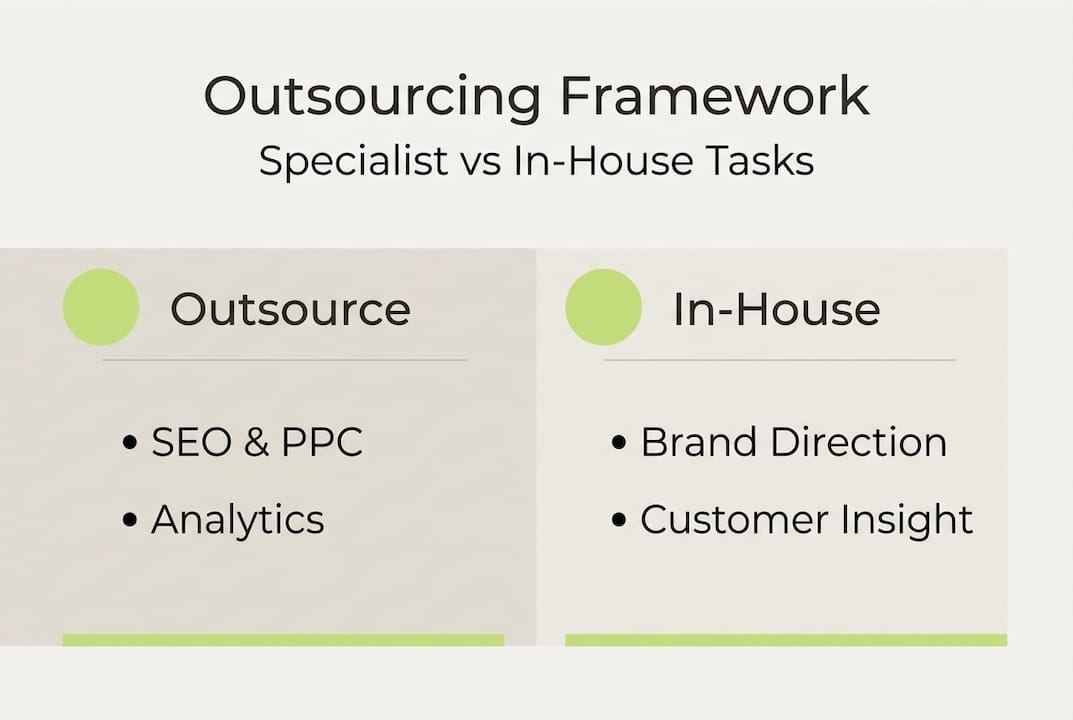
| Marketing function | Recommended approach | Reason |
|---|---|---|
| Brand strategy and positioning | In-house | Requires deep business context |
| SEO and technical audits | Outsource | Specialist skill and tooling |
| Google Ads and PPC | Outsource | Fast-moving, tech-intensive |
| Customer communications | In-house | Brand voice and relationship |
| Social media advertising | Outsource | Platform expertise and creative testing |
| Content ideation | In-house | Brand and audience knowledge |
| Content production | Outsource | Speed, scale, and SEO expertise |
Here is a simple process for deciding what to hand over:
- List every marketing task your team currently handles.
- Rate each task by how specialist the required skill is (1 to 5).
- Rate each task by how much internal bandwidth it consumes (1 to 5).
- Any task scoring 4 or above on either measure is a strong outsourcing candidate.
- Review quarterly as your business and team evolve.
Outsourcing analytics and PPC delivers the strongest results when in-house teams lack either the capability or the bandwidth to manage them properly. These are high-skill, high-frequency tasks where underperformance is costly.
Understanding the role of marketing managers in this model is critical. The best outcomes happen when an internal lead owns the strategy and agency relationship, acting as the bridge between business goals and outsourced execution.
Pro Tip: Retain brand direction, messaging guidelines, and customer insight in-house. Outsource channel management, campaign execution, and performance reporting for the best division of effort.
How to choose and manage a marketing partner for ROI
Choosing the wrong agency is expensive in time, money, and lost momentum. The right one accelerates your growth measurably. Here is what to look for and how to manage the relationship once it starts.
When evaluating agencies, prioritise three things: a demonstrable track record in your sector or a comparable one, genuine expertise across the channels you need, and clear communication processes. Ask for case studies with actual numbers, not just logos.
Once you have selected a partner, manage the relationship with structure:
- Onboarding: Share brand guidelines, customer personas, historical campaign data, and business goals in the first two weeks.
- Set targets: Agree on primary KPIs such as cost per lead, return on ad spend, or organic traffic growth before any campaign launches.
- Establish feedback loops: Weekly check-ins for active campaigns and monthly strategy reviews keep both sides aligned.
- Review performance data together: Do not just receive reports. Discuss what the numbers mean and what changes they imply.
- Reassess scope quarterly: As your business grows, your agency brief should evolve to match.
“The right marketing partner brings value beyond cost; they drive measurable growth.”
On costs, freelancers typically charge £20 to £120 per hour, boutique agencies from £2,500 to £12,500 per month, and full-service agencies even more. Measure the return through customer acquisition cost (CAC), lifetime value (LTV), and revenue directly attributed to agency-driven activity.
The businesses that outsource for digital growth most successfully treat their agency as an extension of their team, not a supplier to be managed at arm’s length. That mindset shift changes everything about how the relationship performs.
Why effective outsourcing is more than just cost savings
Most conversations about outsourcing start and end with the budget argument. And yes, avoiding the salary, benefits, and recruitment costs of five or six specialists is significant. But framing outsourcing purely as a cost decision misses its most powerful benefit.
The real value lies in what your business learns and builds over time. A good agency does not just run your campaigns. They introduce you to new platforms before your competitors discover them, challenge assumptions about your audience, and bring data-driven thinking into decisions that were previously made on instinct.
We have seen this pattern repeatedly at Geo Growth Media: businesses that engage with their outsourced partners strategically, sharing goals and pushing back on ideas, grow faster than those who simply hand over a brief and wait for results. The dialogue itself is part of the value.
The uncomfortable truth is that many SMBs outsource reactively, when they are already behind, rather than proactively as a growth lever. The companies pulling ahead in competitive markets treat their marketing partner as a strategic asset from the start. Speed to market, adaptability, and the ability to test and learn quickly are the real returns on a well-managed outsourcing relationship.
See how Geo Growth Media drives your marketing results
If this article has helped clarify your thinking on outsourced marketing, the next logical step is exploring what the right partnership could look like for your business.
At Geo Growth Media, we work as an extension of your team across digital marketing services including paid social, Google Ads, and expert SEO support. Whether you are scaling a product business through ecommerce growth or generating leads in a competitive B2B market, our strategies are built around your specific goals and sector. Book a discovery call to see what targeted, measurable marketing can do for your growth.
Frequently asked questions
What marketing tasks are best outsourced by small businesses?
Specialist tasks such as SEO, PPC, content marketing, and analytics are usually more cost-effective and impactful to outsource, as they require deep expertise and dedicated tooling that most small businesses cannot justify in-house.
How do you measure ROI when outsourcing marketing?
Track CAC, LTV, and revenue growth attributed to agency activity, comparing these figures against your monthly agency spend to calculate a clear return on investment.
What are the risks of outsourcing marketing?
The main risks are poor brand alignment, unclear expectations, and reduced control over execution. These are best managed through detailed briefs, regular reviews, and well-structured service level agreements from the outset.
How much does outsourced marketing typically cost?
Freelancers charge £20 to £120 per hour, while boutique agencies typically charge from £2,500 to £12,500 per month depending on the scope of services and channels managed.
Recommended
- How SEO drives growth for startups in 2026 (748% ROI)
- How AI boosts digital marketing ROI and performance in 2026
- Top social media strategies for scalable SMB growth in 2026
- Master search engine marketing: 790% ROAS guide for 2026
- Top 5 servicios de marketing para franquicias 2026 - YellowRock Marketing: Posicionamiento Local TOP 3 en Google


.png)