.png)

.svg)



TL;DR:
- Page speed is a confirmed Google ranking factor that influences search visibility and user experience. Improving core metrics like LCP under 2.5 seconds can lead to better rankings, but speed alone cannot outperform strong content and backlinks.
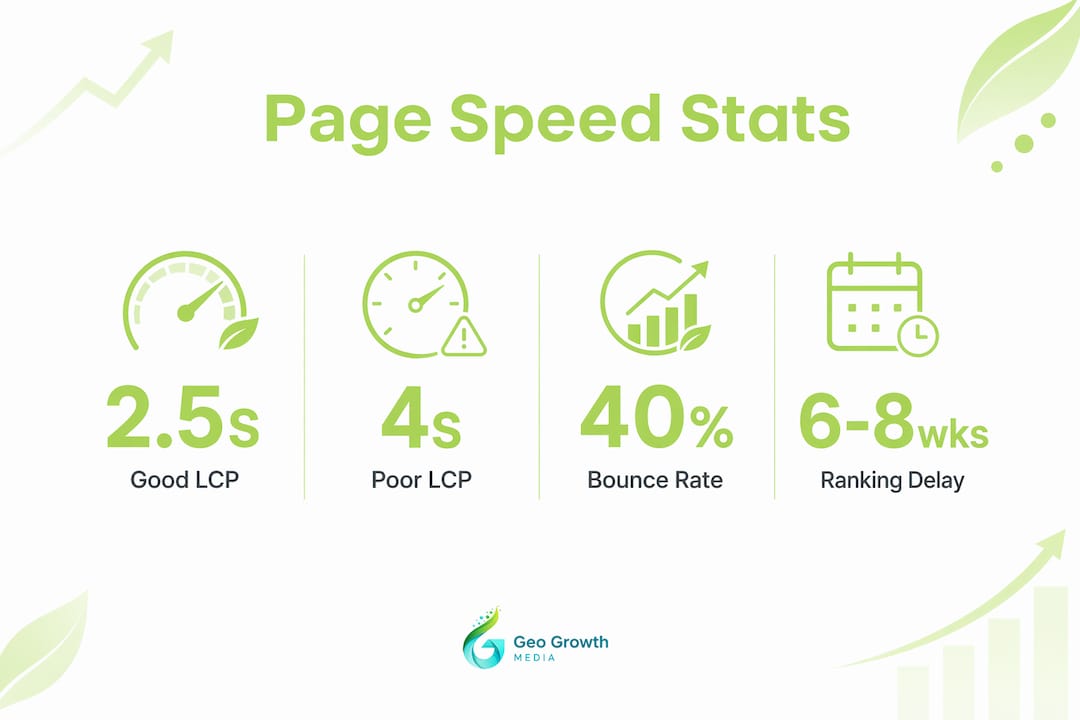
Page speed is a confirmed Google ranking factor that directly affects both search visibility and user experience. Google measures it through Core Web Vitals, specifically Largest Contentful Paint (LCP), Cumulative Layout Shift (CLS), and Interaction to Next Paint (INP). The good LCP threshold is 2.5 seconds or faster. Scores above 4 seconds are classified as poor and carry a ranking penalty. For digital marketers and business owners, understanding why page speed impacts SEO is not a technical nicety. It is a commercial priority.
Why page speed impacts SEO rankings
Page speed influences Google’s ranking algorithm through Core Web Vitals, which are a confirmed ranking signal integrated into Google’s core systems alongside hundreds of other factors. The weighting is real but modest. Speed does not override strong content or a solid backlink profile. It acts primarily as a tiebreaker when two pages are closely matched on relevance and authority.

The most important technical distinction here is the difference between lab scores and field data. Tools like Google Lighthouse and PageSpeed Insights generate lab scores, which are useful for diagnosing problems. Google’s ranking algorithm, however, uses field data from CrUX, the Chrome User Experience Report. CrUX captures how real users experience your page across real devices and connections. A perfect Lighthouse score does not guarantee ranking improvement if real-world users are still experiencing slow loads.
Poor LCP, anything above 4 seconds, signals to Google that your page delivers a poor experience. That signal feeds directly into ranking calculations. Fixing LCP from poor to good is meaningful, but ranking gains typically take 4–8 weeks to materialise and are usually modest unless other SEO fundamentals are already strong.
“Speed is the entry ticket, not the winning hand. You still need strong content and authority to rank well.”
Pro Tip: Monitor your Core Web Vitals using the CrUX dashboard inside Google Search Console rather than relying solely on Lighthouse. Search Console shows field data, which is what Google actually uses to rank your pages.
What does the evidence say about speed and rankings?
The data linking faster pages to better search performance is clear. Pages loading under 1 second receive the highest search impressions, with a performance spread of approximately 63% compared to slower pages. That is not a marginal difference. It means a fast page can attract nearly two thirds more impressions than a slow competitor targeting the same keyword.
The relationship between speed and rankings is not linear, though. There is a competitive threshold, and once you cross it, additional speed gains produce diminishing returns. The goal is to be competitively fast, not to chase milliseconds at the expense of everything else.
Here is how speed affects the metrics that matter most:
- Bounce rate: Slow pages cause users to leave before the page fully loads, reducing dwell time and signalling low quality to Google.
- Conversion rate: Slower pages convert worse, directly reducing the commercial return from organic traffic.
- Return visits: Users who experience slow loads are less likely to return, which compounds the negative SEO impact over time.
- Backlink acquisition: Poor user experience reduces the likelihood that other sites will link to your content, weakening domain authority.
| Speed scenario | Likely SEO outcome |
|---|---|
| LCP under 2.5 seconds | Strong Core Web Vitals signal, competitive ranking position |
| LCP between 2.5 and 4 seconds | Needs improvement, moderate ranking risk |
| LCP above 4 seconds | Poor classification, active ranking penalty |
| Sub-1-second load time | Maximum impression share, highest visibility potential |
The indirect damage from slow loading is often greater than the direct ranking penalty. Slow pages increase bounce rates and reduce dwell time, which feeds back into Google’s understanding of page quality over time.
How does page speed affect user experience and SEO together?
Page speed and user experience are not separate concerns. They are the same concern measured differently. Google’s Core Web Vitals exist precisely because Google recognised that technical speed metrics needed to reflect real human experience.
CLS measures how much the page layout shifts unexpectedly as it loads. A high CLS score means users click the wrong button or lose their place mid-read. Poor CLS correlates with lower engagement and higher bounce rates, with a correlation coefficient of r = -0.470 between CLS and engagement rate. That is a meaningful statistical relationship, not a coincidence.
INP measures how quickly a page responds to user interactions like taps, clicks, and keyboard input. A sluggish INP makes a page feel broken even if it loads quickly. Users abandon pages that feel unresponsive, and that abandonment feeds directly into the engagement signals Google monitors.
Here is a practical framework for improving UX without sacrificing speed:
- Prioritise above-the-fold content. Load the visible portion of the page first. Users judge speed by what they see immediately, not by total load time.
- Eliminate layout shifts. Set explicit dimensions for images and embeds so the page structure does not jump as assets load.
- Reduce third-party scripts. Analytics tags, chat widgets, and ad scripts all add interaction delay. Audit them regularly and remove what you do not actively use.
- Test on real devices. Emulated mobile tests in Lighthouse do not capture the experience of a user on a mid-range Android device with a 4G connection. Use real device testing through tools like WebPageTest.
Pro Tip: Use Google Search Console’s Core Web Vitals report to identify which URL groups are failing. Fix the highest-traffic pages first. A 10% improvement on your top landing pages delivers more commercial value than a 100% improvement on pages nobody visits.
Improving landing page load time is one of the fastest ways to improve both conversion rates and organic performance simultaneously.
How should marketers balance speed with other SEO priorities?
The most practical framing for page speed in 2026 is this: avoiding meaningfully slow pages delivers far more SEO value than chasing marginal speed gains beyond a competitive threshold. A page that loads in 2.3 seconds does not meaningfully outrank one that loads in 1.8 seconds. A page that loads in 5 seconds loses to both.
Speed is one signal among hundreds. A fast page with thin content will not outrank a slower page with strong content and quality backlinks. The SEO fundamentals still apply. Speed removes a barrier. It does not replace the work.
Here is how to prioritise your efforts:
- Fix poor scores first. Any page with an LCP above 4 seconds needs immediate attention. That is where the ranking damage is most acute.
- Use field data, not just lab scores. Monitor CrUX data through Google Search Console. Lighthouse is a diagnostic tool, not a ranking predictor.
- Align speed work with content investment. Speeding up a page with weak content produces limited ranking gains. Pair speed fixes with content improvements for compounding results.
- Set a realistic timeline. Ranking improvements from Core Web Vitals fixes take 4–8 weeks to show up. Do not expect overnight results.
- Audit iteratively. Page speed degrades over time as new scripts, images, and features are added. Schedule quarterly audits rather than treating it as a one-time fix.
For a broader view of where speed fits within your overall strategy, the technical SEO checklist for SMBs covers the full range of on-site factors worth prioritising in 2026.
The indirect impacts through user behaviour typically cause more ranking damage than direct speed penalties. That means the business case for speed is as much about keeping users on your site as it is about satisfying an algorithm.
Key takeaways
Page speed impacts SEO through both direct Core Web Vitals ranking signals and indirect user behaviour effects, making competitive load times a non-negotiable baseline for any serious SEO strategy.
| Point | Details |
|---|---|
| LCP is the key speed metric | Aim for LCP under 2.5 seconds; anything above 4 seconds actively hurts rankings. |
| Field data beats lab scores | Google ranks pages using CrUX real-user data, not Lighthouse lab scores. |
| Speed acts as a tiebreaker | Strong content and backlinks still outweigh speed; fix slow pages, not fast ones. |
| Indirect damage compounds | Slow pages raise bounce rates and reduce return visits, worsening SEO over time. |
| Avoid meaningful slowness | Chasing sub-second gains beyond competitive thresholds delivers diminishing returns. |
Geo Growth Media’s take on page speed and SEO
The conversation around page speed often gets hijacked by technical perfectionism. Marketers spend weeks chasing a perfect Lighthouse score while their content strategy sits untouched and their backlink profile stagnates. That is the wrong priority order.
What actually moves the needle is getting your pages out of the “poor” category and into “good” territory, then directing your energy towards content quality, user intent, and authority building. Speed is the floor, not the ceiling. We have seen businesses improve their Core Web Vitals scores significantly and see modest ranking gains, only to unlock much larger gains when those speed improvements were paired with a content refresh and a structured link-building effort.
The other thing worth saying plainly: most page speed problems are not mysterious. They come from uncompressed images, too many third-party scripts, and cheap hosting. Fix those three things and you will resolve the majority of speed issues on most websites without needing a developer on retainer.
The marketers who get the best results treat speed as hygiene, not strategy. Get it to a competitive level, monitor it quarterly, and spend the rest of your time on the things that actually differentiate your site.
— Geo Growth Media
How Geo Growth Media supports your SEO performance
Page speed is one piece of a larger SEO picture, and getting all the pieces working together is where the real gains come from.

Geo Growth Media works with ambitious brands as an extension of their in-house marketing team, covering technical SEO and site performance, content strategy, backlink building, and website development. If your site is losing rankings to slower competitors or you are unsure where your Core Web Vitals stand, a focused SEO audit is the right starting point. Geo Growth Media also offers website development services built around performance and conversion, so speed improvements are baked into the build rather than bolted on afterwards. Get in touch to find out where your site stands.
FAQ
Does page speed directly affect Google rankings?
Yes. Page speed is a confirmed ranking factor through Core Web Vitals, which are integrated into Google’s core ranking systems. The weighting is real but modest, acting primarily as a tiebreaker when content quality is comparable.
What is a good page speed for SEO?
Google classifies an LCP of 2.5 seconds or faster as good. Scores above 4 seconds are classified as poor and carry an active ranking penalty.
Does Google use Lighthouse scores for rankings?
No. Google uses field data from the Chrome User Experience Report (CrUX), not Lighthouse lab scores. Lighthouse is a diagnostic tool; CrUX reflects real-user experience and is what feeds ranking calculations.
How long does it take to see ranking improvements after fixing page speed?
Ranking improvements from fixing Core Web Vitals typically take 4–8 weeks to materialise. Gains are usually modest unless other SEO fundamentals such as content quality and backlinks are already strong.
Can a fast page outrank a slow page with better content?
No. A fast page with thin content will not outrank a slower page with strong content and quality backlinks. Speed removes a ranking barrier but does not replace content relevance or domain authority.


.png)