.png)

.svg)



TL;DR:
- Effective ad copy focuses on a clear sequence of compelling hook, value proposition, social proof, and call to action to drive conversions.
- Writing emotionally resonant messages that match the audience’s awareness stage significantly improves campaign performance and trust.
Ad copywriting is the craft of writing persuasive advertising text designed to capture attention and motivate readers to take a specific action. Known formally as advertising copy, it sits at the heart of every paid campaign, from Meta ads to Google Search. The role of ad copywriting goes far beyond clever phrasing. It is the mechanism that converts ad spend into leads, sales, and measurable ROI. Skilled copywriting gives businesses a powerful communication tool that bridges the gap between a product’s value and a consumer’s decision to act.
What are the essential components of effective ad copy?
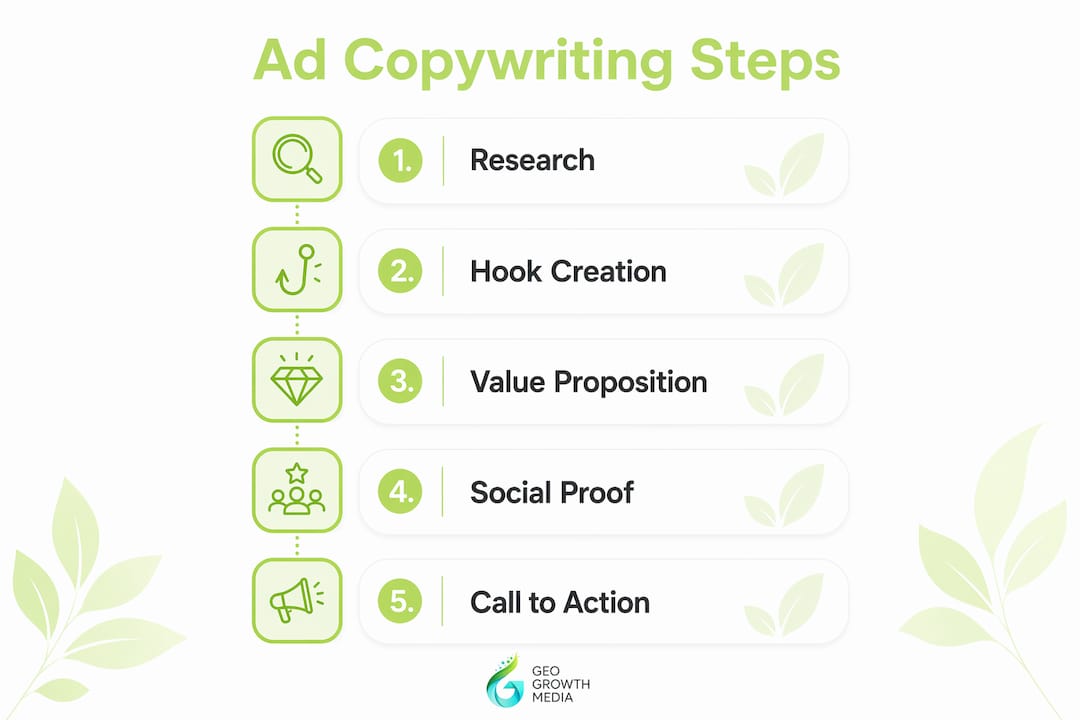
Effective ad copy follows a sequential structure. Each element depends on the one before it. If the hook fails, the entire ad fails, regardless of how strong the offer or CTA might be.
The five core components work in this order:
- The hook. The first 1–3 seconds of an ad determine whether the reader stays or scrolls. The hook must deliver immediate clarity and relevance. Clever wordplay rarely works here. Specificity does.
- The value proposition. This is your credible, specific promise. It tells the reader exactly what they gain and why it matters to them. Vague promises lose readers fast.
- Social proof. A testimonial, a number of customers served, or a recognisable client name reduces scepticism. Proof transforms a claim into a fact in the reader’s mind.
- The call to action (CTA). CTAs must clearly name the action and set expectations. “Get your free audit” outperforms “Click here” every time because it tells the reader what happens next.
- Platform compliance. Every platform has rules around claims, imagery, and character limits. Copy that ignores these gets rejected or throttled before it reaches anyone.
The sequential dependency here is not a suggestion. It is a law of conversion. A weak hook means no one reads the value proposition. No social proof means the CTA feels like a gamble.
Pro Tip: Write your hook last. Once you know your value proposition and social proof, you can craft a hook that speaks directly to the reader’s most pressing concern.
Good copy also distinguishes between features and benefits. A feature is what a product does. A benefit is what the reader gains. “Our software tracks 50 metrics” is a feature. “Know exactly where your ad spend is going” is a benefit. Benefits win.
Why is emotional connection central to ad copywriting?
Consumers make purchase decisions emotionally and justify them logically afterwards. This single insight changes how you write every ad. Copy that leads with logic and data rarely converts as well as copy that speaks to a feeling first.
The most effective advertising copy addresses what the reader wants to feel, not just what they want to own. Consider these emotional drivers:
- Relief. “Stop wasting budget on ads that don’t convert.”
- Ambition. “Your competitors are already running this strategy.”
- Belonging. “Join 10,000 business owners who’ve scaled with paid social.”
- Fear of loss. “Every day without a tested funnel is revenue left behind.”
Each of these taps an existing emotion. The copy does not create the feeling. It names it.
“The most powerful copy does not sell a product. It reflects the reader’s own desire back at them so clearly that buying feels like the obvious next step.”
The unique selling proposition (USP) works best when expressed emotionally. “We manage your Google Ads” is a USP stated as a feature. “You focus on running your business. We handle the ads.” is the same USP expressed as a feeling of relief and control. The second version connects. The first one informs.
Emotional copy also reduces friction. When a reader feels understood, they trust the brand faster. That trust shortens the distance between seeing an ad and clicking it. For ad creatives in campaign performance, emotional resonance is consistently one of the strongest predictors of click-through rate.

How does audience awareness shape your copy strategy?
Not all audiences are equal, and your copy strategy must reflect that. The most common mistake marketers make is writing the same ad for cold and warm audiences. It kills performance.
Cold traffic has never heard of your brand. These readers need immediate relevance. Successful cold-traffic copy matches the audience’s awareness stage by naming a recognised situation in the first few words. No clever phrasing. No brand references. Just a mirror held up to their current reality.
Warm audiences already know you. They have visited your site, engaged with your content, or purchased before. Warm audiences forgive vaguer hooks because brand trust fills in the gaps. You can lead with an offer or a reminder rather than a full context-setting hook.
| Audience type | Hook approach | Body copy length | CTA style |
|---|---|---|---|
| Cold traffic | Situation-specific, names a known problem | Short, 3 sentences max | Low commitment (“Learn more”, “Get free guide”) |
| Warm traffic | Offer-led or brand-led | Moderate, can include more detail | Higher commitment (“Book a call”, “Buy now”) |
The awareness-stage matching methodology matters because it determines whether your first sentence earns the second. Cold traffic copy that opens with your brand name wastes the hook. Warm traffic copy that over-explains what you do wastes the reader’s time.
Cold-traffic body copy follows what practitioners call the “brutal length law.” Every sentence beyond the third reduces conversion chances significantly. This is not about being brief for the sake of it. It is about respecting the attention economy. Cold readers have not opted in to hear from you yet. Earn their attention sentence by sentence.
Pro Tip: Before writing a single word of copy, ask: “Has this person heard of us before?” Your answer changes everything about the hook, the length, and the CTA.
What practical copywriting strategies improve ad performance?
Strong ad copy starts before you write a single word. Audience research is the foundation. You need to know what your audience already believes, what they are searching for, and what language they use to describe their own problems. That language belongs in your hook.
Here are the techniques that consistently improve ad performance:
- Tag the internal conversation. Your hook should feel like it was pulled from the reader’s own thoughts. “Struggling to get consistent leads from paid social?” works because it names an exact situation. It does not try to be clever. It tries to be accurate.
- Lead with the angle, not the power words. Over-optimising power words is less effective than getting the angle and awareness-stage match right. “Exclusive”, “proven”, and “guaranteed” add nothing if the underlying message is off.
- Keep cold-traffic body copy to three sentences. State the problem, introduce the solution, and name the next step. That is the entire job.
- Use social proof with specificity. “Hundreds of happy clients” is weak. “We’ve generated over £2 million in tracked revenue for UK ecommerce brands” is proof. Specificity makes social proof credible.
- Test the hook, not the whole ad. When performance drops, the hook is usually the culprit. Isolate it and test two or three alternatives before changing anything else.
For a practical framework on optimising ad creatives in 2026, the principles above apply across Meta, TikTok, and Google Display. The platform changes. The psychology does not.
The table below shows the contrast between weak and strong copy elements:
| Copy element | Weak version | Strong version |
|---|---|---|
| Hook | “We help businesses grow online.” | “Still spending on ads with nothing to show for it?” |
| Value proposition | “We offer great marketing services.” | “We build paid social campaigns that generate qualified leads within 30 days.” |
| Social proof | “Many clients trust us.” | “Rated 5 stars by 80+ UK business owners.” |
| CTA | “Click here.” | “Get your free campaign audit.” |
The difference in each row is specificity and relevance. Strong copy earns attention. Weak copy gets scrolled past.
Key takeaways
Effective ad copywriting combines emotional resonance, audience awareness, and a clear sequential structure to turn ad spend into measurable results.
| Point | Details |
|---|---|
| Sequential structure matters | Hook, value proposition, social proof, and CTA must each work in order for conversion to happen. |
| Emotion drives decisions | Write to feelings first; logic supports the decision but rarely triggers it. |
| Audience awareness changes everything | Cold traffic needs situation-specific hooks; warm audiences tolerate offer-led copy. |
| Brevity wins with cold traffic | Keep cold-traffic body copy to three sentences maximum to maintain conversion rates. |
| Angle beats power words | Matching the message to the audience’s awareness stage outperforms clever wordsmithing every time. |
What we’ve learned about ad copy after years of paid campaigns
The biggest mistake we see from marketing professionals is treating ad copy as a creative exercise rather than a diagnostic one. When a campaign underperforms, the instinct is to change the image, adjust the budget, or tweak the targeting. The copy is often the last thing tested. That is backwards.
At Geo Growth Media, we have seen campaigns turn around entirely from a single hook change. Not a new offer. Not a new audience. Just a hook that finally named the reader’s situation accurately. That experience has shaped how we approach every brief we take on.
The other pattern we notice is over-reliance on templates. Copy formulas like AIDA (Attention, Interest, Desire, Action) are useful starting points, but they become a crutch when applied without audience research. A formula written for the wrong awareness stage will always underperform, no matter how well it follows the structure.
What actually works is a combination of research and testing. Read your audience’s reviews, forums, and social comments. Find the exact phrases they use to describe their problems. Put those phrases in your hook. Then test two versions and let the data decide. That is not a creative process. It is a scientific one, and it is far more reliable than inspiration alone.
The interplay between creative instinct and data-driven refinement is where the best copy lives. Neither alone is enough. You need the empathy to write something that resonates and the discipline to measure whether it actually does.
— Geo Growth Media
How Geo Growth Media can sharpen your ad copy and campaign results
Writing ad copy that converts is one of the most high-leverage skills in paid advertising. Getting it right means more leads, lower cost per acquisition, and campaigns that actually justify their budget.
Geo Growth Media works with ambitious brands across the UK to build paid social and search campaigns grounded in strong copy and clear strategy. From Meta and TikTok to Google Ads, every campaign we manage starts with understanding your audience before writing a single word. Our digital marketing services cover the full picture, from copy and creative to targeting and optimisation. If your current ads are not performing the way they should, we can help you find out why and fix it.
FAQ
What is the role of ad copywriting in paid advertising?
Ad copywriting is the process of writing persuasive text that captures attention, communicates value, and drives a specific action within a paid ad. It is the primary driver of click-through rate and conversion in any paid campaign.
How does ad copy affect sales?
Strong ad copy directly increases sales by matching the reader’s awareness stage, addressing their emotional motivations, and guiding them towards a clear next step. Weak copy, regardless of budget or targeting, produces poor returns.
What makes a good hook in ad copy?
A good hook names a specific situation or problem the reader already recognises, within the first three to five words. Hooks that match the internal conversation of the audience consistently outperform clever or brand-led openers.
How long should ad copy be for cold audiences?
Cold-traffic ad copy should be extremely concise. Three sentences in the body is the practical maximum before conversion rates decline significantly.
What is the difference between a feature and a benefit in ad copy?
A feature describes what a product does. A benefit describes what the reader gains from it. Benefit-led copy converts better because it speaks directly to the reader’s desired outcome rather than the product’s specifications.


.png)