.png)

.svg)



TL;DR:
- Agile marketing emphasizes short cycles, data-driven adjustments, and cross-functional collaboration to improve results. It builds trust and strategic influence while reducing burnout and inefficiency. Implementing it requires rethinking processes, tracking invisible work, and fostering support across departments.
Agile marketing is defined as an iterative approach to campaign planning and execution, where teams work in short cycles, test ideas quickly, and adapt based on real data. If you are a business owner or marketing decision-maker at a small to mid-sized company, the case for adopting it has never been stronger. The 2026 State of Agile Marketing report from AgileSherpas shows that 87% of Agile marketers report improved productivity, and 77% feel less stressed. Those numbers reflect a fundamental shift in how effective marketing teams operate, not just a passing methodology trend.
Why choose agile marketing: productivity and team reliability
Agile marketing delivers measurable gains in both output and team wellbeing. 87% of Agile marketers report improved productivity, and 77% feel less stressed compared to non-Agile peers. That combination matters because burnt-out teams produce inconsistent work, and inconsistent work erodes client and stakeholder trust.
The organisational credibility gains are equally striking. Agile marketers are 80% more likely to be viewed as reliable by other departments, compared to 66% for non-Agile teams. Reliability is the currency that gets marketing a seat at the table when business decisions are being made.
The strategic influence data reinforces this point:
- 53% of Agile marketers help set organisational strategy, versus 37% of non-Agile marketers.
- 73% of Agile marketers say their daily work connects directly to strategic goals, versus 59% of non-Agile teams.
- 82% of Agile marketers express high confidence in focusing on important work, versus 59% of non-Agile counterparts.
These figures tell a consistent story. Agile marketing does not just make teams faster. It makes them more trusted, more focused, and more central to business growth conversations. For SMB decision-makers, that shift in perception can directly influence budget allocation, headcount, and long-term marketing investment.
How does agile marketing differ from traditional marketing?
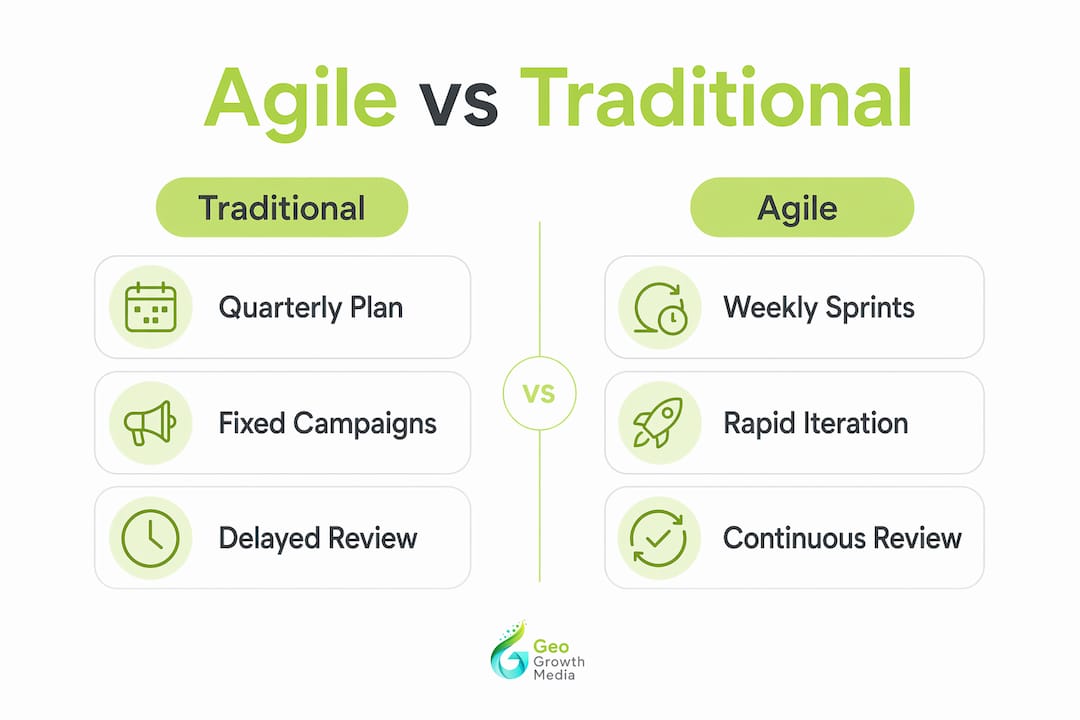
Traditional marketing runs on fixed quarterly or annual plans. A campaign is scoped, approved, launched, and reviewed months later. By the time results come in, the market has moved on. Agile marketing replaces that rigid cycle with a set of principles that keep teams responsive.
The four core principles that separate Agile from traditional approaches are:
- Iterative planning with sprints. Work is broken into short cycles, typically one to two weeks. Each sprint ends with a review of what worked and what did not. This means you are learning and adjusting constantly, not waiting for a year-end debrief.
- Cross-functional collaboration. Agile teams bring together copywriters, designers, analysts, and channel specialists to work on shared goals. Siloed handoffs slow campaigns down. Cross-functional squads speed them up.
- Data-driven prioritisation. Every sprint begins with a prioritisation session. The team asks: what is the highest-value work we can complete this cycle? This prevents the common trap of busy teams doing low-impact tasks.
- Disciplined rhythm and cadences. Agile teams maintain a disciplined cadence for planning, intake, prioritisation, and retrospectives. This rhythm is what prevents chaos, especially when AI-generated content volumes are rising fast.
Pro Tip: Schedule a 15-minute retrospective at the end of every sprint. Ask three questions: what went well, what did not, and what will you change next cycle. That single habit compounds into significant performance improvements over a quarter.
The rhythm point deserves extra attention. Agile’s emphasis is not on ceremonies for their own sake. It is on establishing a sustainable rhythm that incorporates continuous prioritisation and retrospectives to combat content overload. Without that structure, AI-assisted content production can flood a team with output that has no strategic direction.
Is agile marketing just a bolt-on framework?
The most common mistake SMBs make with Agile marketing is treating it as a tool you add to existing processes. It is not. True Agile effectiveness comes from using Agile as an operating system to rebuild marketing’s business relationships. Bolting a kanban board onto a dysfunctional workflow does not fix the dysfunction. It just makes it more visible.
Three specific pitfalls trip up teams that treat Agile as a surface-level fix:
- Capacity mismatch with other departments. Marketing speed often exceeds supporting departments such as legal and IT. Your team can produce a campaign in a week, but if legal sign-off takes three weeks, the sprint rhythm breaks. Agile adoption requires negotiating service-level agreements with those departments, not just speeding up your own team.
- Invisible work left untracked. Marketing teams carry invisible work like last-minute stakeholder edits, content maintenance, and ad hoc requests. If this work is not captured on your board, your capacity estimates are wrong and your team will burn out.
- Fragmented organisational support. The biggest obstacle to Agile success is fragmented support from the wider business. When other departments do not understand or respect the sprint cycle, urgent requests derail planned work constantly.
“Agile adoption requires diagnosing and rebuilding marketing operating models. Simply accelerating current dysfunctional processes is counterproductive.” — AgileSherpas, 2026
The payoff for getting this right is significant. Agile marketing builds trustworthiness that results in marketing being included in strategic organisational conversations. That is the real prize: not just faster campaigns, but a marketing function that shapes business direction.
How can SMBs implement agile marketing in 2026?
You do not need a large team or an enterprise budget to run Agile marketing well. SMBs can start with four practical steps that build momentum without overwhelming existing workflows.

Start with priority-setting, not process overhaul
Pick your top three marketing priorities for the next two weeks. Write them on a board, physical or digital, and commit to finishing them before taking on anything new. That single act of prioritisation is the foundation of Agile thinking. Tools like Trello, Asana, or Notion work well for visualising work and capacity at SMB scale.
Make invisible work visible
Visualising invisible work on kanban-style boards enables honest capacity conversations and prevents team burnout. Add a column for unplanned requests and track how often they appear. If that column fills up every sprint, you have a capacity problem that needs addressing before you can commit to planned campaigns reliably.
Protect strategic thinking time
54% of Agile teams have protected strategic thinking time, versus 29% of non-Agile teams. That gap explains why Agile marketers are more likely to influence organisational strategy. Block time in your calendar each week for planning and analysis. Treat it as a non-negotiable meeting with your future results.
Use Agile to manage AI-driven content volume
The primary goal of Agile marketing in 2026 is to manage uncertainty and protect focus amid AI-generated content overload. AI tools can produce content at a pace that outstrips any team’s ability to review, approve, and distribute it strategically. Agile’s sprint structure gives you a filter: only content that serves this sprint’s goal gets published. Everything else goes into the backlog for future consideration.
Pro Tip: Run a digital marketing audit before launching your first Agile sprint. Knowing your current performance baseline makes prioritisation far more accurate and your first sprint far more impactful.
| Approach | Traditional marketing | Agile marketing |
|---|---|---|
| Planning cycle | Quarterly or annual | Weekly sprints (1–2 weeks) |
| Response to change | Slow, requires plan revision | Fast, built into the process |
| Performance review | End of campaign | End of every sprint |
| Team structure | Siloed by function | Cross-functional squads |
| Strategic influence | Low (executional role) | High (included in strategy) |
The comparison above shows why agile marketing advantages compound over time. Each sprint produces learning. Each retrospective improves the next cycle. After six months, an Agile team has run dozens of structured experiments. A traditional team has run one campaign.
Key takeaways
Agile marketing is the most effective operating model for SMB marketing teams because it combines structured rhythm, data-driven prioritisation, and cross-functional collaboration to produce faster results and greater organisational influence.
| Point | Details |
|---|---|
| Productivity gains are proven | 87% of Agile marketers report improved productivity versus non-Agile peers. |
| Reliability builds strategic influence | Agile teams are 80% more likely to be trusted by other departments and 53% help set company strategy. |
| Agile is an operating model, not a tool | Bolting Agile onto broken processes fails; it requires redesigning how marketing works end to end. |
| Invisible work must be tracked | Untracked ad hoc requests and maintenance tasks destroy sprint accuracy and cause burnout. |
| SMBs can start small | Priority-setting, sprint reviews, and a kanban board are enough to begin seeing Agile benefits. |
Geo Growth Media’s view: Agile is about trust, not just speed
The conversation around Agile marketing often fixates on speed. Faster campaigns, faster iteration, faster results. That framing misses the deeper value. From working with ambitious SMBs across multiple sectors, the most significant shift Agile produces is not velocity. It is trustworthiness.
When your marketing team consistently delivers what it commits to, other departments stop treating you as unpredictable. Legal stops dragging its feet because it trusts your timelines. Leadership starts including you in strategy sessions because you have demonstrated you can execute. That shift in perception changes everything about how marketing is resourced and respected within a business.
The AI dimension adds a layer of urgency to this. Teams without a structured Agile rhythm are at real risk of being buried under AI-generated content that looks productive but lacks strategic direction. We have seen this pattern emerge repeatedly: a team adopts AI content tools, output triples, but campaign coherence drops because there is no sprint structure filtering what gets published. Agile gives you the governance layer that AI tools lack on their own.
One piece of advice worth taking seriously: do not wait until your processes are perfect before starting. Run one sprint. Track your invisible work for two weeks. Hold one retrospective. The data you collect in those two weeks will tell you more about your team’s real capacity than any planning document ever will.
— Geo Growth Media
How Geo Growth Media applies agile principles to paid social
Agile marketing principles are not just for in-house teams. They apply directly to how paid social media campaigns are planned, tested, and refined.
At Geo Growth Media, our paid social media services are built around short testing cycles, rapid creative iteration, and data-driven budget decisions across Meta, TikTok, and LinkedIn. Rather than locking clients into a fixed three-month campaign plan, we review performance at the end of every sprint cycle and reallocate spend to what is working. If you want a paid social partner that operates with the same responsiveness and focus that Agile marketing demands, get in touch with our team to discuss your goals.
FAQ
What is agile marketing in simple terms?
Agile marketing is an approach where teams plan and execute campaigns in short cycles, review results frequently, and adjust based on data. It replaces rigid annual plans with continuous learning and adaptation.
Why does agile marketing work better for SMBs?
SMBs benefit because Agile requires no large team or big budget to start. Short sprints, clear priorities, and regular retrospectives give small teams the focus and responsiveness that larger competitors often lack.
How is agile marketing different from traditional marketing?
Traditional marketing runs on fixed plans reviewed months after launch. Agile marketing reviews performance every one to two weeks, allowing teams to change direction before wasting budget on what is not working.
What are the biggest risks when implementing agile marketing?
The main risks are treating Agile as a surface-level tool rather than an operating model redesign, failing to track invisible work like ad hoc requests, and lacking support from departments such as legal and IT whose slower pace can break sprint commitments.
How long does it take to see results from agile marketing?
Most teams see measurable improvements in focus and output within the first two to three sprint cycles. Strategic influence and cross-departmental trust typically build over three to six months of consistent Agile practice.


.png)