.png)

.svg)



TL;DR:
- Digital branding encompasses a comprehensive system that shapes audience perception through visual identity, voice, UX, content, and engagement across online channels. It focuses on long-term recognition and emotional connection, distinct from short-term digital marketing efforts that aim for immediate conversions. Consistency and active management of brand assets are essential to build trust, loyalty, and sustainable growth in the digital space.
Most marketers assume digital branding means having a decent logo and a website that loads quickly. That assumption is costing businesses real growth. Digital branding is the full system by which your audience perceives, recognises, and emotionally connects with your business across every online touchpoint. It covers your visual identity, brand voice, user experience, content approach, and community presence. Done well, it builds the kind of trust that makes customers choose you before a competitor even gets a look in. This guide covers everything you need to know to get it right.
Table of Contents
- Key takeaways
- What is digital branding?
- Digital branding vs digital marketing
- The power of brand consistency
- How to create digital branding that sticks
- Our perspective on digital branding
- How Geo Growth Media can help
- FAQ
Key takeaways
| Point | Details |
|---|---|
| Digital branding is a system | It goes far beyond logos to include voice, UX, content, and emotional connection across channels. |
| Branding and marketing are not the same | Digital branding builds long-term recognition; digital marketing drives short-term conversions. |
| Consistency is non-negotiable | Brand drift from inconsistent visuals or messaging erodes trust faster than most businesses realise. |
| Identity systems prevent brand erosion | Documented guidelines for colours, typography, and voice keep your brand coherent as teams grow. |
| Brand equity is the end goal | Strong digital branding accumulates assets such as loyalty, awareness, and perceived quality over time. |
What is digital branding?
The clearest digital branding definition is this: it is the practice of building and communicating a brand’s identity, values, and emotional character through digital channels. It is not a single campaign. It is not your logo file saved as a PNG. It is a multi-channel identity system that combines visual identity, brand voice, UX and UI design, personalisation, and community engagement across every platform where your audience finds you.
The core components include:
- Visual identity: Logos, colour palette, typography, imagery style, and graphic treatments applied consistently across web, social, and digital advertising.
- Brand voice: The tone, language, and personality your brand uses in copy, captions, emails, and customer communications.
- UX and UI: How users experience your website or app, including navigation, page speed, accessibility, and interaction design.
- Content strategy: The topics, formats, and channels through which your brand educates, entertains, or informs your audience.
- Community and engagement: How you respond to comments, handle reviews, run social media, and create dialogue with customers.
The channels where this plays out include your website, organic and paid social media, email marketing, search engines, display advertising, and any platform where your audience might encounter your brand. Brand perception starts online long before a prospect ever speaks to your team. A potential client will search for you, check your LinkedIn, read a review, and form a strong opinion before you have exchanged a single word.
What makes digital branding distinct from traditional branding is its dynamic, interactive nature. Digital branding enables real-time feedback, audience engagement, and rapid adaptation in a way that print or out-of-home advertising simply cannot match. That interactivity is both an opportunity and a responsibility.

Digital branding vs digital marketing
This is where most businesses get stuck. The two disciplines are related but they serve fundamentally different purposes, and confusing them leads to wasted budget and muddled strategy.
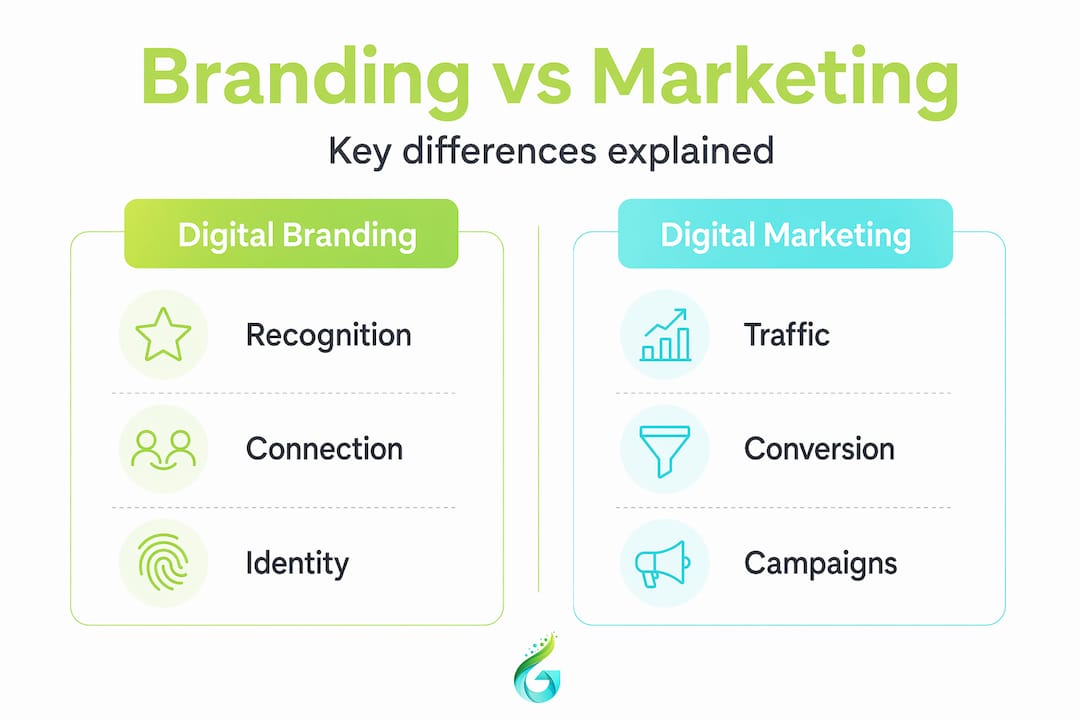
| Factor | Digital branding | Digital marketing |
|---|---|---|
| Primary goal | Build recognition and emotional connection | Drive conversions and measurable ROI |
| Time horizon | Long-term and ongoing | Short-term and campaign-based |
| Core tactics | Visual identity, brand voice, UX, content, community | Paid ads, email sequences, SEO campaigns, lead generation |
| Success measure | Brand awareness, sentiment, loyalty, trust | Clicks, leads, sales, cost per acquisition |
| Audience mindset | Building familiarity and preference | Converting existing interest into action |
Digital branding focuses on long-term emotional connection and recognition, while digital marketing is designed to capture and convert demand. Think of branding as filling the reservoir and marketing as turning on the tap. If the reservoir is empty, no amount of tap-turning produces results.
The practical consequence of mixing these concepts is this: businesses spend heavily on paid social or Google Ads, see underwhelming returns, and blame the channel. Often the real issue is that the brand behind the ads has not earned enough trust or recognition to convert at a competitive rate. The marketing spend is sound; the branding infrastructure it relies on is not.
Pro Tip: Before scaling your ad spend, audit your brand touchpoints. Check your website, your social profiles, and a sample of your email communications. If a stranger encountered all three, would they feel they were dealing with the same business? If not, fix the brand before you increase the budget.
The power of brand consistency
Consistency is the mechanism through which digital branding actually works. Inconsistency causes identity drift, the slow erosion of brand recognition that happens when your website uses different fonts to your social graphics, your email tone is formal while your Instagram is casual, and your ad creative looks nothing like your homepage.
A brand identity system is the structured framework that prevents this. It goes beyond a basic style guide to document detailed rules for every visual, verbal, and experiential element your brand uses. Think of it as your brand’s operating manual.
A solid identity system typically covers:
- Logo usage rules: approved variations, minimum sizes, exclusion zones, and what not to do.
- Colour palette: primary and secondary colours with exact hex, RGB, and CMYK codes.
- Typography: approved typefaces, hierarchy rules, and how to handle digital versus print usage.
- Imagery style: photography direction, illustration style, and rules for icons and graphics.
- Brand voice guidelines: tone spectrum from formal to informal, vocabulary to use and avoid, and examples of on-brand and off-brand copy.
- UX principles: accessibility standards and interaction design guidelines.
On accessibility, it is worth taking seriously. Conforming to WCAG 2.1 standards for web content is not just a legal consideration in many markets. It signals that your brand is credible, professional, and built for everyone. Colour contrast ratios, alt text for images, and keyboard-navigable interfaces all fall under this umbrella.
Pro Tip: Schedule a brand audit every six months. Pull ten random pieces of content from your website, your social profiles, and your email archive. Lay them side by side and ask honestly: do these look and sound like the same brand? This simple exercise catches brand drift before it becomes a reputation problem.
Regular audits and documented guidelines are what separate businesses that enforce brand rules consistently from those that wonder why their marketing is not cutting through.
How to create digital branding that sticks
Building a digital brand is not a one-week project. It is a structured process that demands input from creative, technical, and strategic teams. Here is a practical framework you can apply.
-
Define your brand foundation. Start with your values, purpose, and personality. Who are you for? What do you stand for? What emotional experience do you want customers to associate with your brand? These answers should be documented, not assumed.
-
Develop your visual and verbal identity. Work with designers and copywriters to create a visual system and brand voice that reflect your brand personality and appeal directly to your audience. Do not copy competitors. Your visual identity should be distinctive enough to be recognisable even without your logo present.
-
Build your digital home. Your website is your most controllable brand asset online. Invest in UX-focused website design that reflects your brand identity and delivers a clear, intuitive experience. Landing pages should carry the same visual and verbal consistency as the rest of your digital presence.
-
Implement across all channels. Apply your identity system to social media profiles, email templates, ad creative, and any platform where your brand appears. Prioritise the channels where your audience spends the most time, but maintain consistency everywhere regardless of posting frequency.
-
Use SEO and content marketing to build brand authority. Content-driven SEO is one of the most underrated tools in digital branding. When your brand consistently appears in search results for topics your audience cares about, you build familiarity and authority over time. This compounds. Campaigns do not.
-
Gather feedback and adapt. Digital branding has an advantage traditional branding does not. You can survey customers, monitor social sentiment, analyse on-site behaviour, and adjust. Use that data. Personalised audience engagement strengthens brand connection and signals to customers that you are listening.
-
Protect and govern your brand as you grow. As your team expands or you bring in agencies and freelancers, your brand guidelines become critical. Digital brand equity encompasses brand loyalty, awareness, perceived quality, and brand associations. These assets are built through consistent expression and eroded through inconsistency. Guard them accordingly.
Our perspective on digital branding
I have worked with marketing teams across a wide range of sectors, and the same problem surfaces repeatedly. Businesses treat digital branding as a launch event. They commission a rebrand, update the website, refresh the social profiles, and then assume the job is done. Six months later, the brand looks fragmented again because the guidelines were never properly embedded into day-to-day workflows.
What I have found to be genuinely true is this: brand activity is not brand building. Posting content is not the same as building a brand. Running ads is not the same as building a brand. These activities support the brand, but only if the underlying identity system is solid and actively maintained.
The brands I have seen grow most sustainably are the ones where creative, technical, and marketing teams genuinely collaborate around shared brand principles. Not a PDF that lives in a Dropbox folder nobody opens, but real governance: onboarding processes, design reviews, copy sign-off, and regular audits. It sounds administrative, but it is what separates brands that compound their reputation from those that stay stuck.
The mindset shift worth making is from “we have a brand” to “we manage a brand system.” One is a state; the other is a practice.
— Geo Growth Media
How Geo Growth Media can help
If you have read this far and recognised gaps in your own digital brand, you are already ahead of most. Knowing where the problems are is the first step to fixing them.
At Geo Growth Media, we work as an extension of your marketing team to build and scale digital brand presence across the channels that matter. From paid social media campaigns on Meta, TikTok, and LinkedIn that put your brand in front of the right audiences, to technical SEO that builds long-term search visibility, to website and landing page design that converts brand interest into real business outcomes. Every strategy we deliver is tailored to your goals, sector, and budget. Get in touch with Geo Growth Media to discuss how we can help you build a digital brand that consistently drives growth.
FAQ
What is the digital branding definition?
Digital branding is the process of building and communicating a brand’s identity, values, and emotional character across digital channels including websites, social media, email, and paid advertising. It encompasses visual identity, brand voice, UX design, and content strategy working together to create a consistent and recognisable presence online.
Why does digital branding matter for businesses?
First impressions now happen online, meaning clients and customers form opinions about your brand before any direct contact. Strong digital branding builds trust, improves marketing performance, and creates long-term competitive advantage.
What is digital brand equity?
Digital brand equity refers to the value accumulated through brand assets such as awareness, loyalty, perceived quality, and positive associations built within digital environments. Based on Aaker’s brand equity model, these assets translate directly into commercial advantage when maintained consistently.
How is digital branding different from digital marketing?
Digital branding focuses on long-term recognition and emotional connection, while digital marketing targets short-term conversion and ROI. Branding fills the reservoir of trust and familiarity; marketing channels that trust into measurable actions like leads and sales.
How do you maintain consistency in digital branding?
Maintain a documented brand identity system covering logos, colours, typography, imagery, voice, and UX guidelines, and conduct regular audits to catch drift early. Consistent positioning across touchpoints is what makes audiences recognise all of your communications as coming from the same brand.


.png)