.png)

.svg)



TL;DR:
- Understanding the fundamental differences between SEO and PPC helps businesses make informed marketing budget decisions. Combining both channels enhances ROI, speeds results, and builds long-term search visibility. Integrating SEO and PPC strategies, supported by data sharing, is essential for sustainable digital marketing success.
If you’re deciding where to put your marketing budget, understanding the difference between SEO and PPC is one of the most valuable decisions you can make. These two channels sit at the heart of most digital marketing strategies, yet they work in fundamentally different ways. One builds visibility over time; the other switches it on immediately. Neither is universally better. The right choice depends on your goals, budget, timeline, and where your business sits right now. This article breaks down how each channel works, how they compare side by side, and why the smartest marketers use both.
Table of Contents
- Key takeaways
- The core difference between SEO and PPC
- SEO and PPC comparison: the key dimensions
- Why SEO and PPC work better together
- Choosing the right channel for your situation
- Our perspective on the SEO vs PPC debate
- Let Geo Growth Media manage both channels for you
- FAQ
Key takeaways
| Point | Details |
|---|---|
| Fundamentally different mechanics | SEO builds organic rankings over months; PPC delivers paid traffic within hours of launching a campaign. |
| Cost structures differ sharply | PPC costs continue for as long as your ads run; SEO requires upfront investment but yields compounding returns. |
| Trust and credibility gap | Organic listings consistently earn higher click-through rates as users tend to trust them more than paid ads. |
| Integration outperforms isolation | Running SEO and PPC together produces better ROI, faster learning, and more consistent conversion rates. |
| Channel choice depends on context | New businesses and product launches benefit from PPC first; established brands gain more from scaling SEO. |
The core difference between SEO and PPC
Before you can choose between them, you need to understand what each channel actually does.
SEO (search engine optimisation) is the process of earning visibility in organic search results. You improve your rankings by producing high-quality content, building authoritative backlinks, and fixing technical issues on your website. The goal is to appear prominently when someone searches for a term relevant to your business, without paying for each click. SEO tactics span three broad areas:
- Content: Creating pages that genuinely answer what people are searching for
- Technical SEO: Page speed, crawlability, structured data, and mobile performance
- Backlinks: Earning links from credible external sites to signal authority to Google
PPC (pay-per-click advertising) is paid search. You bid on keywords through platforms like Google Ads, and your ad appears at the top or bottom of the search results page. You pay only when someone clicks. The most important thing to grasp here is the visibility model. SEO traffic persists long-term once rankings are established; PPC traffic is entirely budget-dependent and stops the moment your ads go off.
Both fall under the broader term search engine marketing (SEM), which covers all activity aimed at gaining visibility in search engines. Knowing the difference between SEO and SEM is worth understanding before you build your strategy.
In terms of timeline, the contrast is stark. PPC campaigns can reach profitability in 60 to 90 days, whilst SEO typically requires 6 to 9 months before you see meaningful organic ROI.
SEO and PPC comparison: the key dimensions
Here is where the real decisions get made. Let’s look at how these channels stack up across the metrics that matter most to you as a business owner or marketing manager.
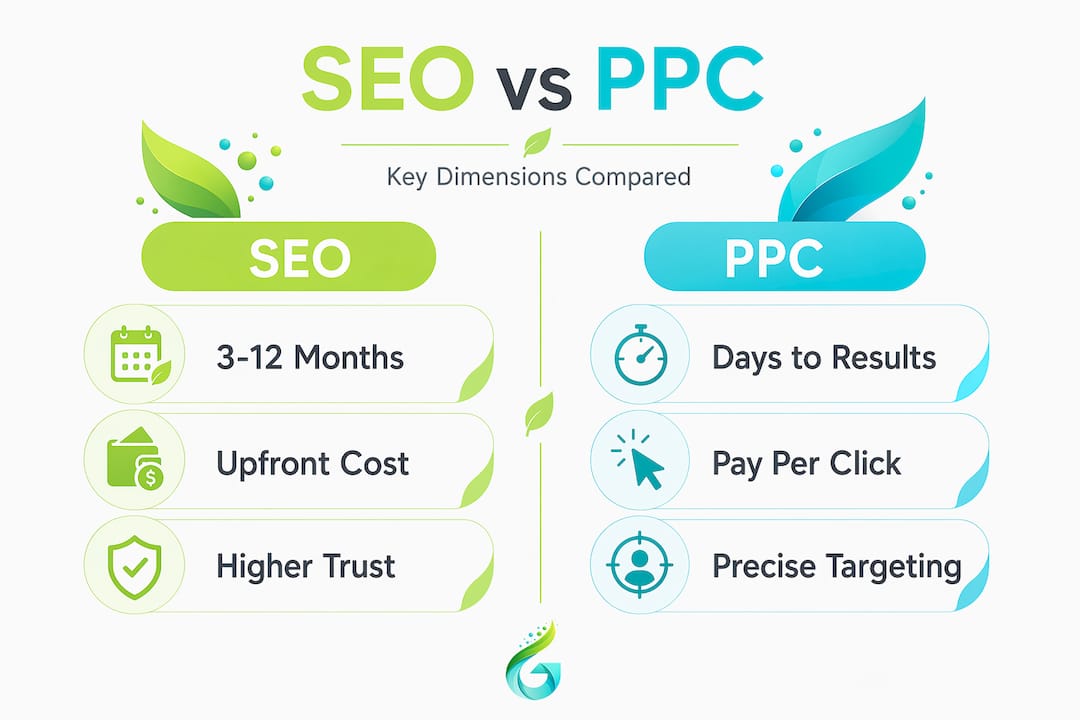
| Dimension | SEO | PPC |
|---|---|---|
| Time to results | 3 to 12 months | Hours to days |
| Cost model | Upfront investment, compounding returns | Ongoing cost per click |
| Trust and CTR | Higher organic CTR | Lower due to ad blindness |
| Targeting | Intent-based via keyword relevance | Demographic, location, device, time |
| Scalability | Efficient across regions | Scales linearly with budget |
| Long-term value | High, traffic continues after work stops | Low, stops when budget stops |
Cost is where most business owners feel the pinch first. With PPC, you pay for every click, and costs vary significantly. Competitive keywords like “plumber” can cost anywhere from £6 to £60 per click depending on location. Scale that across multiple areas or product categories and your ad spend climbs fast. SEO, by contrast, requires investment in content creation, technical work, and link building, but that investment compounds over time. After 12 to 18 months, SEO delivers 40 to 60% lower customer acquisition costs than PPC for established brands.

Trust plays a bigger role than many advertisers acknowledge. Organic results consistently earn higher click-through rates than paid ads, partly because users have developed what researchers call “ad blindness.” Appearing organically signals credibility in a way that a paid placement simply cannot replicate.
Targeting is where PPC genuinely pulls ahead. Google Ads offers granular audience segmentation across demographics, location, device type, time of day, and remarketing lists. SEO targets intent through keyword relevance and content quality, which is powerful but less precise. If you are launching a product in a specific city to a specific age group, PPC gets you there far more quickly.
Pro Tip: If your organic rankings are strong for a keyword, consider pausing PPC spend on that exact term. You are effectively paying for clicks you could receive for free. Redirect that budget to keywords where your organic presence is weak.
Why SEO and PPC work better together
The most common mistake business owners make is treating pay per click vs SEO as an either/or decision. They are not competing for the same job. Integrating SEO and PPC leads to more efficient marketing and measurably better conversion rates.
Here is how a combined approach works in practice:
- Use PPC to discover what converts. When you launch Google Ads, you get fast data on which keywords drive actual sales, not just clicks. That data is gold for your SEO content strategy. Build pages around the terms that already convert in paid search.
- Use SEO to reduce long-term PPC reliance. As your organic rankings improve for high-converting terms, you can shift budget away from those keywords and direct PPC spend toward new markets, seasonal pushes, or higher-funnel terms.
- Double your search page presence. Appearing in both the paid and organic results for the same search term increases total clicks and reinforces brand recognition. Searchers see you twice before they even read a word of your content.
- PPC supports brand defence. Competitors can bid on your brand name. Running a low-cost brand PPC campaign protects that territory while your SEO handles non-branded traffic.
- Retarget organic visitors with PPC. Someone who visited your site via organic search but did not convert becomes a warm remarketing audience for paid ads. That is the kind of cross-channel efficiency that drives down cost per acquisition over time.
It is worth noting that PPC traffic can generate indirect signals that support SEO. Brand awareness from paid campaigns can lead to more branded searches and backlinks, which quietly feeds your organic performance.
Pro Tip: Share keyword performance data between your SEO and PPC teams every month. If your paid campaigns show a 12% conversion rate on a term your site does not yet rank for organically, that is your next content priority.
According to research on integrated SEO and PPC strategies, businesses that run both channels in a coordinated way see improved ROI, less wasted spend, and more consistent results in competitive markets.
Choosing the right channel for your situation
Knowing the difference between paid and organic search is one thing. Knowing which to prioritise given your current situation is another. Here is a practical framework.
Prioritise PPC when:
- You need leads or sales within weeks, not months
- You are launching a new product or entering a new market with no existing organic presence
- You want to test messaging, offers, or landing pages before committing to long-form content
- You operate in a market with short buying cycles or high seasonal demand
- Your competitors are dominating organic results and closing that gap would take over a year
Lean into SEO when:
- You are building a brand for the long term and want compounding returns
- Your customer acquisition cost from PPC is climbing and eroding margins
- You want to build an asset, organic rankings, that does not disappear when you stop paying
- You are in a sector where authority and trust matter, such as financial services, legal, or healthcare
On measuring ROI: this is where many business owners get tripped up. PPC ROI is straightforward, ad spend divided by tracked conversion revenue. SEO ROI requires blended metrics that account for accumulated optimisation costs and organic traffic value over time. Do not expect SEO to look impressive at month three. Measure it at month twelve and beyond, where established SEO can produce 8 to 12x ROI compared to a typical 3 to 5x for mature PPC.
One factor reshaping this decision right now is AI. Strong SEO rankings predict AI search visibility, with search rank scoring 9.4 out of 10 as a predictor of whether your content gets cited in AI-generated answers. As AI-powered search tools become a primary entry point for information, the long-term value of SEO has arguably never been higher. See how AI is reshaping digital marketing ROI for more context on where this is heading.
Track your SEO performance through organic traffic growth, keyword rankings, and organic conversion rate. For PPC, watch cost per click, conversion rate by campaign, and return on ad spend (ROAS). Strong SEM examples show that combining these metrics gives you a far clearer picture of total channel performance.
Our perspective on the SEO vs PPC debate
I will be direct: the framing of SEO versus PPC is one of the most unhelpful constructs in digital marketing. I have seen businesses spend years bouncing between the two, never fully committing to either, and wondering why results feel inconsistent.
What I have found, working across industries and business stages, is that the businesses making the most progress treat these channels as a system, not a choice. PPC tells you what works fast. SEO scales what works sustainably. When those two functions share data and strategy, you stop guessing.
The short-term pressure most business owners feel, the “we need results this quarter” urgency, often pushes them towards PPC exclusively. That is understandable. But the businesses I have seen pull ahead of their competitors are the ones who used that PPC data to invest smartly in SEO during the same window. Twelve months later, their cost per lead has dropped significantly because organic is carrying more of the load.
There is also the AI dimension. Sites that have built genuine SEO authority are already appearing in AI-generated search answers. Sites that skipped SEO in favour of paid-only strategies have no footprint in that space at all. That gap will widen. Thinking about AI-driven search and visibility now is not optional. It is the next frontier.
The takeaway is simple. Stop asking which channel is better. Start asking how to make them work together.
— Geo Growth Media
Let Geo Growth Media manage both channels for you
If you are ready to stop choosing between SEO and PPC and start running them as a coordinated strategy, Geo Growth Media can help. We work as an extension of your marketing team, managing everything from Google Ads campaigns and organic search growth to paid social across Meta, TikTok, and LinkedIn.
Our approach is built around measurable outcomes. We do not separate channels into silos. We use PPC data to inform SEO priorities, and we build content strategies that reduce your dependence on paid spend over time. Whether you are starting from scratch or scaling an existing setup, we tailor every campaign to your goals, sector, and budget. Get in touch with Geo Growth Media to discuss a digital strategy that works on both fronts.
FAQ
What is the main difference between SEO and PPC?
SEO earns organic search rankings through content, technical optimisation, and backlinks, producing traffic that persists over time. PPC is paid advertising where you pay per click, delivering immediate traffic that stops when your budget runs out.
How long does SEO take compared to PPC?
PPC delivers traffic within hours and can reach profitability within 60 to 90 days. SEO typically requires 6 to 12 months before showing significant organic ROI.
Can you run SEO and PPC at the same time?
Yes, and you should. Running both channels together allows PPC data to inform your SEO content strategy, whilst SEO reduces your long-term reliance on paid spend. Businesses that integrate both consistently see better conversion rates and lower customer acquisition costs.
Which channel offers better ROI?
It depends on timeframe. Mature PPC campaigns typically yield 3 to 5x ROI. Established SEO after 18 months can deliver 8 to 12x ROI with significantly lower customer acquisition costs. Integrating both delivers the strongest overall returns.
Does PPC help SEO rankings?
Not directly. Paid advertising does not influence organic rankings, but PPC-driven traffic can generate indirect signals such as brand awareness, branded searches, and backlinks, which support SEO performance over time.


.png)