.png)

.svg)


Most e-commerce landing pages are losing money quietly. Not because they look bad, but because they lack a single clear goal, bury the headline, or ignore mobile shoppers entirely. The gap between a page that converts at 1.8% and one that converts at 5% or above often comes down to a handful of deliberate decisions. In this article, we walk through six real-world landing page examples that have driven measurable results, explain what makes each one work, and give you a practical framework to apply the same principles to your own campaigns.
Table of Contents
Key Takeaways
PointDetailsClear goal and CTAEffective landing pages focus on a single call-to-action and eliminate distractions.Evidence-backed designData from real campaigns proves features like video and social proof significantly boost conversions.Mobile-first essentialsMobile optimisation and fast load times are critical for e-commerce success.AI enables rapid gainsAI-driven landing pages can achieve higher conversion lifts than traditional layouts.Choose by campaign goalSelecting the right example for your audience and objectives is the key to reliable CRO improvement.
What makes a landing page effective?
Before looking at examples, it helps to understand the criteria that separate high-converting pages from average ones. Landing page best practices consistently point to the same core elements, and effective landing pages share a single clear goal, compelling headlines, social proof, and minimal distractions to boost conversions. Our landing page design services look at the best way to optimise for conversions.
Here is what every strong landing page gets right:
Pro Tip: Always test your hero section first. It is the first thing visitors see and, according to conversion specialists, it drives up to 70% of your overall conversion performance. If you are optimising landing pages and unsure where to start, the hero is your highest-leverage point.
These criteria form the lens through which we evaluate every example below.
Six examples of high-performing landing pages
With the criteria defined, let us see those principles in action through standout examples from real e-commerce brands.
CRO case studies from leading e-commerce brands demonstrate just how significant the gains can be. Moon Pod achieved +26.8% CVR alongside $3.3M in additional revenue, Laura Geller saw a +43% conversion increase, and Clear Within recorded an +80% add-to-cart rate through focused landing page improvements.
Here is a breakdown of each example:
The brands that win on landing pages are not the ones with the biggest budgets. They are the ones who test the fastest and remove friction the most ruthlessly.
Pro Tip: Bundle related products and show the outcome of using them together. This approach consistently increases average order value alongside conversion rate. Our landing page design services and e-commerce landing page design resources cover this in more detail.
Comparing landing page approaches: AI vs human design
Seeing how different landing pages perform, let us focus on a growing trend: AI-driven optimisation versus classic marketing design.
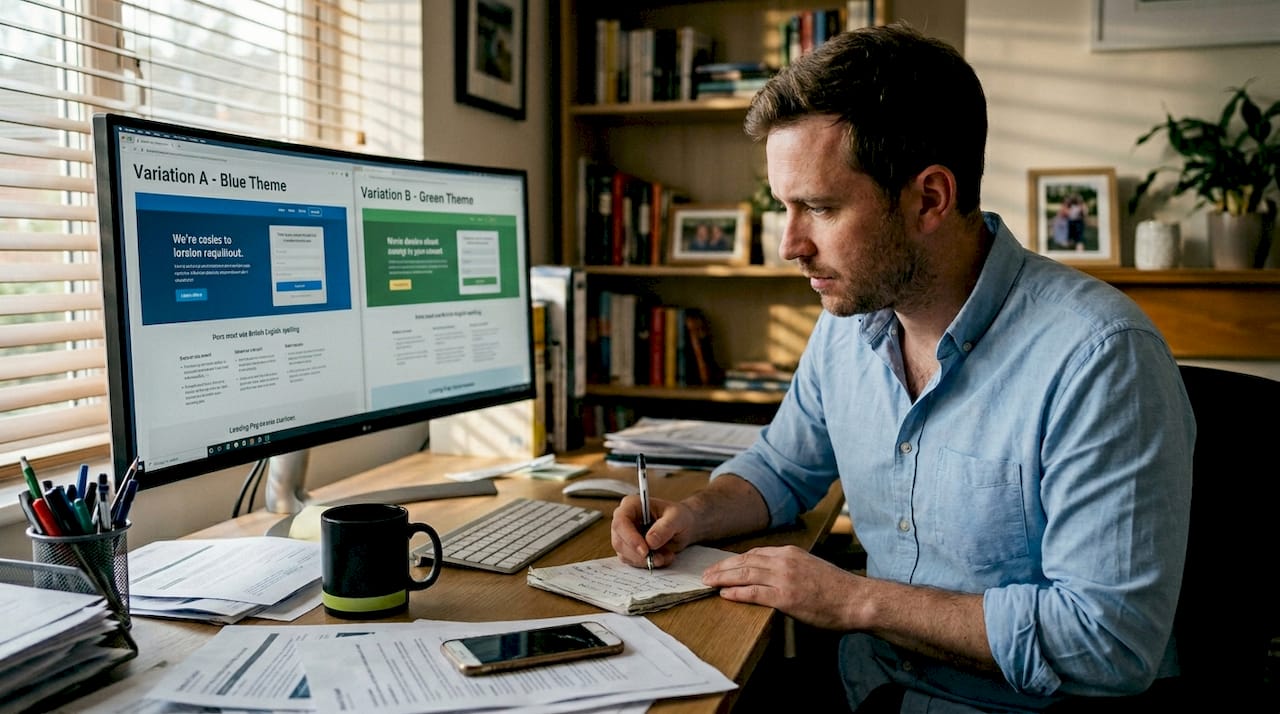
AI-optimised pages can outperform human designs, with the Crazy Egg AI version delivering a +44.83% conversion lift over its human-designed counterpart. That is a significant result, but it does not tell the whole story.
ApproachConversion liftBest suited forKey strengthAI-optimised (Crazy Egg)+44.83%High-volume, product-led pagesRapid iteration and layout testingHuman-led design (Moon Pod)+26.8%Story-driven, premium offersBrand nuance and audience empathyHybrid approachVariesComplex e-commerce funnelsCombines speed with strategic insight
AI excels when you have high traffic volumes and a straightforward conversion goal. It can run dozens of layout variations simultaneously and identify winning combinations faster than any human team. For AI in landing page optimisation, the gains are most pronounced when the product is simple to understand and the audience is already warm.
Human-led design, by contrast, wins when the offer is complex, the price point is high, or the brand story needs to do heavy lifting. Moon Pod is a good example: the product is unfamiliar, the price is premium, and the page needs to build trust before asking for the sale.
The practical takeaway is this:
Refer to the landing page CRO guide for a structured framework on when to apply each approach.
Mobile optimisation: Must-haves for e-commerce landing pages
One factor all six examples share is a deliberate mobile-first focus. Here is how to capture more conversions from smartphone shoppers.
Mobile traffic accounts for over 60% of visitors on most e-commerce landing pages, and pages that load slowly or display poorly on small screens haemorrhage conversions before a visitor even reads the headline.
Mobile-optimised pages increase conversions by up to 68%, making it one of the highest-return improvements you can make to any campaign.
Here are the non-negotiables for mobile landing pages:
Pro Tip: Test your landing page on a real device, not just a browser simulator. Tap targets, font sizes, and image rendering often behave differently on actual smartphones.
For a broader look at how website design for lead generation connects to mobile performance, the principles overlap significantly with landing page best practice. You can also review converting landing pages for further mobile-specific examples.
Choosing the right landing page for your campaign
Having seen which features matter, let us compare the examples to help you decide what fits your campaign.
E-commerce landing pages convert at around 1.8 to 1.84% on average, with the top 25% achieving 5.31% or above. Knowing where you sit relative to these benchmarks helps you prioritise which type of page to build or test next.
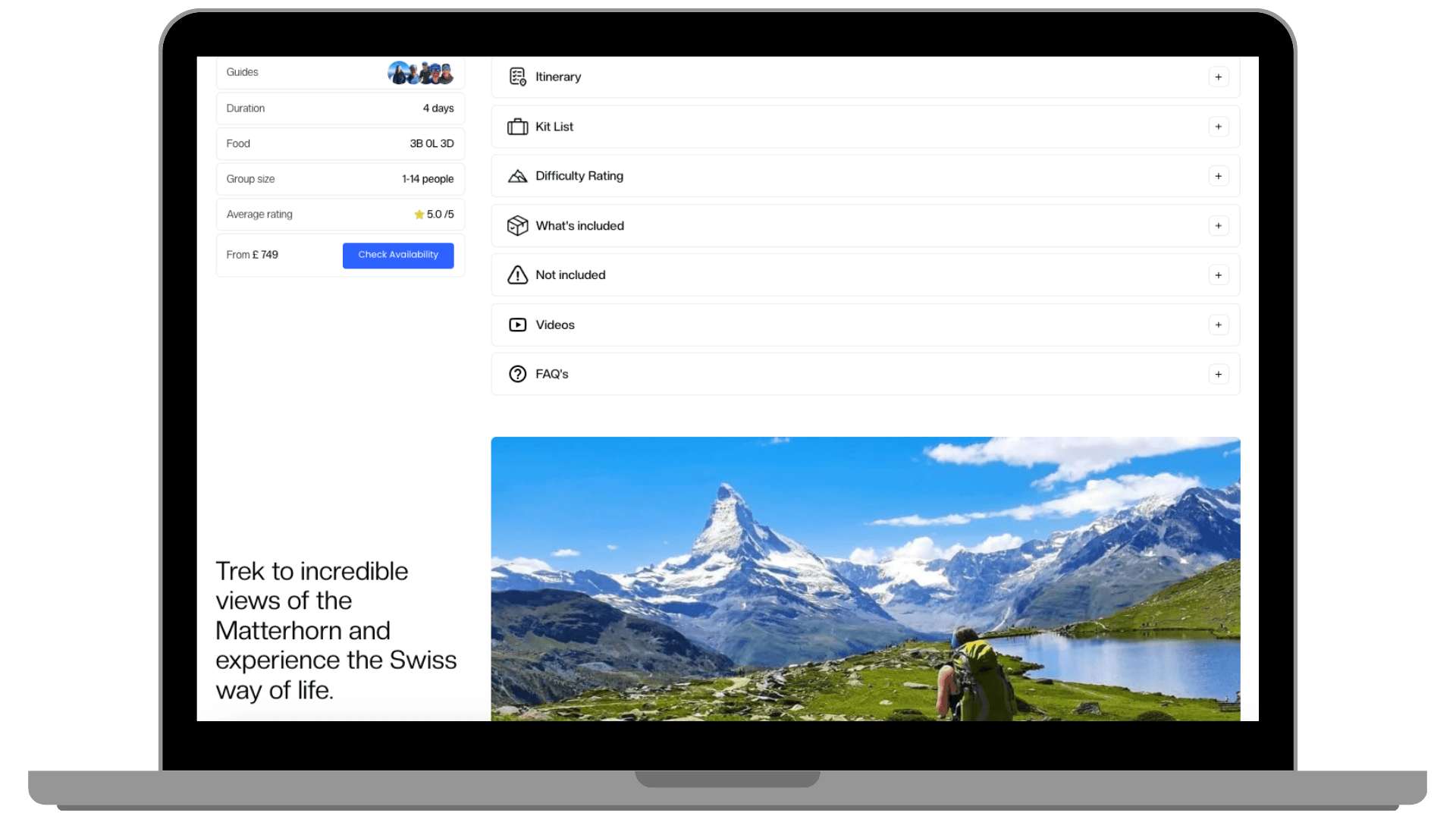
ExampleHeadline styleCTA styleConversion liftBest audience fitMoon PodBenefit-ledSingle button+26.8%Premium, unfamiliar productsLaura GellerStory-drivenBundle offer+43%Beauty, repeat purchasersClear WithinProof-firstMinimal form+80% add-to-cartHealth, sceptical audiencesSmartwoolLifestyle-ledReview-anchored+17.1% RPVOutdoor, lifestyle brandsCrazy EggAI-optimisedVideo-led+44.83%High-volume, SaaS or productWayfairImage-drivenA/B tested+47% CRHome, browse-heavy shoppers
Follow these steps to choose the right approach for your next campaign:
For further guidance on matching page types to campaign goals, our resource on landing page types for SMEs and the broader landing page examples library are useful starting points.
Our perspective: The real secret to landing page effectiveness
After working with UK e-commerce brands across a range of sectors, the pattern we see most often is this: brands obsess over design and ignore message match. A beautifully built page that speaks to the wrong intent will always underperform a plain page that answers exactly what the visitor was searching for.
The single attention ratio, one page, one CTA, is the most predictive metric we use when auditing a page. Not bounce rate. Not time on page. When a visitor has only one place to go, they either convert or they do not, and that clarity makes testing far more meaningful.
Hero section testing is also massively underused. Most teams test button colours or headline wording in isolation. The brands that see transformative results test the entire hero: image, headline, subheadline, and CTA together as a unit. This approach, combined with specific CTA language and social proof placed immediately above or below the button, consistently outperforms aesthetic redesigns.
If you want to build pages that genuinely perform, start with our guide on landing page lead generation and treat message match as your first principle, not an afterthought.
Ready to elevate your landing page strategy?
The examples and frameworks in this article give you a solid foundation, but applying them effectively to your specific products, audience, and campaign goals takes more than a checklist.
At Geo Growth Media, we design and optimise custom landing pages built around your conversion targets, not generic templates. Whether you are running paid social, Google Ads, or a seasonal e-commerce push, our team acts as an extension of your marketing function to deliver pages that are tested, data-led, and built to perform. Explore our full range of digital marketing services or see how we support e-commerce brands specifically. Get in touch to discuss your next campaign.
Frequently asked questions
What is the average conversion rate for e-commerce landing pages?
E-commerce landing pages convert at around 1.8 to 1.84% on average, with top performers achieving 5.31% or above. Knowing your benchmark is the first step to improving it.
How important is video for landing page conversions?
Including video on landing pages can increase conversions by up to 86%, particularly for products that need demonstration or explanation before a visitor will commit to buying.
Should my e-commerce landing page use a single CTA or multiple?
A single clear CTA is most effective. Multiple options create decision fatigue and give visitors a reason to delay, both of which reduce your overall conversion rate.
Are AI-generated landing pages better than human-designed ones?
AI-optimised landing pages can outperform human designs for rapid iteration and incremental gains, but human-led design remains stronger for complex, story-driven, or premium offers.
How many form fields should my landing page have?
Reducing form fields is one of the most reliable ways to improve conversion rates. Ask only for essential information and add fields later in the funnel once trust is established.


.png)