.png)

.svg)




TL;DR:
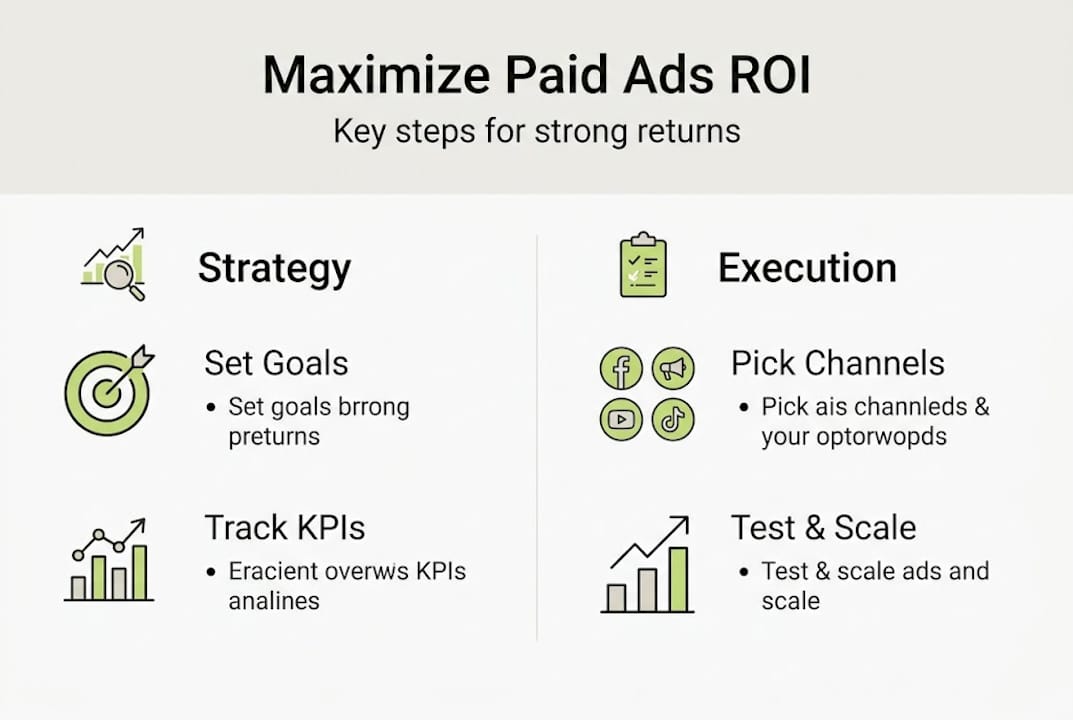
- Effective paid ad strategies require clear goals, measurable KPIs, and data-driven optimization.
- Prioritize high-intent channels like Google Search with 60-70% of the budget before expanding.
- Regular performance review and disciplined stopping of unprofitable campaigns ensure sustainable growth.
Wasted ad spend is one of the most frustrating experiences a marketing manager or business owner can face. You set a budget, launch a campaign, and watch the money disappear with little to show for it. The truth is, most paid advertising failures come down to a lack of strategy rather than a lack of budget. A well-structured, data-driven approach changes everything. In this guide, we walk you through exactly how to build a paid ads strategy tied to real business outcomes, covering goal-setting, channel selection, campaign structure, and continuous optimisation so every pound you spend works harder.
Table of Contents
- Define clear goals and measurable KPIs
- Choose your channels and allocate budget
- Set up campaigns: structure, creative, and targeting
- Optimise and scale: tracking performance and iterating
- What most paid ads guides get wrong: the ROI reality for SMBs
- Unlock scalable growth with expert paid ads strategy
- Frequently asked questions
Key Takeaways
| Point | Details |
|---|---|
| Set clear KPIs | Define campaign goals and success metrics that align with business revenue before spending a penny. |
| Pick platforms wisely | Focus your budget on the channels that best match your audience and business objective, guided by benchmarks. |
| Structure and test | Build campaigns with focused structure and creative testing to rapidly discover what works. |
| Track and optimise | Monitor key metrics and iterate based on results, scaling only what delivers a profitable return. |
| Don’t trust templates blindly | Real SMB growth comes from tailoring strategies, not copying big-brand approaches or off-the-shelf advice. |
Define clear goals and measurable KPIs
Before you spend a single penny on paid advertising, you need to know what success looks like. This sounds obvious, but the majority of SMBs launch campaigns with vague objectives like “get more traffic” or “raise awareness” and then wonder why they cannot measure ROI. Clarity here is everything.
A strong paid ads goal is always tied to a business outcome. Lead generation, direct product sales, booked consultations, and app downloads are all concrete objectives. Each one can be tracked, measured, and improved. Vague goals cannot.
Once your objective is set, define the KPIs that will tell you whether you are on track:
- CTR (Click-Through Rate): The percentage of people who click your ad after seeing it. A low CTR often signals weak creative or poor audience targeting.
- CPC (Cost Per Click): How much you pay for each click. High CPC can erode margins quickly if conversion rates are low.
- CVR (Conversion Rate): The percentage of clicks that turn into the desired action. This is where most campaigns quietly fail.
- ROAS (Return on Ad Spend): Revenue generated for every pound spent on ads. This is your headline profit metric.
SMB paid ads benchmarks 2026 should shape your expectations for each of these figures before you begin. Knowing what is realistic for your sector prevents you from drawing the wrong conclusions from early data.
Tracking clicks alone is a common and costly mistake. A campaign can generate thousands of clicks and still lose money if those clicks do not convert into revenue. Track beyond clicks to revenue using ROAS and CRM integration to connect ad activity directly to your sales pipeline. Tools like Google Analytics 4, HubSpot, or your existing CRM can attribute revenue back to specific campaigns, giving you a true picture of performance.
“If you cannot measure it, you cannot improve it. Tying every campaign to a revenue outcome is the single most important discipline in paid advertising.”
Pro Tip: Set up conversion tracking before your campaign goes live, not after. Retroactive data gaps make it nearly impossible to optimise with confidence. Connecting your CRM to your ad platforms ensures you capture the full customer journey, not just the click.
For a deeper look at how measurable growth from ads translates into real business results, it is worth understanding how optimising marketing spend across channels compounds over time.
Choose your channels and allocate budget
With clear goals and KPIs in place, the next decision is where to spend your budget and how to divide it. Not every platform suits every business, and spreading spend too thin across too many channels is a reliable way to underperform everywhere.
The three main paid advertising environments each serve a different purpose:
- Search (Google Ads): Captures high-intent demand. Users are actively searching for what you offer, making this the highest-converting channel for most SMBs.
- Social (Meta, TikTok, LinkedIn): Interruption-based advertising. Excellent for building awareness, retargeting warm audiences, and mid-funnel nurturing.
- Display: Broad reach at low cost, but typically lower intent and conversion rates. Best used for retargeting rather than cold acquisition.
For most SMBs, Google Search for high-intent leads should receive 60 to 70% of the total paid media budget. The intent signal is simply too valuable to ignore. When someone searches for “accountant in Manchester” or “emergency plumber London,” they are ready to act.

Meta CPC, CTR, ROAS benchmarks show that Meta Ads can be effective for mid-funnel objectives, but expect lower CTR and ROAS compared to search. Meta works best when you have strong creative assets and a clear retargeting strategy.
| Platform | Typical SMB budget share | Average CTR | Average CPC | Expected ROAS |
|---|---|---|---|---|
| Google Search | 60–70% | 3–5% | £1.50–£4.00 | 3–6x |
| Meta Ads | 20–30% | 0.9–1.5% | £0.50–£1.50 | 1.5–3x |
| Display/Retargeting | 5–10% | 0.1–0.3% | £0.20–£0.80 | Variable |
Pro Tip: Resist the temptation to test every platform at once. Start with one or two channels, hit your ROAS targets consistently, and then expand. Premature diversification dilutes data and delays learning.
Understanding the paid social pros and cons for your specific sector will help you make smarter allocation decisions. For a broader view of how these channels fit together, explore our paid media strategies and how they are structured for SMB growth.
Set up campaigns: structure, creative, and targeting
With channels chosen and budgets allocated, it is time to build. Campaign structure is one of the most overlooked drivers of paid ad performance. A disorganised account wastes budget and makes optimisation nearly impossible.
Follow these steps to build campaigns that are both manageable and effective:
- Define your campaign objective first. Match the campaign goal (conversions, leads, traffic) to the platform’s bidding options. Mismatched objectives lead to misaligned delivery.
- Organise ad groups by theme. Group ads around a single product, service, or audience segment. Mixing unrelated keywords or audiences in one ad group confuses the algorithm and dilutes relevance.
- Write creative that matches intent. Your ad copy and visuals must align with what the audience is thinking at that moment. A search ad for “affordable accountant” should not lead to a generic homepage.
- Use audience segmentation and exclusions. Exclude existing customers from cold acquisition campaigns. Segment by geography, device, or demographic where data supports it.
- Test at least two ad variants per ad group. Rotate headlines, calls to action, and imagery to identify what resonates. Never run a single untested creative at scale.
High-performing campaign structures rely on clear ad groups and relevant creatives working together. Relevance between keyword, ad, and landing page is what drives Quality Score in Google Ads, which directly reduces your CPC.
“The biggest creative mistake SMBs make is writing ads for themselves rather than for their customer. Every word should reflect what the buyer wants, not what the business wants to say.”
Quality data for AI bidding is essential for automated strategies like Target CPA or Target ROAS to function correctly. If your conversion tracking is incomplete or inaccurate, the algorithm optimises towards the wrong signals and performance suffers.
Pro Tip: Feed your campaigns at least 30 to 50 conversions per month before switching to automated bidding. Below that threshold, the algorithm lacks sufficient data to make reliable decisions and manual bidding often outperforms it.
For a full walkthrough of how to setup Google Ads for e-commerce, or to understand how paid ad campaign workflows are structured for consistent results, both resources offer practical, step-by-step guidance.
Optimise and scale: tracking performance and iterating
Running campaigns is only the beginning. The real work happens in the weeks and months that follow, as you gather data, identify patterns, and make informed decisions about where to push harder and where to pull back.
Review your campaigns on a structured schedule:
- Daily: Check for budget pacing issues, unusual CPC spikes, or disapproved ads.
- Weekly: Review CTR, CPC, CVR, and ROAS at the ad group level. Pause underperforming ads and allocate more budget to winners.
- Monthly: Assess overall campaign ROAS against targets. Evaluate audience performance, geographic data, and device breakdowns.
- Quarterly: Revisit your channel mix, creative strategy, and budget allocation based on cumulative data.
Paid ads performance benchmarks suggest targeting a ROAS above 3x for sustainable profitability. Below that threshold, many businesses are effectively subsidising their own customer acquisition without a clear path to margin recovery.
| Indicator | Strong performance | Poor performance |
|---|---|---|
| CTR (Search) | Above 3% | Below 1% |
| CPC | Stable or decreasing | Rising week on week |
| CVR | Above 3% | Below 1% |
| ROAS | Above 3x | Below 1.5x |
| Impression share | Above 60% | Below 30% |
Benchmarks for ROI by industry vary significantly. Service businesses typically target 200 to 500% ROI, while e-commerce benchmarks sit between 3x and 6x ROAS. Knowing your sector’s baseline prevents premature panic or misplaced confidence.
Pro Tip: Never scale a campaign until ROAS has consistently exceeded 3x for at least three to four consecutive weeks. Scaling an unprofitable campaign simply accelerates losses. Patience here protects your budget and your business.
For inspiration on what strong campaigns look like in practice, reviewing successful ad examples can sharpen your instincts. A structured approach to digital marketing optimisation ensures these improvements compound over time rather than plateauing.
What most paid ads guides get wrong: the ROI reality for SMBs
Most paid advertising guides are written for businesses with large teams, clean data, and substantial budgets. They assume perfect attribution, consistent creative output, and the luxury of extended testing periods. For most SMBs, none of that reflects reality.
The uncomfortable truth is that cookie-cutter templates and generic best practices rarely survive contact with a real SMB account. Attribution gaps are common. Conversion tracking breaks. Budgets are tight enough that a single bad week of spend genuinely hurts.
What we have found working with SMBs across multiple sectors is that the most important skill in paid advertising is knowing when to stop. Cutting an unprofitable campaign early is not failure. It is discipline. Many businesses haemorrhage budget for months because stopping feels like admitting defeat.
Vanity metrics are another trap. High impressions and strong CTR feel good but mean nothing if ROAS is below 1x. The businesses that grow sustainably through paid ads are the ones measuring outcomes, not activity. Connecting your paid media strategy in practice to genuine revenue metrics, even imperfectly, will always outperform a strategy built around impressive-looking dashboards.
Unlock scalable growth with expert paid ads strategy
Building a paid ads strategy that consistently delivers ROI takes more than a good platform and a decent budget. It requires structured campaign management, rigorous tracking, and the kind of iterative optimisation that compounds results over months, not weeks.
At Geo Growth Media, we act as an extension of your marketing team, managing everything from paid social media campaigns to full-funnel search strategies. Our approach is built around measurable outcomes, transparent reporting, and continuous improvement tailored to your sector and goals. If you are ready to stop guessing and start growing, explore our digital marketing services or speak directly with one of our paid ads strategists about a strategy built around your business.
Frequently asked questions
What is the minimum budget to start a paid ads strategy for SMBs?
A meaningful test typically starts at £1,000 to £2,000 per month across Google and Meta, though minimum spending for reliable ROAS targets matters more than the total figure. Focus on impact and data quality over sheer volume of spend.
How soon can I expect results from paid ads?
Most SMBs see learning phase results within two to four weeks, but sustainable ROAS targets typically require one to two full months of iterative optimisation before drawing firm conclusions.
Which metric matters most: CTR, CPC, CVR, or ROAS?
ROAS is the critical profit metric for any paid ads strategy, but target above 3x ROAS is only achievable when CTR, CPC, and CVR are all performing within healthy benchmarks simultaneously.
How do I know if AI or automated bidding is working?
Track improvement in conversion rates and ROAS after feeding accurate data into your campaigns. AI bidding requires quality input to deliver results, and poor or incomplete conversion data will limit automation success significantly.


.png)