.png)

.svg)


TL;DR:
- Local SEO is essential for small businesses to appear in nearby customer searches.
- Consistent profile management, high-impact local pages, and ongoing monitoring boost visibility.
- Treat local SEO as a continuous process, not a one-time project, for sustained success.
If your business isn’t appearing when nearby customers search for what you offer, you’re handing those leads to a competitor. Most small and medium-sized businesses have some form of online presence, yet they still struggle to show up in local search results. The gap between existing online and being found locally comes down to one thing: local SEO. This guide walks you through the exact steps to fix that, from setting up the right tools to maintaining the kind of presence that keeps you visible month after month. No fluff, no jargon, just a practical framework you can act on.
Table of Contents
- Laying the groundwork: Tools and requirements for local SEO
- Step 1: Optimise your Google Business Profile for maximum impact
- Step 2: Build high-impact local pages and on-site signals
- Step 3: Maintain, monitor, and measure your local SEO success
- Why ‘set and forget’ local SEO fails: A strategist’s take
- Enhance your local presence with expert support
- Frequently asked questions
Key Takeaways
| Point | Details |
|---|---|
| GBP matters most | A complete Google Business Profile is the number one factor for local search results. |
| Ongoing effort wins | Consistent updates, reviews, and monitoring give you an edge over competitors who neglect their presence. |
| Local pages boost visibility | Dedicated, well-optimised location pages drive targeted local traffic to your business. |
| Track and adapt | The best local SEO results come from measuring performance and adjusting strategy over time. |
Laying the groundwork: Tools and requirements for local SEO
With the stakes clear, it’s crucial to start with the essential foundations. Before you can rank locally, you need the right tools in place. Think of this stage as building your toolkit. Without it, you’re making decisions blind and missing opportunities that are sitting right in front of you.
Understanding local SEO explained is the first step, but knowing which tools to use is what separates businesses that grow from those that stay stuck. Here are the four core tools every local business needs:
- Google Business Profile (GBP): Your most important local asset. It controls how you appear in Google Maps and the Local Pack.
- Google Search Console (GSC): Tracks which search queries bring users to your site and flags technical issues.
- LocalFalcon: A rank-tracking tool that shows where you appear on the map grid across different postcodes.
- Profile Strength tool: Audits your GBP completeness and highlights gaps that hurt your visibility.
The 32% Local Pack ranking weight attributed to Google Business Profile makes it the single most influential asset you can control. That’s a significant share of your ranking potential sitting in one free tool.
Here’s a quick summary of each tool and its primary function:
| Tool | Primary use | Cost |
|---|---|---|
| Google Business Profile | Local visibility and customer engagement | Free |
| Google Search Console | Search performance and technical monitoring | Free |
| LocalFalcon | Grid-based local rank tracking | Paid |
| Profile Strength tool | GBP completeness audit | Free/Paid |
Beyond tools, accurate NAP consistency (Name, Address, Phone number) is non-negotiable. Your NAP must match exactly across your website, GBP, and every directory listing. Even small inconsistencies, such as abbreviating “Street” to “St” in one place, can confuse Google and erode your local rankings.
Pro Tip: Before doing anything else, search your business name on Google and check that your NAP details are identical everywhere they appear. Fix discrepancies first. It’s one of the fastest wins available with zero cost.
Always follow the Google Business Profile guidelines when setting up or editing your profile. Getting this right from the start saves you from penalties and ranking drops later.
Step 1: Optimise your Google Business Profile for maximum impact
With your essential tools and data in place, the next logical step is maximising your visibility where it matters most: your Google Business Profile. Claiming and verifying your GBP is straightforward, but optimising it fully is where most businesses fall short.
First, claim your listing at business.google.com and complete the verification process, usually via postcard or phone. Once verified, treat every section as mandatory, not optional.
Here’s how to build a profile that performs:
- Choose the most specific primary category. If you’re a plumber, don’t just select “Contractor.” Pick “Plumber.” Precision matters.
- Write a clear, keyword-informed description. Mention your services and location naturally. Don’t stuff keywords. Google’s GBP guidelines explicitly warn against keyword stuffing, which can result in listing suspension.
- Upload genuine photos regularly. Businesses with photos receive significantly more direction requests and website clicks.
- Keep hours accurate. Update them for bank holidays, seasonal changes, and special events.
- Post weekly updates. GBP posts act like mini social media updates and signal activity to Google.
- Answer every question in the Q&A section. If customers aren’t asking questions, seed your own with useful answers.
- Respond to all reviews. Both positive and negative. This shows engagement and builds trust.
“GBP is the most critical ranking asset, worth 32% of Local Pack weighting. Treat it like your most valuable marketing channel, because it is.”
Active maintenance is the part most businesses skip. Posting once and leaving a profile dormant is a common mistake. Google rewards engagement. A profile with recent posts, fresh photos, and prompt review responses consistently outperforms a static one, even if the static profile was technically “complete” at setup.
Pro Tip: Use GBP’s built-in insights to see how customers find you (direct search vs. discovery search) and which actions they take. This data tells you exactly where to focus your optimisation efforts.
For broader guidance on keeping your profile aligned with SEO best practices for SMBs, make sure your on-site signals match what you’re communicating in your GBP. Consistency across both is what builds Google’s confidence in your business.
Also worth reading: local SEO tips for small businesses for additional context on how profile completeness ties into customer acquisition.
Step 2: Build high-impact local pages and on-site signals
While GBP sits at the centre, the foundation continues with your website and how it signals local relevance. A well-optimised GBP pointing to a generic, location-free website is like a great shop front with a confusing interior. Your website needs to reinforce every local signal your GBP sends.
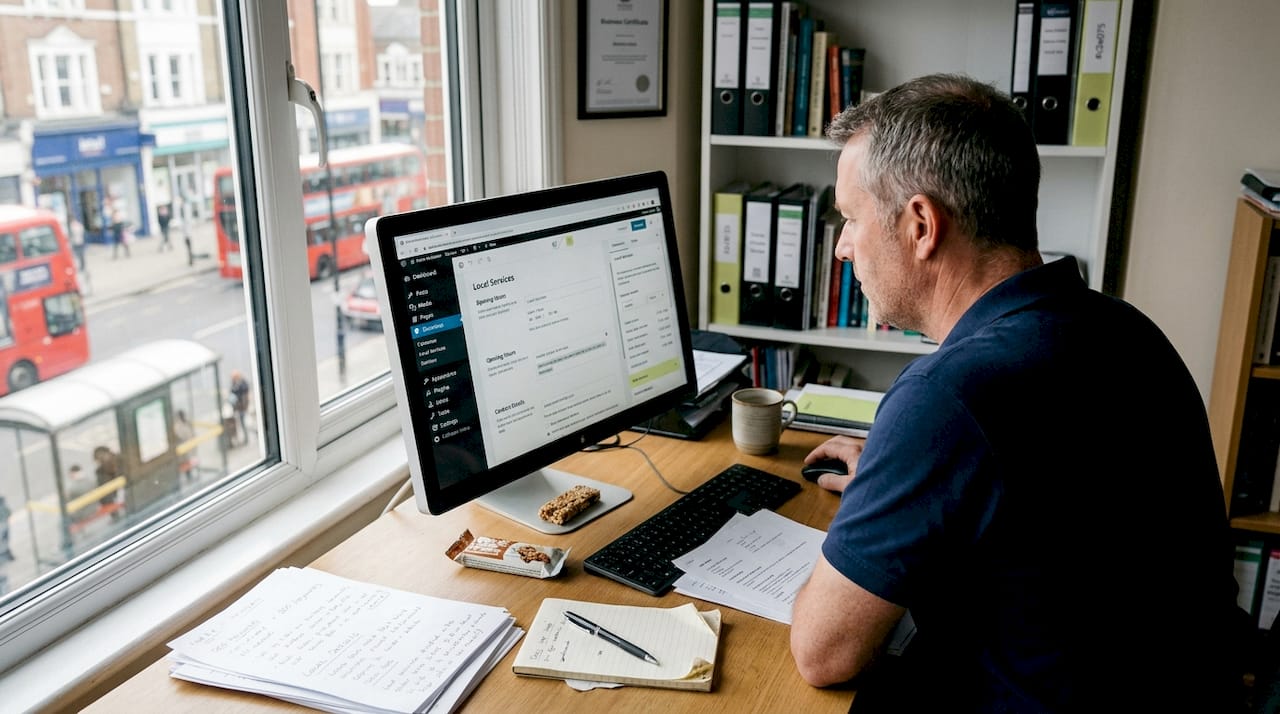
According to local SEO sprint strategies, creating dedicated location and service pages with local keywords, schema markup, and mobile optimisation is one of the highest-impact actions a local business can take in 2026.
Here’s what separates a strong local page from a weak one:
| Element | Strong local page | Poor local page |
|---|---|---|
| Page title | “Plumber in Manchester: Emergency & Planned Repairs” | “Services” |
| Content | Location-specific copy, local landmarks, testimonials | Generic service descriptions |
| Schema markup | LocalBusiness schema with NAP | No structured data |
| Mobile experience | Fast, tap-friendly, clear CTAs | Slow, desktop-only layout |
| Internal links | Links to related services and blog content | Isolated, no internal links |
To build pages that actually rank, follow this checklist:
- Include your target location in the page title, H1, and first paragraph.
- Add LocalBusiness schema markup (structured data that tells Google exactly who you are and where you operate).
- Feature genuine customer testimonials from local clients.
- Embed a Google Map of your location.
- Ensure the page loads in under three seconds on mobile.
- Link internally to related service pages and blog posts.
For practical guidance on structure, our resources on building landing pages for lead generation and optimising landing pages cover the technical and conversion elements in detail. You can also explore SEO strategy examples for real-world applications.
Pro Tip: If you serve multiple towns or boroughs, build a separate page for each location rather than cramming them all onto one page. Each dedicated page gives you a distinct ranking opportunity for that specific area.
Local content should always take precedence over generic content. A blog post about “the five most common boiler faults in Leeds this winter” will outperform a generic “boiler maintenance tips” article for local searches every time.
Step 3: Maintain, monitor, and measure your local SEO success
Even the best-built local SEO must be maintained and measured. Here’s how ongoing work keeps you ahead. The businesses that dominate local search aren’t the ones who did the most work at setup. They’re the ones who kept going.
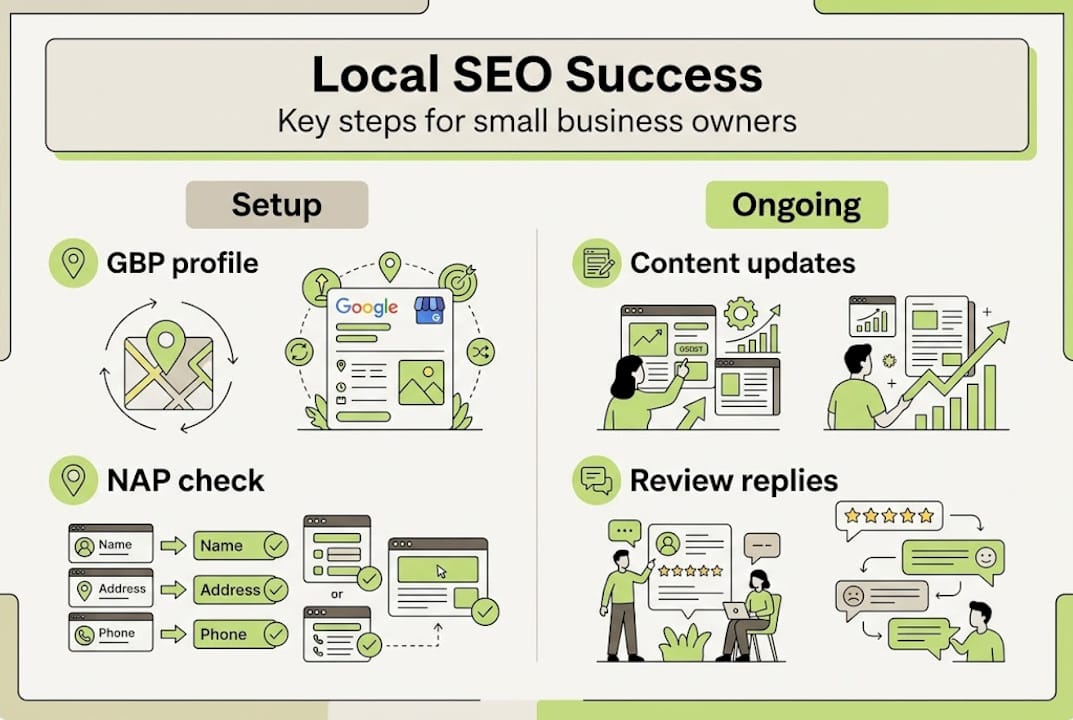
Ongoing maintenance consistently outperforms one-time setup. A 90-day sprint approach, where you build foundations, then optimise, then scale, produces compounding results that a single burst of activity simply cannot match.
Here’s what your ongoing local SEO routine should include:
- Review GBP insights weekly and update posts at least once a week
- Respond to new reviews within 48 hours
- Check GSC monthly for crawl errors, indexing issues, and new keyword opportunities
- Use LocalFalcon to track your grid rankings across different postcodes every month
- Audit NAP consistency across directories every quarter
- Publish at least one piece of locally relevant content per month
For tracking, here’s a simple monitoring framework:
| Metric | Tool | Review frequency |
|---|---|---|
| Local pack rankings | LocalFalcon | Monthly |
| Organic search traffic | Google Search Console | Monthly |
| Profile views and actions | GBP Insights | Weekly |
| Review volume and rating | GBP / Review platforms | Weekly |
| Website errors | Google Search Console | Monthly |
Reviews deserve special attention. Ask every satisfied customer to leave a Google review. Make it easy by sending a direct link. A steady stream of genuine reviews signals trust and relevance to Google far more than a sudden burst followed by silence.
“Consistency in local SEO is a competitive advantage. Most businesses quit after the first month. The ones who stay active are the ones who rank.”
Understanding the local SEO fundamentals keeps your strategy grounded, while exploring the role of social media in local SEO can open up additional visibility channels that complement your core efforts.
Why ‘set and forget’ local SEO fails: A strategist’s take
Stepping back, it’s important to challenge the most persistent myth in the local SEO world: that local SEO is a project with a finish line. It isn’t. It’s a process, and treating it like a one-time task is the single biggest reason businesses stall after an initial rankings boost.
What we see consistently is that businesses who commit to regular reviews, whether monthly profile audits, fresh local content, or simply responding to reviews promptly, uncover opportunities their competitors are completely blind to. A new service category your competitor hasn’t claimed. A question in your GBP Q&A that reveals exactly what customers want. A local keyword trend that emerged last month.
Google rewards freshness and genuine engagement. It’s not just about signals; it’s about demonstrating that your business is active, relevant, and worth recommending. Applying strong SEO best practices consistently, even in small ways each week, produces compounding results that a one-off setup never will.
Enhance your local presence with expert support
Local SEO, done properly, transforms how nearby customers find and choose your business. But keeping up with profile maintenance, content creation, rank tracking, and technical optimisation takes time that most business owners simply don’t have.
At Geo Growth Media, we work as an extension of your team, handling the ongoing work that keeps your local presence sharp and competitive. From SEO solutions tailored to your location and sector, to full digital marketing services that connect every channel, we build strategies around your goals, not generic templates. If you’re ready to stop guessing and start growing, get in touch for a consultation and find out exactly where your local SEO stands today.
Frequently asked questions
How long does it take to see results from local SEO?
Most local businesses notice early improvements within one to two months, with the strongest gains building over three to six months. A 90-day sprint approach is a proven structure for building lasting local visibility.
Is Google Business Profile free to use?
Yes, setting up and managing a Google Business Profile is completely free. Free tools like GBP and Google Search Console give you significant ranking power without any cost.
What is the most important factor in ranking for the local pack?
Google Business Profile is the single most influential factor, accounting for 32% of local pack ranking weight. A complete, active profile is your highest-leverage local SEO asset.
Do I need a separate landing page for each location?
Yes. Creating dedicated location pages with local keywords and schema markup gives each area its own ranking opportunity, significantly improving your chances of appearing in local search results.
How do I keep my local SEO effective over time?
Regularly update your GBP, publish local content, and monitor performance using GSC and LocalFalcon. Ongoing maintenance consistently outperforms a one-time setup when it comes to sustained local rankings.


.png)