.png)

.svg)


TL;DR:
- Treat analytics as an active decision-making tool to drive e-commerce growth.
- Focusing on conversion rate, AOV, and repeat purchase rate boosts ROI significantly.
- Running structured experiments is more effective for growth than chasing new analytics trends.
Most marketing managers look at their analytics dashboards every week and still feel like they are flying blind. The numbers are there, the charts are colourful, and the reports look professional. Yet the gap between collecting data and actually growing revenue remains stubbornly wide. The real problem is not a lack of data. It is the habit of treating analytics as a passive scoreboard rather than an active decision-making engine. When you shift from monitoring metrics to interrogating them, you stop reacting to your business and start steering it. This guide shows you exactly how to make that shift and what it means for your growth and ROI.
Table of Contents
- Why analytics is crucial for e-commerce growth
- Essential analytics metrics and how to measure them
- Navigating attribution and incrementality: Getting true ROI
- Emerging trends: AI, data quality, and the future of analytics
- Why prioritising experiments beats chasing analytics trends
- Take your e-commerce growth further with expert analytics support
- Frequently asked questions
Key Takeaways
| Point | Details |
|---|---|
| Analytics drive growth | Understanding and actively applying analytics turns reporting into real business growth for e-commerce brands. |
| Focus on high-impact metrics | Prioritising conversion rate, AOV, and repeat purchase unlocks the most sustainable improvements. |
| Choose attribution wisely | Proper attribution and incrementality testing prevent misleading ROI calculations. |
| Data quality is vital | Clean, unified data is the foundation for effective analytics and AI-driven insights. |
| Experiment for clarity | Regular marketing experiments reveal the real levers for your business’s growth. |
Why analytics is crucial for e-commerce growth
There is a persistent myth in e-commerce marketing: analytics is for reporting. You pull last month’s numbers, share them in a slide deck, and move on. But the businesses pulling ahead are using analytics very differently. They are using it to identify which customer segments are genuinely profitable, which acquisition channels produce repeat buyers, and where in the funnel revenue is quietly leaking.
The digital marketing analytics impact on real business outcomes is significant. Businesses that actively use analytics to inform decisions see up to 29% higher ROI compared to those relying on intuition alone. That figure matters because it signals a structural advantage, not just marginal gains.
So what should you actually be tracking? For most small to medium-sized e-commerce businesses, three metrics move the needle most:
- Conversion rate: The percentage of visitors who purchase. A benchmark of above 3% is a strong target for most e-commerce stores.
- Average order value (AOV): How much each customer spends per transaction. Increasing AOV by even 10% can dramatically shift profitability.
- Repeat purchase rate: The proportion of customers who buy more than once. Healthy e-commerce businesses typically see repeat rates of 40 to 60%.
Beyond these headline metrics, customer journey analysis reveals which touchpoints genuinely influence purchases versus which ones simply appear at the end of the path. Data-driven campaign optimisation begins with understanding this distinction clearly.
“Optimisation drives efficiency, but analytics reveal new opportunities that optimisation alone will never surface.”
That distinction is critical. Optimisation tightens what you already do. Analytics challenges whether what you are doing is the right thing in the first place. The two work together, but analytics must lead.
Essential analytics metrics and how to measure them
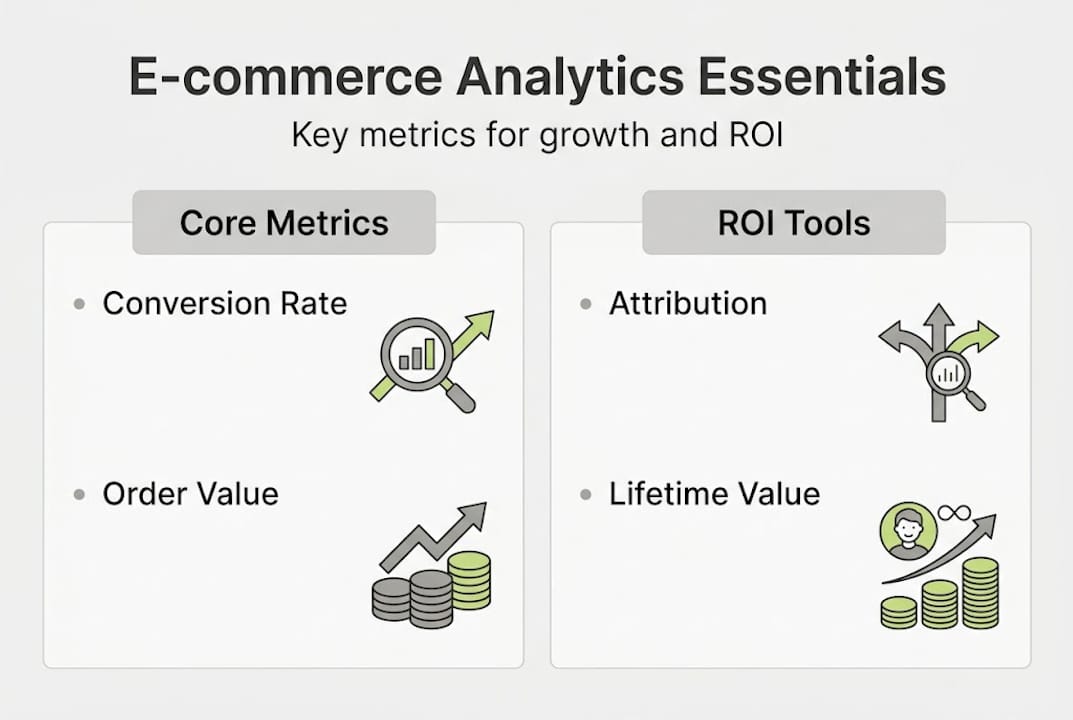
Knowing which metrics matter is only half the battle. Knowing how to capture them reliably and interpret them correctly is where most teams fall short. The table below gives you a practical reference for the four highest-impact e-commerce metrics and what good looks like:
| Metric | What it measures | Target benchmark | Best tool |
|---|---|---|---|
| Conversion rate | Visitors who purchase | Above 3% | GA4, Shopify |
| Average order value | Revenue per transaction | Track growth trend | Shopify, GA4 |
| Customer lifetime value (LTV) | Total revenue per customer | Varies by sector | Custom dashboard |
| Repeat purchase rate | Returning buyer proportion | 40 to 60% | Shopify, Klaviyo |
For most teams, the fastest path to reliable data is starting with built-in platform tools. GA4 and Shopify together cover the majority of what you need for the ecommerce analytics essentials without requiring a data engineering team. Once you have a baseline, you can layer in custom dashboards for more nuanced views.
Here is a simple approach to get your measurement practice right:
- Set up GA4 e-commerce tracking with purchase events and revenue parameters correctly configured.
- Connect your Shopify store to GA4 using the Google and YouTube channel integration.
- Review cohort reports monthly to assess repeat purchase patterns across different acquisition periods.
- Track AOV trends by channel and campaign, not just site-wide averages.
- Run a marketing audit process quarterly to ensure your tracking setup has not drifted.
Pro Tip: Prioritise owned channels such as email and SEO for your cleanest conversion data. Paid channels introduce attribution noise that can distort your understanding of what is genuinely working. Use owned-channel data as your baseline, then compare paid performance against it.
The most common pitfall at this stage is overvaluing vanity metrics. Page views, social media impressions, and click-through rates feel meaningful but rarely correlate with revenue. The second trap is last-click attribution, which we will address directly in the next section. Follow the marketing optimisation guide to understand how to structure your measurement framework before scaling spend.
Navigating attribution and incrementality: Getting true ROI
Attribution is where most e-commerce ROI calculations quietly go wrong. The model you choose determines which channels get credit for a sale, and that shapes every budget decision you make. Here is a comparison of the most common models:
| Model | How it works | Key limitation |
|---|---|---|
| Last-click | 100% credit to final touchpoint | Ignores everything that built intent |
| First-click | 100% credit to first touchpoint | Ignores nurture and closing channels |
| Linear | Equal credit across all touchpoints | Treats all interactions as equal |
| Data-driven | Credit weighted by actual influence | Requires substantial data volume |
The problem with last-click attribution is well documented. It overvalues retargeting campaigns and deep-discount tactics that capture demand rather than create it. When you optimise your budget based on last-click data, you tend to defund the upper-funnel activity that was generating that demand in the first place. The result is short-term efficiency gains followed by a slow erosion of new customer acquisition.
This is where incrementality becomes essential. Incrementality answers one question: would this sale have happened without this marketing activity? It is the difference between correlation and causation in your data.
- Run geo-experiments by activating campaigns in some regions and not others, then compare results.
- Use conversion lift studies within Meta and Google Ads to isolate true incremental impact.
- Test promotional mechanics carefully. E-commerce marketing attribution data often shows that BFCM discounts pull forward purchases from existing customers rather than acquiring genuinely new ones.
- Review cohort quality after major campaigns, not just conversion volume.
Pro Tip: Validate your attribution model assumptions with real cohort data before acting on them. If your data-driven model is attributing high value to a channel but that channel’s cohorts show low LTV customers, the model is misleading you.
The cleaner your understanding of analytics in marketing campaigns, the better your budget decisions will be. Attribution is not about finding the perfect model. It is about understanding the limitations of any model you use.

Emerging trends: AI, data quality, and the future of analytics
AI is genuinely reshaping how analytics works in e-commerce, but the hype often runs ahead of the reality. The honest picture is more nuanced. AI aids pattern recognition and demand forecasting at a scale that manual analysis cannot match. But it fails at causal inference without high-quality, integrated data underneath it.
Put simply: AI amplifies what is already there. If your data is fragmented, inconsistent, or poorly structured, AI will amplify those problems, not fix them. Challenges like privacy and signal loss mean that deterministic experiments combined with calibrated models remain the most reliable path to actionable insight.
Here is what the shift to better analytics infrastructure actually looks like in practice:
- Move away from siloed tools toward composable data stacks that unify your customer, campaign, and revenue data in one place.
- Invest in T-shaped talent. Marketers who understand both campaign strategy and basic data skills consistently outperform teams where these disciplines are separated.
- Prioritise data quality over model sophistication. A simple regression on clean data beats a neural network on messy data every time.
- Use AI for forecasting and segmentation, not for causal business decisions. Reserve those for structured experiments.
The teams winning with AI in marketing analytics are not the ones with the most sophisticated tools. They are the ones who have built disciplined data collection habits first, then layered AI on top. The technology rewards rigour, not enthusiasm.
Why prioritising experiments beats chasing analytics trends
Here is something we have observed consistently across e-commerce clients: the marketing teams most distracted by new analytics tools tend to be the ones growing slowest. There is always a new attribution platform, a new AI feature, or a new measurement framework promising to solve the ROI puzzle. The cycle is seductive and mostly unproductive.
The teams that grow sustainably share one habit. They run structured experiments. A/B tests, geo holdouts, email send-time trials. Nothing exotic. What matters is the discipline to test one variable at a time, measure it properly, and act on the result. Prioritising experiments over models is not a conservative approach. It is actually the most aggressive growth strategy available, because it builds a library of validated knowledge specific to your business.
Generic benchmarks tell you what works for the average e-commerce store. Experiments tell you what works for yours. That distinction compounds over time. The ROI impact of experiments is not theoretical. It shows up in budget efficiency, channel mix, and customer acquisition costs quarter after quarter. Our advice is to run at least one structured experiment per month, keep it small, and document what you learn. That habit, sustained over a year, is worth more than any new analytics platform.
Take your e-commerce growth further with expert analytics support
If this article has surfaced questions about your own analytics setup, that is a good sign. It means there is untapped growth in your data waiting to be found.

At Geo Growth Media, we work directly with e-commerce marketing teams to build analytics frameworks that connect data to decisions. From attribution modelling and conversion tracking to campaign optimisation and growth audits, our expert digital marketing services are built around measurable outcomes. We act as an extension of your team, not an outside vendor. If you are ready to find out what your analytics are actually telling you, explore how our e-commerce growth experts can support your next stage of growth.
Frequently asked questions
What are the most important e-commerce analytics metrics for growth?
Focus on conversion rate, average order value, repeat purchase rate, and customer lifetime value. Strong benchmarks include a conversion rate above 3% and repeat purchase rates between 40 and 60%.
How does attribution modelling affect ROI measurement?
The wrong attribution model channels budget toward the wrong activities. Last-click attribution in particular overvalues retargeting and obscures how upper-funnel investment builds long-term demand.
How can AI help e-commerce analytics?
AI accelerates pattern recognition and demand forecasting but fails causal inference without clean, unified data. It amplifies your data quality, for better or worse.
What is incrementality, and why does it matter?
Incrementality measures whether your marketing actually caused a sale, rather than simply coinciding with one. Without it, optimisation misses incrementality and you risk funding activity that captures existing demand rather than creating new revenue.
How should small e-commerce teams get started with analytics?
Begin with built-in tools like GA4 and Shopify, focus on three to five core metrics, and validate your findings with simple experiments before drawing firm conclusions.



.png)