.png)

.svg)



TL;DR:
- Growth hacking is a data-driven, experiment-based approach to accelerating business growth across the entire customer journey. It emphasizes rapid, iterative testing of hypotheses by cross-functional teams to identify scalable strategies without significant budgets. Effective growth hacking requires discipline in metric tracking, full journey optimization, and fostering a culture of continuous experimentation.
Growth hacking is defined as a systematic, experiment-driven approach to accelerating business growth using creative, low-cost strategies across marketing, product, and customer experience. Sean Ellis coined the term in 2010, describing a growth hacker as someone whose “true north is growth.” Unlike traditional marketing, which leans on large budgets and broad campaigns, growth hacking treats every channel, feature, and customer touchpoint as a testable hypothesis. The discipline spans the full customer journey: acquisition, activation, retention, and revenue. If you are an entrepreneur or marketer looking to grow faster without burning through budget, this is the framework worth understanding.
What is growth hacking and how does it actually work?
Growth hacking is experiment-driven across acquisition, activation, retention, and revenue. That definition matters because it immediately separates growth hacking from a one-off clever trick. The process is a continuous cycle: form a hypothesis, design a controlled experiment, measure the outcome against a clear metric, and then either scale what worked or discard what did not. Repeat. The compounding effect of running dozens of these cycles per quarter is where the real advantage lies.

The methodology borrows directly from scientific thinking. You set a baseline, introduce one variable, and measure the delta. A/B tests and baseline controls separate genuine signal from statistical noise, which means you are not guessing. You are building evidence. Growth teams track metrics like conversion rates, activation milestones, and retention curves to decide which experiments deserve more resource and which should be cut.
What makes this powerful for entrepreneurs is the resource efficiency. You do not need a £500,000 media budget to run a referral experiment or test two versions of an onboarding email. You need a clear question, a measurable outcome, and the discipline to act on the data. That is a playing field where smaller, faster teams can genuinely outmanoeuvre larger competitors.
Pro Tip: Before running any experiment, write down your success metric in advance. “We expect this change to increase 7-day retention by 10%” is a testable hypothesis. “We want to improve retention” is not.
How does growth hacking differ from traditional marketing?
The clearest way to understand the difference is to look at where each approach puts its energy.
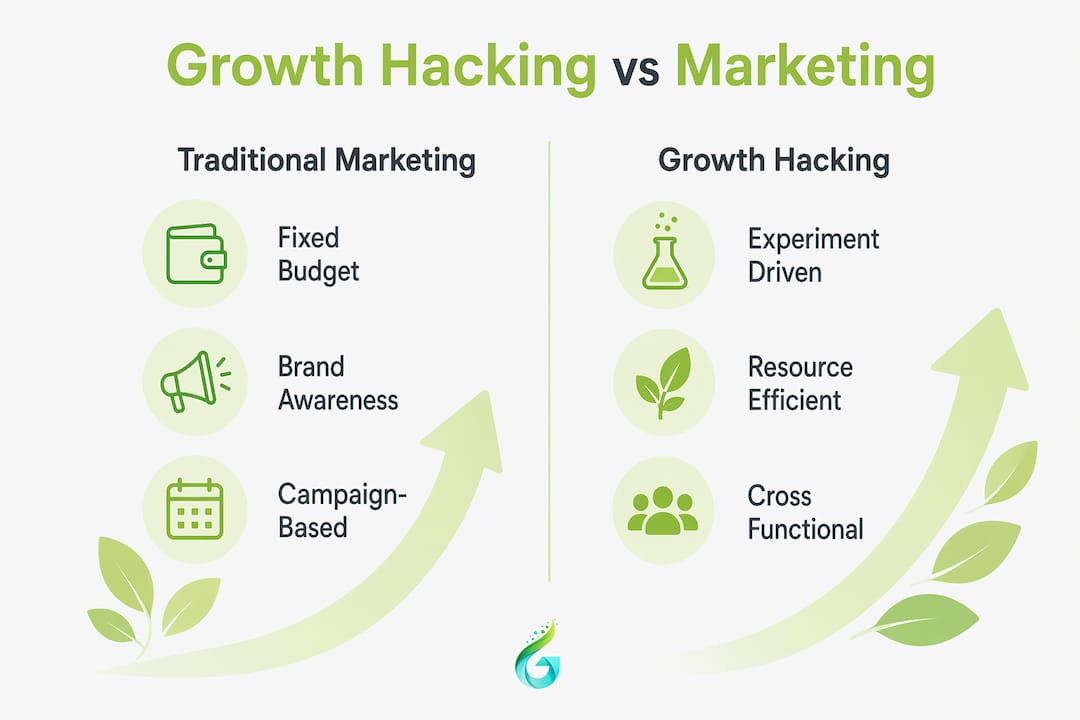
| Dimension | Traditional marketing | Growth hacking |
|---|---|---|
| Budget model | Fixed, campaign-based spend | Variable, experiment-based allocation |
| Speed | Planned, slower execution cycles | Rapid iteration and scaling |
| Team structure | Marketing department led | Cross-functional: marketing, product, engineering |
| Focus | Primarily top-of-funnel awareness | Full customer journey from acquisition to referral |
| Success measure | Reach, impressions, brand recall | Conversion rates, activation, retention, revenue |
Traditional marketing excels at building brand awareness at scale. A well-funded TV campaign or a national press push can shift perception across millions of people simultaneously. Growth hacking does not compete on that terrain. Instead, it finds the specific friction points in your funnel and removes them through targeted experiments.
The cross-functional nature of growth hacking is what most people underestimate. Effective growth hacking requires alignment among marketing, product, and engineering teams to impact all funnel stages. A growth hacker working alone in a marketing silo cannot alter the product onboarding flow or trigger an in-app referral prompt. Those changes require product and engineering involvement. This is why the most successful growth teams sit outside traditional org chart structures and report directly to founders or CEOs.
Typical growth hacking techniques include product feature tweaks that reduce time-to-value, referral incentives that turn existing users into acquisition channels, and low-cost distribution experiments across email, SEO, and social. These are not marketing campaigns. They are product and distribution decisions tested at speed.
What growth hacking strategies can you apply right now?
Knowing the theory is one thing. Knowing where to start is another. The most practical way to approach growth hacking strategies is to map your funnel first and identify where you are losing people.
- Identify your funnel leak. The best growth hack depends on the funnel stage where growth leaks: acquisition, onboarding, or retention. If 80% of users sign up but only 20% complete onboarding, fixing onboarding is worth ten times more than increasing ad spend on acquisition.
- Run targeted experiments with defined metrics. Each experiment needs a hypothesis, a control group, a test group, and a pre-agreed success metric. Tools like Google Optimise, VWO, or Optimizely make A/B testing accessible without heavy engineering resource.
- Optimise your referral and virality mechanics. Dropbox’s storage-for-referrals programme grew its user base by 3,900% in 15 months. The mechanic was simple: refer a friend, both parties get more storage. The product itself became the distribution channel.
- Leverage automation and low-cost channels. Email sequences triggered by user behaviour, retargeting audiences built from site visitors, and SEO content targeting high-intent search queries are all scalable with modest budgets. Tracking marketing metrics consistently tells you which of these channels is actually moving the needle.
- Build an experimentation pipeline. Successful teams build experimentation pipelines that support speed and risk control via limited rollouts and scalable successful tests. Start small, validate, then scale. This prevents you from committing significant budget to an unproven idea.
Pro Tip: Map your customer journey in a spreadsheet with conversion rates at each stage. The stage with the biggest drop-off is your highest-priority experiment. Fix the leak before you pour more water in.
For DTC brands specifically, structured influencer and partner programmes through platforms like PartnerLlama can serve as repeatable, low-cost acquisition experiments that fit neatly into a growth hacking framework.
What pitfalls should you avoid in growth hacking?
Growth hacking done poorly is worse than not doing it at all. You end up with a team running random experiments, celebrating misleading numbers, and burning time on initiatives that do not move the business forward. These are the most common mistakes.
- Chasing vanity metrics. A major pitfall is optimising vanity metrics without linking experiments to the business’s north-star goals. Page views, social followers, and app downloads feel like progress. They are not growth unless they connect to revenue or retention.
- Treating it as a one-off hack. Growth hacking often fails when treated as a one-off hack rather than a repeatable system of experiments that build momentum. One clever idea does not compound. A hundred disciplined experiments do.
- Ignoring the full customer journey. Most teams over-invest in acquisition and under-invest in activation and retention. Growth hackers must stay mindful that the fastest growth comes from optimising activation and referral, not just acquisition. Acquiring a user who churns in week one costs you twice: once to acquire them, once in lost lifetime value.
- Scaling without validation. Putting significant budget behind an experiment that has not yet shown statistically significant results is a common and expensive mistake. Scale only what the data confirms is working.
- Poor experiment design. Running two changes simultaneously in the same test makes it impossible to know which variable caused the outcome. One variable per experiment, always.
Key takeaways
Growth hacking is a disciplined, experiment-driven system that compounds over time, not a collection of clever tricks applied once and forgotten.
| Point | Details |
|---|---|
| Definition and origin | Sean Ellis coined the term in 2010 to describe data-driven, experiment-led growth across the full customer journey. |
| Core cycle | Hypothesise, test, measure, and repeat. Every experiment builds evidence for the next decision. |
| Funnel-first thinking | Identify where users drop off before running experiments. Fix the biggest leak first. |
| Cross-functional teams | Growth hacking requires marketing, product, and engineering working together to impact all funnel stages. |
| Avoid vanity metrics | Track activation milestones, retention curves, and revenue. Not page views or follower counts. |
Growth hacking as a discipline, not a department
At Geo Growth Media, we have worked with enough ambitious brands to say this plainly: the teams that get growth hacking right treat it as a culture, not a job title. The moment it becomes one person’s responsibility, it loses its power. Growth thinking needs to sit inside product decisions, content strategy, paid media planning, and customer success conversations simultaneously.
What we have found is that most businesses already have the raw material for good growth experiments. They have customer data, funnel analytics, and a product that real people use. What they lack is the structured process to turn those inputs into testable hypotheses and the discipline to act on results rather than instinct. The digital marketing optimisation mindset and the growth hacking mindset are, at their core, the same thing: measure, learn, improve.
The uncomfortable truth is that growth hacking is not magic. It is a discipline requiring rigour in choosing metrics, scientific test design, and rapid iteration. The businesses that treat it as a silver bullet will be disappointed. The ones that commit to building an experimentation culture, even at small scale, will find that the results compound in ways that no single campaign ever could.
If you are just starting out, pick one funnel stage, run one experiment per fortnight, and measure it properly. That is a better foundation than a hundred half-tested ideas running in parallel.
— Geo Growth Media
Ready to put growth hacking into practice?
Understanding the framework is the starting point. Executing it at pace, with the right data and the right channels, is where most businesses need support.

At Geo Growth Media, we work as an extension of your marketing team, running data-driven paid social media campaigns across Meta, TikTok, and LinkedIn that feed directly into your acquisition experiments. We also build the organic foundation through SEO services that compound over time, giving you sustainable traffic alongside your paid and experimental growth efforts. If you are ready to move from theory to measurable results, we are worth a conversation.
FAQ
What is a growth hacker?
A growth hacker is someone whose primary focus is driving measurable business growth through rapid experimentation across marketing, product, and distribution. Sean Ellis coined the term in 2010 to describe professionals who prioritise data and iteration over traditional campaign thinking.
How does growth hacking differ from digital marketing?
Digital marketing typically focuses on planned campaigns and brand awareness across paid and organic channels. Growth hacking is cross-functional, experiment-led, and spans the entire customer journey from acquisition through to referral and retention.
What are the main benefits of growth hacking?
The core benefits are speed and resource efficiency. Growth hacking allows businesses to find what works quickly, scale it, and discard what does not, without committing large budgets to unproven strategies.
How do I start with growth hacking strategies?
Map your funnel, identify the stage with the highest drop-off rate, and design one controlled experiment to address it. Track a single, meaningful metric and act on the result before moving to the next test.
What metrics should growth hackers track?
Activation milestones, retention curves, and conversion rates are the most meaningful indicators. Vanity metrics like page views or social impressions do not reliably connect to revenue or long-term growth.



.png)