.png)

.svg)



TL;DR:
- Dynamic ad creative automatically personalizes content in real time using audience data and modular components. It leverages machine learning to test and optimize combinations, increasing relevance and campaign efficiency. Implemented across platforms like Meta, Google, and Amazon, it is especially effective for remarketing and large product catalogs.
Dynamic ad creative is an automated advertising approach that assembles and personalises ad content in real time, combining images, headlines, and calls-to-action based on individual audience data. Unlike static ads, which show the same message to every viewer, dynamic ads adapt their creative elements per impression, making each ad more relevant to the person seeing it. Platforms including Meta Ads Manager, Google Ads, and Amazon Ads all offer native dynamic creative tools. The more advanced form of this technology, Dynamic Creative Optimisation (DCO), uses machine learning to test combinations live and continuously select the best-performing versions. If you are running paid campaigns and still relying solely on static creatives, you are leaving performance on the table.
What is dynamic ad creative and how does it differ from static ads?
Dynamic ad creative is defined as advertising content assembled in real time by combining modular components such as images, product details, headlines, and CTAs based on customer insights and predefined templates. The result is an ad that feels tailored to the viewer rather than broadcast to the masses. A static ad, by contrast, is a fixed asset. One image, one headline, one message, sent to everyone regardless of who they are or what they have browsed.
The practical difference is significant. A retailer running a static ad shows the same winter coat to every user. A retailer using dynamic creative shows that coat to someone who viewed it last week, a different product to someone who browsed footwear, and a sale message to a price-sensitive segment. The ad responds to the data, not the other way around.
Dynamic Creative Optimisation takes this further. DCO uses machine learning to test combinations of creative elements live during a campaign, automatically prioritising the versions that generate the strongest results. Think of it as A/B testing at scale, running continuously without manual intervention.
How does dynamic ad creative work in practice?
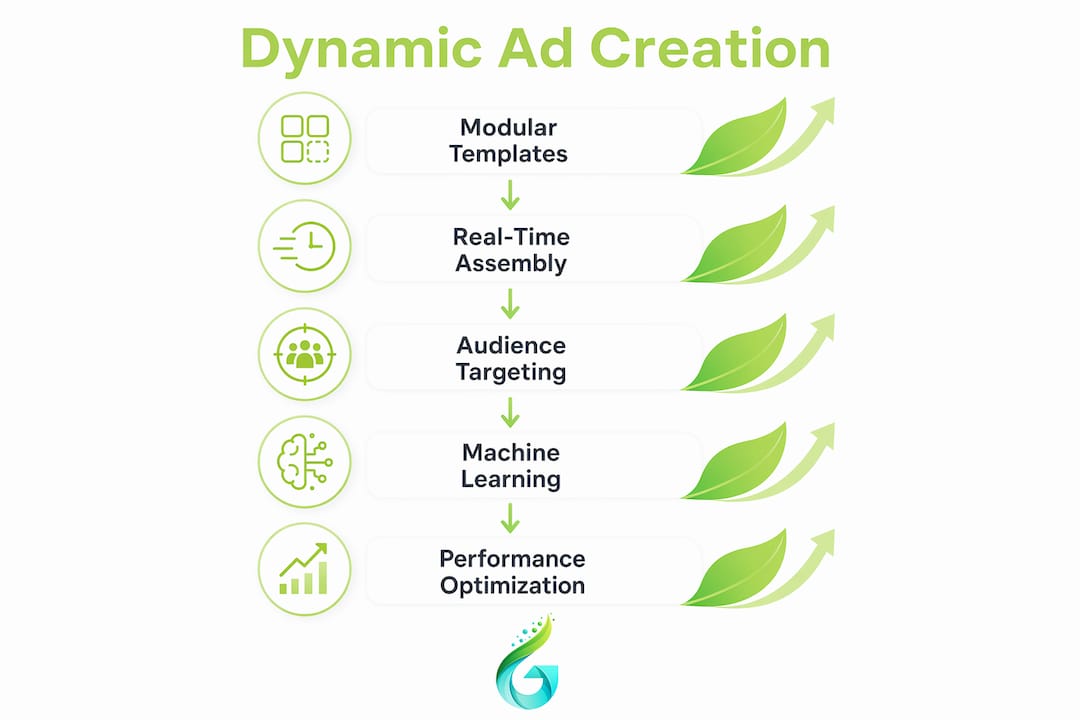
The mechanics rely on modular templates with designated component slots. Each slot holds a variable, such as a product image, a headline, a proof point, or a CTA. The platform pulls the appropriate asset for each slot based on audience signals, behavioural data, and contextual information at the moment of the auction.

Modular templates combine distinct creative options to determine winning combinations, with the system learning over time which pairings resonate with which audience segments. The inputs are your assets. The platform handles the assembly and the routing.
Here is what that looks like in practice across major platforms:
- Google Responsive Search Ads (RSAs): You supply up to 15 headlines and 4 descriptions, and Google dynamically assembles the combination most likely to match the user’s search intent at auction time. No two users necessarily see the same ad.
- Meta Ads Manager dynamic creative: You upload multiple images, videos, headlines, body copy variants, and CTAs. Meta’s system tests combinations across your audience and allocates spend toward the top performers automatically.
- Amazon dynamic TV creative: A single base video creative is adapted at impression time, with interactive elements like CTAs and product details personalised based on viewer shopping behaviour and Amazon signals. No need to produce multiple video assets.
The machine learning layer is what separates dynamic creative from simple ad rotation. The system does not just cycle through options randomly. It learns which combinations drive results for which audience segments and weights delivery accordingly.
Pro Tip: Supply assets that are genuinely distinct from one another. If your three headlines all say a version of “Buy now and save,” the system has nothing meaningful to learn from. Differentiate by angle: one headline on price, one on social proof, one on urgency.
What are the benefits of dynamic ad creative compared to static ads?
The core advantage is relevance. Dynamic ads increase ad relevance over static digital billboards by responding to customer insights rather than broadcasting a single message. Relevance drives engagement, and engagement drives conversions.
Beyond relevance, the efficiency gains are real. You are not manually producing dozens of ad variants and trafficking them individually. The platform handles permutation testing at a scale no human team can match. This frees your time for strategy, creative direction, and audience planning rather than production management.
| Point | Details |
|---|---|
| Personalisation at scale | Ads adapt per viewer, improving relevance without manual production of every variant. |
| Automated optimisation | Machine learning continuously tests combinations and shifts spend to top performers. |
| Remarketing effectiveness | Dynamic ads perform best for remarketing and frequently changing inventory campaigns. |
| Reduced creative fatigue | Rotating combinations keeps ads fresh for audiences who see them repeatedly. |
Dynamic creative is particularly well suited to remarketing. When someone has already visited your site or viewed a product, showing them a generic brand ad is a missed opportunity. Dynamic ads can surface the exact product they browsed, paired with a message calibrated to where they are in the buying journey.
“Dynamic ad creative is not a shortcut to good advertising. It is a multiplier for good inputs. The quality of your creative assets and the accuracy of your audience data determine the ceiling of what the system can achieve.”
For e-commerce brands with large catalogues, the case is even stronger. Catalogue-based dynamic product ads pull directly from your product feed, meaning every SKU can be advertised without manually creating an individual ad for each one. That is the kind of scale that static creative simply cannot match.
What are practical examples and platform implementations of dynamic ad creative?
Understanding the theory is one thing. Seeing how it plays out across real platforms makes the decision to adopt it much clearer. Here are four concrete implementations worth knowing:
-
Meta dynamic creative: Within Meta Ads Manager, you upload up to 10 images or videos, five headlines, five body copy options, and five CTAs within a single ad set. Meta’s delivery system tests combinations across your audience and identifies which pairings drive the lowest cost per result. It is one of the most accessible entry points for marketers new to dynamic creative.
-
Google Responsive Search Ads: RSAs are Google’s primary search ad format. By providing multiple headline and description options, you allow Google to assemble the most contextually relevant combination for each auction. Advertisers who use RSAs alongside Shopping Ads gain dynamic creative coverage across both search intent and product discovery.
-
Amazon dynamic product ads: Amazon’s dynamic ad tools pull from product feeds to serve ads featuring items a shopper has viewed or that are algorithmically relevant to their browsing history. This is dynamic ad personalisation at the product level, not just the message level.
-
Amazon dynamic TV creative: This is the most technically advanced example currently available. A single video asset is adapted at impression time using Amazon’s first-party shopping signals. The CTA, featured product, and on-screen details change per viewer without requiring separate video production for each variant.
The common thread across all four platforms is the separation of creative inputs from creative assembly. You provide the raw materials. The platform builds the ad. This division of labour is what makes dynamic creative genuinely scalable, and it is why leading advertising platforms have made it a central feature of their ad products.
What strategies ensure effective use of dynamic ad creative?
Dynamic creative does not run itself. The system is only as good as what you put into it, and there are several operational disciplines that separate campaigns that learn quickly from those that stall.
- Differentiate your creative inputs: Clear, distinct creative options are necessary to avoid testing too many similar assets, which creates noisy data and reduces optimisation efficiency. If your images all look the same or your headlines carry the same message, the system cannot identify a meaningful winner.
- Maintain feed and data hygiene: Stale or incorrect product data in your feeds causes ads to show wrong pricing or out-of-stock items, wasting spend and damaging trust. Audit your product feeds regularly and set up automated alerts for feed errors.
- Set creative guardrails: Define which asset combinations are acceptable before launch. Not every headline works with every image. Use exclusion rules within platforms like Meta to prevent off-brand pairings from being served.
- Pair dynamic creative with catalogue ads: For e-commerce, combining dynamic creative with catalogue-based product ad campaigns gives you both personalisation at the message level and relevance at the product level simultaneously.
- Monitor combination-level performance: Most platforms surface data on which creative combinations are winning. Review this regularly and retire underperforming assets to keep the learning pool clean and focused.
Pro Tip: Treat dynamic creative as “production plus routing,” as expert practitioners describe it. It accelerates finding the best combination within your asset pool, but it cannot compensate for a weak creative strategy. Plan your asset variety before you build the campaign, not after.
The strategic discipline here mirrors what you would apply to any well-run paid campaign. Dynamic creative removes the manual assembly work, but it does not remove the need for sharp creative thinking, audience understanding, and ongoing performance analysis.
Key takeaways
Dynamic ad creative works because it combines quality creative inputs, accurate audience data, and machine learning optimisation to deliver personalised ads at a scale no static approach can match.
| Point | Details |
|---|---|
| Core definition | Dynamic ad creative assembles ad components in real time based on audience data and predefined templates. |
| DCO as advanced form | Dynamic Creative Optimisation uses machine learning to test live combinations and prioritise top performers automatically. |
| Platform examples | Meta, Google RSAs, and Amazon all offer native dynamic creative tools with different levels of personalisation. |
| Input quality matters | Creative effectiveness improves with distinct assets, clean data feeds, and clear strategic guardrails. |
| Best use cases | Remarketing and catalogue-based campaigns gain the most from dynamic creative due to audience familiarity and inventory scale. |
Our view on dynamic ad creative in 2026
From where we sit at Geo Growth Media, the biggest mistake marketers make with dynamic creative is treating it as a set-and-forget solution. We have seen campaigns where clients uploaded five near-identical images and wondered why performance plateaued after two weeks. The platform had nothing to learn from.
The second pitfall is feed neglect. For e-commerce clients running dynamic product ads, a feed with outdated pricing or discontinued SKUs is not just inefficient. It actively damages the customer experience and wastes budget on impressions that cannot convert.
What actually works is treating dynamic creative as a structured testing framework rather than an automation shortcut. You define the creative hypotheses, you supply genuinely different assets, and you let the machine find the winners. Then you take those insights and apply them to your next round of creative production. That feedback loop is where the real value sits.
We are also watching the evolution of dynamic creative in video formats closely. Amazon’s dynamic TV creative is an early signal of where the industry is heading: single-asset production with impression-level personalisation. As first-party data becomes more valuable and third-party signals continue to erode, platforms that can personalise from their own behavioural data will pull further ahead. Building dynamic creative competency now is not just about today’s performance. It is about being ready for how advertising works in three years.
— Geo Growth Media
Work with Geo Growth Media on dynamic ad creative
If you are ready to move beyond static ads and build campaigns that adapt to your audience in real time, Geo Growth Media can help you get there.
We work as an extension of your marketing team, building and managing paid social, PPC, and creative optimisation strategies tailored to your goals, sector, and budget. From Meta dynamic creative campaigns to Google RSA structures and paid social media advertising, we handle the strategy, the setup, and the ongoing optimisation. Explore our full range of digital marketing services to see how we can build a dynamic ad creative strategy that drives measurable results for your business.
FAQ
What is dynamic ad creative in simple terms?
Dynamic ad creative is an advertising format that automatically assembles ad components such as images, headlines, and CTAs based on audience data at the moment of delivery, so each viewer sees a version of the ad relevant to them.
How do dynamic ads differ from responsive ads?
Dynamic ads and responsive ads both assemble components automatically, but responsive ads like Google RSAs focus on matching search intent through headline and description combinations, while dynamic ads can also personalise based on browsing behaviour, product feeds, and customer signals.
Which platforms support dynamic ad creative?
Meta Ads Manager, Google Ads (via Responsive Search Ads and Performance Max), and Amazon Ads all support dynamic creative natively, each with different levels of personalisation and machine learning optimisation.
What are the biggest risks with dynamic ad creative?
The two main risks are poor creative differentiation, where similar assets prevent the system from learning, and feed data errors, where stale product information causes ads to display incorrect pricing or unavailable items.
Is dynamic ad creative suitable for small budgets?
Dynamic creative can work on modest budgets, particularly through Meta’s dynamic creative tool or Google RSAs, but campaigns need sufficient impression volume for the machine learning to gather meaningful data and optimise effectively.


.png)