.png)

.svg)


TL;DR:
- Targeted advertising matches the right message to relevant audiences using data signals, not surveillance.
- Methods like retargeting and contextual targeting improve ROI and reduce ad waste for SMEs.
- Privacy concerns and cookie deprecation are prompting shifts toward privacy-first and contextual advertising strategies.
Most marketing managers assume targeted advertising means someone is watching their every click. The reality is far more strategic and far less sinister. Targeted advertising is simply the practice of matching the right message to the right person at the right moment, using data signals to improve relevance rather than invade privacy. For SMEs trying to stretch every pound of their marketing budget, understanding this distinction is not just useful, it is essential. This guide breaks down how targeted advertising works, which methods deliver results, what the risks actually are, and how to apply it responsibly for measurable business growth.
Table of Contents
- What is targeted advertising?
- The core targeting methods used today
- Benefits of targeted advertising for SMEs
- Risks, privacy, and the new landscape
- A smarter approach to targeted advertising: what experts get wrong
- Empower your campaigns with expert help
- Frequently asked questions
Key Takeaways
| Point | Details |
|---|---|
| Precision audience targeting | Targeted advertising lets you reach only those most likely to care, boosting every pound spent. |
| Multiple effective methods | Use demographics, interests, contexts, and AI tools to tailor ads for better results. |
| Balance and compliance | Blending personalisation with privacy obligations is essential for long-term brand trust and growth. |
| Practical impact for SMEs | Even small businesses can harness targeting to save budget and increase conversion rates. |
What is targeted advertising?
At its core, targeted advertising means delivering promotional messages to specific groups of people based on data, rather than broadcasting the same message to everyone and hoping it lands. Think of it as the difference between putting a flyer through every door on a street versus posting one only to households that recently searched for exactly what you sell. The intent is relevance, not surveillance.
“Targeted advertising uses audience signals to show the most relevant ads to the most relevant people, improving efficiency for both businesses and consumers.”
Untargeted advertising, such as a billboard or a national TV spot, reaches a wide audience but wastes significant spend on people who will never buy. Targeted advertising flips this logic. It uses data to focus spend where it is most likely to convert, which is why it has become central to modern digital marketing strategies for businesses of all sizes.
The channels where targeted advertising operates include:
- Search advertising (Google Ads, Bing): ads triggered by specific search queries
- Paid social media (Meta, TikTok, LinkedIn): ads served based on profile data and behaviour
- Display advertising: banner ads shown across websites based on user signals
- Email marketing: personalised messages sent to segmented subscriber lists
- Video advertising (YouTube, TikTok): content matched to viewer interests
The core methodologies span demographic and geographic targeting (age, gender, location), behavioural and interest-based targeting (browsing history, past purchases), contextual targeting (matching ads to page content without needing user data), retargeting (re-engaging people who have already visited your site), and AI and machine learning predictive targeting that analyses signals such as device type, time of day, and purchase intent.
The objective across all of these is the same: improve relevance, reduce wasted spend, and increase return on investment. For an SME with a limited budget, this focus is not a luxury, it is a necessity.
The core targeting methods used today
Understanding what targeted advertising is, let us examine the distinct methods businesses use to reach their audiences. Each method suits different goals, budgets, and stages of the customer journey.
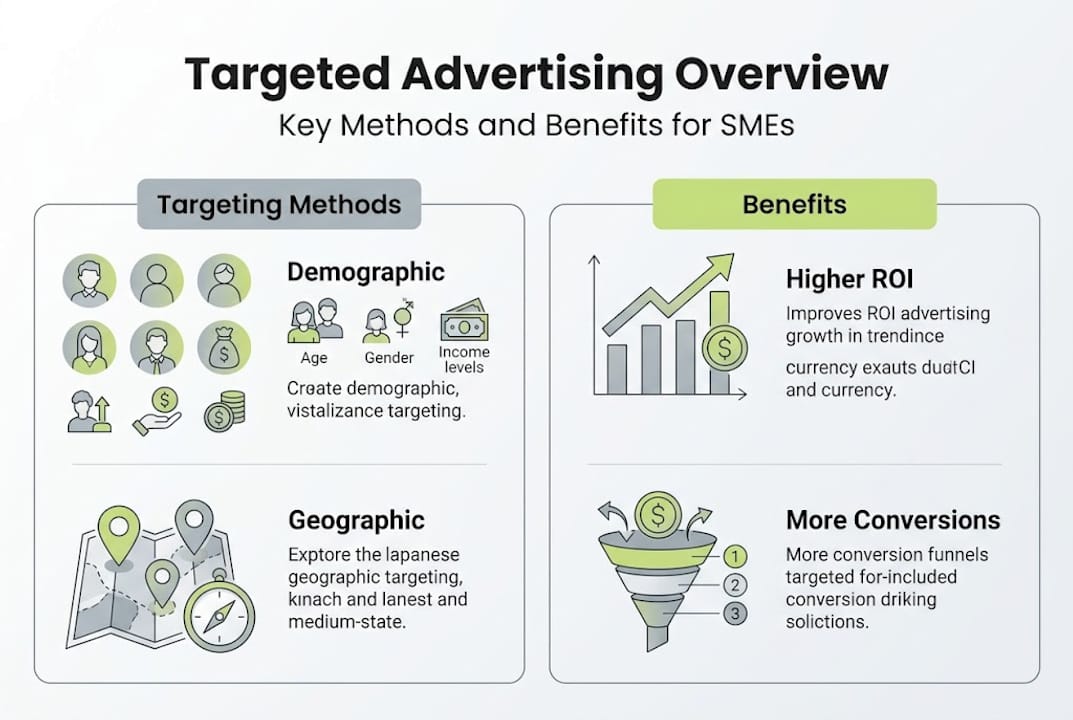
- Demographic targeting: Filters audiences by age, gender, income, or job title. Useful for products with a clearly defined buyer profile, such as a B2B software firm targeting finance directors.
- Geographic targeting: Serves ads based on location, from country level down to postcode. Ideal for local businesses or regional campaigns.
- Behavioural targeting: Uses browsing history, app usage, and past purchase data to identify people actively in a buying mindset.
- Interest-based targeting: Groups people by declared or inferred interests, such as fitness, travel, or home improvement.
- Contextual targeting: Matches ads to the content of the page being viewed, with no user data required. A sports nutrition brand appearing on a running blog is a classic example.
- Retargeting: Re-engages visitors who left your website without converting. These audiences already know your brand, making them significantly warmer prospects.
- AI and predictive targeting: Machine learning models analyse multiple audience signals including device, time, location, and behaviour patterns to predict who is most likely to convert next.
| Method | Best for | SME suitability |
|---|---|---|
| Demographic | Brand awareness, B2B | High |
| Geographic | Local/regional reach | Very high |
| Behavioural | Mid-funnel conversion | High |
| Contextual | Privacy-safe reach | High |
| Retargeting | Bottom-funnel sales | Very high |
| AI/Predictive | Scale and efficiency | Medium |
For practical inspiration, reviewing paid advertising examples from businesses in similar sectors can sharpen your own approach. The best targeting strategies rarely rely on a single method.
Pro Tip: Layering two or three targeting methods together, for example geographic plus behavioural plus retargeting, creates compound effectiveness. You narrow the audience to those most likely to act, without sacrificing meaningful reach.
Benefits of targeted advertising for SMEs
Knowing the methods, how do these translate into tangible results for your business? The case for targeted advertising is built on measurable efficiency rather than abstract theory.

The most immediate benefit is reduced ad waste. When you only pay to reach people who match your ideal customer profile, every pound works harder. A local accountancy firm running geo-targeted Google Ads to business owners within a 20-mile radius will consistently outperform a broad national campaign at a fraction of the cost.
Key benefits for SMEs include:
- Higher conversion rates: Relevant ads convert better because the audience already has context or intent
- Improved ROI: Budget concentrates on high-value audiences rather than broad, unqualified reach
- Better customer experience: People see offers that are genuinely relevant to them, reducing the friction of irrelevant messaging
- Supports business scaling: Campaigns can grow incrementally as data improves and budgets increase
- Enables free services: Research highlights that personalised advertising subsidises many free online platforms and tools that SMEs rely on daily
| Targeting approach | Average improvement vs. untargeted |
|---|---|
| Retargeting campaigns | Up to 70% higher conversion rate |
| Demographic + behavioural | Up to 2x ROI improvement |
| Contextual advertising | 30-40% lower cost per acquisition |
For SMEs specifically, the search marketing ROI case is particularly compelling. Search ads reach people at the exact moment they express intent, making them one of the highest-converting formats available. Pairing search with retargeting is a proven formula for boosting ROI without dramatically increasing spend.
Pro Tip: If your budget is limited, prioritise high-intent audiences first. People who have already visited your website or searched for your specific product or service are far more likely to convert than cold audiences, so start there before expanding reach.
Risks, privacy, and the new landscape
While benefits are clear, targeted advertising also comes with notable challenges every business should weigh carefully before committing budget.
The primary concerns fall into several categories:
- Privacy and data misuse: Collecting and using personal data without proper consent exposes businesses to regulatory risk and reputational damage
- User backlash: Overly aggressive retargeting or creepy ad experiences erode trust and can actively harm brand perception
- Regulatory penalties: GDPR in the UK and EU carries fines of up to 4% of global annual turnover for serious violations
- Brand safety: Appearing alongside inappropriate content on display networks can damage credibility
- Cookie deprecation: The phaseout of third-party cookies is already reshaping how behavioural targeting operates
Sensitive sectors face additional constraints. Restricted advertising categories including health, finance, and certain consumer credit products face stricter rules around personalised targeting, limiting how granular you can get with audience segmentation.
“Privacy risks, including potential surveillance, algorithmic bias, and manipulation, are real concerns that have accelerated calls for a shift toward contextual and privacy-preserving advertising models.”
The good news is that the industry is adapting. AI in advertising is increasingly being used to build privacy-first targeting solutions that do not rely on individual user tracking. Contextual targeting is experiencing a significant revival as a result, with platforms investing heavily in tools that match ads to content signals rather than personal data profiles.
For SMEs, the practical takeaway is straightforward: ensure your data collection practices comply with UK GDPR, use consent management tools on your website, and lean into contextual and first-party data strategies where possible. The businesses that build trust now will have a significant advantage as privacy regulations tighten further.
A smarter approach to targeted advertising: what experts get wrong
Here is the uncomfortable truth most agencies will not tell you: more data does not automatically mean better results. Many SMEs invest heavily in sophisticated targeting setups, audience segmentation tools, and automation platforms, only to see mediocre performance because the creative strategy and the underlying message are weak.
Targeted advertising gets the right ad in front of the right person. But if the ad itself is generic, unconvincing, or misaligned with what that person actually needs at that moment, no amount of targeting precision will save it. The technology is a delivery mechanism, not a substitute for genuine insight into your customer.
The businesses we see succeed with targeted advertising share a common trait: they start narrow, learn fast, and iterate constantly. They do not try to target everyone at once. They pick one audience, one message, and one goal, measure rigorously, and build from there. Understanding what digital marketing actually involves at a foundational level helps avoid the trap of chasing tactics without strategy. Blindly following every new targeting trend, whether it is AI bidding, broad match keywords, or Advantage Plus audiences, without understanding your own data first, is how budgets get wasted.
Empower your campaigns with expert help
Putting targeted advertising into practice requires more than reading a guide. It takes the right tools, the right data, and experienced hands to manage the moving parts.
At Geo Growth Media, we work alongside SMEs as an extension of their in-house marketing team, building paid social media campaigns across Meta, TikTok, and LinkedIn that are grounded in audience insight rather than guesswork. Our SEO solutions ensure your organic presence supports your paid efforts, and our website design services make sure the landing experience converts the traffic you work hard to attract. If you are ready to run smarter, more accountable campaigns, get in touch to book a discovery call and find out what a tailored strategy looks like for your business.
Frequently asked questions
How does targeted advertising actually work?
It uses audience data such as age, interests, or browsing history to show ads to those most likely to engage or buy. Platforms like Google apply multiple targeting signals including demographics, behaviour, and device context to match ads to the right users.
Is targeted advertising legal in the UK?
Yes, but it is regulated under GDPR and UK privacy law, particularly for sensitive categories or cookie-based tracking. Restricted product categories such as health and finance face additional constraints on how personalised targeting can be applied.
What are the risks of targeted advertising?
The main risks are privacy concerns, user backlash, and regulatory fines if compliance is not maintained. Research highlights that surveillance and bias risks are driving a broader industry shift toward privacy-preserving approaches.
Can small businesses use targeted advertising effectively?
Absolutely. SMEs often see stronger results than larger competitors because they can focus spend tightly on high-intent, well-defined audiences rather than broad reach campaigns that dilute relevance.
How is targeted advertising changing after cookies?
The industry is shifting toward contextual targeting and AI-driven models that do not rely on individual tracking. Cookie deprecation is accelerating adoption of first-party data strategies and privacy-first audience solutions across all major platforms.


.png)