.png)

.svg)



Most businesses are not short of marketing data. They are short of clarity. If you have ever opened a dashboard full of numbers and walked away less certain than before, you already understand the problem. Knowing why track marketing metrics correctly matters is the difference between spending your budget confidently and hoping for the best. This article cuts through the noise to explain what metrics actually move the needle, which ones quietly waste your attention, and how to build a tracking system that tells you something useful every single time you look at it.
Table of Contents
Key takeaways
PointDetailsMetrics reveal real impactTracking the right metrics connects your marketing spend directly to revenue, leads, and growth.Less is genuinely moreLimiting dashboards to 3–5 KPIs per objective prevents confusion and improves decision-making.Vanity metrics misleadLikes and open rates feel good but rarely tell you whether your campaigns are generating income.Clean tracking is non-negotiableUTM parameters and consistent data collection are the foundation of any trustworthy measurement system.Metrics justify your budgetPresenting revenue-linked data to leadership positions marketing as a profit driver, not a cost.
What marketing metrics actually are
Before getting into why tracking them matters, it helps to be precise about what marketing metrics are. A marketing metric is any quantifiable measure that tells you how a marketing activity is performing. That sounds broad because it is. Click-through rates, cost per lead, customer acquisition cost, conversion rates, and return on marketing investment all qualify. So does monthly website traffic. The problem is that these metrics are not equally useful.
There is a meaningful distinction between vanity metrics and outcome-based metrics. Vanity metrics are numbers that look impressive but do not connect to revenue or business growth. Page views, social media followers, and email open rates fall into this category. They are not worthless, but they are easy to misread as signs of success when nothing commercially significant is actually happening.
Outcome-based metrics are different. They measure whether your marketing is achieving something that matters to the business:
These are the metrics that connect your daily marketing activity to the financial outcomes your business actually cares about. Understanding what digital marketing ROI means is the first step towards measuring it accurately.
The problem with tracking too much
Here is the uncomfortable truth that most marketing advice skips past. More data does not equal better decisions. Monitoring more than 30 metrics reduces clarity on priorities by 38%, a condition sometimes called dashboard fatigue. You have probably felt it yourself. You pull up a report, scan a wall of numbers, and end up defaulting to the metrics you already understand rather than the ones that matter most.
The root cause is not a lack of analytical skill. It is a lack of structure. When every possible metric competes for your attention, none of them get the focus they deserve. Only 36% of businesses can accurately measure the ROI of their marketing spend, and a significant 34.2% rarely or never measure it at all. That is not a technology problem. It is a prioritisation problem.
The fix is deliberate constraint. Limiting your dashboard to 3–5 KPIs per business objective forces you to decide what success actually looks like before you start measuring it. When you define success first, the metrics you choose become tests of a hypothesis rather than a search for something to feel good about.
Pro Tip: Before adding any new metric to your reporting, ask one question: if this number changes, will I change a decision? If the answer is no, leave it out.
Which metrics SMBs should prioritise in 2026
So, which marketing metrics to track if you are a small or medium-sized business in 2026? The data points toward a clear revenue-focused hierarchy. Top KPIs this year reflect a deliberate shift away from activity reporting and towards financial outcomes.
MetricWhat it measuresWhy it matters for SMBsLead qualityLikelihood of a lead converting to a customerPrevents wasting sales resource on poor-fit prospectsConversion ratePercentage of leads or visitors who take a desired actionDirectly reflects campaign and landing page effectivenessROMIRevenue generated per pound of marketing spendThe clearest measure of whether marketing is paying for itselfCustomer acquisition cost (CAC)Total spend divided by number of new customers acquiredTracks efficiency and sustainability of growthLead volumeTotal number of qualified leads generatedBaseline measure of pipeline health
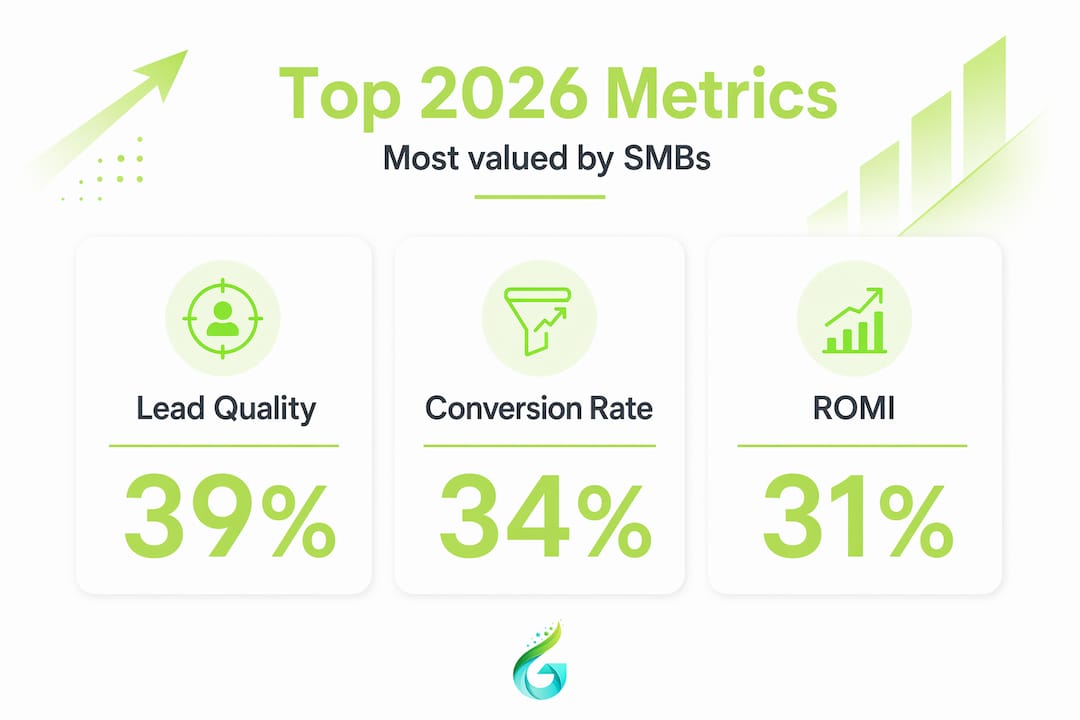
Lead quality ranks first at 39.4% of marketers naming it a top KPI, followed by conversion rates at 33.9% and ROMI at 31.1%. This ordering makes commercial sense. Generating a hundred leads is irrelevant if none of them are likely to buy.
Compare that to where social media engagement sits in the rankings. Only 15% of marketers name it a top KPI in 2026, and email open rates drop to 8.4%. Neither figure means you should ignore those channels. It means you should not treat activity on those channels as proof that your marketing is working.
For sustainable growth, a healthy LTV to CAC ratio should be at least 3:1. That means for every pound you spend acquiring a customer, they should return at least three pounds in lifetime value. If your ratio is lower, your growth model will struggle to scale regardless of how impressive your traffic numbers look.
Successful marketers are shifting focus from vanity metrics towards performance-linked KPIs precisely because of this connection. Data-driven campaigns built around these priorities consistently outperform those built around reach and awareness alone.
Setting up tracking that you can actually trust
Choosing the right metrics only works if the data feeding them is reliable. This is where a surprising number of businesses fall down, not because they lack tools, but because their tracking is inconsistent.

UTM parameters are foundational to any trustworthy measurement system. A UTM parameter is a short tag added to the end of a URL that tells your analytics platform exactly where a visitor came from, which campaign brought them, and which specific piece of content or ad they clicked. Without these tags applied consistently across every paid campaign, email, and social post, your attribution data becomes fragmented. You will know that traffic arrived. You will not know what drove it.
The attribution challenge runs deeper than most marketers realise. 47% of marketers struggle with multi-touch attribution, which is the process of assigning credit to multiple touchpoints across a customer’s journey rather than just the last click. A customer might see a Facebook ad, read a blog post, and then convert via a Google search. Single-source attribution gives all the credit to the search. Multi-touch attribution distributes it more accurately.
Here are the practical steps to build a reliable data foundation:
Pro Tip: Create a shared UTM naming document your whole team can access. One person using “Facebook-ads” and another using “fb_paid” for the same campaign will fracture your data permanently.
From tracking to improving: using metrics to optimise campaigns
Tracking metrics is only valuable if it changes what you do next. Marketing metrics turn marketing from a cost centre into a profit driver by linking activities to financial outcomes. But that shift requires more than a dashboard. It requires a habit of interrogating the data regularly and acting on what you find.
The most useful way to think about your metrics is as leading and lagging indicators. Lagging indicators, like revenue generated, tell you what already happened. Leading indicators, like cost per lead or conversion rate by channel, tell you what is likely to happen if current trends continue. Monitoring both gives you the ability to course-correct before a problem appears in your revenue figures.
Real-time data makes this especially powerful for paid campaigns. If your cost per lead on a Google Ads campaign doubles over two weeks, you do not need to wait for a monthly report to act. You can identify the underperforming ad groups, adjust bids, or pause spend on poor-performing placements immediately. Understanding how to build data-driven marketing campaigns is what separates businesses that iterate quickly from those that repeat the same mistakes each quarter.
There is also a leadership dimension that many marketing managers underestimate. Boards and senior leadership prioritise long-term financial strength. When you present metrics that connect marketing activity to revenue contribution and sales pipeline value, you are speaking their language. You are no longer defending a budget. You are presenting an investment case. Marketing-influenced revenue and pipeline contribution are the metrics most valued by C-suite executives, and aligning your reporting to those numbers changes your position in every budget conversation.
The specific benefits of tracking the right metrics include:
My perspective on why most SMBs get this wrong
I have worked with enough small and medium-sized businesses to recognise a pattern. Most of them are not tracking too little. They are tracking too much of the wrong things, and they are doing it reactively rather than by design.
The most common mistake I see is building a dashboard around what the tools offer by default rather than what the business actually needs to know. Google Analytics gives you forty-plus metrics straight away. Most of them are irrelevant to your specific objectives. When business owners or marketing managers open those reports and see declining bounce rates alongside rising session duration alongside flat conversion rates, they freeze. The data appears contradictory because it was never organised around a question.
What changed the outcomes I have seen most dramatically was helping teams define success before they looked at the numbers. Once a business agrees that success this quarter means generating 50 qualified leads at a CAC below £200, the entire tracking exercise becomes a test of one hypothesis. Either you hit it or you do not, and the metrics tell you exactly where the gap is.
I also think the shift from vanity to performance metrics is accelerating, and it will continue to do so as businesses face pressure to justify every pound of marketing spend. The businesses that will win are not those with the most sophisticated analytics stack. They are the ones who have chosen five numbers that matter, built clean tracking around them, and review them consistently enough to actually act on what they find.
The measuring marketing effectiveness conversation has changed. It is no longer about proving that marketing happened. It is about proving that it worked.
How Geo Growth Media helps you track what matters
Choosing the right metrics is one thing. Having the infrastructure, expertise, and ongoing discipline to track them accurately is another challenge entirely. At Geogrowthmedia, we work as an extension of your marketing team, helping you select the KPIs that align with your specific business objectives and building the tracking systems that make them reliable.
Our digital marketing services cover paid social advertising across Meta, TikTok, and LinkedIn, search engine marketing via Google Ads and Performance Max, SEO, and web development. Every campaign we run is built around measurable outcomes from day one. We do not just report on what happened. We use the data to improve what happens next.
If you are ready to move beyond dashboard confusion and start measuring marketing effectiveness in a way that genuinely informs your decisions, explore how we can support your growth at Geogrowthmedia.
FAQ
Why should I track marketing metrics at all?
Tracking marketing metrics shows you which activities are generating leads, conversions, and revenue so you can allocate budget towards what works and stop spending on what does not.
How many marketing metrics should I track?
Limit your focus to 3–5 KPIs per business objective. Tracking more than 30 metrics reduces decision clarity by 38%, making it harder to act on what the data is telling you.
What are the most important marketing KPIs in 2026?
Lead quality, conversion rate, and ROMI are the top three KPIs for marketing teams this year, reflecting a broader shift from activity-based reporting to revenue-focused measurement.
What is the difference between a vanity metric and a performance metric?
A vanity metric, such as social media followers or page views, measures activity without connecting to revenue. A performance metric, such as CAC or ROMI, measures commercial outcomes directly linked to business growth.
How do UTM parameters improve marketing measurement?
UTM parameters tag every campaign link so your analytics platform can attribute traffic, leads, and conversions accurately to the specific campaign, channel, or ad that generated them. Without them, your attribution data is largely guesswork.


.png)