.png)

.svg)



TL;DR:
- Cross-channel marketing involves coordinating messaging and sharing data across various platforms to guide the customer through a unified journey. It differs from multichannel marketing by enabling channels to communicate and inform each other, resulting in a seamless, relevant experience. Implementing it starts with defining goals, building unified customer profiles, and gradually coordinating channels based on customer behavior.
Most marketers know they should be present on multiple platforms. But what is cross-channel marketing, really? It is not simply running a Facebook ad and sending an email newsletter in the same week. True cross-channel marketing means those channels talk to each other, share data, and guide your customer through a joined-up journey. Coordinated messaging across channels creates one connected customer experience rather than a series of disconnected touchpoints. This guide breaks down the definition, the real benefits, how to implement it, and the pitfalls that trip up even experienced teams.
Table of Contents
- Key takeaways
- What cross-channel marketing actually means
- Benefits of cross-channel marketing
- How to implement cross-channel marketing
- Analytics and attribution across channels
- Common challenges and how to address them
- Our take on what actually makes this work
- Ready to build a coordinated marketing strategy?
- FAQ
Key takeaways
| Point | Details |
|---|---|
| Cross-channel is not multichannel | Being present on multiple platforms is not enough. True cross-channel marketing shares data and coordinates messaging between channels. |
| Customer journey continuity matters | Channels must hand off context to each other so customers receive relevant messages at every stage of the buying journey. |
| Attribution is often underestimated | Without multi-touch attribution, you risk optimising individual channels in isolation and missing how they interact. |
| Behavioural triggers beat fixed schedules | Real-time signals should drive your sequencing decisions, not a rigid calendar-based send plan. |
| Start before you are ready | Begin with two or three coordinated channels and build from there. Waiting for perfect data unification means never starting. |
What cross-channel marketing actually means
At its core, cross-channel marketing coordinates messaging and timing across email, social media, SMS, paid search, and your website so that each channel builds on what the others have done. A customer who clicks a Google Ad and lands on your site should receive a follow-up email that references what they browsed, not a generic welcome message that ignores their behaviour entirely.
The confusion usually starts with terminology. Multichannel, cross-channel, and omnichannel are often used interchangeably, but they describe meaningfully different levels of maturity. Understanding the distinction is not just academic. It shapes the technology you need, the team structures that support it, and the results you can realistically expect.
The table below makes the differences concrete:
| Approach | Channel coordination | Data integration | Customer experience |
|---|---|---|---|
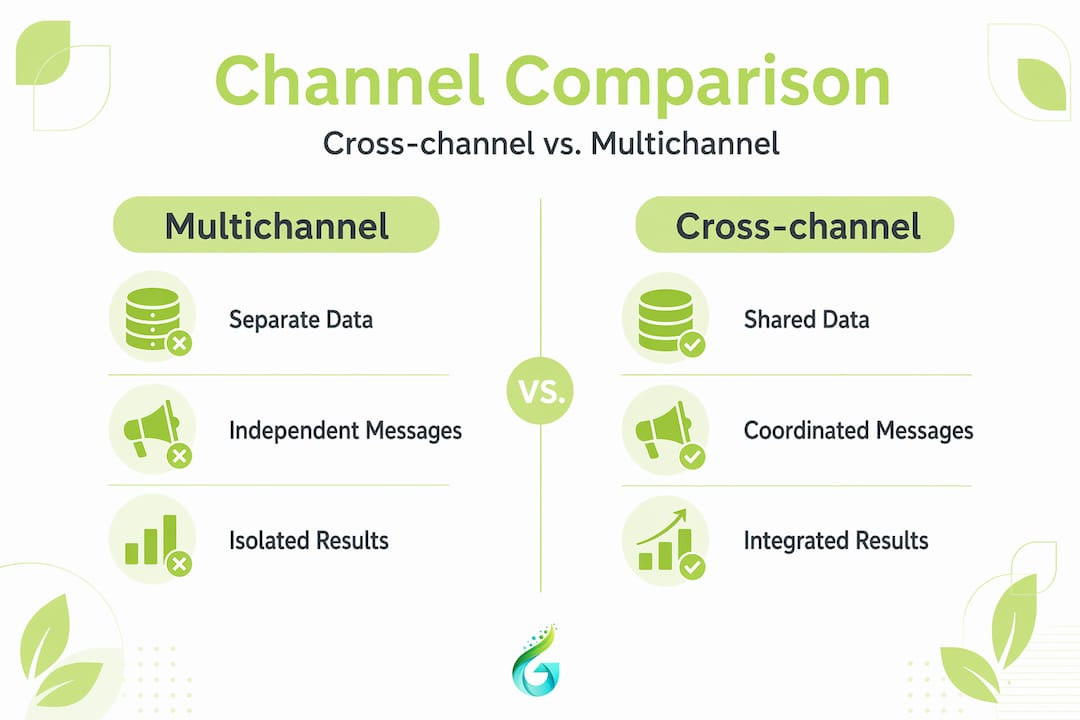
| Multichannel | Channels operate independently | Siloed data per channel | Consistent brand presence, disconnected messaging |
| Cross-channel | Channels share context and inform each other | Partial data sharing and unified profiles | Contextually relevant, joined-up journey |
| Omnichannel | Fully integrated across all touchpoints | Complete data unification in real time | Truly seamless, personalised at every step |
Cross-channel marketing sits in the middle and is, for most businesses, the most practical starting point. It is a step towards omnichannel maturity without requiring full system unification on day one. Think of it as getting your channels to have a conversation with each other, even if that conversation is not yet perfect.
What are marketing channels in this context? They include any owned, paid, or earned touchpoint: email, organic social, paid social (Meta, TikTok, LinkedIn), paid search, display, SMS, push notifications, and your website itself. The channel mix you choose depends on your audience and product, but the principle remains the same across all of them.

Benefits of cross-channel marketing
The commercial case for coordinating your channels is well established. Consistent, relevant communication increases engagement, improves conversion rates, and builds longer-term brand loyalty. But the benefits go deeper than headline metrics.
“Cross-channel marketing solves the common problem of siloed teams and inconsistent messaging by coordinating channels around the customer rather than around internal structures.”
Here is what you gain when you get it right:
- Higher conversion rates. A customer who receives a cart abandonment email, sees a retargeting ad on Instagram, and lands on a personalised page is far more likely to complete the purchase than one who sees a single touchpoint in isolation.
- Reduced wasted spend. When your channels share suppression data, you stop serving paid ads to customers who already converted. That budget goes back into prospecting.
- Improved customer relevance. Messaging that reflects where someone actually is in their journey feels helpful rather than intrusive. Relevance is the difference between a customer who engages and one who unsubscribes.
- Better brand recall. Consistent creative and messaging across channels reinforces your brand without repeating the same ad verbatim. Frequency with variation is more memorable than frequency alone.
- Stronger retention. Customers who experience a coordinated post-purchase journey, onboarding emails, retargeting for complementary products, loyalty programme reminders, are more likely to return.
For performance marketing that drives real ROI, the ability to attribute results across the full journey rather than the last click is where cross-channel marketing pays for itself many times over.
How to implement cross-channel marketing
Implementation is where most teams stall. The concept makes sense; the execution requires discipline. Here is a practical sequence that works whether you are starting from scratch or trying to bring order to an existing fragmented setup.
1. Define your goals and the customer journey you are mapping. Before touching any technology, agree on what you are trying to achieve. Are you reducing cart abandonment? Shortening the B2B sales cycle? Improving post-purchase retention? Your goal shapes which channels you coordinate and in what order.
2. Build unified customer profiles. Fragmented customer data and disparate identifiers are the single biggest barrier to effective cross-channel marketing. You need a shared view of the customer across channels, whether that lives in a CRM, a customer data platform (CDP), or a well-configured marketing automation tool.
3. Map behavioural triggers, not just send schedules. The difference between cross-channel marketing and multichannel marketing often comes down to this step. Context-aware decision engines enable dynamic sequencing based on real-time behaviour rather than fixed calendars. A customer who opens your email but does not click should receive a different next message than one who clicked but did not convert.
4. Set up consistent branding and creative frameworks. Your tone, visual identity, and core message should translate across every channel. This does not mean identical copy everywhere. It means the same customer could move from a TikTok ad to a landing page to a follow-up SMS and feel like they are talking to the same brand throughout.
5. Implement cross-channel suppression and frequency capping. Coordinated frequency capping requires visibility into messaging history across all channels. Without it, you will over-message your most engaged customers and burn goodwill fast. Suppression rules, such as pausing paid retargeting for 48 hours after a purchase email is sent, require your tools to share send history.
6. Choose your technology stack deliberately. You do not need the most expensive platform. You need tools that can share data with each other. Many mid-market brands build data-driven campaigns effectively using a combination of a solid CRM, an email automation platform, and a paid social setup that reads from the same audience lists.
7. Launch, measure, and optimise continuously. Successful campaigns rely on continuous optimisation rather than set-and-forget execution. Build a review cadence into your plan from the start.
Pro Tip: Start with a single high-value journey, such as cart abandonment or post-trial nurture, and coordinate just two or three channels around it. Prove the model, then expand. Trying to coordinate every channel at once before your data infrastructure is ready is a reliable way to create a more complicated mess than you started with.
A practical cross-channel marketing example: an e-commerce brand running a product launch could sequence a teaser email to their list, a paid social campaign targeting lookalike audiences, a retargeting ad for anyone who visited the product page but did not purchase, and a final urgency email to non-converters. Each step is informed by what happened in the previous one. That is trigger-based sequencing in practice.
Analytics and attribution across channels
This is the workstream most teams underestimate. Without multi-touch attribution, you will optimise each channel in isolation and draw the wrong conclusions. Your email team will claim the conversion. Your paid social team will claim the conversion. Both will be right and both will be wrong.
The goal is a unified view of how channels interact across the full customer journey. The table below illustrates a simplified multi-touch attribution model for a five-touchpoint journey:
| Touchpoint | Channel | Attribution model: last click | Attribution model: linear | Attribution model: time decay |
|---|---|---|---|---|
| 1 | Paid search ad | 0% | 20% | 7% |
| 2 | Organic social | 0% | 20% | 10% |
| 3 | Email click | 0% | 20% | 18% |
| 4 | Retargeting ad | 0% | 20% | 28% |
| 5 | Direct visit | 100% | 20% | 37% |
Last-click attribution makes paid search look useless and direct traffic look like a genius. Linear and time-decay models reveal how each channel contributed. For integrated analytics that improve ROI, the model you choose should reflect how your customers actually make decisions, not which model flatters your biggest budget line.
Fragmented data is the enemy here. If your paid social platform, email tool, and CRM are not sharing identifiers, you are measuring three separate stories rather than one joined-up truth. Resolving this, even partially, is worth significant effort.
Common challenges and how to address them
Cross-channel marketing sounds logical in theory. In practice, several obstacles slow teams down or cause campaigns to fall apart mid-execution.
- Data silos. Different teams own different tools and rarely share data in real time. The fix is not always a new platform. Sometimes it is a shared audience list in Google Ads that your email tool also writes to.
- Inconsistent messaging. When paid social, email, and content teams work independently, customers receive conflicting offers, different tones, and mismatched creative. A shared campaign brief and a single creative framework solve most of this.
- Terminology confusion. Teams that think they are doing cross-channel marketing when they are actually running multichannel campaigns will overestimate their integration maturity and underinvest in the data work that makes coordination possible.
- Technology fragmentation. Too many tools that do not talk to each other is a common outcome of growing marketing stacks organically. Audit your stack against your data-sharing requirements before adding anything new.
- Over-messaging. Without shared suppression rules, your most loyal customers receive the most messages. That is backwards. Frequency capping across channels protects both deliverability and customer goodwill.
Pro Tip: Audit your last major campaign and ask one question: did every channel know what the others had already sent to the same customer? If the answer is no, you have a coordination gap, not a creative problem. Fix the data flow before you fix the copy.
For e-commerce brands scaling online, these challenges are particularly acute because the volume of customer touchpoints is high and the margin for over-messaging is low.
Our take on what actually makes this work
I have worked with enough clients on cross-channel campaigns to know where the real problems live. And it is rarely the creative. Most of the time, the issue is that teams are measuring channel performance rather than customer journey performance. They optimise the email open rate. They optimise the cost per click on paid social. But nobody is asking whether those two channels are working together to move the same customer forward.
What I have found is that the businesses who get cross-channel marketing right share one characteristic: they start with the customer journey and work backwards to the channels, not the other way around. They ask “what does this customer need to see next, given what they have already done?” rather than “what is our email schedule this week?”
The other thing worth saying plainly: many marketers confuse multichannel with cross-channel, and that confusion leads to real budget waste. You can be on six channels and still be doing multichannel marketing if those channels share no data and make no reference to each other. Presence is not coordination.
My practical advice is to start small and prove the model. Pick one customer journey, coordinate two channels around it with shared data and suppression rules, and measure the outcome against your baseline. Once you see the lift, the case for investing in better data infrastructure writes itself.
— Geo Growth Media
Ready to build a coordinated marketing strategy?
If this article has clarified what cross-channel marketing can do for your business, the next step is putting the right channels and infrastructure in place to make it happen.

At Geo Growth Media, we work as an extension of your marketing team to build coordinated strategies across paid social media, SEO, and landing page design that are built to work together, not in isolation. Whether you are starting from scratch or trying to bring order to a fragmented setup, we tailor our approach to your goals, sector, and budget. Get in touch to discuss how a joined-up strategy could improve your results.
FAQ
What is cross-channel marketing in simple terms?
Cross-channel marketing means coordinating your messaging across multiple channels, such as email, paid social, and SMS, so that each channel shares context and guides the customer through a connected journey rather than operating independently.
How does cross-channel marketing differ from multichannel marketing?
Multichannel marketing uses multiple platforms independently with no shared data. Cross-channel marketing connects those platforms so that messaging is informed by customer behaviour across all of them, creating a more relevant and joined-up experience.
What are the main benefits of cross-channel marketing?
The key benefits include higher conversion rates, reduced wasted ad spend through shared suppression, improved customer relevance, stronger brand recall, and better retention through coordinated post-purchase journeys.
How do I start implementing a cross-channel marketing strategy?
Begin by mapping one high-value customer journey, build unified customer profiles across your tools, set up behavioural triggers rather than fixed schedules, and coordinate two or three channels with shared suppression rules before scaling further.
Why is attribution important in cross-channel marketing?
Without multi-touch attribution, each channel claims credit for conversions independently, which leads to misleading optimisation decisions. Integrated attribution reveals how channels interact across the full customer journey and where budget is genuinely driving results.


.png)