.png)

.svg)


TL;DR:
- Most e-commerce stores struggle with converting anonymous visitors into contacts they can market to repeatedly. Effective strategies include using quizzes, automation workflows, and multiple channels to build first-party data and optimise lead capture. Consistent measurement, testing, and leveraging personalisation are essential for long-term growth and reducing reliance on paid platforms.
Most e-commerce stores have a traffic problem that isn’t actually a traffic problem. Visitors arrive, browse, and leave without a trace. No email address, no phone number, no way to follow up. Effective e-commerce lead generation strategies fix this by turning anonymous visitors into owned contacts you can market to repeatedly, without paying for the same eyeballs twice. This article covers the practical tools, capture mechanisms, automation workflows, and measurement frameworks you need to build a lead generation engine that actually grows your business.
Table of Contents
- Key takeaways
- Foundations of e-commerce lead generation
- Lead capture: quizzes, popups, and profiling
- Email and SMS automation workflows
- Paid media, SEO, and content for list growth
- Measuring and optimising your lead funnel
- My take on where e-commerce lead gen is heading
- How Geo Growth Media can help you grow
- FAQ
Key takeaways
| Point | Details |
|---|---|
| Build first-party data first | Prioritise email and SMS list building to reduce dependence on paid platforms for long-term growth. |
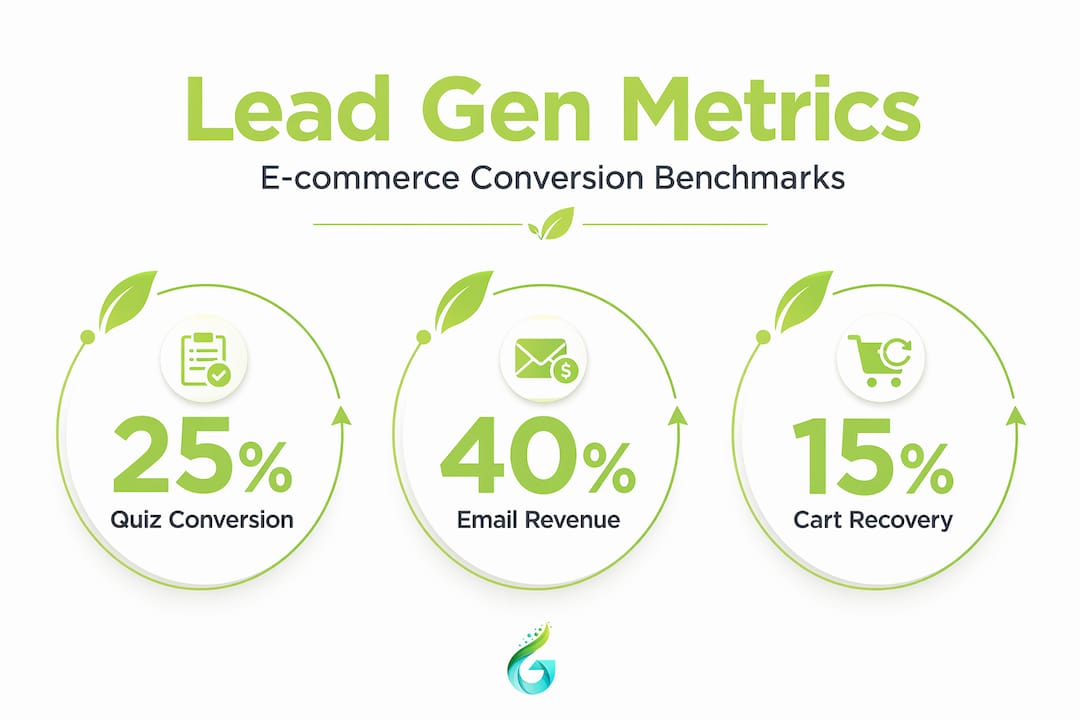
| Use quizzes to capture and convert | Interactive product recommendation quizzes convert at 25–40%, far above the standard e-commerce average. |
| Automate your core email flows | Welcome, abandoned cart, and post-purchase sequences can generate over 40% of total email revenue. |
| Optimise before you expand | Audit existing automation before adding new tools to avoid compounding inefficiencies. |
| Match channels to intent | Combine paid social, SEO, and content marketing to attract, capture, and nurture leads across the funnel. |
Foundations of e-commerce lead generation
Before you launch a single popup or write a single email, you need to know who you are talking to. Defining your buyer personas is not a box-ticking exercise. It shapes every capture mechanism, every message, and every offer you put in front of a potential customer.
Start by mapping your audience segments: what problems do they have, what products solve those problems, and what would make them hand over their email address? Once you have that clarity, you can select the right tools to support your e-commerce customer acquisition methods.
Core tools to set up before anything else:
- Email marketing platform: Klaviyo, Omnisend, or a comparable provider with e-commerce integrations and automation capabilities
- SMS marketing provider: Postscript or Attentive for high-intent, time-sensitive messages
- Analytics platform: Google Analytics 4 plus your store’s native reporting to track lead capture rates and funnel drop-offs
- CRM or customer data platform: To centralise contact data and power segmentation
Privacy compliance is non-negotiable. GDPR in the UK requires explicit consent for marketing communications. Build this into every capture form from day one, not as an afterthought.
| Tool category | Popular options | Key feature |
|---|---|---|
| Email marketing | Klaviyo, Omnisend | E-commerce flows, segmentation |
| SMS marketing | Postscript, Attentive | Automated sequences, compliance |
| Quiz builder | Typeform, Outgrow | Branching logic, CRM integration |
| Analytics | Google Analytics 4 | Funnel tracking, event data |
Lead capture: quizzes, popups, and profiling
Here is where most e-commerce brands leave serious money on the table. Standard capture forms asking for an email address in exchange for a 10% discount have become wallpaper. Visitors ignore them. Interactive mechanisms work differently because they deliver value before asking for anything.
Product recommendation quizzes are the standout tactic. E-commerce stores using quizzes achieve conversion rates of 25 to 40% on completions, nearly ten times the average e-commerce page rate of 2.86%. The reason is straightforward: quizzes reduce decision friction. When a shopper faces a catalogue of 200 products, choice overload causes abandonment. A quiz that asks five to eight targeted questions guides them to the right product and builds confidence in the purchase decision.

Brands implementing quizzes also report a 15 to 30% increase in average order value, with some seeing lifts of up to 45 to 50% depending on quiz complexity. That is not a marginal improvement. That is a structural change to your revenue per visitor.
Best practices for quiz design:
- Keep quizzes to five to eight questions with clear, visual answer options
- Use branching logic so each answer path feels personalised, not generic
- Place the email capture step before showing results, but make it optional with a compelling incentive such as a discount or free guide
- Integrate quiz results directly into your CRM for segmentation
Pro Tip: Gating quiz results behind mandatory signup kills completion rates. Make email capture optional and offer a genuine incentive. You will collect fewer addresses from uninterested browsers and far more from shoppers who are genuinely engaged.
Exit-intent popups still work, but only when they are timed correctly and carry a relevant offer. On mobile, use scroll-based triggers rather than exit-intent, which does not translate well to touchscreens. Timed popups set to appear after 45 to 60 seconds of engagement consistently outperform those that fire within five seconds of page load.
Progressive profiling takes a longer view. Rather than asking for name, email, phone number, and preferences all at once, you collect only an email address initially. Then, through subsequent interactions, you gather preference data, size information, purchase history, and more. This reduces form friction significantly and improves segmentation quality over time, giving you richer customer profiles without scaring people off at the first touchpoint.
Email and SMS automation workflows
Capturing a lead is step one. Converting that lead into a paying customer, and then a repeat buyer, is where automation earns its keep.
There are three foundational sequences every e-commerce store needs before building anything else:
- Welcome series: Send three to five emails over the first seven to ten days. Introduce your brand story, highlight bestsellers, share social proof, and deliver any promised incentive. This sequence sets the tone for the entire relationship.
- Abandoned cart sequence: A three-email abandoned cart sequence can recover 10 to 15% of lost sales. The first email goes out within one hour of abandonment, the second at 24 hours with social proof or a FAQ, and the third at 72 hours with a time-limited incentive if appropriate.
- Post-purchase flow: Confirm the order, set delivery expectations, then follow up with cross-sell recommendations and a review request. Post-purchase sequences reinforce brand loyalty and increase customer lifetime value.
Automated email flows generate over 40% of total email revenue for well-configured stores. That is a significant share of revenue running on autopilot.
Pro Tip: Use AI-driven send-time optimisation available in platforms like Klaviyo to deliver emails when individual subscribers are most likely to open them. Combined with dynamic product recommendation blocks that pull from browsing and purchase history, this alone can lift click-through rates by 20 to 30% without changing a single word of copy.
Segmentation is what separates average automation from genuinely effective automation. Split your list by purchase frequency, product category interest, quiz responses, and engagement level. A lapsed customer who bought once 18 months ago needs a completely different message than a loyal buyer who purchases monthly. Sending the same email to both is a missed opportunity at best, and an unsubscribe at worst.
SMS works best for time-sensitive messages: flash sales, back-in-stock alerts, and abandoned cart reminders. Keep messages short, include a clear link, and never send more than two to three SMS messages per week to avoid opt-outs.
Paid media, SEO, and content for list growth
Building your list through organic and paid channels simultaneously is how you scale without becoming dependent on any single source. Building an owned audience through first-party data collection reduces your reliance on paid platforms over time, which is the only truly sustainable position to be in.
Paid social lead generation:
- Run lead generation campaigns on Meta using instant forms or traffic campaigns driving to a dedicated landing page with a strong lead magnet
- TikTok lead gen ads work particularly well for younger demographics and visually driven product categories
- Use lookalike audiences built from your existing email list to find high-quality prospects at lower CPCs
- Retarget website visitors who viewed product pages but did not capture with a quiz or discount offer
For SEO, the goal is attracting visitors who are already in a buying mindset. E-commerce SEO best practices include optimising category and product pages for transactional keywords, but the real lead capture opportunity lies in content. Buying guides, product comparison posts, and care instruction articles attract mid-funnel searchers who are not quite ready to buy but are actively researching. These pages convert well when paired with a relevant lead magnet or quiz.
Creator partnerships and social commerce integrations are increasingly effective for native lead capture. A creator promoting your quiz or lead magnet to their audience delivers warm, pre-qualified traffic that converts at a higher rate than cold paid traffic. The key is choosing creators whose audience genuinely overlaps with your buyer personas, not just those with the largest follower counts.
You can find paid ads strategy guidance to help structure campaigns that support both immediate lead capture and longer-term list growth.
Measuring and optimising your lead funnel
You cannot improve what you do not measure. These are the metrics that matter most for e-commerce lead generation strategies:
| Metric | What to track | Target benchmark |
|---|---|---|
| Lead capture rate | Percentage of visitors who opt in | 2–5% site-wide |
| Quiz completion rate | Percentage who finish the quiz | 60–80% |
| Abandoned cart recovery | Revenue recovered from sequences | 10–15% of abandoned carts |
| Email open rate | Engagement with automated flows | 35–50% for welcome series |
| List growth rate | Net new subscribers per month | Positive month-on-month |
A/B testing should be continuous, not occasional. Test quiz question sets and branching logic to improve recommendation accuracy. Test subject lines, send times, and CTA copy in your email sequences. Test popup timing, offer type, and design on your capture forms. Small, consistent improvements compound quickly.
Pro Tip: Audit and optimise your existing automated flows before adding new ones. Fix timing gaps, update personalisation tokens, and refresh product recommendation blocks in your abandoned cart and welcome sequences. Most stores have leaky pipes in their existing automation that are worth far more to fix than building new sequences from scratch.
The most common mistake is adding complexity before fixing the basics. If your welcome series has a broken product block or your abandoned cart email goes out six hours after abandonment instead of one, no amount of new tooling will compensate. Get the foundations right first.
My take on where e-commerce lead gen is heading
I’ve worked with enough e-commerce brands to know that the ones who win long-term are not the ones with the most sophisticated tech stack. They are the ones who obsess over first-party data quality. The shift away from third-party cookies is not a future problem. It is happening now, and brands that have not built owned audiences are feeling it in their acquisition costs.
What I’ve learned about product recommendation quizzes is that their value goes well beyond the conversion rate lift. The data they generate is genuinely useful. When you integrate quiz data into your CRM, you get preference signals that make every subsequent campaign more relevant. That is the compounding advantage most brands are not talking about.
My honest view on personalisation: most brands confuse it with inserting a first name into a subject line. Real personalisation means sending a different message to a customer who bought your skincare starter kit than to one who bought your premium range. It means your abandoned cart email references the specific product they left behind, not a generic “you forgot something.” That level of specificity is what drives the results that look impressive in case studies.
The brands I see getting this right are not doing anything exotic. They are combining solid foundational flows with disciplined, incremental testing. They are growing their lists through multiple channels rather than relying on one. And they are treating lead quality as more important than lead volume, because e-commerce success depends on owned contacts collected through genuine engagement, not bulk imports from dubious sources.
— Geo Growth Media
How Geo Growth Media can help you grow
If you have read this far, you already know what needs to happen. The question is whether you have the bandwidth to execute it properly.
At Geo Growth Media, we work as an extension of your marketing team to implement the exact strategies covered in this article. Our paid social campaigns are built to lower your customer acquisition costs while growing your email and SMS lists with high-intent prospects. Our SEO services attract organic traffic that is already in a buying mindset. And our landing page design turns that traffic into captured leads. If you are ready to build a lead generation engine that compounds over time, let’s talk.
FAQ
What are the best e-commerce lead generation strategies?
The most effective strategies combine interactive lead capture (such as product recommendation quizzes), automated email and SMS workflows, and multi-channel traffic from paid social and SEO. Prioritising first-party data collection through these channels reduces reliance on paid platforms over time.
How do product recommendation quizzes improve lead capture?
Quizzes reduce decision friction by guiding shoppers through targeted questions, which builds purchase confidence. E-commerce stores using quizzes achieve conversion rates of 25 to 40% on completions, compared to the standard e-commerce average of 2.86%.
How much revenue can abandoned cart emails recover?
A well-structured three-email abandoned cart sequence can recover 10 to 15% of lost sales. Automated email flows as a whole can generate over 40% of total email revenue when properly configured with timing, personalisation, and product recommendations.
What is progressive profiling in e-commerce?
Progressive profiling collects only an email address initially, then gathers additional preference and behavioural data over subsequent interactions. This approach reduces form friction, improves opt-in rates, and builds richer customer profiles for better segmentation over time.
How do I measure e-commerce lead generation performance?
Track lead capture rate (target 2 to 5% site-wide), quiz completion rate (target 60 to 80%), abandoned cart recovery rate, email open rates for automated flows, and net list growth month-on-month. A/B test continuously across capture forms, email sequences, and CTAs to drive incremental improvement.


.png)