.png)

.svg)




Most small businesses start a website project with a rough idea of what they want and a deadline in mind. Then reality hits. Scope creep sets in, timelines stretch, and the final product doesn’t quite match the original vision. Understanding the web development process before you begin isn’t a luxury. It’s the difference between a project that delivers measurable results and one that drains your budget without clear returns. This guide breaks down every stage, from initial planning through to post-launch, so you can engage with developers confidently and set realistic expectations from day one.
Table of Contents
Key takeaways
PointDetailsPlan before you buildSkipping discovery and requirements gathering is the single most common cause of project failure and budget overruns.Design iterates, not finalisesWireframes and prototypes exist to catch problems early. Use them to test ideas before development begins.Testing is ongoing, not a final stepContinuous quality assurance throughout development prevents costly fixes at the end of the project.Timelines are longer than expectedA typical website project spans 8 to 24 weeks depending on complexity. Plan accordingly.Launch is just the beginningPost-launch monitoring, performance optimisation, and content updates are part of the web development life cycle.
The web development process: starting with solid foundations
Before a single line of code is written or a design mockup is opened, the most valuable work you can do happens in a document or a meeting room. The preparation phase, often called discovery or requirements gathering, is where projects are won or lost.
Vague goals like “improve our online presence” don’t give developers or designers anything concrete to work with. You need measurable objectives. Think “increase enquiry form submissions by 30% within six months” or “reduce bounce rate on the product page to under 50%.” These goals shape every decision that follows, from navigation structure to which features get prioritised.
What good preparation looks like
Effective web development project planning covers several areas before work begins:
A practical way to capture all of this is a project brief. It should include your goals, audience, scope, budget range, and a realistic timeline. The more detailed this document, the fewer surprises you’ll encounter later.
DeliverablePurposeProject briefAligns all stakeholders on goals, scope, and constraintsUser personasGuides design and content decisions based on real audience needsFeature prioritisation listPrevents scope creep by distinguishing must-haves from nice-to-havesContent planClarifies ownership and deadlines for all written and visual assets
Pro Tip: Set a formal sign-off process for the project brief before design begins. Changes made after development starts cost significantly more than changes made on paper.
A structured web development lifecycle with clear milestones at each stage reduces risk and keeps costs predictable. Compressing or skipping this phase is the fastest route to rework.
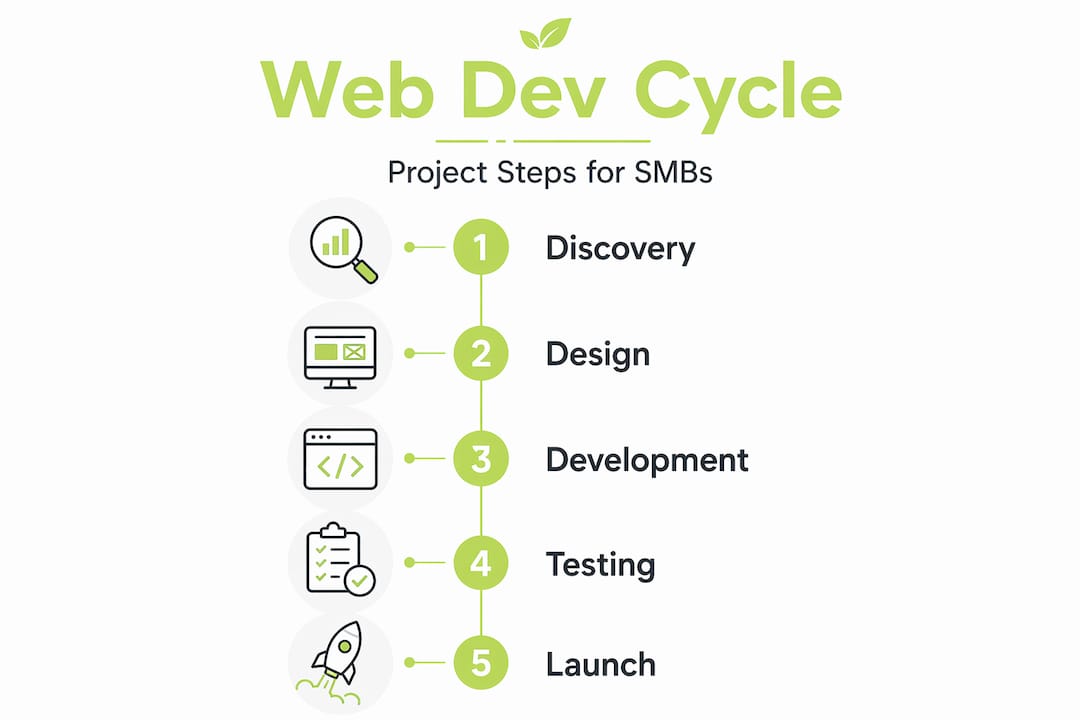
Design phase: UX, UI, and getting it right before it’s built
Once requirements are agreed, the design phase translates your goals and audience insights into a visual and functional blueprint. This is where the web design process becomes tangible, but it’s important to understand the difference between the three main deliverables.

A wireframe is a low-fidelity sketch of page layouts showing structure and content placement without colour or imagery. A mockup adds visual design, branding, and typography to that structure. A prototype is an interactive version that simulates user journeys, allowing you to click through the site before a single line of code exists.
Each stage exists to catch problems early. A wireframe review might reveal that the navigation structure is confusing. A prototype test might show that users can’t find the call-to-action on mobile. Fixing these issues at the design stage costs a fraction of what it costs to fix them after development. Effective website design directly influences how many visitors convert into leads, which makes this phase commercially critical, not just aesthetic.
Common design phase pitfalls
Pro Tip: Ask your designer to present wireframes in a clickable prototype tool before moving to high-fidelity mockups. It’s far easier to restructure a wireframe than to redesign a finished visual.
Mobile-responsive design is non-negotiable in 2026. Over half of web traffic comes from mobile devices, and Google indexes the mobile version of your site first. Any design that doesn’t account for smaller screens from the outset will create problems in both development and SEO.
Development stage: building frontend and backend
With approved designs in hand, development begins. This is where the web development life cycle shifts from planning and visuals into actual code, and it’s where most SMBs have the least visibility into what’s happening.
The development work splits into two distinct areas. Frontend development covers everything a user sees and interacts with: layout, typography, buttons, animations, and forms. Backend development covers the server, database, and business logic that powers the site behind the scenes, such as processing a form submission or retrieving product data.
Modern teams use API-first development to allow frontend and backend teams to work simultaneously rather than sequentially. By agreeing on data contracts early, both sides can build in parallel, which accelerates delivery and reduces integration delays significantly.
How development typically progresses
Agile development methods build the site in shorter cycles rather than one long sequential build. This means you can review working features incrementally, provide feedback earlier, and reduce the risk of a major mismatch at the end.
Pro Tip: Request access to the staging environment early in development. Regular reviews of work-in-progress catch misalignments before they become expensive fixes.
Communication is the most underrated factor in this phase. Weekly check-ins, shared project management tools, and a clear escalation process for decisions keep projects on track. A well-aligned client is a developer’s best asset.
Testing, quality assurance, and launch
Testing is not a final checkbox. Continuous testing throughout development is what separates projects that launch smoothly from those that go live with broken forms, slow load times, or accessibility failures. Agile teams test features as they’re built, not only when the full site is assembled.
Before launch, a thorough quality assurance process should cover:
Test typeWhat it checksFunctionalLinks, forms, and interactive features across browsersPerformancePage speed and Core Web Vitals complianceAccessibilityWCAG compliance and screen reader compatibilitySecurityInput validation, SSL, and data protection measuresContentAccuracy, SEO metadata, and image optimisation
The launch itself involves DNS configuration, hosting migration if applicable, and choosing a low-traffic window to minimise disruption. Always have a rollback plan. If something goes wrong post-launch, you need to be able to revert quickly.
One detail worth knowing: Core Web Vitals improvements take up to four weeks to reflect in Google’s SEO reports due to the 28-day rolling data window. Don’t panic if rankings don’t shift immediately after a performance fix. Understanding technical SEO signals like this helps you interpret post-launch data accurately.
Pro Tip: Schedule your launch for a Tuesday or Wednesday morning. You’ll have a full working week ahead to monitor performance and address any issues that surface.
My honest take on the web development process
I’ve worked alongside dozens of small businesses going through website projects, and the pattern is almost always the same. The ones who struggle are the ones who treat discovery as a formality and rush into design. The ones who succeed are the ones who invest real time in the planning phase, even when it feels like nothing visible is being produced.
The most expensive mistake I see is scope creep caused by undefined requirements. A client adds a feature mid-development, then another, and suddenly the timeline doubles and the budget is exhausted before the site is live. The fix is simple but requires discipline: agree on scope, document it, and treat any additions as formal change requests with cost and timeline implications.
I’ve also seen businesses hand over a brief and then disappear, expecting to be presented with a finished site. That never ends well. The best projects I’ve been part of involved clients who reviewed work regularly, gave clear feedback, and understood that their input was part of the process, not a disruption to it.
Building a website that drives genuine business growth requires alignment between your commercial goals and every technical and design decision. That alignment doesn’t happen by accident. It happens because someone asked the right questions at the start and kept asking them throughout.
Launch day is not the finish line. It’s the starting point for ongoing optimisation, content updates, and performance monitoring. The businesses that treat their website as a living asset rather than a completed project are the ones that see compounding returns over time.
How Geo Growth Media supports your web project
If reading through this process has made you realise how much there is to coordinate, you’re not alone. Most small businesses don’t have the internal capacity to manage discovery, design, development, testing, and launch simultaneously while running their core operations.
At Geo Growth Media, we act as an extension of your team across every stage of the web development process. From initial requirements gathering and project planning through to design, build, and post-launch performance monitoring, our team brings structured methodology and hands-on experience to each project. Our website development services are built around your commercial goals, not just deliverables. We also offer dedicated website design expertise to make sure your site converts visitors, not just attracts them. If you’re planning a new build or a significant redesign, speak to us before you brief anyone. The conversations we have at the planning stage consistently save clients time, money, and frustration down the line.
FAQ
How long does the web development process take?
Typical web projects take 8 to 24 weeks depending on complexity. Simpler sites or MVPs can be completed in as little as 2 to 8 weeks when scope is tightly defined.
What is the most important stage of web development?
Discovery and planning is the most critical stage. Skipping this phase is the leading cause of scope creep, budget overruns, and misaligned outcomes.
What are Core Web Vitals and why do they matter?
Core Web Vitals are Google’s performance benchmarks covering load speed, interactivity, and visual stability. Passing them supports better search rankings and lower bounce rates.
What is agile web development?
Agile development builds a website in short iterative cycles rather than one sequential process. It allows for regular feedback, faster problem-solving, and better alignment between client expectations and the final product.
When should I start thinking about SEO during a web project?
SEO considerations should begin in the planning phase, not after launch. Site structure, URL architecture, page speed, and metadata all need to be built in from the start to avoid costly retrofitting later.


.png)