.png)

.svg)


TL;DR:
- Rapid growth can lead to cash flow crises, quality issues, and burnout if not managed sustainably. The sustainable growth rate (SGR), based on return on equity and retention, guides how fast a business can expand without undue risk. Achieving lasting growth requires aligning operational capacity, profitability, and social responsibility to construct a resilient, scalable business foundation.
Rapid growth can destroy a business just as effectively as no growth at all. Many business owners discover this the hard way when a surge in sales triggers a cash flow crisis, quality collapses, or the team burns out trying to keep pace. Understanding what is sustainable growth, and applying it deliberately, is what separates businesses that scale successfully from those that implode under their own momentum. This article breaks down the financial mechanics, operational realities, and strategic mindset behind genuine, lasting growth.
Table of Contents
- Key takeaways
- What is sustainable growth, and how is it measured financially?
- Operational readiness: the part most plans ignore
- Balancing growth with profitability
- Sustainable growth beyond the balance sheet
- How to achieve sustainable growth in practice
- My perspective on sustainable growth
- Grow with a strategy that lasts
- FAQ
Key takeaways
| Point | Details |
|---|---|
| SGR is a financial ceiling | Your sustainable growth rate tells you how fast you can grow without new equity or increased debt. |
| Operations must scale with revenue | Growing sales faster than your systems and team can handle creates quality failures and cash shortages. |
| Growth and profitability work together | Chasing revenue without protecting margins weakens your business, even when top-line numbers look strong. |
| Sustainability goes beyond the environment | True sustainable growth covers financial health, operational stability, and social responsibility simultaneously. |
| Retention compounds growth | Keeping existing customers reduces acquisition costs and builds more durable revenue than constant new customer chasing. |
What is sustainable growth, and how is it measured financially?
The sustainable growth rate, or SGR, gives you a precise answer to a question most business owners never think to ask: how fast can we actually grow? The SGR is the maximum annual rate a company can grow without issuing new equity or increasing its financial leverage. It is a number grounded in your own financial performance, not ambition or market opportunity.
The formula is straightforward. SGR = Return on Equity (ROE) multiplied by the retention ratio. Your ROE measures how efficiently the business generates profit from shareholders’ equity. The retention ratio is simply the proportion of profit you keep in the business rather than paying out as dividends. If your ROE is 15% and you retain 60% of earnings, your SGR is 9%. That is the rate at which your business can grow while remaining financially self-sufficient.
SGR versus internal growth rate
It is worth distinguishing the SGR from the internal growth rate (IGR). The SGR links return on equity with retention policy to estimate growth funded internally without changing your leverage position. The IGR, by contrast, uses return on assets and assumes no external financing whatsoever. The SGR is the more practical figure for most businesses because it accounts for the realistic use of existing debt capacity.
| Scenario | ROE | Retention ratio | SGR |
|---|---|---|---|
| Conservative payout | 12% | 50% | 6% |
| Moderate reinvestment | 15% | 60% | 9% |
| Aggressive reinvestment | 20% | 80% | 16% |
| High dividend payout | 18% | 30% | 5.4% |
Growing above your SGR is not impossible, but it requires new equity or additional debt. Both carry risk and cost. The SGR is a ceiling, not a target, and businesses that treat it as a diagnostic tool avoid the cash flow crises that catch fast-growing companies off guard.
Pro Tip: Run your SGR calculation quarterly, not just annually. If your retention ratio drops because profits thin out, your safe growth ceiling falls with it. Catching that early gives you time to adjust before the business is already overstretched.
Operational readiness: the part most plans ignore
Financial capacity is only half the picture. A business can be well-capitalised and still collapse operationally if it scales faster than its systems, people, and processes can absorb. This is where the importance of sustainable growth becomes viscerally clear.
Rapid growth can cause a growth-induced cash flow crisis when working capital needs outpace revenue. Sales grow 50%, but inventory and receivables grow 70%, leaving you technically profitable on paper and genuinely short of cash in practice. This is not a theoretical risk. It is one of the most common reasons operationally sound businesses hit serious trouble.
The operational pillars of sustainable growth include:
- Workforce scaling: Hire in response to confirmed, sustained demand rather than projected demand. One well-trained person handling increased volume beats three rushed hires creating quality problems.
- Scalable systems: Invest in processes and technology that handle two or three times your current volume without proportional cost increases. Manual workarounds that work at your current size become bottlenecks at the next level.
- Quality control: Growth pressure is the most common trigger for quality deterioration. Build explicit quality checkpoints into your operations before you scale, not after problems emerge.
- Cash flow management: Model your working capital requirements at each growth stage. Know exactly how much cash a 20% revenue increase actually demands before you pursue it.
- Phased scaling: Grow in stages with defined review points. Each phase should prove the model before committing resources to the next.
Pro Tip: Before launching a growth push, stress-test your operations at 1.5x your current volume using your existing team and systems. The gaps you find are the things that will break first when real growth arrives.
Balancing growth with profitability
There is a persistent myth that growth and profitability are in tension, that you have to sacrifice one for the other. The reality is more useful. Growth and profitability are complementary, and stability is a competitive advantage rather than a constraint.

The danger lies in treating revenue growth as the primary success metric. If operational costs rise 70% while sales rise 50%, the underlying financial position weakens despite the impressive top-line number. Profit margins, customer acquisition cost, and customer lifetime value tell you far more about the health of your growth than revenue alone.
Here is a practical sequence for balancing the two:
- Establish your baseline margins. Know your gross and net margins before you grow. Growth should protect or improve them, not erode them.
- Set a profitability floor. Decide the minimum margin you will accept during a growth phase and treat it as non-negotiable.
- Track acquisition cost against lifetime value. If you are spending more to acquire customers than they return over their lifetime, scaling that acquisition model accelerates losses.
- Adopt a lean mindset. Data-driven strategies monitoring margins and customer lifetime value consistently outperform those chasing volume. Reduce waste before you scale it.
- Review unit economics at each growth stage. What works at £500k revenue often breaks at £2m. Build in formal reviews rather than assuming the model holds.
The businesses that achieve durable scale are almost always the ones that treat profitability as a growth input, not a growth obstacle.
Sustainable growth beyond the balance sheet
The sustainable growth definition most finance textbooks offer is purely quantitative. But the concept has a broader dimension that is increasingly relevant for business owners operating in 2026.
The United Nations defines sustainable development as meeting present needs without compromising the ability of future generations to meet theirs, integrating economic, environmental, and social goals. For business, this translates into a straightforward question: is your growth model one that can continue, or does it consume resources, relationships, and goodwill faster than it creates them?
| Dimension | Narrow view | Broader sustainable view |
|---|---|---|
| Financial | Revenue and profit growth | Profitable growth within financial capacity |
| Operational | Headcount and output | Scalable systems with quality preservation |
| Environmental | Compliance with regulations | Reducing waste and energy use as cost levers |
| Social | Employee headcount | Staff wellbeing, fair pay, community impact |
The good news is that sustainability practices provide practical benefits through cost reduction and resilience, not just reputational value. Reducing energy consumption cuts overhead. Retaining staff reduces recruitment costs. Maintaining supplier relationships reduces supply chain risk. These are not soft metrics. They feed directly into the financial sustainability of the business.
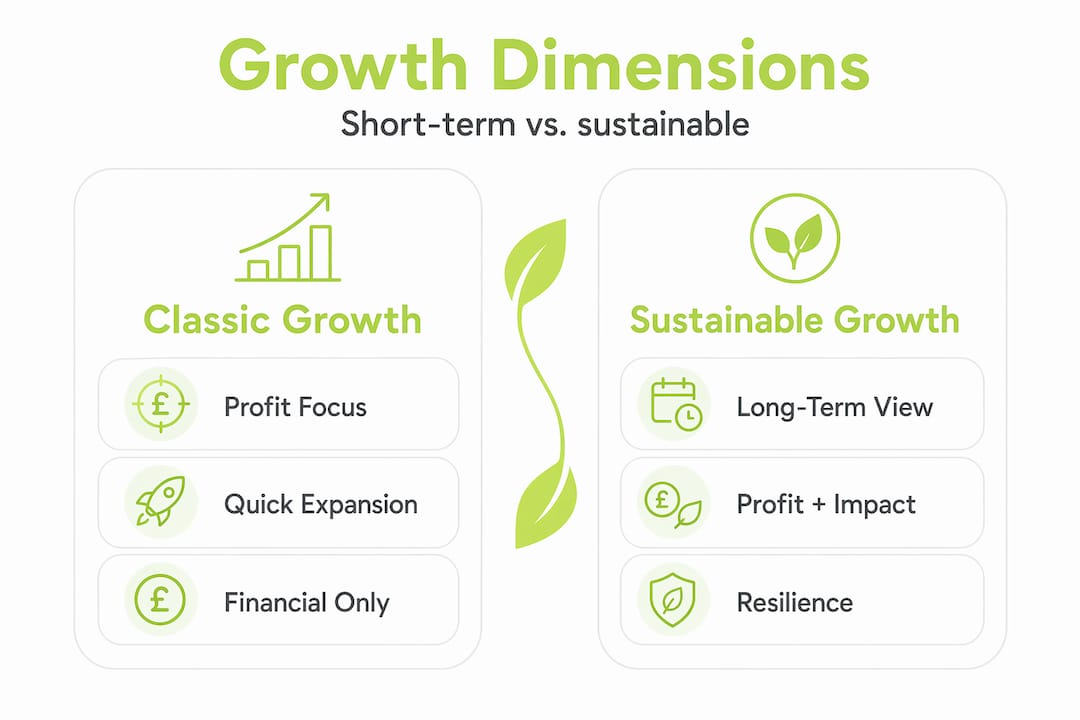
The UN’s ‘beyond GDP’ dashboard measuring well-being, equity, and sustainability alongside economic output reflects a global shift in how progress is assessed. Forward-thinking businesses are applying the same logic internally, tracking indicators beyond revenue to get a genuine picture of organisational health.
How to achieve sustainable growth in practice
Knowing the theory is one thing. Applying it inside a real business with competing priorities is another. These are the practical steps that translate sustainable growth principles into daily decision-making.
- Use your SGR as a planning anchor. Before setting annual growth targets, calculate your SGR. If your target exceeds it, identify explicitly how you will finance the gap and what risk that creates.
- Build a rolling cash flow model. Map cash requirements at your current growth trajectory and at 1.5x. Know your liquidity position at each stage before you commit to growth spending.
- Invest in systems before you need them. The time to upgrade your CRM, fulfilment process, or reporting infrastructure is before growth exposes their limits, not after.
- Prioritise customer retention alongside acquisition. Retention-driven growth compounds benefits through lower acquisition costs, better referrals, and more durable revenue streams. A 5% improvement in retention often has more financial impact than a 20% increase in new customer acquisition.
- Hire deliberately. Base hiring decisions on confirmed workload, not projected growth. Premature headcount expansion is one of the fastest ways to compress margins during a growth phase.
- Monitor the right indicators. Revenue is a lagging indicator. Watch gross margin, debtor days, stock turnover, and customer satisfaction scores. These tell you where the business is heading before the revenue line reflects it.
You can explore scalable marketing approaches that align with these principles if you want to apply the same thinking to your marketing investment.
My perspective on sustainable growth
I have worked with businesses at very different stages, and the pattern I see most consistently is this: the companies that struggle are rarely the ones that grew too slowly. They are the ones that grew faster than their foundations could support.
What strikes me is how often “growth” gets treated as a strategy in itself. It is not. Growth is an outcome. The strategy is the set of decisions about pricing, hiring, systems, customer selection, and financial discipline that either support durable expansion or undermine it. I have seen businesses with genuinely impressive revenue numbers that were quietly becoming more fragile with every new client they added, because the unit economics were wrong and nobody was watching.
The mindset shift I find most useful is treating your current operational and financial capacity as the real constraint, not the market. Markets are usually willing to give you more business than you can handle well. The question is whether you can handle it well. If the answer is not yet, that is not a reason to slow ambition. It is a reason to build the foundations first.
Sustainable growth is not the cautious, slow alternative to real growth. It is the only kind of growth that actually compounds over time. Everything else is borrowing from the future.
— Geo
Grow with a strategy that lasts
If this article has clarified what sustainable growth means for your business, the next step is making sure your marketing investment reflects the same discipline.
At Geogrowthmedia, we work as an extension of your in-house team, building digital marketing strategies that are calibrated to your financial capacity, operational stage, and growth targets. Whether that means long-term organic growth through SEO, paid social campaigns on Meta or LinkedIn, or performance-led Google Ads, every recommendation we make is tied to measurable outcomes. We do not recommend channels or budgets that exceed what your business can absorb and convert profitably. That is what growth-focused marketing actually looks like in practice.
FAQ
What is the sustainable growth rate formula?
The sustainable growth rate (SGR) is calculated as ROE multiplied by the retention ratio. For example, a business with 15% ROE and a 60% retention ratio has an SGR of 9%, meaning it can grow at that rate without new equity or additional debt.
Why does sustainable growth matter for business owners?
Sustainable growth ensures that revenue expansion does not outpace financial capacity or operational capability. Businesses that grow beyond their means often face cash flow crises, quality failures, and margin erosion, even when top-line numbers look strong.
What are the main benefits of sustainable growth?
The core benefits include financial stability, preserved profit margins, lower operational risk, and the ability to compound growth over time. Retention-focused growth also reduces customer acquisition costs and builds more durable revenue streams.
How does sustainable growth differ from rapid growth?
Rapid growth prioritises speed of expansion, often requiring external financing and stretching operations. Sustainable growth aligns expansion with existing financial capacity, operational readiness, and profitability targets, reducing the risk of a growth-induced cash flow crisis.
Does sustainable growth include environmental responsibility?
Yes. While the financial definition focuses on SGR and capital efficiency, the broader sustainable growth definition incorporates environmental and social dimensions. Practices like energy efficiency and staff retention reduce costs and build long-term resilience, making them financially relevant, not just ethical choices.


.png)