.png)

.svg)




Slow-loading websites cost retailers £2.6 billion in lost sales every single year, yet many small e-commerce brands still treat design as a cosmetic concern rather than a commercial one. The truth is, your website is your most powerful sales tool, and every pixel, page load, and navigation choice either earns or loses you revenue. This guide breaks down exactly how website design shapes user behaviour, brand trust, and conversion rates, and gives you a practical framework to start making improvements that compound over time.
Table of Contents
- The business case for prioritising website design
- How design impacts user behaviour and brand trust
- Speed, navigation, and sales: the hidden ROI factors
- Design frameworks for SME e-commerce: practical steps
- Take the next step: maximise your e-commerce growth
- Frequently asked questions
Key Takeaways
| Point | Details |
|---|---|
| Prioritise design for growth | A well-designed website can deliver up to 40% more sales for e-commerce brands. |
| Speed equals profit | Even a one-second delay reduces conversions, costing real revenue. |
| Trust drives sales | Professional website design sharply boosts credibility and customer trust. |
| Small steps, big gains | Auditing and updating design quickly leads to measurable improvements. |
The business case for prioritising website design
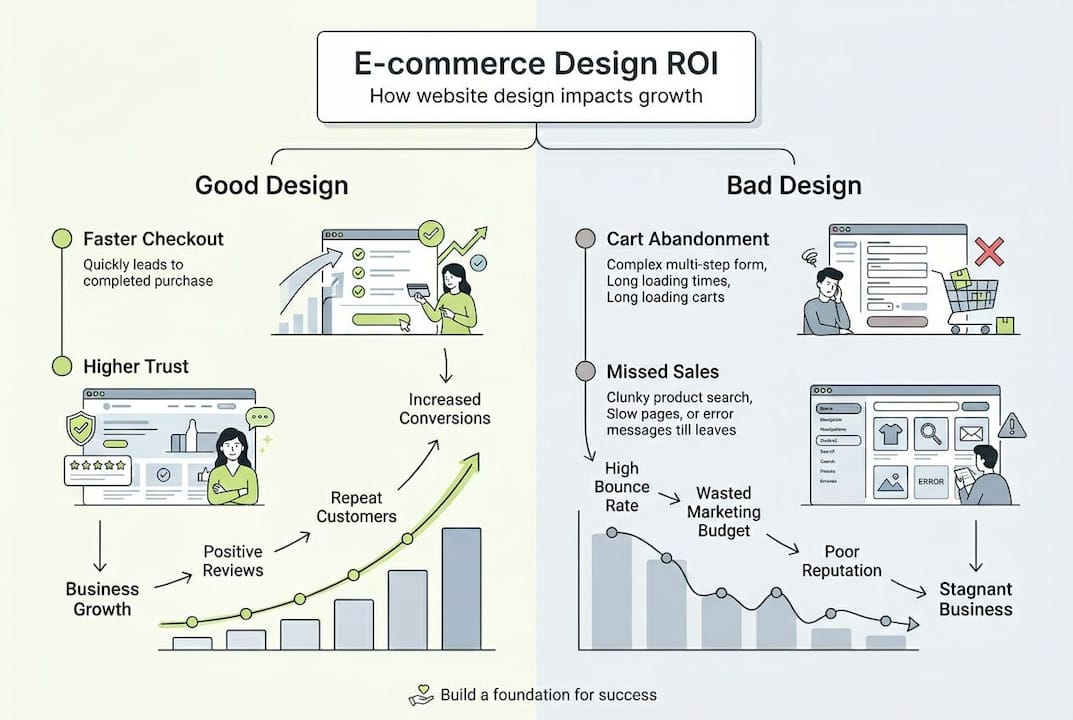
If you have ever wondered whether investing in website design is truly worth it, the data settles the argument quickly. Well-designed e-commerce sites can boost sales by 30 to 40% compared to poorly designed equivalents, simply through better navigation, clearer product presentation, and a smoother checkout process. That is not a marginal gain. That is the difference between a business that scales and one that stagnates.
Conversion rates tell a similar story. The average e-commerce conversion rate sits between 1.81% and 3%, which means the vast majority of your visitors leave without buying. Targeted UX and design improvements can lift that figure by 8 to 15 percentage points, which on any meaningful traffic volume translates directly into significant additional revenue. Understanding website design and business success as interconnected, rather than separate disciplines, is the first mental shift every e-commerce brand needs to make.
| Design quality | Avg. conversion rate | Potential sales uplift |
|---|---|---|
| Poor design | Below 1.81% | Baseline |
| Average design | 1.81% to 3% | Up to 30% |
| Optimised design | 3% and above | 30 to 40% |
Key insight: A 1% improvement in conversion rate on a site generating 10,000 monthly visitors at a £50 average order value is worth £5,000 in additional monthly revenue. Design is not a cost. It is an investment with a measurable return.
The compounding effect of good design is also worth noting. Better UX reduces cart abandonment, increases repeat purchases, and improves your paid advertising efficiency because you are sending traffic to pages that actually convert.
How design impacts user behaviour and brand trust
Customers make a subconscious judgement about your brand within the first few seconds of landing on your site. That judgement is based almost entirely on visual quality, layout consistency, and how quickly they can find what they need. A cluttered homepage, inconsistent typography, or a mobile experience that forces users to pinch and zoom signals one thing: this brand does not take its customers seriously.

The numbers back this up. Professionally designed websites report 53% higher business success rates compared to those without professional design input. That gap exists because design quality directly influences whether a visitor trusts you enough to hand over their payment details. Trust is not built through copy alone. It is built through every visual and structural decision on your site.
Here are the design elements that most directly shape user behaviour and trust:
- Mobile responsiveness: Over half of e-commerce traffic now comes from mobile devices. A site that does not adapt fluidly to smaller screens loses those visitors almost immediately.
- Clear navigation: Users should be able to find any product category within two clicks. Confusing menus increase bounce rates and reduce time on site.
- Consistent visual identity: Fonts, colours, and imagery should feel cohesive across every page. Inconsistency creates doubt.
- Accessible design: Contrast ratios, readable font sizes, and logical page structure make your site usable for a wider audience and improve SEO simultaneously.
- Social proof placement: Reviews, trust badges, and testimonials positioned near conversion points reduce purchase hesitation.
Understanding how website design drives lead generation goes hand in hand with understanding trust. When visitors feel confident in your brand, they do not just buy once. They return, they refer others, and they engage with your marketing. If you are running digital marketing for e-commerce brands and sending paid traffic to a site that lacks trust signals, you are essentially pouring budget into a leaking bucket.
Speed, navigation, and sales: the hidden ROI factors
Site speed is the design element most brands underestimate until they look at their analytics. A one-second loading delay reduces conversions by 7%, and that effect compounds with every additional second. A site that takes four seconds to load on mobile can lose more than a quarter of its potential conversions before a single product has been viewed.
Navigation is equally critical but often overlooked in favour of visual redesigns. A beautifully designed site with a confusing menu structure will still underperform. The goal is to remove friction at every stage of the customer journey, from landing page to checkout confirmation.
| Factor | Fast and clear UX | Slow and confusing UX |
|---|---|---|
| Page load time | Under 2 seconds | 4 seconds or more |
| Conversion rate impact | Positive, up to 15% lift | Up to 25% reduction |
| Bounce rate | Lower, more engaged users | Higher, fewer completions |
| Cart abandonment | Reduced | Significantly increased |
| Repeat purchase rate | Higher | Lower |
Pro Tip: Use Google PageSpeed Insights to audit your site’s current load time on both desktop and mobile. Focus first on compressing images and enabling browser caching. These two changes alone can shave seconds off your load time without a full redesign.
For brands investing in paid traffic, speed and navigation are not optional extras. Every pound spent on ads is wasted if the landing page loads slowly or confuses the visitor. Reviewing landing page design best practices and optimising your landing pages should be a priority before scaling any paid campaigns. The technical and visual elements of design are inseparable from your commercial outcomes.
Design frameworks for SME e-commerce: practical steps
Knowing that design matters is one thing. Knowing where to start when you have limited time and budget is another. The good news is that e-commerce platforms have significantly lowered the barrier to entry. Only 26% of small and 34% of medium OECD businesses currently use e-commerce, which means there is still a real competitive advantage available to brands that invest in their digital presence now.
Here is a practical, step-by-step framework for SMEs looking to prioritise website design:
- Audit your current site. Use tools like Google Analytics, Hotjar, and PageSpeed Insights to identify where users drop off, which pages have high bounce rates, and how fast your site loads on mobile.
- Prioritise quick wins. Fix image compression, improve your homepage headline clarity, and ensure your call-to-action buttons are visible above the fold on all devices.
- Map the customer journey. Walk through your own checkout process as a new customer would. Note every point of friction, confusion, or hesitation and address each one systematically.
- Invest in mobile-first design. If your site was built desktop-first, a mobile audit is non-negotiable. More than half your traffic likely arrives on a phone.
- Test and iterate. Run A/B tests on key pages, particularly product pages and checkout flows. Small changes to button colour, copy, or layout can produce measurable conversion lifts.
- Plan for ongoing optimisation. Design is not a one-time project. Schedule quarterly reviews to assess performance data and make incremental improvements.
Pro Tip: Before commissioning a full redesign, run a heatmap tool like Hotjar for two to four weeks. The data will show you exactly where users click, scroll, and abandon, giving you a precise brief for your designer rather than guessing.
Exploring digital marketing strategies for e-commerce alongside your design improvements will accelerate results. Design and marketing work best when they are aligned, and professional website development ensures that the technical foundation supports your broader growth ambitions rather than limiting them.
Take the next step: maximise your e-commerce growth
You now have the evidence, the frameworks, and the practical steps to start treating website design as the commercial priority it genuinely is. The brands that act on this insight now will build a compounding advantage over competitors who are still treating their website as a digital brochure.
At Geo Growth Media, we work as an extension of your marketing team to build and optimise websites that convert visitors into customers. Our website design services are built around your specific goals, sector, and budget, not generic templates. We combine design expertise with digital marketing for e-commerce brands and SEO consultancy to ensure your site performs across every channel. If you are ready to turn your website into your strongest sales asset, get in touch with our team today for a no-obligation discovery call.
Frequently asked questions
How much can website design lift my e-commerce sales?
Well-executed redesigns can increase online sales by 30 to 40% on average, making design one of the highest-return investments available to e-commerce brands.
Does website speed really affect conversion rates?
Yes. A one-second loading delay reduces conversions by 7%, meaning even modest speed improvements can deliver meaningful revenue gains.
What are the first steps for improving a small e-commerce website?
Audit your site for speed, mobile responsiveness, and navigation clarity first, then address those issues before investing in visual redesign. UX improvements alone can lift conversion rates by 8 to 15%.
Is professional website design worth it for SMEs?
Absolutely. Professionally designed sites report 53% higher business success rates, making professional design one of the most impactful investments a small or medium-sized brand can make.
Recommended
- How landing page design boosts e-commerce conversions 2026
- Why website design drives 53% higher business success
- SEO Strategy Guide 2026: Drive E-Commerce Growth
- Ecommerce SEO | Geo Growth Media
- Payment Gateway Selection Tips for Retail Success - Omnichannel payments at the Point Of Sale | Sensepass


.png)