.png)

.svg)




Many small and medium businesses pour thousands into digital marketing campaigns yet track almost nothing. Without measurement, you cannot identify which channels drive revenue, which waste budget, or how to justify future spending to stakeholders. This article explains why measuring digital marketing results matters for optimising strategies and demonstrating ROI, covering essential metrics, attribution models, privacy challenges, and practical steps tailored for SMB digital marketing managers seeking sustainable growth.
Table of Contents
- The Importance Of Measuring Digital Marketing Outcomes
- Core Digital Marketing Metrics And Models For SMB Measurement
- Addressing Measurement Challenges And Privacy Shifts In 2026
- Practical Steps For SMB Digital Marketers To Measure Results Effectively
- How Geo Growth Media Supports Your Measurement And Optimisation Journey
Key takeaways
| Point | Details |
|---|---|
| Measurement enables optimisation | Tracking results identifies what drives revenue and eliminates wasted spend for better ROI. |
| Essential metrics include ROI, CAC, LTV | These core models help SMBs quantify campaign performance and customer value efficiently. |
| Privacy laws complicate attribution | Regulations reduce data availability, making incrementality testing and holdout groups more reliable. |
| Simple, defensible metrics outperform perfection | Directional insights with position-based attribution guide strategy better than complex, flawed models. |
| Benchmarks set realistic targets | Industry standards like 5:1 ROI for paid search help audit performance and identify improvement areas. |
The importance of measuring digital marketing outcomes
Measuring digital marketing results transforms guesswork into strategic decision-making for small and medium businesses. When you track which campaigns generate revenue, you eliminate inefficient spending and redirect budgets towards high-performing channels. This data-driven approach helps you justify marketing investments to stakeholders with concrete ROI figures rather than vague promises.
Without measurement, SMBs operate blindly, repeating failed tactics whilst missing genuine growth opportunities. You might invest heavily in paid social whilst organic search delivers better returns, or continue expensive partnerships that produce zero conversions. Attribution flaws cause 40% of marketers to struggle with ROI measurement, yet even imperfect tracking builds credibility and guides necessary strategy pivots.
Consider these critical benefits of systematic measurement:
- Identifies revenue-driving channels and content types
- Reduces wasted ad spend by eliminating underperforming campaigns
- Provides evidence to secure larger budgets from leadership
- Enables rapid testing and optimisation of messaging and targeting
- Reveals customer journey patterns that inform better touchpoint design
Pro Tip: Start measuring one core metric consistently rather than attempting comprehensive tracking immediately. A single reliable data point beats ten unreliable ones when making strategic decisions.
Many SMB marketing managers avoid measurement because attribution seems overwhelmingly complex or technically demanding. The reality is that directional insights from simple tracking methods deliver more value than perfect attribution models requiring extensive data infrastructure. Understanding digital marketing ROI basics helps you build measurement confidence without needing advanced analytics expertise.
“The goal is not perfect measurement but defensible insights that guide better decisions. Simple, consistent tracking beats sophisticated models that nobody trusts or acts upon.”
Measurement also accelerates learning cycles. When you track campaign performance weekly rather than quarterly, you spot problems faster and capitalise on opportunities before competitors. This agility becomes particularly valuable in dynamic markets where consumer behaviour and platform algorithms shift constantly.
Core digital marketing metrics and models for SMB measurement
Understanding which metrics matter most helps SMB digital marketers focus limited resources on tracking that drives decisions. The fundamental ROI formula (Revenue minus Cost, divided by Cost) provides a baseline performance indicator, with strong SMB benchmarks typically achieving around 5:1 returns on paid channels. However, relying solely on overall ROI obscures important nuances about customer acquisition efficiency and long-term value.
Customer Acquisition Cost (CAC) measures how much you spend to gain each new customer, calculated by dividing total marketing and sales costs by new customers acquired. This metric reveals whether your acquisition strategy remains sustainable as you scale. Lifetime Value (LTV) estimates the total revenue a customer generates throughout their relationship with your business, helping you determine how much you can afford to spend on acquisition whilst maintaining profitability.

Return on Ad Spend (ROAS) focuses specifically on advertising effectiveness, showing revenue generated per pound spent on ads. Whilst ROI considers all costs, ROAS isolates advertising efficiency, making it particularly useful for optimising paid campaigns across platforms like Meta, Google Ads, or LinkedIn.
| Metric | Formula | SMB Benchmark | Primary Use |
|---|---|---|---|
| ROI | (Revenue - Cost) / Cost | 5:1 paid search | Overall campaign profitability |
| CAC | Total Marketing Cost / New Customers | Varies by sector | Acquisition efficiency |
| LTV | Average Purchase Value × Purchase Frequency × Customer Lifespan | 3x CAC minimum | Long-term value assessment |
| ROAS | Ad Revenue / Ad Spend | 4:1 minimum | Advertising effectiveness |
Attribution models determine how credit for conversions gets distributed across marketing touchpoints. The most common approaches include:
- Last-click attribution assigns full credit to the final touchpoint before conversion
- First-click attribution credits the initial interaction that started the customer journey
- Linear attribution distributes credit equally across all touchpoints
- Time-decay attribution gives more weight to recent interactions
- Position-based attribution credits 40% each to first and last touches, 20% to middle interactions
- GA4 data-driven attribution uses machine learning to assign credit based on actual conversion patterns
For most SMBs, position-based attribution offers the best balance between simplicity and multi-touch insight. It acknowledges that both initial awareness and final conversion moments matter whilst remaining interpretable without advanced analytics expertise. This model suits businesses with typical customer journeys spanning multiple interactions over days or weeks.
Pro Tip: Compare your ROAS against channel-specific benchmarks rather than universal standards. Paid search averages 5:1 ROI, SEO around 22:1, and email marketing 36:1, so context matters when evaluating performance.
Benchmarking your metrics against industry standards helps identify whether underperformance stems from poor execution or unrealistic expectations. If your paid social ROAS sits at 3:1 whilst competitors average 4:1, you have a clear improvement target. Conversely, if you exceed benchmarks, you gain confidence to increase investment in winning channels.
Understanding digital marketing optimisation metrics within your specific sector context prevents wasted effort chasing impossible targets or settling for mediocre results. The marketing manager’s role in SMB strategies increasingly centres on interpreting these metrics to guide resource allocation and tactical pivots.
Addressing measurement challenges and privacy shifts in 2026
Privacy regulations fundamentally changed how digital marketers track and attribute results. Laws like GDPR and evolving cookie policies reduce data availability for traditional multi-touch attribution modelling, leaving many measurement frameworks unreliable. Privacy laws undermine traditional attribution, with 83% of measurements failing due to flawed methodology or incomplete data capture.
Data silos compound these challenges. When your CRM, advertising platforms, website analytics, and email system do not communicate effectively, you cannot build accurate customer journey maps. Information fragmentation creates blind spots where conversions appear to materialise without clear cause, making optimisation decisions feel like educated guesses rather than data-driven strategies.
Short-term bias skews campaign evaluations when measurement windows prove too narrow. A customer might see your ad today but convert three weeks later after researching alternatives and reading reviews. If your attribution window only captures seven days, you undervalue that initial touchpoint and potentially cut effective campaigns prematurely.
Modern approaches address these limitations through incrementality testing and simplified metrics:
- Incrementality testing with holdout groups measures true causal impact by comparing exposed versus unexposed audiences
- Marketing Efficiency Ratio (MER) simplifies tracking by dividing total revenue by total marketing spend
- First-party data collection prioritises owned customer information over third-party tracking
- Server-side tracking reduces reliance on browser cookies and client-side pixels
Incrementality testing with 10% holdout groups and MER targeting 5x returns offer more defensible results in privacy-constrained environments. Rather than attempting to track every touchpoint perfectly, these methods focus on overall marketing effectiveness and controlled experiments that reveal genuine lift.
Pro Tip: Run quarterly incrementality tests on your largest channel by withholding ads from 10% of your target audience. Compare conversion rates between exposed and unexposed groups to measure true incremental impact rather than relying on platform-reported attribution.
Accepting directional rather than perfect measurement balances effort with insight. You do not need to know precisely which touchpoint deserves credit for each conversion. You need reliable indicators showing whether overall marketing performance improves or declines, and which major channels drive disproportionate results. This pragmatic approach reduces analysis paralysis whilst maintaining strategic clarity.
“Perfect attribution died with third-party cookies. Successful marketers now prioritise simple, defensible metrics that guide decisions despite incomplete data. Focus on directional accuracy over precision.”
Understanding digital marketing optimisation challenges helps you anticipate measurement limitations and design tracking strategies that remain robust despite privacy constraints. The goal shifts from comprehensive attribution to reliable performance indicators that survive regulatory changes and platform updates.
Practical steps for SMB digital marketers to measure results effectively
Implementing effective measurement requires systematic setup and disciplined focus on actionable metrics. Start by configuring GA4 properly to gather reliable data across all digital channels. Ensure tracking codes fire correctly on every page, conversion events capture key actions like form submissions and purchases, and cross-domain tracking links your main site with landing pages or booking systems.
Follow these steps to build a defensible measurement framework:
- Set up GA4 with proper event tracking for all conversion types
- Implement position-based attribution as your default model for multi-touch visibility
- Define your core metrics based on business goals (CAC, LTV, ROAS, MER)
- Establish tracking cadences with weekly reviews for paid channels, monthly for organic
- Document baseline performance before testing new strategies
- Create simple dashboards showing trends rather than overwhelming stakeholders with data
Choose position-based attribution for its balance between simplicity and multi-touch insight. This model acknowledges that both initial awareness and final conversion moments influence results whilst remaining interpretable without advanced analytics skills. Prioritise GA4 setup and simple position-based attribution for practical multi-touch tracking that informs decisions.
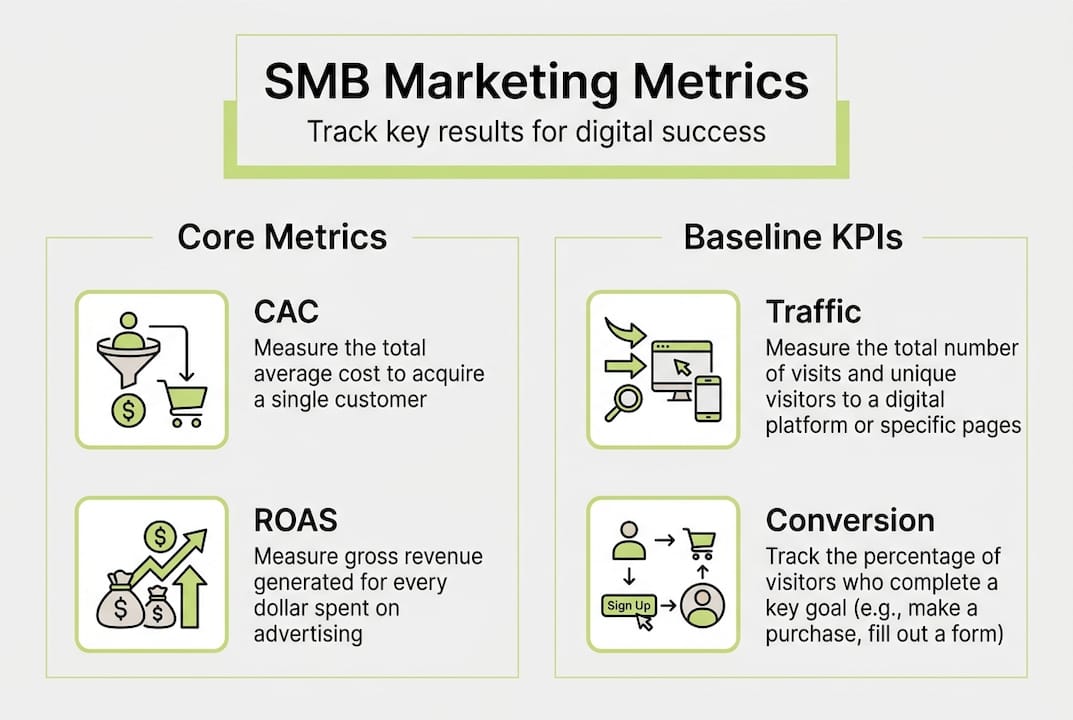
Track CAC, LTV, and ROAS alongside baseline KPIs like traffic, conversion rate, and average order value. These metrics together reveal whether you acquire customers efficiently, whether those customers deliver long-term value, and whether specific advertising investments pay off. Avoid vanity metrics like social media followers or page views that correlate poorly with revenue.
Pro Tip: Calculate your MER weekly by dividing total revenue by total marketing spend. This simple ratio cuts through attribution complexity and reveals whether overall marketing effectiveness improves or declines regardless of which channels get credit.
Use industry benchmarks to audit your performance realistically:
- Compare your CAC against sector averages to identify acquisition inefficiency
- Evaluate ROAS by channel against typical returns for paid search, social, or display
- Assess your LTV to CAC ratio, targeting at least 3:1 for sustainable growth
- Review conversion rates against industry standards for your sector and traffic sources
Focus on defensible, directional insights rather than perfect accuracy. You need confidence that performance trends upward or downward, not precision about which specific touchpoint deserves 23% versus 27% credit. This pragmatic approach enables faster decision-making and reduces analysis paralysis that delays necessary optimisations.
Pivot strategies quickly based on measurement findings to maximise ROI. If paid social delivers 6:1 ROAS whilst paid search struggles at 3:1, shift budget accordingly. When blog content drives high-intent organic traffic with strong conversion rates, increase content production. Speed matters because competitors who act on insights faster capture market share whilst you deliberate.
Triangulate data sources when possible by comparing platform-reported metrics against GA4 and CRM data. Discrepancies reveal tracking gaps or attribution issues requiring attention. If Meta reports 50 conversions but your CRM only shows 30 new customers from that source, investigate whether tracking breaks at checkout or whether Meta overclaims credit.
Document your measurements consistently to build credibility with stakeholders. Monthly reports showing metric trends, channel performance, and optimisation actions taken demonstrate marketing accountability and justify budget requests. Clear documentation also helps you spot seasonal patterns and long-term trends that inform strategic planning.
The marketing manager’s guidance for SMBs emphasises starting simple and expanding measurement sophistication as capabilities grow. Begin with one reliable metric per channel, then add complexity only when additional tracking delivers actionable insights that improve decisions.
How Geo Growth Media supports your measurement and optimisation journey
Building effective measurement frameworks whilst executing campaigns stretches SMB marketing teams thin. Geo Growth Media specialises in delivering measurable results through paid social media services across Meta, TikTok, and LinkedIn, combining creative excellence with rigorous performance tracking. Our approach integrates campaign execution with transparent reporting that shows exactly which investments drive revenue.

Our SEO services boost organic visibility whilst tracking keyword rankings, traffic growth, and conversion impact to demonstrate clear ROI from content and technical optimisation efforts. When you need strategic guidance without full-service execution, our SEO consultancy services help you build internal measurement capabilities and optimisation processes that scale with your business. Partnering with specialists who understand both campaign delivery and performance measurement helps SMBs maximise marketing effectiveness without expanding headcount.
FAQ
How can small businesses measure digital marketing success effectively?
Small businesses should start by tracking one core metric per channel consistently rather than attempting comprehensive attribution immediately. Set up GA4 properly, choose position-based attribution for multi-touch visibility, and calculate your Marketing Efficiency Ratio weekly by dividing total revenue by total marketing spend. Focus on directional trends showing whether performance improves rather than obsessing over perfect attribution precision.
What are the best attribution models for small businesses?
Position-based attribution works best for most SMBs because it credits both initial awareness and final conversion touchpoints whilst remaining simple to interpret. This model assigns 40% credit each to first and last interactions, with 20% distributed across middle touches. Avoid complex data-driven models requiring extensive historical data and analytics expertise that most small teams lack.
How do current privacy laws affect marketing measurement?
Privacy regulations like GDPR reduce data availability for traditional multi-touch attribution by limiting cookie tracking and cross-site data sharing. This makes platform-reported attribution less reliable and creates measurement blind spots. Incrementality testing with holdout groups provides more defensible results by comparing exposed versus unexposed audiences to measure true causal impact despite tracking limitations.
Which key metrics should I focus on to prove marketing ROI?
Prioritise ROI, CAC, LTV, and ROAS as your core metrics for demonstrating marketing value. ROI shows overall profitability, CAC reveals acquisition efficiency, LTV indicates customer value over time, and ROAS measures advertising effectiveness. Compare these against industry benchmarks like 5:1 ROI for paid search to provide context and set realistic improvement targets that stakeholders understand.



.png)