.png)

.svg)


TL;DR:
- Targeted ads ensure small businesses reach only pre-qualified audiences, reducing wasted spend.
- They help SMEs compete with larger brands through precision, improving ROI and customer acquisition.
- Starting with clear audience definitions and continuous data-driven optimization is key to success.
Bigger budgets do not automatically win in digital advertising. A local plumber or a small e-commerce brand selling handmade goods can genuinely outperform a national chain if they put their message in front of exactly the right people. The problem most small and medium-sized businesses face is not a lack of ambition; it is a lack of precision. Broad, untargeted advertising burns through budgets quickly and delivers poor returns. Targeted advertising changes the equation entirely, letting you compete on intelligence rather than sheer spend. In this guide, we will cover what makes targeted ads different, why they matter for your business, and how to get started effectively.
Table of Contents
- What makes targeted ads different?
- How targeted advertising benefits SMEs and local services
- Tangible results: Targeted advertising case studies
- Getting started: Steps to run effective targeted ad campaigns
- A fresh perspective: Targeted ads are a must, not a luxury
- Supercharge your growth with expert targeted advertising support
- Frequently asked questions
Key Takeaways
| Point | Details |
|---|---|
| Precision beats volume | Targeted ads let you reach only the audiences most likely to buy, improving ROI. |
| Level the playing field | Small businesses can compete with larger brands by using smart targeting and tighter budgets. |
| Turn local attention into sales | Hyper-local targeting boosts both foot traffic and in-store revenue for area-based services. |
| Evidence-backed growth | Case studies show revenue and visitor surges when SMEs adopt targeted ad strategies. |
| Start small, scale smart | Begin with test campaigns, and use data to optimise and expand your reach cost-effectively. |
What makes targeted ads different?
After understanding why advertising spend so often falls short for small businesses, it is essential to clarify how targeted ads actually differ in practice.
Targeted ads are promotional messages served only to people who meet specific criteria you define in advance. Rather than broadcasting to everyone on a platform and hoping the right person happens to see it, you build a precise audience profile and your ad appears only to people who match it. This is precise audience reach based on demographics, interests, behaviours, and location, which drastically reduces wasted spend compared to broad advertising.
The four main segmentation methods available to you are:
- Demographics: Age, gender, income, education level, and job title. Useful for products or services aimed at a particular life stage or profession.
- Interests: Hobbies, favourite brands, content consumption habits, and lifestyle preferences gathered from platform activity.
- Behaviours: Purchase history, device usage, travel patterns, and online engagement signals that indicate buying intent.
- Location: Country, city, postcode radius, or even a specific neighbourhood. Vital for local service providers.
Here is a direct comparison to illustrate how these two approaches stack up:
| Factor | Broad advertising | Targeted advertising |
|---|---|---|
| Audience reach | Wide, largely unqualified | Precise, pre-qualified |
| Cost per relevant click | High | Significantly lower |
| Wasted impressions | Very high | Minimal |
| Ability to measure ROI | Difficult | Clear and trackable |
| Budget requirement | Large | Scalable from small |
| Creative relevance | Generic | Personalised to segment |
“Advertising without targeting is like handing out flyers in the wrong postcode. You will spend a lot and reach very few people who actually want what you offer.”
The practical implication for an SME is enormous. Understanding digital marketing and ROI helps you see that precision is not a luxury reserved for large brands. When your budget is £500 per month rather than £50,000, every penny needs to work. Targeted ads make that possible by ensuring your creative lands in front of people who are already predisposed to care about your offer.
How targeted advertising benefits SMEs and local services
Now that we know how targeted ads are defined, let us see why they are so essential for businesses like yours.
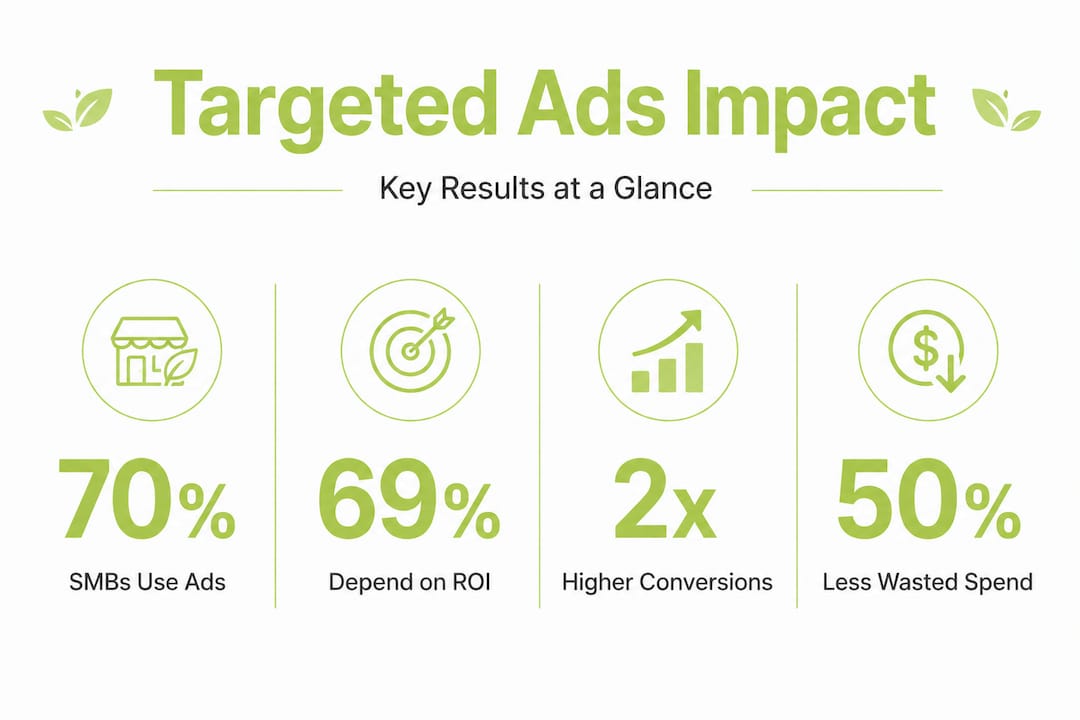
The single most important truth about targeted advertising for smaller brands is this: it levels the playing field. Large competitors may have far greater spend capacity, but they often cannot match the precision and agility of a well-run targeted campaign built around a niche audience. The benefits for small businesses are well documented, with 70% of small and medium-sized businesses investing in targeted digital ads and 69% reporting they could not launch or sustain their business without them.
Those figures are striking. They confirm that targeted advertising has moved well beyond a nice-to-have tactic and into core business infrastructure for growing brands.
| Business goal | Impact with targeted ads |
|---|---|
| Customer acquisition cost | Reduced by focusing only on high-intent audiences |
| Revenue per campaign | Higher due to relevant creative and precise delivery |
| Brand awareness in niche markets | Stronger than broad campaigns for the same spend |
| Repeat purchase rate | Improved through retargeting warm audiences |
Here are the top three business goals that smaller brands consistently achieve through targeted advertising:
- Generate qualified leads quickly. Rather than waiting months for organic SEO to build momentum, targeted paid ads can put your offer in front of ready-to-buy customers within hours of launching a campaign.
- Build a loyal local customer base. Location-based targeting lets service providers attract customers within a specific catchment area, making every campaign highly relevant to the community you serve.
- Scale revenue without proportionally scaling spend. As you gather performance data, you optimise towards your best-performing audience segments. Over time, your cost per acquisition drops as your campaigns improve.
Learning how to boost ROI with digital marketing is closely linked to mastering audience precision. Platforms like Meta and Google reward relevance with lower costs and higher ad placement, meaning a tightly targeted campaign often outperforms a broad one even when the broad campaign has a bigger budget.
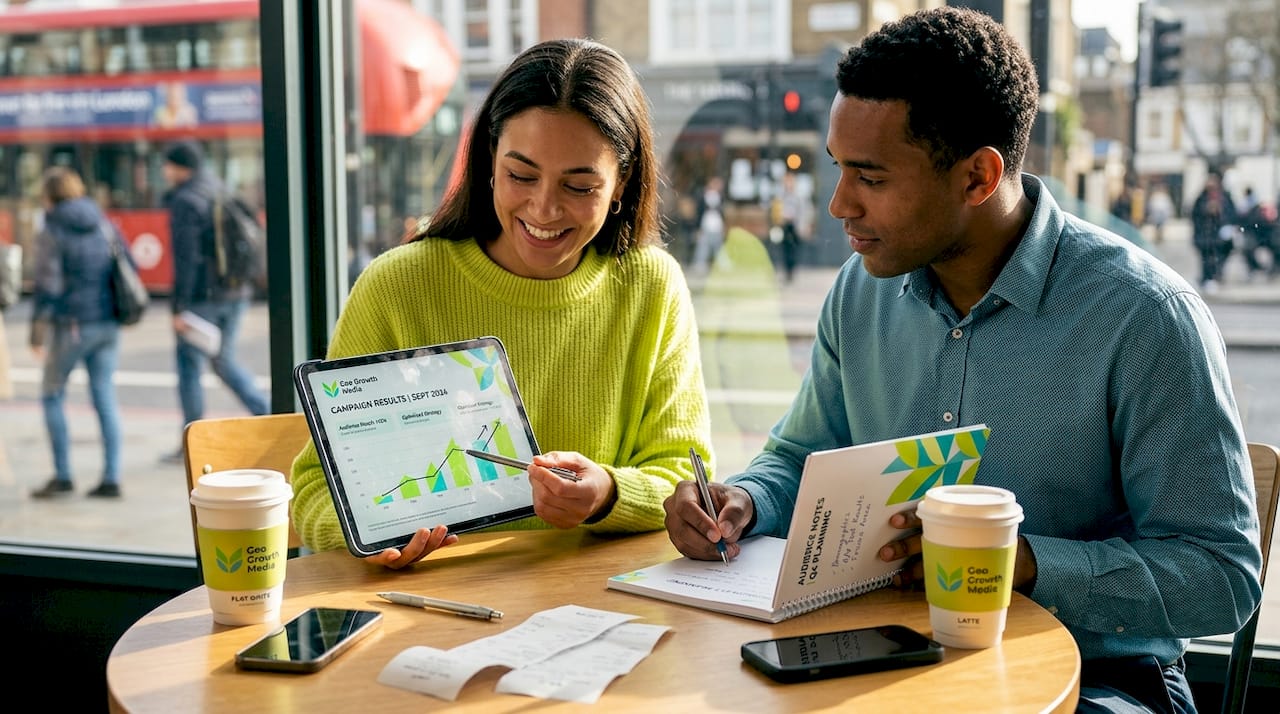
Pro Tip: Do not measure success purely by short-term conversions. Track customer lifetime value (CLV) for each audience segment you target. A customer acquired through a well-targeted Instagram ad may return five or six times, making the original acquisition cost look small in comparison. Understanding CLV shifts your perspective from “did this campaign break even?” to “how much is this audience segment worth over a year?”
When you combine precise targeting with compelling creative through paid social ads for growth, the compounding effect on revenue becomes very real. You are not just running ads; you are building a system that learns which customers are most valuable and continuously improves its ability to find more of them.
Tangible results: Targeted advertising case studies
Understanding the benefits in theory is one thing. Here are real SMEs that experienced dramatic improvements with targeted strategies.
Nothing makes the case for targeted advertising more effectively than specific, measurable outcomes. Two examples stand out clearly.
A local bakery used hyper-local geo-targeting to promote seasonal products to residents and office workers within a short radius of the shop. The result was a 20% revenue increase that consistently exceeded their sales targets throughout the campaign period. The key was not a large budget; it was pinpoint delivery to people who could actually walk through the door.
A garden centre used a combination of location-based targeting and interest segmentation (gardening enthusiasts, homeowners, DIY buyers) to promote seasonal events and product ranges. The outcome was a 189% increase in revenue and a 312% increase in foot traffic during the campaign window. That kind of result with a modest SME budget would simply not be achievable through broad newspaper or radio advertising.
Beyond these two headline cases, real data from diverse sectors reinforces the pattern:
- A local restaurant running Instagram ads targeted within a five-mile radius saw a 40% increase in table bookings within the first fortnight of the campaign.
- A regional plumbing service using Google Local Services Ads (LSAs) targeting postcodes with older housing stock achieved a 55% reduction in cost per lead compared to their previous generic Google Ads approach.
- An independent fashion boutique using Facebook Custom Audiences to retarget website visitors saw a 3.8x return on ad spend on its new season collection launch.
- A fitness studio targeting lapsed members with personalised reactivation ads recovered 22% of churned customers within six weeks.
These are not anomalies. They reflect a consistent pattern: when ads reach the right people, conversion rates rise and costs fall simultaneously.
Understanding a well-structured paid ads workflow is what separates campaigns that deliver these results from ones that drain budgets without impact.
Pro Tip: Use geo-targeting not just to attract new customers, but to recapture lapsed ones. If someone visited your physical location or your website six months ago and has not returned, a location-triggered ad reminding them of a new product or seasonal offer is far cheaper than acquiring a brand-new customer from scratch.
Getting started: Steps to run effective targeted ad campaigns
Seeing the results is inspiring. Here is how you can put targeted ads into practice for your own business.
Running effective targeted ad campaigns is a process, not a one-off task. Follow these steps in order and you will avoid the most common and costly mistakes SMEs make when starting out.
-
Define your ideal customer in detail. Start with a clear audience profile. What is their age range? Where do they live? What problem are they trying to solve? What platforms do they use most? The more specific you are here, the more effective every subsequent decision becomes. Vague audiences produce vague results.
-
Choose the right platform for your audience. Google Ads works best when people are already searching for what you offer. Meta (Facebook and Instagram) works well for interest-based discovery. LinkedIn suits B2B and professional services. TikTok is increasingly effective for product-based brands reaching a younger demographic. Match platform to audience behaviour, not just popularity.
-
Create audience-specific creative. A single generic ad running across all segments is a missed opportunity. A 45-year-old homeowner searching for a boiler repair and a 28-year-old renter looking for a handyman have different concerns. Your creative should speak directly to each group’s specific need. Precise audience reach only delivers full value when paired with relevant messaging.
-
Set a realistic test budget and track everything. You do not need to commit large sums immediately. Start with a modest test budget, run the campaign for two to three weeks, and measure key metrics: click-through rate, cost per click, cost per acquisition, and return on ad spend. Use platform pixels and Google Analytics to capture what happens after the click.
-
Optimise continuously based on real data. Pause underperforming audience segments and creative variations. Increase budget on what is working. Test new angles, headlines, and offers systematically rather than making random changes. Campaigns improve over time if you are disciplined about reading and acting on data.
Avoid these common pitfalls, as they catch out many SMEs:
- Targeting too broadly in an effort to reach more people, which defeats the entire purpose and drives up costs.
- Ignoring mobile performance, since the majority of social ad clicks happen on mobile devices and a poor mobile landing page kills conversions.
- Skipping the tracking setup, which makes it impossible to know which ads are actually driving revenue.
- Giving up too soon, as new campaigns often need two to three weeks for platform algorithms to optimise delivery before results stabilise.
- Mixing too many objectives in one campaign, such as trying to drive both brand awareness and direct sales with the same ad set.
Developing a solid paid ads strategy before you spend a penny is the most valuable preparation you can do. And if you are running an online shop, understanding a proper Google Ads setup for ROI will give your e-commerce campaigns a significant structural advantage from day one.
Pro Tip: Start with a test budget of no more than £10 to £20 per day across two or three distinct audience segments. Run them simultaneously for two weeks without interference. The data you collect will tell you exactly where to concentrate your real budget, saving you considerable money compared to guessing upfront.
A fresh perspective: Targeted ads are a must, not a luxury
There is a persistent belief among many smaller business owners that sophisticated audience targeting is something only large brands with dedicated marketing teams can manage. That belief is not only wrong; it is actively costing businesses money every single day they delay.
The data speaks plainly. 70% of SMBs invest in targeted digital advertising, and 69% report they simply could not sustain operations without it. These are not venture-backed startups with aggressive growth mandates. These are businesses very much like yours, running on careful budgets, making pragmatic decisions.
What we see consistently at Geo Growth Media is that the hesitation rarely comes from a lack of budget. It comes from a lack of confidence in the process. Business owners worry about wasting money on something they do not fully understand, so they default to doing nothing or, worse, running a broad boosted post that gets plenty of impressions and very little of anything else. That approach wastes more money than a well-planned targeted campaign ever would.
The uncomfortable truth is that ignoring targeted advertising does not protect your budget. It surrenders ground to competitors who are already using it. Every month you run generic ads while your competitor runs precisely targeted ones, the gap between you widens. They are building data, optimising audiences, and lowering their cost per acquisition. You are starting from zero.
Tracking analytics for ROI is what transforms targeted advertising from a tactical experiment into a genuine competitive advantage. The numbers do not lie, and once you have a campaign generating consistent, measurable returns, scaling it becomes a straightforward decision rather than a leap of faith.
Targeted advertising is not a premium add-on for businesses that have already “made it.” It is the mechanism through which ambitious smaller businesses make it in the first place.
Supercharge your growth with expert targeted advertising support
If this guide has clarified the value of targeted advertising, the logical next step is putting that knowledge into action with a strategy built specifically around your business, your audience, and your goals.
At Geo Growth Media, we work as an extension of your marketing team, designing and managing targeted ad campaigns across paid social, search, and display channels. Whether you are an e-commerce brand looking to scale revenue or a local service provider building a stronger customer base, we combine data, strategy, and creative thinking to deliver measurable results. Explore our full range of digital marketing services, see how we support ecommerce marketing brands at every stage, or learn more about our paid social media services to take the next step with confidence.
Frequently asked questions
How do targeted ads reduce wasted ad spend?
Targeted ads reduce wasted spend by showing your message only to people who match your defined audience criteria, so your budget is not consumed by irrelevant impressions from users who would never convert.
What platforms can I use to run targeted ads as an SME?
Most SMEs find strong results on Google Ads, Facebook, and Instagram, where targeting options are detailed and campaign performance is fully measurable from day one.
Is targeting worth the extra effort for local businesses?
Absolutely. Local businesses using hyper-local targeting consistently see significant gains in both foot traffic and revenue, as seen in the bakery and garden centre examples above.
How quickly can I see results from targeted ads?
Many campaigns begin showing meaningful data within the first week, with platforms optimising delivery over two to three weeks as the algorithm learns which audiences respond best.
What is the first step to launching targeted ads?
Define your ideal customer as specifically as possible before anything else, then choose the platform where that audience is most active and most receptive to your type of offer.
Recommended
- Unlock the advantages of social ads for business growth
- 6 Search Engine Marketing Examples for Higher ROI
- How to create a paid ads strategy for maximum ROI
- Why use paid advertising for measurable growth in 2026
- 7 Winning Paid Media Campaign Examples for CrossFit Gyms
- Advanced Diploma Digital Marketing Australia | AI-Powered Marketing Career | CTDI — Canterbury Training and Development Institute


.png)