.png)

.svg)




TL;DR:
- Successful scaling requires solid tracking, good unit economics, and optimized landing pages upfront.
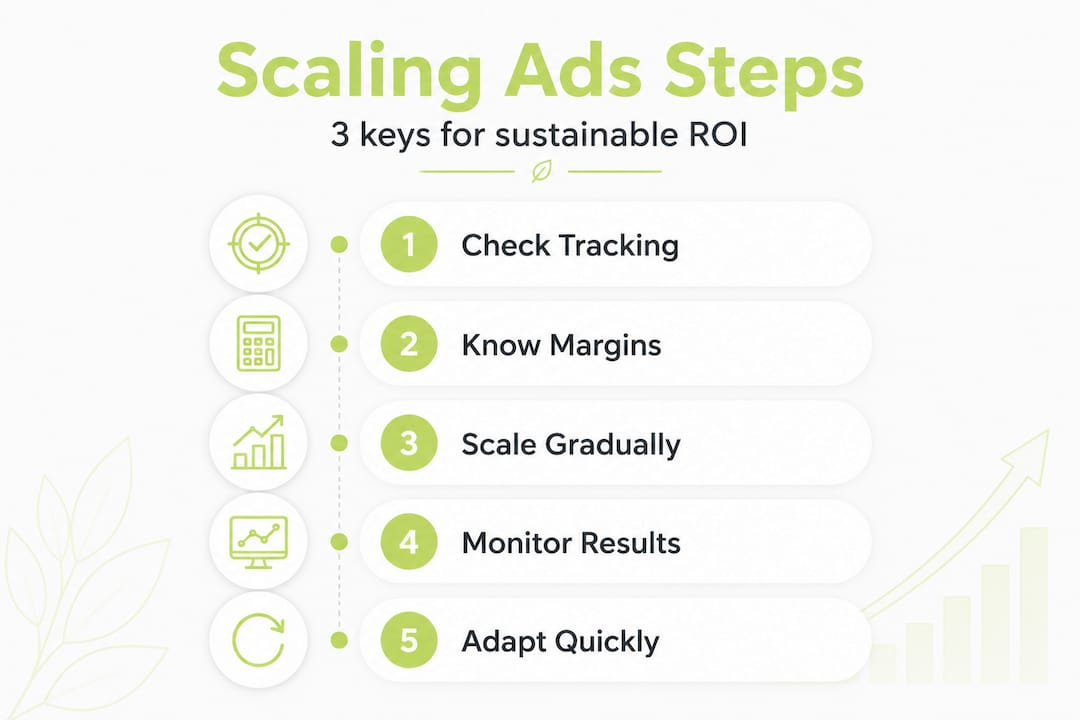
- Increase ad budgets gradually by 20-30% every few days, monitoring CPA and ROAS closely.
- Focus on measurement, creative refreshes, and fixing leaks to grow profitably rather than just increasing spend.
Pouring more money into your paid ads should mean more sales. In practice, many e-commerce brands watch their return on investment shrink the moment they push budgets higher, leaving them wondering what went wrong. Scaling digital advertising is not simply a matter of raising your daily spend and waiting for the revenue to follow. It demands preparation, discipline, and a measurement framework that keeps you honest at every step. This guide walks you through the exact process, from laying the right foundations to troubleshooting in real time, so you can grow profitably rather than just noisily.
Table of Contents
- Get ready to scale: Key prerequisites and pitfalls
- Step-by-step framework: How to scale ads sustainably
- Track, measure, and adapt: Maintaining profitability at scale
- Bonus: Creative, funnel, and CRO tactics for multiplying your scaling gains
- Why most brands misunderstand scaling—and what actually works
- Scale faster with experts: Your e-commerce growth partner
- Frequently asked questions
Key Takeaways
| Point | Details |
|---|---|
| Preparation is vital | Solid tracking, attribution hygiene, and unit economics must be in place before you scale digital ads. |
| Scale gradually, not abruptly | Increase spend in small steps and watch metrics to avoid algorithm shocks and wasted budget. |
| Track beyond ROAS | Monitor margin, CPA and store-side revenue as you go—not just ad platform returns. |
| Upgrade landing pages | Well-designed landing pages and CRO are central to maximising gains from scaled traffic. |
| Creative refresh matters | Regular ad creative updates prevent fatigue and help algorithms learn efficiently for growth at scale. |
Get ready to scale: Key prerequisites and pitfalls
Before you can increase ad budgets, you need to lay a solid foundation that supports higher spend without waste.
The first thing to audit is your tracking setup. Broken or misconfigured conversion tracking is far more common than most brands realise. If your data is inaccurate, every decision you make about scaling is built on sand. Check that ad attribution accuracy is working correctly across every campaign before you touch a budget figure. This means verifying that your purchase events fire reliably, your attribution windows match your actual sales cycle, and your pixel or tag is not double-counting.
Next, know your unit economics cold. You need to understand your contribution margin per order, your maximum allowable CPA, and the ROAS threshold below which you are losing money in real terms. As the Good Monster Blog points out, you should build scaling discipline around contribution margin and unit economics rather than just ROAS, so you do not expand ad spend faster than the business can profit from it. Fixating on a top-line ROAS figure without understanding what is left after cost of goods, shipping, and returns is one of the most common and costly mistakes in e-commerce advertising.
Landing pages are another frequent bottleneck. Budget scaling can fail when your landing pages and funnel simply cannot absorb the extra traffic. Sending more users to a slow, confusing, or poorly structured page will lower your conversion rate and inflate your CPA precisely when you need efficiency most. Review your pages with fresh eyes, and consider reading about optimising landing pages before pressing go.
| Prerequisite | What to check | Pass criteria |
|---|---|---|
| Conversion tracking | Events fire on every purchase | Zero duplicate or missing events |
| Attribution setup | Windows match sales cycle | Platform data aligns with backend |
| Contribution margin | Margin per order is calculated | Positive margin after all costs |
| CPA ceiling | Maximum CPA is defined | Tied to margin, not gut feel |
| Landing page speed | Page loads under 3 seconds | Core Web Vitals pass |
| Funnel conversion rate | Current CVR is measured | Benchmark established pre-scale |
“You cannot profitably scale an ad account that is leaking money through poor tracking or low-converting pages. Fix the foundation first, or you are simply amplifying an existing problem.”
Pre-scaling checklist:
- Verify purchase conversion events are firing without duplication
- Cross-reference platform-reported conversions with Shopify or GA4 data
- Calculate your contribution margin and set a hard CPA ceiling
- Audit landing page speed and mobile experience
- Confirm funnel CVR is stable and benchmarked
Pro Tip: Run a week of stable ads at your current budget with clean tracking before scaling. This gives you a reliable performance baseline to measure against as you grow.
Step-by-step framework: How to scale ads sustainably
Once you have eliminated foundational risks, you are ready to scale. Here is how to do it systematically.
The single biggest mistake brands make is jumping budgets dramatically in one go. A 200% overnight increase does not just change your spend; it resets the learning phase of whatever platform you are running on. Meta, Google, and TikTok all rely on machine learning to optimise delivery, and abrupt changes force that learning to restart from scratch. You lose accumulated signal and efficiency in one move.
Instead, follow a structured approach. The Search Engine Journal recommends scaling by maintaining your ROAS and CPA guardrails and increasing budgets gradually rather than abruptly, to avoid efficiency loss and algorithm instability. In practice, that means:
- Increase budgets by 20 to 30% every two to three days. This sits inside the tolerance window of most platform algorithms and avoids triggering a full learning reset.
- Monitor CPA and ROAS daily after each increase. If CPA rises by more than 20%, stop and hold the budget steady for 48 to 72 hours.
- Avoid major campaign edits during a scaling phase. Changing targeting, creative, or bidding strategy mid-scale compounds the instability. Make one change at a time.
- Plan creative refresh cycles in advance. Creative fatigue is a silent killer of scaling efficiency. According to Search Engine Land, sustainable performance marketing requires managing creative fatigue with structured refresh and ensuring conversion volume is sufficient for optimisation.
- Duplicate winning ad sets before scaling them. This preserves a stable baseline and lets you test higher budgets without compromising what is already working.
- Scale horizontal as well as vertical. Rather than only raising budgets on existing campaigns, test new audiences, new placements, or new creative formats running in parallel.
| Factor | Gradual scaling | Abrupt scaling |
|---|---|---|
| Algorithm learning | Maintained | Disrupted and reset |
| CPA trend | Stable or modest rise | Sharp increase common |
| ROAS stability | Consistent | Volatile |
| Creative fatigue | Manageable | Accelerated |
| Risk of wasted spend | Low | High |
| Recovery time if it fails | Days | Weeks |
This framework is the backbone of a well-structured paid ads strategy for any e-commerce brand. It also pairs naturally with the kind of optimisation strategies that compound gains over time rather than creating one-off spikes.
Pro Tip: Use campaign budget optimisation (CBO) at the campaign level rather than controlling spend at ad set level when scaling. It gives the algorithm more room to find efficient delivery without you having to micromanage every line.
A useful benchmark: campaigns that scale by no more than 30% per increment and hold steady for at least 48 hours before the next increase tend to maintain efficiency far better than those scaled aggressively. Brands that follow this rhythm also tend to see stronger long-term ROI in 2026 as they build compounding signal into their accounts.
Track, measure, and adapt: Maintaining profitability at scale
Sustainable scaling depends on continuous measurement, not blind hope. Here is how to avoid surprises.

Once budgets are rising, your measurement discipline becomes more important than ever. Small errors in attribution that seemed irrelevant at £500 per month become very significant at £5,000 per month. The core metrics to track after every incremental budget increase are: contribution margin per order, CPA, ROAS, and store-side revenue from your e-commerce platform.
The critical point here is that platform-reported conversions and attribution windows may not match your store-side revenue. Meta may claim credit for a sale that Google also attributes to itself. Your Shopify or WooCommerce dashboard is the closest thing to ground truth you have. Reconcile the numbers weekly. If your ad platforms are reporting 30% more revenue than your store backend, something is misconfigured, and scaling on that inflated data is genuinely dangerous.
One area that catches brands off guard is platform pacing. When budgets change mid-month, Google Ads recalculates its pacing from the change date and can temporarily allow daily spend up to twice the new budget limit to compensate. This is not a glitch; it is by design. But if you are not aware of it, a mid-month budget increase can feel like a runaway spend event.
| Issue | Likely cause | Action |
|---|---|---|
| Platform reports higher sales than Shopify | Attribution window overlap | Audit pixel and GA4 data |
| CPA spikes after budget increase | Algorithm learning phase | Hold budget, do not cut creatives |
| ROAS drops without creative change | Audience saturation | Refresh creative or expand targeting |
| Google Ads overspends after budget edit | Mid-month pacing recalculation | Monitor daily caps for 48 to 72 hours |
| Conversion rate drops with same traffic | Landing page bottleneck | Audit page load speed and CTA |
For guidance on optimising attribution tracking, a structured approach helps you identify which sources are genuinely driving revenue and which are taking unearned credit. Pairing this with robust campaign ROI measurement tools gives you a reliable picture across channels.
Pause scaling outright if any of these signals appear: contribution margin falls below your minimum threshold, conversion rate drops by more than 15% week on week, or CPA exceeds your ceiling for more than three consecutive days. These are not warning signs to note and ignore. They are stop signals.
Review your scalable media strategy regularly to ensure your measurement framework grows with your budget, not behind it.
Pro Tip: Set automated alerts inside Google Ads and Meta Business Manager for CPA and ROAS thresholds. An alert at 90% of your ceiling gives you time to react before real damage is done, rather than discovering the problem during your weekly review.
Bonus: Creative, funnel, and CRO tactics for multiplying your scaling gains
Scaling success is not just about spend. Here is how creative and funnel upgrades add exponential value.
One of the most underestimated growth levers in e-commerce advertising is what happens after the click. Brands that invest in conversion rate optimisation before and during a scaling phase consistently outperform those that treat it as an afterthought. The evidence is clear: fixing product-page conversion foundations can improve your conversion rate without any additional ad spend, which means that scaling ads onto a poorly converting funnel actively wastes money.
Here is a practical creative and CRO checklist to run alongside your budget increases:
- Refresh ad creative every two to four weeks. Audiences on Meta and TikTok particularly suffer from ad blindness quickly. A stale creative does not just underperform; it actively trains the algorithm to show your ads to less engaged users over time. Use a structured creative calendar, not reactive changes when performance drops.
- Review landing page speed before every scaling phase. A page that loads in four seconds will convert at a fraction of the rate of one that loads in two. Mobile load time is especially critical given that most e-commerce traffic is now mobile.
- Make your value proposition unmissable. Visitors arriving from paid ads have a very short attention span. Your headline, product benefit, and CTA should all be visible above the fold without scrolling.
- Run split tests on key pages. Even a 0.5% improvement in conversion rate on a high-traffic landing page translates into significant revenue when you are scaling spend. Test one element at a time: headline, hero image, CTA text, button colour.
- Design for mobile first, not as an afterthought. With the majority of paid social traffic arriving on mobile devices, a desktop-first page design is a direct drain on scaling efficiency.
For practical ideas on building high-performing landing pages that convert paid traffic, a well-structured page is often worth more than an additional £1,000 in ad spend. You can also explore professional landing page design if you want pages built specifically to convert at scale.
A useful guide for this work is the Google Ads performance guide, which covers how landing page quality affects both ad rank and conversion rates simultaneously.
Pro Tip: Before scaling, run your most important landing page through Google PageSpeed Insights and fix any issues flagged as “poor.” A quick technical fix often delivers a bigger lift than a new creative concept.
Why most brands misunderstand scaling—and what actually works
Here is what most guides miss when talking about scaling digital ads.
Most e-commerce brands approach scaling as a budget decision. The thinking goes: if this ad set is profitable at £100 per day, it should be profitable at £1,000 per day. Just spend more. This is understandable but fundamentally wrong. Real scaling is not about multiplying spend; it is about expanding your capacity to profit from every pound spent.
The brands that scale successfully treat CRO, measurement integrity, and margin health as the true limiting factors. Budget is almost never the constraint. A brand with clean attribution, a converting landing page, and a healthy contribution margin can scale quickly and confidently because they know exactly what each pound is doing. A brand without those things is essentially guessing, and guessing gets more expensive as budgets grow.
The uncomfortable truth is that most ad budgets include a significant proportion of genuinely wasted spend, money going to users who were never going to convert, or being attributed to the wrong channel, or being sent to a page that leaks traffic. Fixing those leaks through conversion optimisation fundamentals before scaling often delivers better returns than the budget increase itself would have.
What the most successful brands we work with have in common is not bigger budgets or more sophisticated targeting. It is discipline. They measure obsessively, they scale incrementally, they refresh creative on a schedule, and they treat a drop in contribution margin as a hard stop signal, not a minor inconvenience. Scaling is repeatable and safe only when cost, profit, and measurement capacity all rise together.
Scale faster with experts: Your e-commerce growth partner
If you want practical support putting these strategies into action, here is how our team can help.
Knowing the framework is one thing. Executing it consistently while running a business is another. At Geo Growth Media, we work as an extension of your marketing team, bringing hands-on expertise in paid social media scaling across Meta, TikTok, and LinkedIn, as well as Google Ads management and structured measurement setup. We do not just run your ads; we build the infrastructure that makes profitable scaling possible.
Our team also specialises in landing page design built specifically to convert paid traffic at scale, so you are not pouring budget into pages that were never built to perform under pressure. Whether you need a full growth strategy or targeted support in a specific area, we work with ambitious e-commerce brands ready to grow beyond guesswork. Book a consultation with our team and let us show you exactly where your scaling potential is being left on the table.
Frequently asked questions
How fast should I raise my digital ad spend when scaling?
Increase your budget by no more than 20 to 30% every few days to let algorithms adjust, and pause if CPA rises sharply or ROAS drops below your target threshold.
What key numbers should I track as I scale ads?
Monitor your contribution margin, CPA, ROAS, and compare ad platform conversions to your e-commerce revenue. Building scaling discipline around contribution margin prevents you from expanding spend faster than the business can profit from it.
Does Google Ads change spending behaviour when budgets change mid-month?
Yes. Adjusting your budget mid-month prompts Google to recalculate pacing from the change date and can temporarily allow daily spend up to twice the new budget limit to compensate for earlier underspend.
How do I know if my landing pages are ready for more ad traffic?
Check that your pages convert well with current traffic and have the speed and clarity to handle increased volume. Scaling can fail outright if your landing page conversion capacity cannot absorb the extra traffic a larger budget drives.
Recommended
- How to create a paid ads strategy for maximum ROI
- Boost your ROI with strategic digital marketing in 2026
- Why use paid advertising for measurable growth in 2026
- Google Ads Campaign Setup for UK E-Commerce ROI
- Scale digital marketing to win more clients: complete guide - Jarrod Harman
- Effective Online Advertising Tips for Small Businesses 2025 | Ibrandmedia


.png)