.png)

.svg)




Marketing managers at small to medium-sized businesses often question whether content marketing delivers real returns or simply drains budgets. The data tells a compelling story: businesses with blogs generate 126% more leads than those without, and companies publishing 11 or more posts monthly see four times the lead volume of less frequent publishers. Content marketing isn’t just another channel—it’s a strategic investment that builds compounding value over time. This article examines why content marketing works, where it outperforms traditional advertising, and how SMEs can implement strategies that drive measurable business growth.
Table of Contents
- What is content marketing and why does it matter?
- The hard evidence: ROI and growth from content marketing
- Content marketing vs paid advertising: Long-term value compared
- Building an effective content marketing strategy for SMEs
- How to maximise ROI and avoid common content marketing mistakes
- Unlock your content marketing advantage with expert support
- Frequently asked questions
Key Takeaways
| Point | Details |
|---|---|
| Content attracts leads | Consistent content marketing generates far more leads than traditional marketing or sporadic efforts. |
| ROI improves over time | Well-executed content marketing delivers increasing returns as assets compound and build authority. |
| Blend strategies for growth | Combining content and paid advertising yields the most stable and scalable results for SMEs. |
| Strategy and measurement matter | A documented plan, regular evaluation, and focusing on business outcomes lead to content marketing success. |
What is content marketing and why does it matter?
Content marketing is the strategic creation and distribution of valuable, relevant material designed to attract and retain a clearly defined audience. Unlike traditional advertising that interrupts, content marketing educates, entertains, and solves problems—building trust before asking for a sale.
For SMEs, this approach levels the playing field against larger competitors. You don’t need massive budgets to create helpful guides, insightful case studies, or engaging videos that demonstrate expertise. What you need is consistency, focus, and genuine understanding of your audience’s challenges.
The business benefits extend far beyond immediate conversions. Quality content improves search visibility, establishes thought leadership, nurtures prospects through longer sales cycles, and creates assets that continue generating returns months or years after publication. Whilst 97% of B2B organisations use content marketing, only 29% rate their efforts as highly effective—revealing a significant opportunity for SMEs who execute strategically.
Top-performing content types for small businesses include:
- Long-form educational articles that address specific customer questions
- Short-form video content demonstrating products or explaining concepts
- Email newsletters maintaining regular touchpoints with prospects
- Case studies showcasing real client results and applications
- Industry insights positioning your brand as a knowledgeable resource
Understanding the distinction between content marketing and other channels helps clarify its role. Whilst content marketing vs social media serve different purposes, they work best when integrated into a cohesive strategy.
The hard evidence: ROI and growth from content marketing
Scepticism about content marketing ROI often stems from its delayed gratification compared to paid advertising. However, the numbers reveal a different reality. Research shows that 82% of marketers report positive ROI from inbound strategies, with small businesses seeing particularly strong results when they maintain consistency.
The lead generation advantage is substantial. Companies maintaining active blogs don’t just see marginal improvements—they experience 126% more lead growth than competitors without content strategies. For businesses publishing frequently, the returns multiply: 11 or more monthly posts generate four times the leads of less active publishers.
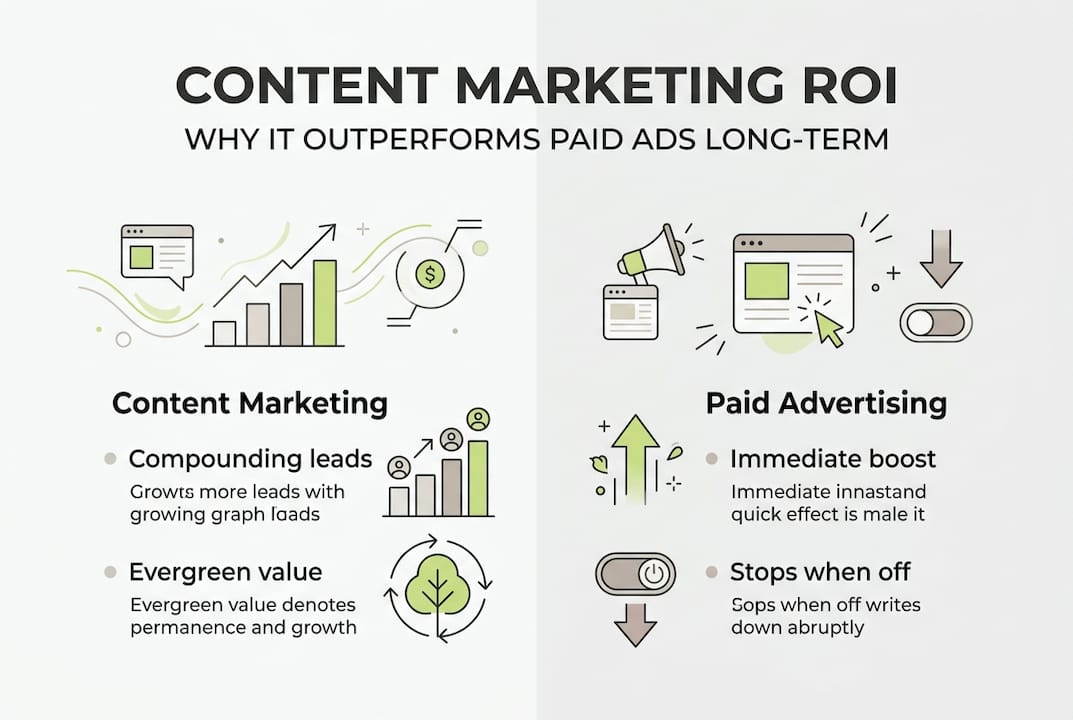
Content marketing delivers compounding returns that paid advertising cannot match. Whilst a paid campaign stops generating results the moment you stop spending, quality content continues attracting visitors, building authority, and converting prospects months after publication. This creates an asset-based approach to marketing rather than a purely expense-based one.

| Metric | Content marketing impact | Timeline |
|---|---|---|
| Lead generation | 126% increase vs no blog | 6-12 months |
| Cost per lead | 62% lower than outbound | 12+ months |
| Conversion rate | 6x higher for nurtured leads | Ongoing |
| Brand authority | Measurable search visibility gains | 3-6 months |
The data becomes even more compelling when examining sustained performance. Over a 36-month period, content marketing generates three times more leads per pound spent compared to paid advertising alone. This doesn’t mean abandoning paid channels—it means recognising content’s role in building durable competitive advantages.
For practical implementation guidance, explore these content marketing ideas for UK SMEs that align with current market conditions.
Content marketing vs paid advertising: Long-term value compared
The content marketing versus paid advertising debate misses a crucial point: they serve complementary rather than competing purposes. Understanding their respective strengths helps SMEs allocate budgets effectively.
| Factor | Content marketing | Paid advertising |
|---|---|---|
| Time to results | 3-6 months | Immediate |
| Cost trajectory | Decreasing over time | Constant or increasing |
| Asset creation | Builds owned media library | No residual value |
| Trust building | High credibility | Lower trust |
| Scalability | Compounds with consistency | Linear with spend |
| Measurement | Attribution complex | Direct tracking |
Paid advertising excels at validation and quick wins. When launching new products or testing markets, ads provide immediate feedback and controllable traffic. They’re ideal for time-sensitive promotions and reaching cold audiences who don’t yet know your brand exists.
Content marketing builds the foundation for sustainable growth. It establishes expertise, answers questions prospects are actively searching for, and creates touchpoints throughout the buyer journey. Over time, content outperforms paid ads by generating three times more leads per pound invested across 36 months.
Most successful SMEs adopt a 60/40 split: 60% of marketing resources towards content and organic channels, 40% towards paid advertising. This balance captures immediate opportunities whilst building long-term assets.
Pro Tip: Use paid advertising to amplify your best-performing content rather than treating the channels as separate. Promote high-converting blog posts, case studies, or guides through targeted ads to combine content’s credibility with paid media’s reach. This approach typically delivers 2-3x better conversion rates than promoting product pages directly.
For businesses exploring paid channels, understanding why use paid advertising alongside content helps create balanced strategies. A comprehensive paid media strategy integrates both approaches for maximum impact.
Building an effective content marketing strategy for SMEs
Strategy separates successful content programmes from random acts of publishing. Research confirms that documented strategies correlate strongly with effectiveness, yet many SMEs skip this foundational step.
-
Define specific business objectives. Move beyond vague goals like “increase awareness” to measurable targets: generate 50 qualified leads monthly, reduce cost per acquisition by 30%, or rank first page for 10 commercial keywords.
-
Research your audience deeply. Interview existing customers about their challenges, questions, and decision-making processes. Analyse search data to understand what prospects seek before purchasing. Create detailed personas representing your ideal customers.
-
Choose content types strategically. For SMEs, long-form expert content, short video, email newsletters, and case studies typically deliver the highest ROI. Select formats matching your team’s strengths and audience preferences.
-
Establish a realistic publishing cadence. Consistency matters more than perfection. Aim for at least 11 monthly blog posts to achieve the 4x lead generation multiplier, but start with what you can sustain and scale gradually.
-
Plan distribution as thoroughly as creation. The 50/50 rule applies: spend half your time creating content, half promoting it. Quality content without distribution reaches nobody.
-
Implement measurement from day one. Track metrics tied to business outcomes: leads generated, pipeline influenced, customer acquisition cost, and revenue attributed to content touchpoints.
Pro Tip: Repurpose strategically to maximise efficiency. Transform one comprehensive guide into a blog series, social media posts, an email sequence, a video script, and presentation slides. This approach multiplies your content’s reach whilst reducing creation time by 60-70%.
Integrating content with broader digital strategies amplifies results. Explore SEO strategy examples for SMBs and scalable social media strategies to build comprehensive programmes.
How to maximise ROI and avoid common content marketing mistakes
Even well-intentioned content programmes fail when they repeat predictable mistakes. Understanding these pitfalls helps SMEs avoid wasted investment and accelerate results.
-
Publishing without measurement. Creating content without tracking performance is like advertising blindfolded. Implement analytics from the start, monitoring traffic sources, engagement metrics, conversion paths, and revenue attribution.
-
Chasing vanity metrics. Page views and social shares feel good but rarely correlate with business growth. Focus on metrics that matter: qualified leads, sales pipeline contribution, customer acquisition cost, and lifetime value.
-
Inconsistent publishing. Sporadic content confuses audiences and algorithms alike. Top-performing organisations are 37 times more likely to succeed through consistent measurement and scalable processes.
-
Ignoring distribution. Brilliant content that nobody sees delivers zero ROI. Allocate equal time to promotion through email, social media, partnerships, and paid amplification.
-
Creating for yourself, not your audience. Content that showcases your expertise without addressing customer questions wastes resources. Every piece should answer: “What problem does this solve for my prospect?”
Pro Tip: Establish a simple ROI tracking framework by tagging all content URLs with campaign parameters, setting up goal tracking in analytics platforms, and reviewing monthly reports that connect content consumption to lead generation and revenue. This visibility transforms content from a cost centre into a measurable growth driver.
For ongoing inspiration and tactical approaches, review these content ideas for UK SMEs that address current market conditions.
Unlock your content marketing advantage with expert support
Building an effective content marketing programme requires strategic thinking, consistent execution, and ongoing optimisation. For many SMEs, partnering with specialists accelerates results whilst allowing internal teams to focus on core business activities.
Geo Growth Media helps ambitious brands develop and execute content strategies that drive measurable growth. Our approach integrates content marketing with SEO, paid media, and conversion optimisation to create comprehensive programmes tailored to your sector, audience, and budget. We function as an extension of your team, bringing specialist expertise without the overhead of full-time hires.
Whether you need strategic guidance, content creation support, or complete programme management, our services scale to match your ambitions. Explore our digital marketing services or discover how we support ecommerce marketing specifically. Ready to transform your content marketing results? Let’s discuss how we can help you achieve sustainable, measurable growth.
Frequently asked questions
How long does it take to see results from content marketing?
Content marketing typically requires 3 to 6 months before delivering noticeable ROI, with benefits compounding over 36 months to generate three times more leads per pound than paid advertising.
What content works best for small businesses?
Long-form articles, short videos, email newsletters, and case studies provide the highest ROI for most SMEs, particularly when addressing specific customer questions and demonstrating real-world applications.
Does content marketing replace paid ads completely?
No, successful SMEs blend both approaches. Whilst content builds long-term authority, paid advertising delivers immediate validation and reach. Most businesses achieve optimal results with a 60/40 content-to-paid split.
How much content should an SME publish to succeed?
Publishing at least 11 blog posts monthly generates 4x more leads than less frequent posting, though consistency matters more than volume. Start with a sustainable cadence and scale as resources allow.



.png)