.png)

.svg)



TL;DR:
- A multi-channel strategy uses various communication platforms to boost brand visibility, customer engagement, and sales. Implementing three to five focused channels with integrated data systems significantly increases purchase rates and customer retention while reducing operational costs. Proper foundation systems, like CRM integration and AI tools, enable efficient, consistent cross-channel marketing that drives long-term growth.
A multi-channel strategy is the deliberate use of multiple communication and sales channels to engage customers, increase brand visibility, and drive conversions across platforms. Known formally as multichannel marketing, it means your brand shows up where your audience already spends time, whether that is Google Search, Meta, email, LinkedIn, or in-store. Businesses using multi-channel marketing report a 23% revenue increase, and multi-channel shoppers spend roughly three times more than single-channel shoppers. That gap is not a coincidence. It reflects a fundamental shift in how buyers research, compare, and purchase.

What is multi-channel strategy and how does it differ from omnichannel?
Multi-channel strategy and omnichannel marketing are not the same thing, and confusing the two leads to wasted budget and misaligned expectations. Understanding the distinction is the first practical step before building any campaign.
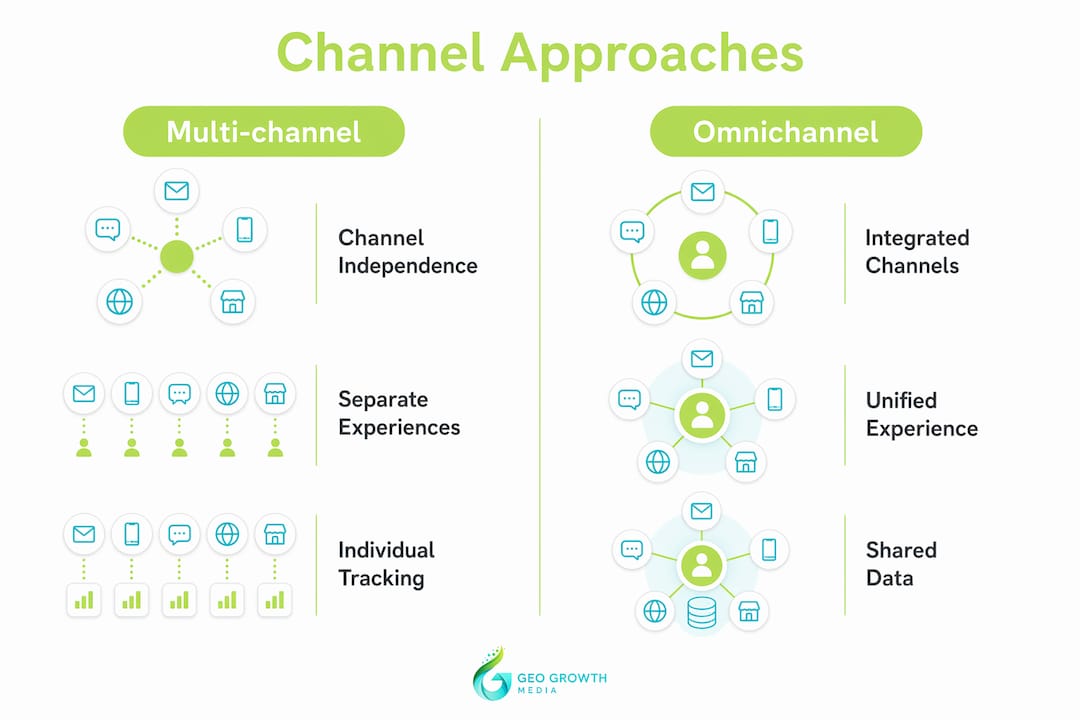
In a multi-channel approach, your brand operates across several independent channels. Each channel, say your paid social ads on Meta and your email nurture sequence, may have its own messaging, creative, and KPIs. The customer connects the dots themselves. They might see a Facebook ad on Monday, receive an email on Wednesday, and convert via Google Shopping on Friday. The brand is present on all three channels, but the experience is not necessarily stitched together behind the scenes.
Omnichannel marketing takes this further. The brand holds the context. If a customer abandons a basket on your website, your CRM triggers a retargeting ad and a personalised email referencing the exact products left behind. The customer touchpoints integrate for a smoother journey, with data flowing between channels in real time. Think of multi-channel as being in multiple rooms at a party. Omnichannel means you remember every conversation you had in each room and pick up exactly where you left off.
Cross-channel marketing sits between the two. It shares data between some channels but does not achieve full integration. For most marketing professionals and business owners starting out, a well-executed multi-channel strategy is the right foundation before attempting the operational complexity of true omnichannel.
| Feature | Multi-channel | Omnichannel | Cross-channel |
|---|---|---|---|
| Channel independence | High | Low | Medium |
| Customer experience continuity | Customer-led | Brand-led | Partial |
| Data integration | Siloed or partial | Unified | Selective |
| Implementation complexity | Moderate | High | Medium |
| Best suited for | Growth-stage brands | Mature brands | Scaling brands |
Pro Tip: If you are not yet sharing data between your CRM, ad platforms, and email tool, start there before calling your approach omnichannel. Calling it multi-channel and executing it well beats calling it omnichannel and executing it poorly.
What are the real benefits of a multi-channel strategy?
The business case for multichannel marketing is backed by hard numbers, not marketing theory. Here is what the 2026 research actually shows.
Campaigns using 3 or more channels achieve a 287% higher purchase rate than single-channel campaigns. Brands using five or more channels see purchase rates climb to 412% higher. That is not a marginal uplift. It is a structural advantage for brands willing to show up consistently across multiple touchpoints.
The retention numbers are equally compelling:
- Customer retention can improve by up to 91% when customers interact with a brand across multiple channels.
- Multi-channel shoppers spend 1.5 to 3 times more than single-channel customers, depending on the sector.
- Integrating email, LinkedIn, and phone can boost conversions by up to 250% compared to single-channel strategies, with some B2B firms reporting 494% engagement increases.
- Companies relying on a single channel lose 30% more revenue than their multi-channel peers.
Beyond revenue, there are operational gains. Retailers using unified commerce platforms report 22% lower total cost of ownership and 20% faster implementations. That means less time managing disconnected systems and more time optimising campaigns that actually perform.
The practical implication is clear. If your brand is currently running paid social in isolation from your SEO content or email programme, you are leaving a significant share of revenue on the table. The benefits of multi-channel strategy compound over time as each channel reinforces the others, building brand familiarity and shortening the path to purchase.
How to implement a multi-channel strategy that actually works
Knowing the benefits is one thing. Building a plan that delivers them is another. Here is a practical framework for getting it right.
-
Audit your audience data first. Before selecting channels, understand where your customers actually spend time. Use Google Analytics 4, Meta Audience Insights, and your CRM to identify which platforms drive the highest quality traffic and conversions. Do not guess.
-
Start with three to five channels. Focusing on 3 to 5 high-impact platforms leads to stronger engagement than spreading budget thinly across ten. For most B2B brands, that means LinkedIn, Google Search, and email. For B2C ecommerce, it typically means Meta, Google Shopping, and email or SMS.
-
Develop channel-specific but brand-consistent messaging. Your tone on LinkedIn differs from your tone on TikTok, but your value proposition should not. Create a messaging framework that defines your core claims, then adapt the format and register for each platform.
-
Integrate your tools. Connect your CRM, ad platforms, and email marketing software so data flows between them. Platforms like HubSpot, Klaviyo, and Salesforce Marketing Cloud all offer native integrations with Meta, Google Ads, and LinkedIn. This is the foundation of data-driven campaign optimisation.
-
Set unified attribution from day one. Decide how you will measure cross-channel performance before you launch. GA4 with data-driven attribution, combined with UTM parameters across every channel, gives you a cleaner picture than last-click models.
-
Review and scale. Run your initial channel mix for 60 to 90 days, then use performance data to decide which channels to scale and which to cut or adjust.
Pro Tip: Resist the urge to launch on every platform simultaneously. A focused three-channel strategy with tight creative and proper tracking will outperform a sprawling eight-channel approach with inconsistent messaging every time.
What operational systems make multi-channel marketing succeed?
The marketing execution is only half the picture. The backend systems that support it determine whether the customer experience holds together or falls apart.
Unified commerce platforms are the operational backbone of any serious multi-channel approach. Real-time inventory syncing across your website, marketplace listings, and physical locations prevents the single most damaging customer experience failure: a customer seeing an item as available online, only to find it out of stock when they arrive in store or at checkout.
The key operational pillars to get right are:
- CRM alignment: Your CRM should receive data from every channel, including paid ads, organic search, email, and direct sales. Without this, you cannot build accurate customer profiles or trigger relevant follow-up sequences.
- Attribution modelling: Siloed data across channels leads to misallocated budgets. Tools like GA4, Northbeam, or Triple Whale give you cross-channel visibility that last-click attribution in a single platform cannot.
- POS and inventory syncing: For brands with physical and digital presence, point-of-sale systems must connect to your ecommerce platform. Shopify Markets, for example, handles this natively for many retailers.
- Automation workflows: Marketing automation tools like HubSpot or Klaviyo should trigger communications based on cross-channel behaviour, not just actions within a single platform.
Getting these systems aligned before scaling spend is not optional. It is the difference between a multi-channel strategy that compounds in effectiveness and one that generates noise without results.
How AI and modern platforms are reshaping multi-channel marketing
AI has changed what is operationally possible for marketing teams of any size. Tasks that previously required dedicated technical resource, such as maintaining message parity across six channels or building dynamic audience segments, are now achievable with mid-market platforms.
AI-driven tools now enable consistent messaging across diverse customer touchpoints and can deliver up to 50% higher ROI while reducing operational costs. That figure reflects a genuine shift in what lean marketing teams can execute without adding headcount.
Specific applications worth knowing:
- AI voice agents integrated with email and SMS increase engagement and conversion by capturing high-intent traffic in real time, maintaining brand voice parity across text and speech channels.
- Platform connectors like Zapier, Make (formerly Integromat), and native API integrations reduce the manual effort of syncing data between ad platforms, CRMs, and email tools.
- Predictive audience tools in Meta Advantage+ and Google Performance Max use machine learning to identify and reach high-intent users across placements, reducing the manual workload of audience management.
“Previously, maintaining message parity across multiple channels was nearly impossible for many organisations. AI-based marketing platforms have made consistent, measurable messaging across diverse touchpoints not just feasible but standard practice.” Sprinklr
For multi-platform advertising to deliver compounding returns, the technology layer must be set up to share signals, not operate in isolation.
Key takeaways
A well-executed multi-channel strategy requires coordinated data, focused channel selection, and integrated backend systems to deliver measurable revenue and retention gains.
| Point | Details |
|---|---|
| Define before you build | Multi-channel and omnichannel are distinct approaches; choose the right one for your current operational maturity. |
| Revenue impact is significant | Campaigns using 3 or more channels achieve up to 287% higher purchase rates than single-channel campaigns. |
| Start focused, then scale | Limit initial efforts to 3 to 5 channels to maintain message quality and avoid diluting your budget. |
| Backend systems matter | CRM integration, unified attribution, and inventory syncing are as critical as the marketing execution itself. |
| AI reduces the complexity | Tools like Meta Advantage+, Klaviyo, and AI voice agents make consistent cross-channel execution achievable for lean teams. |
Our take on where multi-channel strategy is heading
At Geo Growth Media, we have worked with brands across ecommerce, B2B services, and retail, and the pattern we see most often is this: businesses invest in multiple channels but fail to connect them. They run Meta ads, send email newsletters, and publish SEO content, but each sits in its own silo with its own reporting. The result is a fragmented picture of performance and a customer experience that feels disjointed.
The brands that pull ahead are not necessarily spending more. They are sharing data better. When your paid social campaigns inform your email segmentation, and your SEO content feeds your retargeting audiences, the whole system gets more efficient over time. That is the compounding effect that makes multi-channel marketing genuinely powerful, rather than just a box-ticking exercise.
Our honest observation is that most teams try to do too much too soon. Launching on eight channels before you have clean attribution on three is a recipe for confusion. Start with the channels where your audience is most active, get the data flowing properly, and then scale. The temptation to be everywhere at once is understandable, but discipline in the early stages pays off significantly later.
AI tools are accelerating this, and we encourage every marketing team to test them seriously rather than treating them as a future consideration. The gap between teams using AI-assisted attribution and automation and those managing everything manually is widening fast.
— Geo Growth Media
How Geo Growth Media can help you build a multi-channel strategy
If you are ready to move from running isolated campaigns to building a genuinely connected marketing system, Geo Growth Media works as an extension of your in-house team to make that happen.
We specialise in paid social media advertising across Meta, TikTok, and LinkedIn, alongside Google Ads, SEO, and web development. Every strategy we build is tailored to your sector, budget, and growth targets, with full transparency on performance and continuous optimisation built in. Whether you are starting with two channels or scaling an existing multi-channel programme, our digital marketing services are designed to deliver measurable results, not just activity. Get in touch with Geo Growth Media to discuss what a focused, data-driven approach looks like for your business.
FAQ
What is a multi-channel strategy in marketing?
A multi-channel strategy is the coordinated use of multiple platforms, such as paid social, email, SEO, and search advertising, to reach and engage customers. It increases brand visibility and gives customers more ways to discover and purchase from you.
How does multi-channel differ from omnichannel?
Multi-channel means operating across several independent channels where the customer connects the experience themselves. Omnichannel means the brand holds the context, with data flowing between channels to create a continuous, personalised customer journey.
How many channels should I start with?
Start with three to five channels that align with where your audience is most active. Focusing on a smaller number of high-impact platforms produces stronger engagement and cleaner data than spreading budget across too many channels at once.
What metrics should I track in a multi-channel strategy?
Track channel-specific metrics like cost per acquisition and return on ad spend alongside cross-channel metrics including customer lifetime value, retention rate, and multi-touch attribution. GA4 with data-driven attribution is a reliable starting point for unified reporting.
Can small businesses benefit from a multi-channel strategy?
Yes. Starting with three focused channels, such as Google Search, Meta, and email, gives smaller brands a meaningful presence without requiring large budgets. The key is consistent messaging and proper tracking from the outset, not the number of channels you run.


.png)