.png)

.svg)




TL;DR:
- Media mix modelling analyzes historical data to measure each marketing channel’s contribution to sales and revenue. It guides budget reallocation by identifying diminishing returns and optimizing media spend across channels. Effective implementation requires clean data, regular calibration, and organizational alignment to realize its full strategic potential.
Media mix modelling (MMM) is a statistical technique that quantifies how each marketing channel contributes to business outcomes such as sales, leads, and revenue. It works by analysing aggregated historical data across channels, time periods, and external factors to isolate the true impact of your advertising spend. Unlike platform-level attribution, which tracks individual user journeys, MMM takes a top-down view using multi-linear regression and Bayesian methods to separate marketing-driven growth from baseline performance. For any marketer serious about optimising media spend and improving return on ad spend (ROAS), understanding what is media mix modelling is no longer optional.
What is media mix modelling and how does it work?
MMM builds a statistical model using historical aggregated data to estimate the incremental sales contribution of each marketing channel. The inputs typically include weekly or monthly figures for marketing spend by channel, total sales or conversions, pricing data, distribution metrics, and external variables such as seasonality and macroeconomic conditions.

The core statistical engine is multiple linear regression, which assigns a coefficient to each variable. That coefficient represents how much a unit change in spend on a given channel moves the sales needle. More advanced implementations use Bayesian approaches, which incorporate prior knowledge about channel behaviour to produce more stable estimates when data is limited.
One of the most important technical elements is ad stock transformation. Ad stock decay modelling captures the fact that advertising does not stop working the moment a campaign ends. Geometric decay with half-lives of 2–4 weeks for digital channels is the standard approach, accounting for conversion lag that click-based models miss entirely. TV and out-of-home channels typically carry longer half-lives, sometimes extending to several weeks.
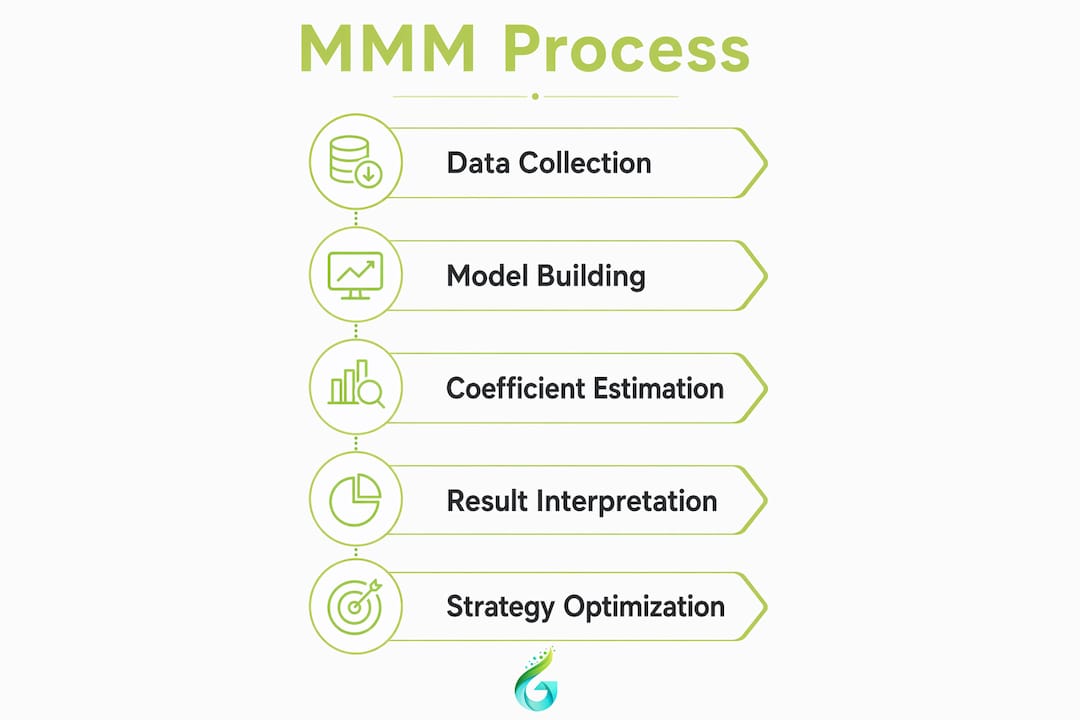
The six core steps in a standard MMM framework are:
- Data collection — gather spend, sales, and external data across all channels
- Data hygiene — clean, align, and standardise inputs to remove noise
- Model development — build the regression or Bayesian model with ad stock transformations
- Analysis — decompose sales into base sales and incremental marketing contributions
- Optimisation — identify which channels deliver the best marginal returns
- Forecasting — simulate future budget scenarios to plan campaigns
Pro Tip: Start your data collection at least two years before you intend to run your first MMM. The model needs enough history to separate seasonal patterns from genuine marketing effects.
Common misconceptions about interpreting MMM results
MMM is not a replacement for platform-level tracking. It is a complement to it. MMM provides a top-down view of incremental value, controlling for external factors, while tools like Google Analytics or Meta’s attribution models work at the individual user level. Both perspectives are useful. Neither is complete on its own.
The most common mistake marketers make is confusing contribution with efficiency. A channel with high gross contribution, say paid social, may account for a large share of total sales simply because it receives the most budget. That does not mean it is the most efficient channel. Channels with high spend often show large contributions but lower ROI per pound spent. Optimisation decisions should focus on marginal returns, not total volume.
A few other pitfalls to watch for:
- Insufficient data history. MMM requires 18–24 months of historical data to accurately separate signal from noise and capture seasonality. Shorter data sets produce unreliable decompositions, particularly for brand-building channels.
- Seasonal distortion. Seasonal spikes and one-off events can distort outputs if not cross-validated with long-term business data. A single record-breaking Black Friday can skew the model’s view of paid search performance for months.
- Treating the first run as final. MMM outputs are not gospel on day one. The model needs iterative calibration.
- Ignoring external noise. Economic shocks, competitor activity, and supply chain disruptions all affect sales. A model that does not account for these will misattribute their impact to your marketing.
Pro Tip: Cross-check your MMM outputs against geo-based A/B tests or incrementality experiments. If the model says TV drives a 20% sales lift, a regional holdout test should broadly confirm that before you act on it.
How to apply MMM insights to optimise your media mix strategy
The real value of media mix analysis sits in what you do after the model runs. Raw coefficients are interesting. Budget decisions are where the money is made.
The first application is identifying diminishing returns. Every channel has a saturation point where additional spend produces less and less incremental return. MMM plots a response curve for each channel. When you can see that curve flattening, you know you are approaching saturation. That is the signal to redirect budget elsewhere.
Brands using MMM strategies typically achieve 20–30% higher ROAS compared to single-channel approaches. Simulated budget shifts of 10% from saturated channels to stronger ones can improve ROAS by 15–25%. Those are not marginal gains. They are the difference between a campaign that breaks even and one that funds the next quarter’s growth.
Practical ways to act on MMM findings include:
- Reallocate from saturated to under-invested channels. If paid search is flattening but connected TV is still on the steep part of its response curve, shift budget accordingly.
- Use scenario planning before committing spend. Run simulations for three or four budget allocations before the quarter starts. Pick the one with the best projected return.
- Balance your channel portfolio like a financial portfolio. MMM as a portfolio approach means spreading risk across channels rather than concentrating spend where last-click attribution looks strongest.
- Plan for the long term. Brand-building channels like display and video often show weak short-term coefficients but strong base sales contributions over time. MMM captures this. Last-click attribution does not.
The table below illustrates how a typical budget reallocation scenario plays out:
| Channel | Pre-reallocation share | Post-reallocation share | Expected ROAS change |
|---|---|---|---|
| Paid search | 45% | 35% | Marginal decline (near saturation) |
| Paid social | 30% | 35% | Moderate improvement |
| Connected TV | 10% | 20% | Strong improvement (under-invested) |
| Display | 15% | 10% | Neutral to slight decline |
Numbers in this table are illustrative. Your actual response curves will differ based on your sector, brand maturity, and competitive environment.
Technical challenges and best practices for implementing MMM
Data quality is the single biggest barrier to a reliable model. Garbage in, garbage out applies here more than almost anywhere else in marketing analytics. You need clean, unified data sets where spend figures, sales figures, and external variables all align to the same time grain, whether that is weekly or monthly.
MMM models are iterative. First runs often require calibration with business data or A/B tests before you should trust them enough to act. Blind reliance on initial results leads to flawed decisions. Build in a validation phase before any budget changes go live.
Best practices for a successful MMM deployment:
- Use at least two years of longitudinal data. Anything shorter and the model cannot reliably decompose seasonality from marketing effects.
- Include external variables. GDP growth, category search volume, competitor spend estimates, and weather data (for relevant categories) all belong in the model.
- Couple human oversight with statistical outputs. AI and machine learning tools can accelerate model building, but a marketer who understands the business must sense-check every output.
- Validate incremental lift independently. Geo holdout tests and conversion lift studies provide ground truth that keeps the model honest.
- Rerun the model regularly. Market conditions shift. A model built on 2023 data may not reflect 2026 consumer behaviour. Quarterly recalibration is a sensible minimum.
Pro Tip: When you brief an analytics team or agency on an MMM project, ask them to show you the model’s out-of-sample fit. If the model cannot predict a held-out period of historical data reasonably well, it is not ready to guide live budget decisions.
Key takeaways
Media mix modelling is the most reliable method for understanding true channel contribution and making budget decisions that improve ROAS across your entire marketing portfolio.
| Point | Details |
|---|---|
| MMM uses aggregated historical data | It analyses years of spend and sales data, not individual user journeys, to isolate channel impact. |
| Ad stock decay is critical | Geometric decay models with 2–4 week half-lives capture the delayed effect of digital advertising. |
| Contribution does not equal efficiency | Focus on marginal ROI per pound spent, not gross contribution, when reallocating budgets. |
| 18–24 months of data is the minimum | Shorter data sets cannot separate seasonality from marketing effects accurately. |
| MMM requires iterative calibration | First model runs need validation against A/B tests or geo experiments before driving decisions. |
Geo Growth Media’s perspective on MMM as a strategic compass
We have worked with enough marketing teams to know that MMM gets misused as often as it gets used well. The most common mistake is treating it as a one-time audit rather than an ongoing measurement discipline. A team runs the model once, shifts some budget, and then goes back to making decisions based on platform dashboards. That is missing the point entirely.
MMM is most powerful when it sits alongside your platform data, not above it. Your Google Ads account will tell you which keywords convert. Your MMM will tell you whether Google Ads as a whole is still earning its share of the budget relative to other channels. Those are different questions, and you need both answers.
The other thing we consistently see is a lack of organisational buy-in. The model might say cut paid social by 15% and invest it in audio. But if the paid social team owns that budget and their performance is measured on last-click conversions, that reallocation will never happen. Getting MMM to drive real decisions means aligning incentives and measurement frameworks across the whole marketing function. That is a people problem as much as a data problem.
The marketers who get the most from multi-platform advertising are the ones who treat MMM outputs as a starting point for a conversation, not a verdict. They cross-check the findings, challenge the assumptions, and then make a considered call. That combination of statistical rigour and business judgement is where the real competitive edge lives.
— Geo Growth Media
How Geo Growth Media can help you act on MMM insights
Understanding MMM theory is one thing. Turning it into better campaign performance is another.

Geo Growth Media works as an extension of your marketing team, integrating measurement thinking into every campaign we run across Google Ads, Meta, TikTok, LinkedIn, and SEO. We help ambitious brands move beyond last-click attribution and build data-driven marketing strategies that account for the full picture of channel performance. Whether you are looking to reallocate budget more confidently, improve ROAS, or build a measurement framework that actually reflects how your customers buy, we can help. Get in touch with Geo Growth Media to discuss how we can put these principles to work for your business.
FAQ
What is media mix modelling in simple terms?
Media mix modelling is a statistical method that uses historical sales and spend data to measure how much each marketing channel contributes to business outcomes. It helps marketers decide where to allocate budget for the best return.
How is MMM different from digital attribution?
MMM analyses aggregated data across all channels over months or years, while digital attribution tracks individual user journeys through clicks and sessions. They answer different questions and work best when used together.
How much historical data does MMM need?
MMM requires at least 18–24 months of historical data to accurately separate marketing effects from seasonality and external factors. Shorter data sets produce unreliable results.
Can small businesses use media mix modelling?
Small businesses with limited channel diversity and data history may find MMM difficult to implement reliably. A simpler incrementality testing approach or performance marketing framework is often a more practical starting point.
What ROAS improvement can MMM deliver?
Brands using MMM typically achieve 20–30% higher ROAS compared to single-channel approaches, with simulated budget shifts of 10% from saturated channels improving ROAS by 15–25%.



.png)