.png)

.svg)



TL;DR:
- Interactive content marketing involves creating engaging, personalized digital experiences that drive higher user participation and data collection. It surpasses static content by generating more engagement, better quality leads, and stronger brand memorability through tailored interactions. Focusing on simple, targeted tools that align with funnel stages maximizes effectiveness and user satisfaction.
Interactive content marketing is the practice of creating digital content requiring active participation from users, delivering personalised, data-driven outputs that static content simply cannot match. Where a blog post talks at your audience, a well-built quiz or ROI calculator talks with them. The difference in results is significant. Interactive content generates 52.6% more engagement than static content and keeps viewers on-page for an average of 13 minutes. That is 4.5 minutes longer than conventional articles or videos. Formats like Typeform quizzes, IKEA Place’s augmented reality configurator, and Grammarly’s writing assessments show what this looks like in practice across different industries and funnel stages.

What is interactive content marketing and how does it differ from traditional content?
Interactive content marketing is a subset of what is digital content marketing, but it operates on a fundamentally different model. Traditional content is one-way. You publish a blog, a video, or an infographic, and the reader consumes it passively. Interactive content adapts to buyer needs in real time, responding to user input rather than broadcasting a fixed message to everyone.
The practical implication is significant. With static content, you have no idea whether a visitor found your pricing page helpful or confusing. With an interactive pricing calculator, you know exactly what inputs they entered, what result they received, and whether they converted. That is a qualitative leap in marketing intelligence.
Personalisation is the other major differentiator. Interactive formats allow you to tailor the experience based on what the user tells you. A personality quiz that recommends a product based on answers creates a sense of relevance that a generic product page cannot replicate. This also enables zero-party data collection, where users voluntarily share preferences and intent signals, giving you explicit data rather than inferred behaviour from cookies.
| Feature | Static content | Interactive content |
|---|---|---|
| User role | Passive reader | Active participant |
| Personalisation | None | Based on user input |
| Data collected | Page views, time on site | Explicit preferences, intent signals |
| Engagement depth | Surface level | High, with measurable interaction |
| Lead quality | Low to medium | High, self-qualified |
Pro Tip: Keep your interactive experience focused on one clear outcome. Trying to collect too much data or answer too many questions in a single tool creates friction and reduces completion rates.
What types of interactive content are most effective in marketing campaigns?
The most effective types of interactive content depend on where your audience sits in the buying journey. Different formats serve different purposes, and choosing the wrong one at the wrong stage is a common mistake.
Here is a breakdown of the most widely used formats and their strategic value:
- Quizzes and assessments. Typeform-built quizzes work well at the top of the funnel. They attract clicks, generate shares, and collect lead data in a low-pressure environment. A skincare brand asking “What is your skin type?” qualifies leads while delivering genuine value.
- ROI and pricing calculators. These sit firmly in the mid-to-lower funnel. A prospect entering their monthly ad spend into a calculator and seeing a projected return is self-educating and self-qualifying simultaneously.
- Product configurators. IKEA Place lets users visualise furniture in their own home using augmented reality. This removes purchase hesitation far more effectively than product photography alone.
- Interactive videos. Shoppable videos allow viewers to click on products within the footage and purchase directly. This collapses the gap between inspiration and transaction.
- Polls and surveys. These work across all funnel stages. On social media, a quick poll drives engagement and signals. Embedded on a landing page, a survey collects segmentation data before a lead magnet download.
- Interactive infographics. These let users explore data at their own pace, clicking into the sections most relevant to them rather than reading a linear document.
The funnel logic matters here. Quizzes and polls attract and qualify. Calculators and assessments convert. Configurators and shoppable videos close. Mapping your format to the stage prevents you from deploying a complex configurator to cold traffic that is not yet ready to buy.
Pro Tip: Start with the format your audience already uses. If your prospects are active on LinkedIn, a poll is a lower-friction entry point than asking them to complete a 10-question assessment on your website.
What benefits does interactive content marketing deliver over static content?
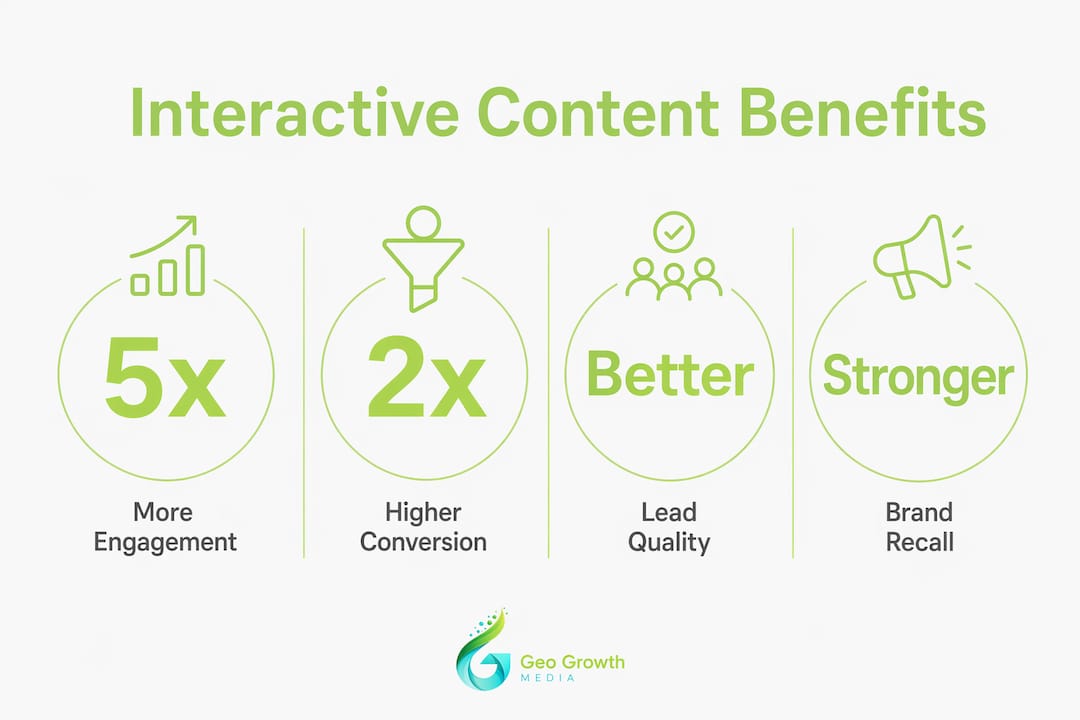
The performance gap between interactive and static content is well documented. Interactive assets generate up to 5 times more views and double the conversion rates compared to static equivalents. That uplift comes from personalisation and tailored calls to action, not from novelty alone.
Engagement depth is the first measurable benefit. A user who spends 13 minutes completing an assessment and reading their personalised results is far more invested than someone who skimmed a 600-word article. That investment translates directly into higher recall and stronger purchase intent.
The second benefit is lead quality. Interactive marketing reduces friction in the buyer journey, enabling prospects to self-educate before they ever speak to your sales team. When a lead arrives having already completed an ROI calculator showing a projected 3x return, your sales conversation starts at a completely different point. Generic discovery calls become unnecessary.
Emotional connection is the third, and often underestimated, benefit. Interactive marketing builds stronger brand memorability through personalised feedback loops and gamification. In a market saturated with AI-generated blog posts and templated social content, an experience that responds to the user personally stands out. That memorability drives repeat visits and word-of-mouth.
The data dimension completes the picture. Consumers resist generic messaging, and interactive content addresses this directly by validating the user’s specific situation before making a recommendation. The zero-party data you collect in the process enables hyper-segmentation that passive tracking cannot achieve.
| Benefit | Impact |
|---|---|
| Engagement rate | 52.6% higher than static content |
| Average time on page | 13 minutes versus 8.5 minutes for static |
| Views generated | Up to 5 times more than static assets |
| Conversion rate | Up to double compared to static content |
| Lead quality | Higher due to explicit intent signals |
“Interactive content validates the user’s experience, building trust before purchase in a way that generic messaging never can.” — Podium
How to create effective interactive content marketing campaigns
Effective interactive campaigns follow a clear process. Skipping steps, particularly the objective-setting stage, is where most brands go wrong.
- Define a single objective. Every interactive piece should serve one primary goal: generate leads, qualify prospects, increase time on site, or drive product discovery. Trying to achieve all four with one tool dilutes the experience and the data.
- Choose the format that matches your audience’s readiness. Cold traffic needs low-commitment formats like polls or short quizzes. Warm prospects who already know your brand are ready for calculators or assessments that require more input.
- Reduce friction at every step. Over-engineering interactive content can backfire. Simpler tools like calculators and quizzes consistently outperform complex experiences because users respond to immediate, tangible value. If your quiz takes longer than three minutes to complete, expect drop-off.
- Personalise the output, not just the input. The result a user receives must feel tailored to their answers. A generic “thank you for completing our quiz” page wastes the data you just collected. Serve a specific recommendation, a relevant resource, or a targeted offer based on their responses.
- Integrate across channels and funnel stages. An interactive asset sitting on a single landing page is underutilised. Promote your calculator via paid social on Meta or LinkedIn, embed your quiz in an email sequence, and retarget completers with ads based on their results.
- Measure and optimise. Track completion rates, drop-off points, and post-interaction conversion rates. If 60% of users abandon a quiz at question four, that question needs reworking. Use data-driven campaign analysis to refine your approach continuously.
The most common pitfall is building an interactive experience without a clear next step. Every piece of interactive content needs a conversion path: a lead capture form, a product recommendation, a consultation booking, or a content download. Without it, you are generating engagement without generating pipeline.
Pro Tip: Test your interactive content on mobile before launch. Most quiz and calculator tools render differently on smaller screens, and a poor mobile experience will kill your completion rate before you have gathered enough data to optimise.
Key takeaways
Interactive content marketing outperforms static content across every measurable metric because it replaces passive consumption with active participation, delivering personalised outputs that build trust, qualify leads, and drive conversion.
| Point | Details |
|---|---|
| Definition | Interactive content requires active user participation and delivers personalised, data-driven results. |
| Engagement advantage | Interactive content generates 52.6% more engagement and up to 5 times more views than static content. |
| Lead quality | Zero-party data from interactive formats provides explicit intent signals, improving segmentation and sales readiness. |
| Format selection | Match your format to the funnel stage: quizzes for awareness, calculators for consideration, configurators for decision. |
| Simplicity wins | Lower-friction tools like quizzes and calculators consistently outperform complex interactive experiences. |
Why simplicity is the most underrated principle in interactive content
At Geo Growth Media, we have seen brands invest heavily in elaborate interactive experiences, only to watch completion rates flatline. The instinct to build something impressive is understandable. The reality is that users do not want impressive. They want fast, relevant, and useful.
The brands getting the most from interactive content right now are not the ones with the most technically complex tools. They are the ones who have identified one specific question their audience is asking and built a simple, direct answer around it. A two-minute ROI calculator that gives a prospect a credible projection of their return will outperform a 15-step interactive assessment every time, because it respects the user’s time and delivers value immediately.
We also think the data opportunity is being underused. Most marketers treat interactive content as an engagement tactic. The smarter play is to treat it as a content marketing investment that generates first-party intelligence. Every completed quiz or calculator tells you something about that prospect’s priorities, budget, and readiness to buy. That data should feed directly into your segmentation, your email sequences, and your paid retargeting.
The future of interactive content sits at the intersection of personalisation and speed. Users’ expectations are rising. They have experienced genuinely personalised digital experiences from platforms like Spotify and Netflix, and they now apply that standard to brand content. If your interactive tool feels generic or slow, it will not hold attention. Build for the outcome, keep it tight, and let the data do the work.
— Geo Growth Media
How Geo Growth Media can support your interactive content strategy
Building interactive content that actually converts requires more than a good idea. It requires the right distribution, the right targeting, and a clear measurement framework behind it.
At Geo Growth Media, we work with ambitious brands to design and deploy digital marketing strategies that put interactive content to work across the full funnel. From paid social campaigns on Meta, TikTok, and LinkedIn that drive traffic to your interactive assets, to SEO content planning that positions your calculators and quizzes in front of high-intent searchers, we build the infrastructure that makes interactive content perform. If you are ready to move beyond static content and start generating leads that arrive pre-qualified, get in touch with our team to discuss a strategy built around your goals.
FAQ
What is interactive content marketing in simple terms?
Interactive content marketing is a digital strategy where content requires the user to actively participate, such as completing a quiz, using a calculator, or configuring a product, and then delivers a personalised result based on their input.
How does interactive content improve conversion rates?
Interactive content doubles conversion rates compared to static content by delivering personalised calls to action and allowing prospects to self-qualify before reaching your sales team.
What are the best examples of interactive content?
The most effective interactive content examples include ROI calculators, personality quizzes built with tools like Typeform, product configurators like IKEA Place, shoppable videos, and interactive assessments that segment leads by need or budget.
Is interactive content suitable for small businesses?
Yes. Simple formats like polls, short quizzes, and basic calculators are low-cost to produce and deliver strong engagement results without requiring large budgets or technical development resources.
How do I measure the success of interactive content?
Track completion rates, drop-off points within the experience, post-interaction conversion rates, and the quality of leads generated. These metrics tell you far more than page views alone.


.png)