.png)

.svg)



TL;DR:
- Enterprise SEO requires a distinct approach involving cross-functional teams, scalable content strategies, and unified data management to succeed at large scale. Most failures stem from organizational silos and broken operating models, not strategy flaws, emphasizing the importance of agile pods and proper platforms. Building infrastructure for rapid execution and measurable revenue impact is essential for sustainable organic growth.
Enterprise SEO is not traditional SEO with a bigger budget. If you are a marketing leader at a large organisation and you have tried applying the same playbook that works for smaller sites, you already know the results are disappointing. What is enterprise SEO, really? It is a distinct discipline that combines technical infrastructure, cross-functional team design, and scalable content strategy to manage organic search performance across thousands or millions of pages. The stakes are higher, the complexity is greater, and the approach must be fundamentally different from the ground up.
Table of Contents
- Key takeaways
- What enterprise SEO actually means
- Why enterprise SEO teams often fail
- Enterprise SEO platforms and tools
- The real business impact of enterprise SEO
- Getting started with enterprise SEO
- My take on where enterprise SEO actually breaks down
- How Geo Growth Media can help
- FAQ
Key takeaways
| Point | Details |
|---|---|
| Enterprise SEO is a distinct discipline | It is not scaled-up traditional SEO; it requires different tools, teams, and operating models. |
| Agile product pods drive execution | Cross-functional teams working in two-week sprints remove bottlenecks and accelerate results. |
| Small gains create large revenue impact | Even 0.1% conversion improvements at enterprise scale generate hundreds of thousands in additional revenue. |
| Technology must unify your data | Enterprise SEO platforms consolidate reporting, automate workflows, and connect departments. |
| Organisational change is non-negotiable | Breaking down silos between SEO, engineering, content, and product teams is what separates winning enterprises from stagnant ones. |
What enterprise SEO actually means
The enterprise SEO definition goes well beyond page count. Yes, enterprise sites typically manage thousands to millions of URLs across multiple domains, subdomains, and international markets. But the real defining characteristic is the organisational complexity required to execute SEO at that scale.
Cross-department collaboration is not optional. Enterprise SEO touches engineering, legal, product, content, data, and marketing simultaneously. A single canonical tag error across a product catalogue can affect tens of thousands of pages. A slow site migration decision can cost months of organic traffic. This is what makes large-scale SEO fundamentally different.
Here is what enterprise SEO actually encompasses:
- Technical SEO at scale. Site architecture, crawlability, and indexation become exponentially more complex when you are managing hundreds of thousands of pages. Crawl budget management, structured data deployment, and Core Web Vitals improvements require dedicated engineering resource, not an occasional sprint.
- Scalable content strategy. You cannot hand-craft every page. Enterprise SEO requires template-driven content frameworks that maintain quality and topical authority across entire site sections without relying on individual writers for every update.
- Multi-domain and international management. Hreflang tags, geo-targeting, and regional domain structures introduce layers of technical complexity that simply do not exist at smaller scale.
- Consistency across departments. Standardising technical, content, and offsite SEO efforts across teams who do not report to the same leader is a genuine operational challenge, and it is one that most enterprise SEO programmes underestimate badly.
Understanding these characteristics is what separates teams that make real progress from those stuck in an endless queue of backlogged tickets.
Why enterprise SEO teams often fail
Here is the uncomfortable truth: most enterprise SEO programmes fail not because the strategy is wrong, but because the operating model is broken. Shifting from siloed advisory teams to cross-functional autonomous pods is what actually accelerates results. This is one of the most important lessons for any marketing leader to absorb.
The classic failure mode looks like this: the SEO team identifies a critical technical fix, raises a ticket with the engineering team, waits six weeks, gets deprioritised in favour of product work, and eventually delivers a partial fix that no longer matches the original brief. That is not an SEO problem. That is an organisational structure problem.
The solution is the SEO product pod. These are small, cross-functional teams that bring together every capability needed to execute SEO work without waiting for another department to act. An effective pod typically includes:
- SEO strategist. Owns the roadmap, identifies opportunities, and sets priorities based on traffic and revenue potential.
- Dedicated developer. Embedded directly in the SEO team rather than borrowed from a separate engineering queue, this person removes the single biggest bottleneck in enterprise SEO execution.
- Content manager. Responsible for producing, updating, and scaling content assets aligned to the keyword and topical strategy.
- Product manager. Coordinates delivery, manages dependencies, and keeps the team accountable to sprint goals.
- Data analyst. Tracks performance, attributes revenue to SEO activity, and identifies where the biggest opportunities are hiding in the data.
These pods operate in 14-day agile sprints, which means technical fixes, content updates, and on-page changes ship in weeks rather than quarters. The speed difference is not incremental. It is transformational.
Successful enterprise SEO teams also practise what is often called “influence without authority”. Rather than acting as isolated consultants who hand over recommendations and hope for the best, they embed SEO thinking into product design, engineering standards, and content governance across the whole organisation.
Pro Tip: When building your first SEO product pod, start small. One pod of five people focused on a single high-value site section will demonstrate ROI faster than a large team spread thinly across the entire site.
Enterprise SEO platforms and tools
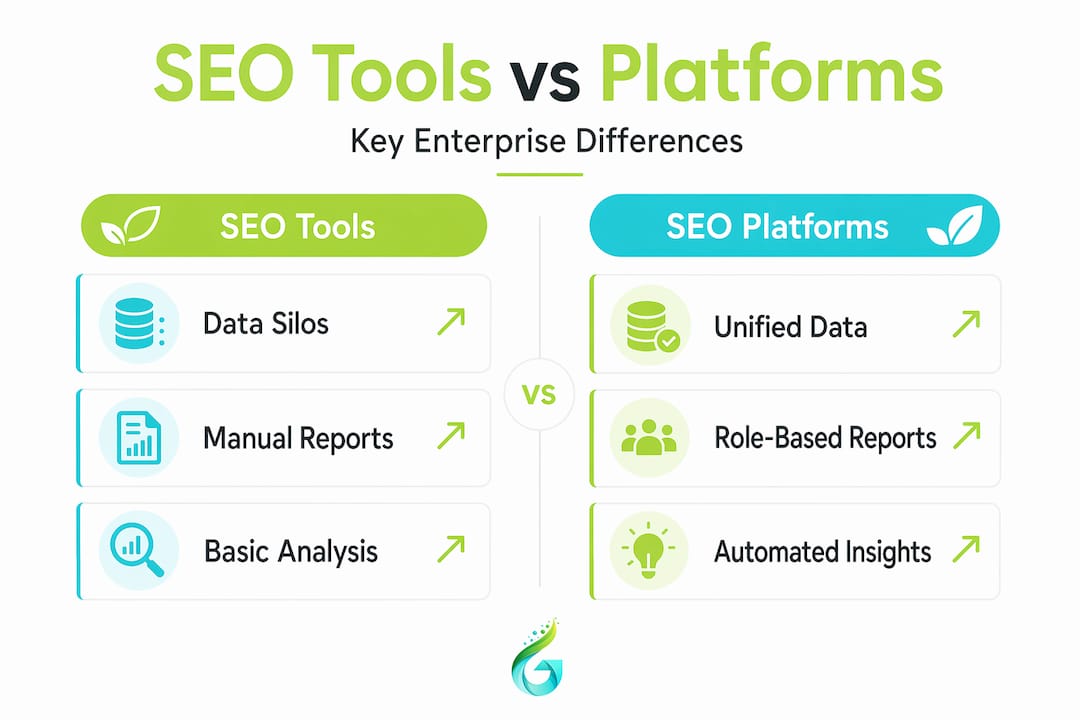
There is a meaningful difference between using SEO tools and operating an enterprise SEO platform. Tools give you data. Platforms give you the infrastructure to act on it at scale.

| Capability | Standard SEO tools | Enterprise SEO platforms |
|---|---|---|
| Data consolidation | Fragmented across multiple dashboards | Unified across domains, markets, and departments |
| Workflow automation | Manual processes for most tasks | Automated meta tag management and keyword tracking |
| Reporting | Export-based, one-size reporting | Role-based dashboards for executives, analysts, and content teams |
| Integration depth | Limited to SEO-specific data | Connects with analytics, Search Console, and CRM systems |
| AI and AEO support | Minimal or absent | Supports optimisation for AI answer engines like ChatGPT and Perplexity |
Enterprise SEO platforms unify data and deliver role-based reporting essential for managing thousands of pages without losing visibility into what is actually working. When your CMO needs a revenue attribution report and your content team needs a cluster performance breakdown, the same platform should serve both without requiring a data export or manual reconciliation.
One capability that is rapidly becoming non-negotiable is answer engine optimisation (AEO). SEO strategies now must account for AI-powered answer engines like ChatGPT, Perplexity, and Google’s AI Overviews. Enterprise brands that appear in these surfaces alongside traditional search results have a compounding visibility advantage that is already widening the gap between market leaders and everyone else.
A single integrated SEO platform serving multiple departments also improves data consistency and accelerates decision-making. When everyone is looking at the same numbers, alignment becomes dramatically easier.
The real business impact of enterprise SEO
The benefits of enterprise SEO become vivid when you understand the mathematics of scale. A 0.1% improvement in conversion rate on a site generating five million monthly visits is not a minor win. It is a material revenue event.
“At enterprise scale, the compounding effect of incremental improvements across thousands of pages is where organic search becomes one of the most efficient growth channels a business can operate.”
Consider a large e-commerce brand ranking on page two for 500 product category terms. Moving each of those terms to page one does not require a complete overhaul. It requires consistent technical improvements, better internal linking, and targeted content updates. Delivered through an agile pod structure over two or three quarters, that programme can double organic traffic to entire site sections. At enterprise volume, even small conversion rate improvements translate into hundreds of thousands of pounds in incremental revenue.
Enterprise SEO also plays a role that paid channels simply cannot replicate. Paid search stops the moment you turn off the budget. Organic visibility compounds over time, and the SEO and business growth relationship creates an asset that appreciates rather than depreciates. For marketing leaders under pressure to improve cost per acquisition, this distinction matters enormously when presenting to the board.
Getting started with enterprise SEO
If you are assessing where your organisation currently stands, the honest audit starts with your operating model, not your keyword rankings. Here is a practical framework for moving forward:
- Audit your current workflows. Map how an SEO recommendation travels from identification to live implementation. Count the handoffs, the approvals, and the average time to deploy. If that number is measured in months, you have an organisational problem to solve first.
- Identify your first pod opportunity. Find a high-traffic site section with clear revenue attribution and assemble a cross-functional team around it. Give the pod a clear sprint goal and the autonomy to ship changes without waiting for external approval.
- Evaluate your tooling. If your SEO data lives in five separate platforms and nobody outside the SEO team can read the reports, you are operating with a significant handicap. Assess enterprise platforms that consolidate data and produce executive-ready dashboards.
- Invest in technical foundations. Managing site health and crawl budget at enterprise scale requires structured processes and someone with genuine technical depth, not a generalist with a plugin.
- Build reporting that connects to revenue. Attribution dashboards tailored for enterprise SEO create accountability and secure strategic funding from leadership. If you cannot demonstrate organic search’s contribution to pipeline, you will always struggle to resource the programme properly.
Pro Tip: Before selecting an enterprise SEO platform, get your data analyst and your engineering lead in the same room for the vendor demo. The questions they ask will surface integration limitations that no sales deck will volunteer.
My take on where enterprise SEO actually breaks down
I have seen well-resourced enterprise SEO programmes stall for years, and the problem is almost never the strategy document. It is the gap between writing a strategy and actually shipping the work.
What I have found is that the organisations making the fastest progress are those that stopped treating SEO as a marketing function and started treating it as a product function. When SEO sits alongside engineering and product in the same sprint cadence, recommendations stop collecting dust in a slide deck and start becoming live changes on the site.
The other thing I would push back on is the obsession with rankings as the primary success metric. Rankings are a useful signal, but revenue attribution is what keeps SEO funded. When you can show leadership that organic traffic contributed directly to a measurable share of last quarter’s revenue, the conversation about team investment and tooling budget becomes very different. Build that measurement infrastructure early, because retrofitting attribution after the fact is painful.
The enterprises that win at SEO are not the ones with the biggest teams or the most expensive platforms. They are the ones that removed the friction between insight and execution. That is the real answer to why enterprise SEO is its own discipline entirely.
— Geo Growth Media
How Geo Growth Media can help
If this article has confirmed what you suspected, that your current SEO operating model is the bottleneck, you are not alone. Many enterprises have the ambition and the content assets but lack the team structure and platform infrastructure to convert that into measurable organic growth.
At Geo Growth Media, our enterprise SEO services are built around exactly the challenges this article describes. We help marketing leaders design cross-functional SEO workflows, select and implement the right platforms, and build the attribution reporting that gets SEO properly resourced at board level. Whether you need a full programme audit or support building your first agile SEO pod, our team works as an extension of yours. Explore our full range of digital marketing services to see how we approach scalable, measurable growth for enterprise clients.
FAQ
What is enterprise SEO in simple terms?
Enterprise SEO is the practice of managing and improving organic search performance for large organisations with complex websites, multiple domains, and cross-functional teams. It requires specialised tools, agile operating models, and deeper technical expertise than standard SEO.
How does enterprise SEO differ from regular SEO?
Regular SEO focuses on optimising a single site with a small team. Enterprise SEO involves managing thousands to millions of pages, coordinating across multiple departments, and operating with platforms that automate workflows and unify reporting at scale.
What are the main types of enterprise SEO strategies?
The main types of enterprise SEO strategies include large-scale technical SEO (site architecture, crawl management), scalable content strategy using template-driven frameworks, international and multi-domain SEO, and answer engine optimisation for AI-powered search platforms.
Why do enterprise SEO programmes fail?
Most enterprise SEO programmes fail because of a broken operating model rather than a flawed strategy. Siloed teams, slow development queues, and fragmented data prevent recommendations from being executed quickly enough to generate meaningful results.
What tools do enterprises need for SEO at scale?
Enterprises need a unified SEO platform that consolidates data across domains, automates repetitive tasks such as meta tag management, integrates with analytics and CRM systems, and delivers role-based reporting to both executives and operational teams.



.png)