.png)

.svg)



TL;DR:
- Account-based marketing treats each target account as its own market, using personalized campaigns to reach high-value organizations. It aligns sales and marketing around shared account lists and measures success at the account level, delivering significantly higher ROI than traditional methods.
Account-based marketing (ABM) is a B2B strategy that treats each target account as its own market, deploying personalised campaigns to a defined set of high-value organisations rather than casting a wide net. ABM aligns your sales and marketing teams around a shared list of ideal accounts, then orchestrates tailored outreach across every decision-maker within those accounts. Platforms like Salesforce, Demandbase, and ZoomInfo have made modern ABM far more executable at scale. ABM programmes typically deliver 21–50% higher ROI than traditional lead-based marketing. That figure alone explains why so many B2B teams are rethinking their entire go-to-market approach.
What is account based marketing and how does it work?
ABM targets accounts as organisational entities rather than individual leads, flipping the traditional wide lead funnel upside down. Instead of attracting thousands of leads and filtering them down, you start with a pre-qualified list and build campaigns outward from there.
The process follows four coordinated steps:
- Define your Ideal Customer Profile (ICP). Identify the firmographic, technographic, and behavioural traits of your best-fit accounts. This is your filter for everything that follows.
- Identify and prioritise target accounts. Use data from tools like ZoomInfo or Demandbase to build a tiered account list. Not every account deserves the same level of investment.
- Orchestrate personalised, multi-channel campaigns. Reach every relevant stakeholder within each account across LinkedIn, email, paid display, and direct outreach. Engaging the buying committee, the full group of decision-makers across functions, is where most ABM programmes win or lose.
- Measure via account-level metrics. Replace Marketing Qualified Leads (MQLs) with Marketing Qualified Accounts (MQAs). An MQA signals that an entire account is showing buying intent, not just one contact.
AI-driven orchestration now allows scaling from 5–15 accounts in a one-to-few model to thousands in a programmatic model. That shift has made ABM accessible to teams that previously lacked the headcount to run it manually.
Pro Tip: Build your ICP before you touch any technology. The quality of your account list determines the ceiling of your entire ABM programme. Garbage in, garbage out.

ABM also works for existing customers, not just new acquisition. Upsell, cross-sell, and renewal strategies benefit directly from account-level precision, making ABM a full-lifecycle approach rather than a top-of-funnel tactic.
What are the three types of ABM strategies?
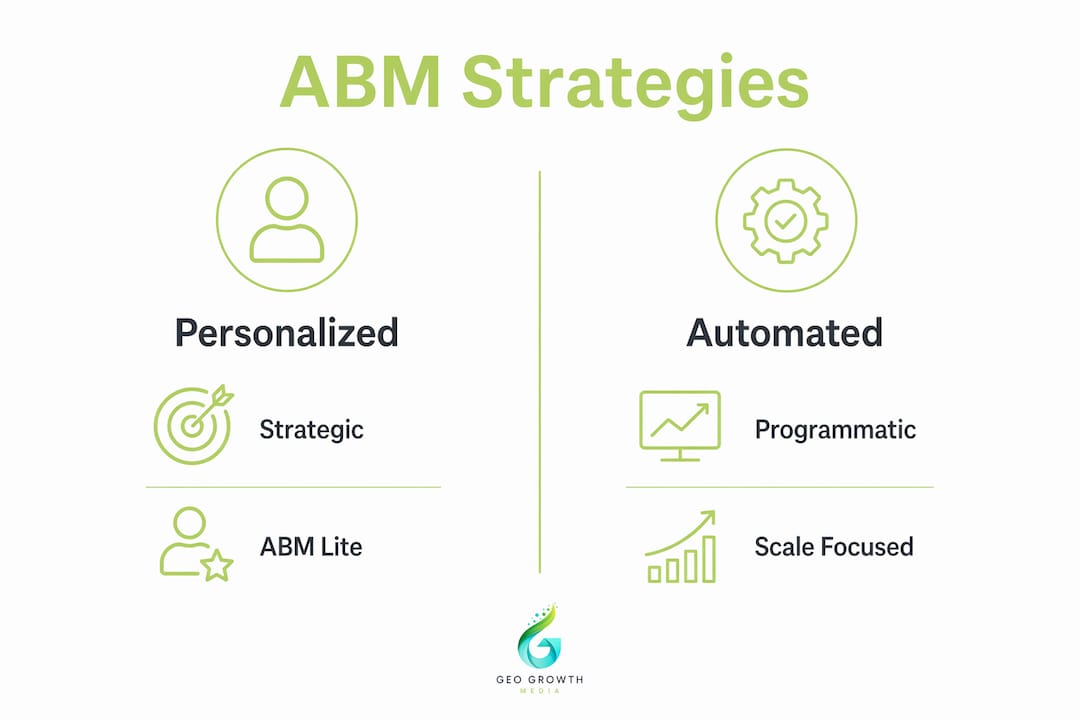
The three main ABM types are Strategic (one-to-one), ABM Lite (one-to-few), and Programmatic (one-to-many). Each differs in scale, personalisation depth, and resource intensity.
| ABM type | Scale | Personalisation | Resource intensity | Best for |
|---|---|---|---|---|
| Strategic (one-to-one) | 5–15 accounts | Fully bespoke | Very high | Top-tier enterprise targets |
| ABM Lite (one-to-few) | 15–100 accounts | Segment-level | Medium | Mid-market clusters |
| Programmatic (one-to-many) | Hundreds to thousands | Automated and data-driven | Lower per account | Broad named account lists |
Strategic ABM is the most resource-intensive tier. You build entirely custom content, campaigns, and outreach for each individual account. This makes sense when a single deal could be worth seven figures.
ABM Lite groups accounts by shared characteristics such as industry, company size, or technology stack. You personalise at the segment level rather than the individual account level. This is where most mid-market B2B teams start.
Programmatic ABM uses AI and automation to engage hundreds or thousands of accounts with personalised content, balancing scale and personalisation. It relies on platforms like Demandbase to serve the right message to the right account at the right moment without manual intervention for each one.
The most effective ABM teams segment accounts by tier and tailor resource investment accordingly. Jumping straight to one-to-one strategies across a large account list burns budget and team capacity fast.
What are the main benefits of account based marketing?
ABM delivers measurable improvements across the metrics that matter most to B2B revenue teams. The evidence is consistent and compelling.
“Organisations using ABM report an 86% improvement in sales win rates and up to 80% increase in customer lifetime value due to focused, relationship-driven engagement.”
That win rate improvement reflects what happens when sales and marketing stop competing for credit and start working from the same account list. ABM shortens sales cycles by 30–50% and achieves 2–4x higher close rates compared to traditional demand generation. Shorter cycles mean faster revenue and lower cost per acquisition.
The budget efficiency argument is equally strong. Traditional demand generation spends heavily on attracting leads that will never convert. ABM concentrates spend on accounts that already fit your ICP. Every pound of ad spend, every piece of content, and every sales call goes toward accounts with genuine potential.
ABM also produces larger average deal sizes. When you engage the full buying committee rather than a single champion, you reduce the risk of deals stalling because one stakeholder was never brought along. You can track data-driven campaign performance at the account level, which gives your team far clearer signals about where to focus next.
ABM vs inbound marketing: what is the difference?
ABM and inbound marketing are not opposites. They serve different purposes and work best when combined.
Traditional demand generation and inbound marketing cast wide nets. They attract as many leads as possible, then qualify them down through a funnel. The metric of success is the MQL. ABM flips this. You define the accounts first, then build campaigns to reach them.
Key differences at a glance:
- Funnel direction. Inbound pulls leads in. ABM pushes personalised outreach out to pre-selected accounts.
- Metrics. Inbound tracks MQLs. ABM tracks MQAs, account engagement scores, and pipeline velocity per account.
- Content purpose. Inbound content attracts broad audiences. ABM content speaks directly to the challenges of a specific account or segment.
- Sales involvement. ABM requires sales input from day one. Inbound often hands leads to sales only after qualification.
Inbound marketing supports ABM by generating content and traffic, but ABM limits the audience purposefully to best-fit accounts. Think of inbound as the engine that creates credibility and content assets, and ABM as the targeting layer that directs those assets at the right organisations.
Pro Tip: Do not dismantle your inbound programme when you launch ABM. Use your best-performing inbound content as the foundation for ABM personalisation. Repurpose, do not rebuild.
Shifting from MQLs to MQAs is critical for authentic ABM success. Teams that apply traditional lead metrics to ABM programmes consistently underreport results and lose executive buy-in early.
How to implement and scale an ABM programme
Successful ABM implementation starts with sales and marketing alignment. Shared goals, metrics, and target lists from the outset are non-negotiable. Without this, campaigns pull in different directions and accounts fall through the gaps.
Follow these steps to get your programme off the ground:
- Align sales and marketing on ICP and account tiers. Run a joint workshop before any campaign planning begins. Agree on what a tier-one account looks like and how many accounts each tier will contain.
- Start with a pilot. Resource intensity is higher per account in ABM than in traditional demand generation. A pilot of 10–20 accounts lets you test messaging, channels, and measurement before committing full budget.
- Build account-specific content. Each account tier needs content that speaks to its specific challenges. Generic content kills ABM programmes faster than anything else.
- Select your technology stack. Platforms like Demandbase handle intent data and ad targeting. ZoomInfo provides contact and firmographic data. Salesforce connects account activity to pipeline. You do not need all three on day one, but you do need clean data.
- Measure at the account level. Track account engagement scores, MQAs, pipeline created per account, and deal velocity. Use marketing performance metrics that reflect account progress, not individual lead activity.
Pro Tip: Run your first ABM pilot on accounts already in your CRM. You have existing data, warmer relationships, and a faster feedback loop. New logo ABM is harder and slower.
Deep data and analytics integration is what separates ABM programmes that scale from those that plateau. Real-time personalised outreach across multi-stakeholder buying committees requires your data, CRM, and campaign tools to talk to each other continuously.
Key takeaways
Account-based marketing delivers measurably higher ROI, shorter sales cycles, and better win rates because it concentrates resources on pre-qualified, high-value accounts rather than broad lead pools.
| Point | Details |
|---|---|
| ABM definition | ABM treats each target account as its own market, replacing broad lead generation with focused, personalised outreach. |
| Three ABM tiers | Strategic, ABM Lite, and Programmatic differ in scale and personalisation; match the tier to your account value and team capacity. |
| Measurable ROI | ABM programmes deliver 21–50% higher ROI and 2–4x higher close rates than traditional demand generation. |
| Sales and marketing alignment | Shared ICP, account lists, and metrics from day one are the foundation of any effective ABM programme. |
| Measurement shift | Replace MQL tracking with MQAs and account engagement scores to accurately reflect ABM performance. |
The uncomfortable truth about ABM adoption
From where Geo Growth Media sits, working with B2B teams across multiple sectors, the biggest ABM failure mode is not technology. It is patience. Teams launch ABM expecting the same volume metrics they got from inbound, then pull the plug after 90 days because the MQL count dropped. They are measuring the wrong thing entirely.
The second most common mistake is skipping the pilot phase. ABM is resource-intensive by design. Running one-to-one campaigns across 200 accounts simultaneously without testing your messaging first is like printing 200 bespoke proposals before you have had a single discovery call. It wastes budget and demoralises the team.
What actually works is starting small, measuring account engagement rather than lead volume, and letting the data tell you which tier each account belongs in. The teams that do this consistently report the win rate and deal size improvements the research describes. The teams that rush to scale before the model is proven rarely get there.
AI is changing the execution layer fast. Programmatic ABM tools now do in minutes what took weeks of manual segmentation. But the strategic thinking, the ICP definition, the account prioritisation, and the content quality still require human judgement. Technology scales good ABM. It cannot fix bad ABM.
— Geo Growth Media
How Geo Growth Media supports your ABM strategy
Running an effective ABM programme requires the right mix of paid media, content, and technical infrastructure working together across every channel your target accounts use.
Geo Growth Media builds and runs multi-channel digital marketing campaigns that align directly with ABM execution. From LinkedIn and Meta paid social to Google Ads and SEO, the team handles the channel layer so your internal team can focus on account strategy and sales alignment. Whether you are launching a pilot programme or scaling an existing ABM effort, Geo Growth Media brings the data, the creative, and the channel expertise to make it work. Explore the full range of services and see how targeted digital marketing can sharpen your account-level results.
FAQ
What is the account based marketing definition?
Account-based marketing is a B2B strategy that identifies specific high-value accounts and deploys personalised, multi-channel campaigns to every decision-maker within those accounts, rather than generating broad lead pools.
How does ABM differ from traditional lead generation?
Traditional lead generation attracts a wide audience and qualifies leads down through a funnel. ABM starts with a pre-qualified account list and builds campaigns outward, measuring success at the account level using MQAs rather than MQLs.
What tools are commonly used for ABM?
Platforms like Demandbase, ZoomInfo, and Salesforce are widely used for ABM. Demandbase handles intent data and targeting, ZoomInfo provides firmographic and contact data, and Salesforce connects account activity to pipeline reporting.
What is B2B account based marketing best suited for?
ABM works best for B2B organisations selling high-value products or services with long sales cycles and multiple stakeholders involved in the buying decision. It is equally effective for expanding existing accounts through upsell and cross-sell as it is for new customer acquisition.
How long does it take to see results from ABM?
ABM typically takes longer than inbound to show volume metrics because it focuses on fewer, higher-value accounts. Most teams see meaningful pipeline impact within two to three quarters, particularly when starting with a focused pilot of 10–20 accounts.


.png)