.png)

.svg)


Having a website isn’t enough anymore. Research reveals that 73% of small businesses have websites, yet many fail to generate meaningful results. The difference? Professional website design correlates with 53% higher success rates compared to amateur-built sites. For small and medium-sized business owners and marketing managers, understanding what separates effective design from digital deadweight is crucial for online growth. This guide explores why website design matters, how different approaches influence visitor behaviour, and practical steps you can implement to transform your site into a growth engine.
Table of Contents
- Key takeaways
- Understanding how website design impacts business success
- Different website design styles and their effects on first impressions
- Balancing aesthetics and functionality for effective website design
- Practical steps to enhance your website design for business growth
- Boost your online presence with professional website design services
- Frequently asked questions
Key Takeaways
| Point | Details |
|---|---|
| Professional design uplift | Professionally designed websites achieve about 53 per cent higher success rates than amateur builds. |
| First impressions matter | Visitors form quick judgements about credibility and trust based on design within five seconds, affecting whether they stay or leave. |
| UX and content drive conversions | User experience, clear content and intuitive navigation are key to guiding visitors toward conversions. |
| No single best style | Different design styles influence aesthetics and memorability, with context and audience mattering more than chasing a universal best. |
Understanding how website design impacts business success
Your website functions as a 24/7 storefront, representing your brand to every visitor who lands on your digital doorstep. When someone discovers your business online, they form immediate judgements about your credibility, professionalism, and trustworthiness based purely on design quality. These snap decisions determine whether they explore further or click away to a competitor.
The statistics paint a clear picture. Whilst 73% of small businesses operate websites, the quality gap separates winners from also-rans. Professionally designed sites report 53% higher success rates, demonstrating that investment in proper design directly correlates with business outcomes. Poor design doesn’t just fail to impress, it actively repels potential customers before they engage with your content or offerings.
Website design extends far beyond aesthetics. Consider these fundamental elements that drive business success:
- User experience (UX) determines how easily visitors accomplish their goals on your site
- Navigation structure influences whether users find information or abandon in frustration
- Loading speed affects both user satisfaction and search engine rankings
- Mobile responsiveness ensures consistent experience across devices
- Visual hierarchy guides attention toward your most important messages
Pro Tip: Think of your website as a silent salesperson. Would you hire someone who looks unprofessional, confuses customers, and makes simple tasks difficult? Your website deserves the same scrutiny you’d apply to any customer-facing team member.
Effective website design services recognise that design serves marketing objectives. Every colour choice, layout decision, and interactive element should support your conversion goals. When design aligns with strategy, websites become powerful tools for attracting qualified traffic, building trust, and converting visitors into customers. This synergy between design and marketing amplifies your SEO and business growth efforts, creating a virtuous cycle of visibility and performance.
“Professional website design isn’t an expense, it’s an investment in every future customer interaction. The difference between amateur and expert design shows up directly in your conversion rates and bottom line.”
Different website design styles and their effects on first impressions
Research examining how different designs influence first impressions reveals fascinating insights about user perception. Studies comparing three distinct design approaches (SCOFA, LAPIC, and SAPAT styles) found that each impacts aesthetics, memorability, and user judgement differently after just five seconds of exposure. Surprisingly, no single design style emerged as universally superior, suggesting that context and audience matter more than following rigid design trends.
First impressions form remarkably quickly online. Within five seconds, visitors make subconscious decisions about your site’s credibility, relevance, and appeal. These initial reactions influence whether users invest time exploring your content or immediately seek alternatives. Understanding how design elements shape these snap judgements helps you make strategic choices aligned with your brand and audience expectations.
| Design element | Impact on first impression | Strategic consideration |
|---|---|---|
| Colour scheme | Evokes emotional response and brand association | Match colours to industry expectations and brand personality |
| Layout structure | Affects perceived organisation and professionalism | Balance creativity with familiar patterns users recognise |
| Typography | Influences readability and perceived authority | Prioritise legibility over decorative fonts |
| White space | Creates breathing room or cluttered feeling | Use generously to guide attention and reduce overwhelm |
| Imagery | Establishes tone and authenticity | Choose relevant, high-quality visuals over generic stock photos |
Different industries and audiences respond to design styles differently. A creative agency might benefit from bold, unconventional layouts that showcase innovation, whilst a financial services firm typically needs conservative, trust-building design that emphasises stability. Your landing page design for conversion should reflect these audience-specific expectations whilst maintaining your unique brand identity.
Key factors that influence visitor perception include:
- Visual consistency across pages reinforces professionalism
- Loading animations or transitions can delight or frustrate depending on execution
- Content density affects whether sites feel informative or overwhelming
- Interactive elements signal modernity but must serve clear purposes
- Brand alignment ensures design supports rather than contradicts your message
Pro Tip: Test your website’s first impression by showing it to someone unfamiliar with your business for exactly five seconds, then asking what they remember and how they felt. Their immediate reaction reveals what your design actually communicates, which may differ from your intentions.
The relationship between design style and business success isn’t one-size-fits-all. Rather than chasing the latest design trends, focus on understanding your target audience’s preferences and expectations. A design that resonates with your specific customers whilst supporting your SEO strategy examples will outperform generic trendy designs every time.
Balancing aesthetics and functionality for effective website design
The eternal tension between beautiful design and practical usability challenges every website project. Striking the right balance requires understanding that aesthetics serve functionality, not the other way round. A visually stunning website that confuses users or obscures key information fails its primary purpose regardless of how impressive it looks in a portfolio.

Interesting research on balancing aesthetics and functionality reveals counter-intuitive findings. In certain trust-building scenarios, particularly for service-based businesses, simpler or even “ugly” authentic designs can convert better than polished corporate aesthetics. This challenges the assumption that more visual sophistication always improves results. Sometimes, straightforward clarity trumps design awards.
Common design elements that prioritise form over function include:
- Auto-playing slideshows that distract from core messages and slow page loads
- Parallax scrolling effects that look impressive but impair navigation
- Hidden navigation menus that sacrifice discoverability for minimalist aesthetics
- Tiny fonts or low-contrast text that strain readability for visual appeal
- Complex animations that delay access to actual content
Digital nudging techniques offer powerful tools for small and medium enterprises to guide visitor behaviour without manipulation. These behavioural design principles leverage psychology to make desired actions easier and more intuitive. Examples include placing call-to-action buttons in natural eye-path locations, using colour contrast to highlight important elements, and reducing form fields to minimise friction in conversion processes.
Pro Tip: Conduct a “grandmother test” on your website. If your grandmother (or any non-technical person) can’t figure out how to contact you or find key information within 30 seconds, your design prioritises aesthetics over functionality. Simplify ruthlessly until usability wins.
Professional website design recognises that every visual choice should serve user goals. This doesn’t mean abandoning creativity or brand personality. Rather, it means ensuring that creative expressions enhance rather than obstruct the user journey. Thoughtful website development services build this balance into every project phase, testing designs with real users before launch.
Practical strategies for achieving aesthetic-functional balance:
- Prioritise content hierarchy so users immediately identify what matters most
- Use white space strategically to create visual breathing room without wasting screen real estate
- Implement consistent branding elements that orient users without overwhelming them
- Choose typography that balances personality with readability across devices
- Test interactive elements with actual users to ensure intuitive operation
- Optimise images for visual impact and fast loading times simultaneously
For small businesses, behavioural design principles offer disproportionate advantages. Large enterprises can overcome design weaknesses through brand recognition and marketing budgets. SMEs need every visitor interaction to count, making thoughtful behavioural cues essential for guiding prospects toward conversion without heavy-handed sales tactics.
Practical steps to enhance your website design for business growth
Transforming website design theory into business results requires systematic implementation. These actionable steps provide a framework for small and medium business owners and marketing managers to improve their digital presence progressively, even with limited budgets or technical expertise.
- Audit your current website from a visitor’s perspective, identifying friction points where users might struggle or abandon
- Implement responsive design ensuring consistent, optimised experiences across mobile phones, tablets, and desktop computers
- Prioritise page speed by compressing images, minimising code, and choosing reliable hosting that supports fast loading
- Simplify navigation to three to five main menu items, with logical subcategories that match how users think about your offerings
- Create clear calls-to-action on every page, guiding visitors toward their next logical step in the customer journey
- Add trust signals including customer reviews, industry certifications, security badges, and transparent contact information
- Test design changes with real users through informal feedback sessions or formal usability testing before full implementation
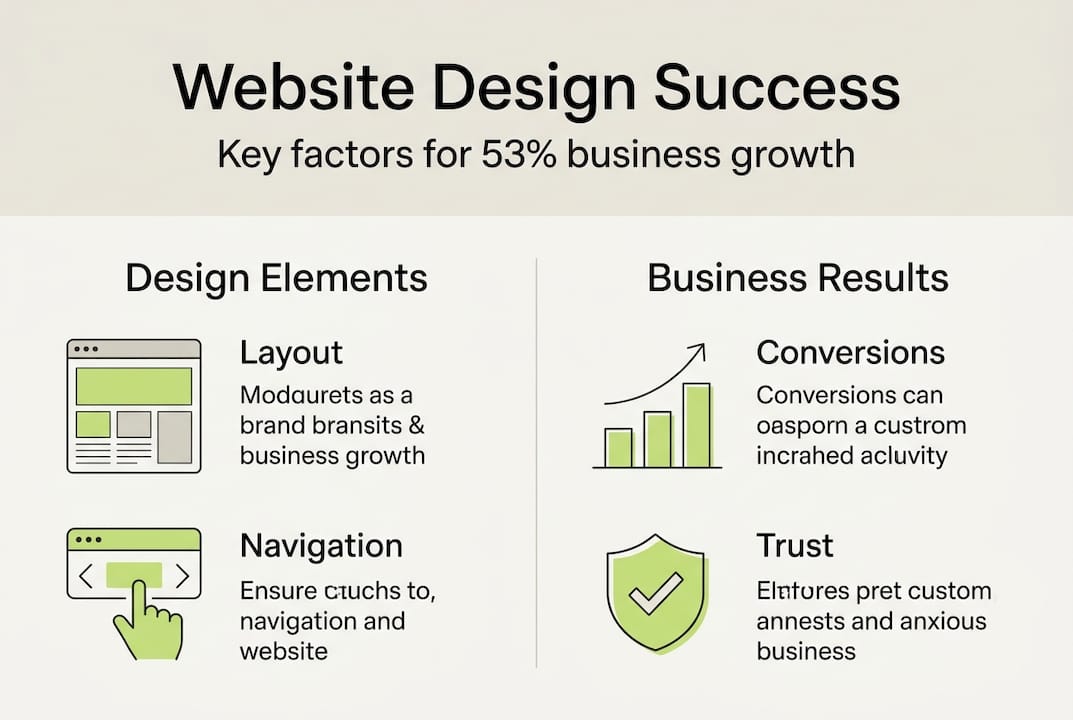
The connection between professional design and business outcomes becomes clear in conversion data. Sites with professionally designed elements report 53% higher success compared to amateur-built alternatives. This performance gap translates directly into leads, sales, and revenue for businesses that invest in proper design.
| Design improvement | Expected impact | Implementation priority |
|---|---|---|
| Mobile optimisation | 40-60% of traffic now mobile | Critical, immediate |
| Page speed under 3 seconds | Reduces bounce rate by 32% | High, within 1 month |
| Clear calls-to-action | Increases conversions 20-30% | High, within 2 weeks |
| Trust signals visible | Improves credibility perception | Medium, within 1 month |
| Simplified navigation | Reduces user frustration | Medium, ongoing |
| Accessibility compliance | Expands audience, improves SEO | Medium, within 3 months |
Analytics provide essential feedback for design decisions. Rather than relying on opinions or assumptions, track actual user behaviour through metrics like bounce rate, time on site, pages per session, and conversion rates for specific goals. These data points reveal which design elements work and which create obstacles, enabling evidence-based improvements over time.
Understanding your marketing managers’ digital role helps coordinate design improvements with broader strategy. Website design doesn’t exist in isolation but integrates with content marketing, SEO for small business growth, and paid advertising efforts. Coordinated improvements across these channels amplify results beyond what isolated changes achieve.
Accessibility deserves special attention in modern website design. Creating sites that work for users with disabilities isn’t just ethically important, it expands your potential audience and improves SEO performance. Simple improvements like proper heading structure, alt text for images, and keyboard navigation support make your site more usable for everyone whilst signalling quality to search engines.
Pro Tip: Implement changes incrementally rather than attempting a complete redesign all at once. Small, tested improvements reduce risk whilst building momentum. Track performance before and after each change to identify what actually moves your specific business metrics.
For businesses exploring advanced strategies, techniques from B2B upselling strategies can inform design choices that encourage higher-value engagements. Design elements that showcase premium offerings, simplify upgrade paths, and highlight value differences support revenue growth beyond basic conversion optimisation.
Boost your online presence with professional website design services
Implementing these website design principles transforms theory into tangible business growth, but execution requires expertise, time, and ongoing optimisation. Professional support accelerates results whilst avoiding costly mistakes that amateur approaches often encounter.
Geo Growth Media specialises in creating professional website design services tailored specifically for small and medium-sized businesses seeking measurable online growth. Our approach combines aesthetic excellence with conversion-focused functionality, ensuring your website doesn’t just look impressive but actively drives leads and sales. We position ourselves as an extension of your in-house marketing team, delivering personalised strategies aligned with your specific goals, sector requirements, and budget realities.
Our comprehensive digital marketing services integrate website design with SEO, paid advertising, and content strategy for maximum impact. This holistic approach ensures your beautifully designed website attracts qualified traffic and converts visitors efficiently. From initial website development services through ongoing optimisation, we focus on measurable results, transparency, and continuous improvement that increases your ROI over time.
Frequently asked questions
How does website design affect customer trust?
Professional, clean design immediately signals credibility and reliability to visitors, establishing confidence before they read a single word. Conversely, outdated or cluttered sites trigger subconscious doubt about business legitimacy, often causing potential customers to seek alternatives rather than risk engagement. Trust-building design elements include security badges, clear contact information, professional photography, and consistent branding throughout the site.
What are the key elements of effective website design for small businesses?
Prioritise user-friendly navigation that helps visitors find information quickly, responsive design that works flawlessly across devices, and fast loading times under three seconds. Include clear calls-to-action guiding users toward desired next steps, prioritised content addressing customer needs first, and consistent branding that reinforces your professional identity. Trust signals like reviews, certifications, and transparent policies complete the foundation for effective small business website design.
How can I measure if my website design is successful?
Track user behaviour through analytics metrics including bounce rate (percentage leaving immediately), average time on site, and pages per session to gauge engagement levels. Measure conversion rates for specific goals like contact form submissions, phone calls, or purchases to quantify business impact directly. Gather qualitative feedback through user surveys and conduct periodic usability testing with representative customers to identify friction points analytics might miss.
Should I redesign my entire website or make incremental improvements?
Incremental improvements typically deliver better results with lower risk compared to complete redesigns, allowing you to test changes and measure impact progressively. Full redesigns make sense when your current site suffers from fundamental structural problems, outdated technology, or brand repositioning requirements. For most small businesses, strategic incremental updates based on user data and business priorities prove more cost-effective and less disruptive than periodic complete overhauls.
How often should I update my website design?
Minor updates addressing user feedback, content freshness, and performance optimisation should occur continuously throughout the year. Significant design refreshes typically make sense every two to three years to maintain modern standards and incorporate evolved best practices. However, let data rather than arbitrary timelines drive major changes, updating when analytics reveal declining performance or user behaviour shifts rather than following fixed schedules disconnected from actual business needs.


.png)