.png)

.svg)




TL;DR:
- A well-developed website enhances credibility, traffic, and conversions, driving business growth.
- Growth-Driven Design enables continuous improvement, resulting in higher traffic and conversion rates.
- Speed, scalability, and security are critical for retaining users and supporting long-term expansion.
A website without strategy is like a shop with no signage, no lighting, and no staff. Plenty of businesses invest in getting online, then wonder why the sales don’t follow. The reality is that web development drives growth through enhanced online presence, improved conversions, and scalable digital storefronts. It’s not about having a site. It’s about having the right one. In this guide, we’ll walk through the specific web development strategies that separate high-growth SMEs and e-commerce brands from those that stagnate, covering performance, scalability, security, and design methodology.
Table of Contents
- Why web development is crucial for business growth
- Traditional redesigns vs. Growth-Driven Design: Which fuels better results?
- Mastering performance: Why speed and user experience drive conversions
- Scalability and security: Preparing your web presence for lasting growth
- Practical steps: How SMEs and e-commerce brands can maximise web ROI
- The overlooked truth: Sustainable growth requires more than digital quick-fixes
- Accelerate your growth with expert web development support
- Frequently asked questions
Key Takeaways
| Point | Details |
|---|---|
| Strategy beats appearance | Growth-driven and evidence-led web development yields better ROI than static, appearance-focused redesigns. |
| Performance drives profits | Faster websites with superior UX can dramatically increase conversion rates and online sales. |
| Sustainability needs planning | Scalable and secure infrastructure is mandatory to support long-term business growth. |
| Continuous improvement wins | Iterative changes and ongoing analytics integration keep web presence aligned with market demand. |
| Expert support accelerates success | Partnering with skilled web and marketing professionals streamlines implementation and maximises results. |
Why web development is crucial for business growth
For SMEs and e-commerce managers, the question is rarely whether to invest in a website. It’s whether that investment is working hard enough. A well-built site does far more than display products or services. It builds credibility, drives organic traffic, enables multichannel selling, and gives you the data to make smarter decisions.
The numbers back this up. E-commerce sales are projected to rise from $5.2 trillion in 2023 to $10.8 trillion by 2027. That’s a market doubling in size, and the businesses positioned to capture that growth are those with robust, scalable web infrastructure in place today. Meanwhile, web development boosts online presence and conversion rates in ways that traditional offline expansion simply cannot match at the same cost.
Here’s what strategic web development actually delivers:
- Credibility and trust: A professionally built site signals legitimacy to first-time visitors
- Wider reach: SEO-optimised architecture helps you rank and attract organic traffic
- Multichannel sales: Integrate with marketplaces, social shops, and email seamlessly
- Actionable analytics: Track digital marketing analytics and refine what’s working
- Scalability: Grow without rebuilding from scratch every two years
| Metric | Benchmark | Business impact |
|---|---|---|
| Conversion rate improvement | Up to 200% with UX-focused redesign | Direct revenue lift |
| E-commerce market growth | $5.2T to $10.8T by 2027 | Massive opportunity window |
| Cost vs. offline expansion | Significantly lower per customer acquired | Improved margins |
| Organic traffic growth | 20%+ with optimised architecture | Reduced paid ad dependency |
Understanding the importance of website design is the first step. Executing it consistently is where most SMEs fall short.
Traditional redesigns vs. Growth-Driven Design: Which fuels better results?
Most businesses approach web development the traditional way: commission a full redesign every three to five years, spend months in development, launch, and hope for the best. It’s expensive, slow, and often obsolete before the site even goes live. Markets shift. Customer behaviour changes. What felt cutting-edge in the planning phase can feel dated by launch day.
Growth-Driven Design (GDD) flips this model entirely. Instead of one large, high-risk project, GDD launches a lean, high-impact site quickly, then uses real user data to make continuous, evidence-based improvements. It’s iterative by design, which means your site evolves alongside your business rather than lagging behind it. Research shows that GDD increases traffic by 20% and conversions by 15% compared to traditional redesigns.
For growth for e-commerce brands, this approach is particularly powerful. You’re not betting everything on a single launch. You’re learning what your customers actually respond to, then doubling down on it.
“Businesses that treat their website as a living asset, not a finished product, consistently outperform those that don’t. The data always tells you what to do next.”
Pro Tip: If your business model evolves frequently, or if you’re in a competitive sector where customer expectations shift fast, GDD is almost always the better choice over a traditional static redesign.
| Factor | Traditional redesign | Growth-Driven Design |
|---|---|---|
| Upfront cost | High | Lower, spread over time |
| Time to launch | 3 to 6 months | 4 to 8 weeks |
| Risk level | High (big bet) | Low (iterative) |
| Adaptability | Low | High |
| Conversion impact | Variable | Up to 15% improvement |
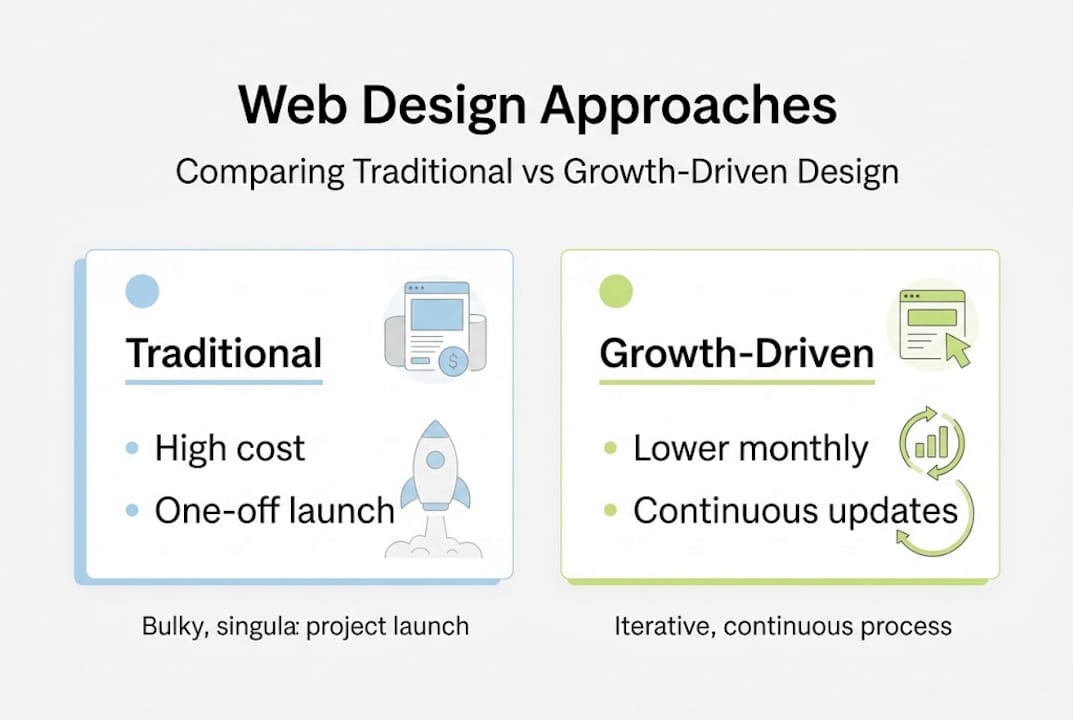
Studies on platform efficiency and innovation confirm that iterative digital investment consistently outperforms one-off projects in both ROI and long-term resilience. The website design for ecommerce decisions you make today should be built to evolve, not expire.
Mastering performance: Why speed and user experience drive conversions
You can have the most beautifully designed website in your sector. If it loads slowly, users will leave before they ever see it. Speed isn’t a technical nicety. It’s a commercial necessity.

Google’s Core Web Vitals set the benchmark. Largest Contentful Paint (LCP) measures loading speed and should be under 2.5 seconds. Interaction to Next Paint (INP) measures responsiveness and should stay below 200 milliseconds. Cumulative Layout Shift (CLS) measures visual stability and should remain under 0.1. These aren’t arbitrary numbers. They directly affect both your search rankings and your users’ willingness to stay and buy.
The conversion cost of poor performance is stark. Every second of delay reduces conversions by 7%. For an e-commerce store turning over £500,000 annually, a two-second delay could be costing you £70,000 or more in lost revenue every year.
Real-world cases reinforce this. Rakuten 24 improved LCP by 53% and saw a 33% increase in revenue per visitor. Tokopedia reduced load time and achieved a 23% increase in conversion rates. These aren’t outliers. They’re what happens when performance marketing strategies are backed by fast, stable infrastructure.
Pro Tip: The quickest wins in site speed are almost always image optimisation and browser caching. Compress images to WebP format and set long cache expiry times before touching anything else.
Here are the most impactful steps to improve performance:
- Compress and convert images to modern formats like WebP
- Enable browser caching and use a content delivery network (CDN)
- Minify CSS, JavaScript, and HTML files
- Reduce server response time by upgrading hosting or using edge servers
- Audit and remove unused third-party scripts
Applying these changes to your landing page design and key conversion pages first will deliver the fastest commercial return. Then use tools like Google PageSpeed Insights to optimise landing pages across the rest of your site.
Scalability and security: Preparing your web presence for lasting growth
Growth creates its own problems. A campaign goes viral, a product gets featured in the press, or a seasonal surge hits harder than expected. If your infrastructure can’t handle the spike, you lose the very customers you worked so hard to attract.
62% of high-growth companies outgrow their website architecture within 24 months. That’s not a technical problem. It’s a business risk. Downtime during peak demand is one of the most expensive mistakes an e-commerce brand can make, both in lost sales and in long-term customer trust.
Scalable architecture means building with growth in mind from the start. Modular design, edge computing, and intelligent caching allow your site to handle traffic surges without grinding to a halt. Cloud hosting with auto-scaling capabilities means you only pay for what you use, while staying ready for demand spikes.
Security is equally non-negotiable. A breach doesn’t just cost money in remediation. It destroys the trust you’ve spent years building. Implement HTTPS, OWASP Top 10 defences, and data encryption as foundational requirements, not optional extras.
“The cost of a security breach or unexpected downtime almost always exceeds the cost of preventative infrastructure investment. Build it right the first time.”
Core scalability and security practices every SME should implement:
- Use cloud hosting with auto-scaling to handle traffic surges
- Implement a CDN to distribute load and reduce latency globally
- Enforce HTTPS across every page, not just checkout
- Apply OWASP Top 10 security controls to protect against common vulnerabilities
- Encrypt all customer and payment data at rest and in transit
- Schedule regular security audits and penetration testing
Your website design for lead generation efforts will only pay off if the infrastructure underneath can support sustained demand without failing.
Practical steps: How SMEs and e-commerce brands can maximise web ROI
Knowing what good looks like is one thing. Building a clear plan to get there is another. Here’s a practical framework to help you prioritise and execute.
Digitalisation and optimised technology investment can drive a 3x EBITDA lift for SMEs. That’s not a marginal gain. It’s a transformational one. But it requires deliberate, structured investment rather than reactive spending.
Follow these steps to build a growth-oriented web development strategy:
- Self-audit your current site: Assess speed, mobile usability, security, and conversion rates using free tools like Google Search Console and PageSpeed Insights
- Choose your methodology: Decide between a traditional redesign or GDD based on your budget, timeline, and how frequently your business model evolves
- Prioritise performance: Fix Core Web Vitals issues before investing in new features or design elements
- Lock down security: Implement HTTPS, encryption, and OWASP controls before scaling traffic
- Integrate analytics from day one: Set up goal tracking in Google Analytics 4 and connect it to your digital marketing optimisation efforts
- Iterate consistently: Review performance data monthly and make incremental improvements rather than waiting for the next big redesign
Pro Tip: If you’re on Shopify or a similar platform, use built-in analytics alongside third-party tools to track the full customer journey, from first visit to repeat purchase. Small improvements in each stage compound quickly.
Even a 10% improvement in conversion rate, combined with a 10% reduction in page load time, can meaningfully shift your revenue without increasing your ad spend.
The overlooked truth: Sustainable growth requires more than digital quick-fixes
Here’s something we see repeatedly: businesses invest in a new website, see a short-term traffic spike, then watch results plateau within six months. They assume the strategy failed. In reality, they stopped too soon.
Quick wins are real. A faster site, a cleaner layout, a better checkout flow. These improvements create genuine lifts. But they are not a destination. They are the beginning of an ongoing process. The brands that sustain growth are those that treat their website as a living system, not a finished project.
Markets shift. Algorithms update. Customer expectations rise. What converted well in 2024 may underperform in 2026. The only reliable response is continuous iteration backed by data. Not chasing every new trend, but consistently measuring, learning, and improving.
We’d encourage you to explore marketing growth insights that go beyond surface-level tactics. The businesses we see achieve lasting results are those that build web development into their ongoing marketing rhythm, not treat it as a one-off project to be ticked off and forgotten.
Accelerate your growth with expert web development support
If the strategies in this guide resonate but the execution feels overwhelming, you don’t have to figure it out alone. Geo Growth Media works with SMEs and e-commerce brands as an extension of their marketing team, bringing targeted web development and digital strategy together in one place.
From website development services built around your growth goals to fully integrated digital marketing solutions that connect your site to paid media, SEO, and analytics, we tailor every engagement to your sector, budget, and ambitions. If you’re in e-commerce, explore how we support digital marketing for ecommerce brands specifically. Get in touch today to discuss where your web presence is leaving growth on the table.
Frequently asked questions
How does web development directly impact sales growth?
Effective web development improves visibility, user experience, and conversion rates, all of which lift online revenue directly for SMEs and e-commerce brands.
What is Growth-Driven Design and should I use it?
Growth-Driven Design is an iterative approach that launches quickly then improves using real user data; it delivers a 20% traffic and 15% conversion improvement over traditional redesigns and suits most growth-focused businesses.
Why is website speed so critical for conversions?
Slower load times cause users to abandon your site, with each second of delay reducing conversions by up to 7%, making speed one of the highest-ROI improvements you can make.
How can SMEs make their sites scalable as they grow?
Adopt modular, cloud-based architectures with auto-scaling and CDN support; 62% of high-growth companies outgrow their infrastructure within 24 months without this planning.
What web security basics should not be overlooked?
Implement HTTPS sitewide, apply OWASP Top 10 defences, and encrypt all customer data to protect trust and prevent costly breaches.


.png)