.png)

.svg)



TL;DR:
- Ad creatives are now the primary engine of performance, guiding platforms to target audiences effectively.
- Focusing on one clear message and iterating proven concepts sustains successful campaigns and improves conversions.
Ad creatives are no longer just the pretty packaging around your message. They are the engine. The role of ad creatives has shifted dramatically as platforms like Meta, TikTok, and LinkedIn have moved away from precise demographic targeting toward machine learning models that read your creative itself to decide who sees it. If you have been treating creative production as a downstream task, something to tick off after strategy is done, you are leaving serious performance on the table. This guide covers what actually makes effective ad creatives, how platforms judge them, and how to build a system that keeps your campaigns fresh and converting.
Table of Contents
- Key takeaways
- The role of ad creatives in 2026
- Creative elements that actually move conversions
- Building a creative pipeline, not a creative pile
- How platforms score your creative quality
- Designing for how people actually consume ads
- Our perspective on creative strategy
- Work with a team that gets creative strategy right
- FAQ
Key takeaways
| Point | Details |
|---|---|
| Creatives are now targeting signals | On platforms like Meta, the creative itself tells the algorithm who to find, making quality non-negotiable. |
| Single message per ad wins | One focused message per creative improves signal clarity and algorithm learning, not a mix of claims. |
| Iteration beats reinvention | A 70/30 split between iterating proven concepts and testing new ones sustains performance without burning budget. |
| Platform metrics measure creative quality | Google’s Ad Strength and similar scores directly affect delivery priority and impression share. |
| Post-click experience matters too | A strong creative that leads to a weak landing page loses the sale; both must be aligned. |
The role of ad creatives in 2026
Ask most marketers what drives paid social performance and they will say targeting or budget. Both matter. But creative quality is structural, not supplementary. Poor creative undermines even the most sophisticated bidding strategy.
An ad creative is not just an image or a video. It encompasses every element a user encounters before and during their interaction with your ad:
- Visual assets: images, videos, carousels, and thumbnails
- Copy: headline, body text, and call to action
- Overlays: text on video, captions, and graphic elements
- Brand signals: logos, colour palettes, and tone of voice
- Page identity: the sender name and profile presentation
- Post-click experience: the landing page the ad leads to
All of these components work together. Strip any one of them out and you change the signal the platform receives.
Meta’s Andromeda shift has made this impossible to ignore. The platform now uses creative content as a primary targeting input, meaning the algorithm reads your visuals, copy, and format to determine which users are most likely to respond. You are not just targeting an audience. You are sending a signal about the audience through what you create.

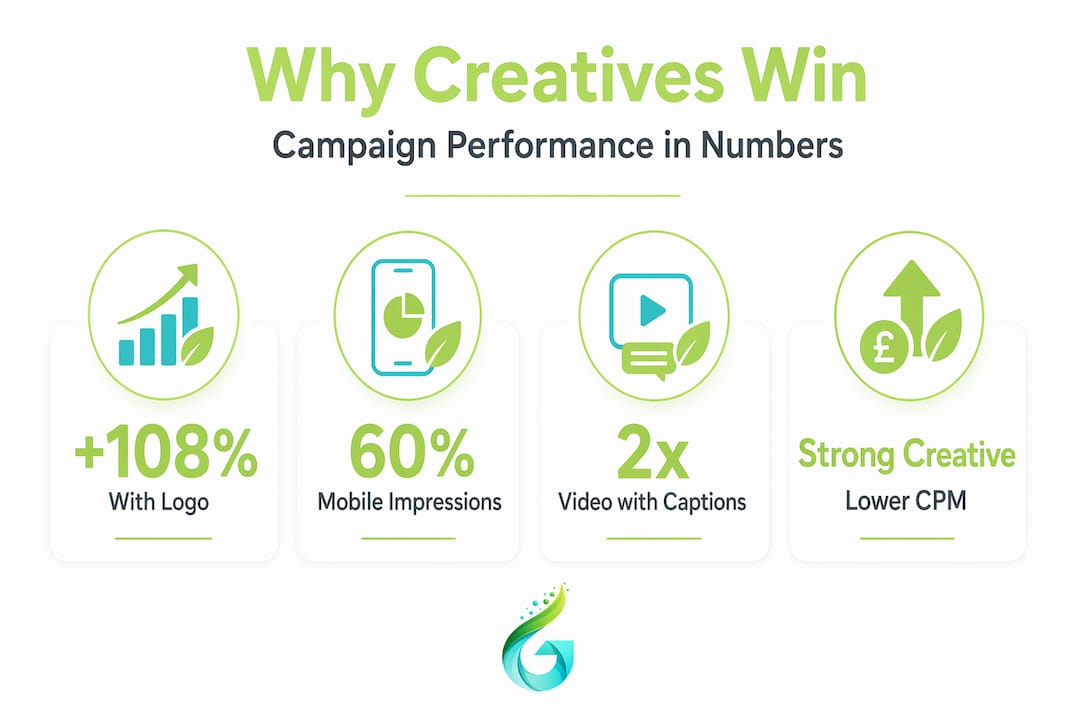
Beyond Meta, the numbers underline why this matters at a practical level. Over 60% of impressions on mobile feeds are consumed with sound off, so anything relying purely on audio is already fighting a losing battle. Your creative must communicate with and without sound. That is not a design preference; it is a structural requirement for modern campaign delivery.
When your creative is strong, platforms reward you with broader delivery at more efficient CPMs. When it is weak, your bids go further just to achieve the same reach. Creative quality is, in effect, part of your auction strategy, even when you do not think of it that way.
Creative elements that actually move conversions
Gut feel has a poor track record in creative decisions. The good news is that data from real campaigns now provides clear guidance on which elements move the needle.
| Creative element | Effect on conversion | Condition |
|---|---|---|
| Brand logo in image ads | +108% conversion rate | Logo present vs. absent |
| Video overlay text/captions | +8.2% conversion | Sound-off environments |
| Image text overlays | -13% conversion | General use |
| Urgent image overlays | Positive uplift | Time-limited offers |
| Short-form video under 6 seconds | Higher average CVR | Mobile-first placements |
| 4:5 aspect ratio video | Outperforms square and widescreen | Reddit and vertical feeds |
A few of these findings cut against common instinct. Many designers resist cluttering images with text, and in most cases, image text overlays reduce conversions by around 13%. The exception is urgency-led copy like “Ends Sunday” or “Last 48 Hours,” which can reverse that effect entirely.
Logo placement is worth treating as a non-negotiable. A brand logo in an image ad correlates with a 108% higher conversion rate. That is not a marginal gain. It reflects the trust and recognition signals a logo provides, especially in a fast-scrolling feed where users make split-second judgements.
For video, captions pay for themselves. With the majority of mobile viewing happening without sound, video overlay text keeps your message intact regardless of playback environment. Short-form video under six seconds consistently delivers stronger conversion rates on mobile placements. Pair that with a 4:5 aspect ratio and you are working with the format the platform prefers, not against it.
Research into attention capture also confirms that dynamic designs outperform static for holding viewer focus, though combining heavy colour and motion can tip into cognitive overload. Movement draws the eye; too much of it sends the viewer scrolling past.
Pro Tip: Test your video ads with the sound muted before publishing. If the core message is lost without audio, add captions or rethink the visual story. What passes the silent test converts better across all placements.
Building a creative pipeline, not a creative pile
Most brands treat ad creatives as deliverables: produce a batch, run them, repeat. The problem is that this approach has no memory. When a creative works, there is no system for understanding why. When it stops working, there is no framework for what comes next.
The shift from “creative as file” to “creative as system” is where sustained campaign performance is actually built. Here is how to structure that system:
-
Anchor on one message per creative. Meta’s guidance is explicit: one core message per ad. When you try to communicate three benefits in a single ad, the algorithm struggles to classify who it is for, and users process it as noise. Pick the single most relevant hook for the audience and let it breathe.
-
Apply the 70/30 split. A creative freshness approach that allocates 70 to 80% of creative production to iterating proven concepts, and 20 to 30% to genuinely new ideas, keeps performance stable while testing new territory. Iteration might mean different copy angles on a winning visual, or new hooks on a proven format. Exploration means a completely different creative concept.
-
Build a winning concepts library. When a creative performs well, document what made it work. Was it the hook? The offer? The format? This library becomes the foundation for your iteration budget. Without it, you are starting from scratch every time, which is expensive and slow.
-
Generate genuinely distinct concepts. Shallow variants waste budget. Swapping a caption on an otherwise identical creative does not generate new learning for the algorithm. It just splits delivery across what the machine sees as the same ad. Distinct concepts require different visual stories, different hooks, or different emotional angles. That is what feeds platform learning properly.
-
Track fatigue, not just performance. Creatives do not fail overnight. Frequency rises, CTR dips, and CPAs creep up before collapse. Monitoring these signals weekly, rather than waiting for a dramatic drop, gives you time to introduce fresh assets before performance suffers.
If you want a practical framework for scaling ads without losing ROI, the same principles apply across paid social and search.
Pro Tip: When a creative stops performing, do not delete it. Archive it with performance notes. Seasonality and audience refreshes can make a previously exhausted creative effective again six months later.
How platforms score your creative quality
Understanding how digital platforms evaluate your creative assets is not optional knowledge. It directly affects whether your ads win impressions at a competitive price.
Google Ads uses a metric called Ad Strength for Responsive Search Ads and Performance Max campaigns. It evaluates three things:
- Quantity: Are you providing enough assets per type? Google recommends uploading up to the maximum per asset type, for instance, four text variants, twenty images, and twenty videos for App campaigns.
- Diversity: Do your assets use different messaging angles, or do they repeat the same point? Distinct and diverse assets boost impressions by approximately 15%, directly improving CPC efficiency.
- Relevance: Do the assets align with what users are searching for and what the landing page delivers?
Ad Strength is not the same as Quality Score. Quality Score reflects keyword relevance and expected CTR in search. Ad Strength reflects creative completeness and variety within responsive formats. Both matter for campaign delivery and auction priority, but they measure different things.
A common mistake is treating asset quantity as the goal. Adding combinations without improving the core persuasive message reduces impact. A high asset count with five variations of the same weak headline is worse than three genuinely strong, distinct headlines. The platform can generate more combinations, but none of them will perform.
Designing for how people actually consume ads
You can have the right message and the wrong format. In 2026, the format is inseparable from performance.
The modern consumer encounters ads in a predominantly mobile, fast-scrolling, often sound-off environment. Designing for desktop first and adapting for mobile is working backwards. Here is what designing for actual consumption looks like:
- Vertical first. Vertical formats (9:16 for Stories and Reels, 4:5 for feed placements) take up more screen real estate on mobile and consistently outperform square or landscape on mobile-first platforms.
- Hook within three seconds. Short video ads must capture attention in 1.5 to 3 seconds. Open with the most compelling element, whether that is a bold visual, a provocative statement, or an immediate demonstration of the product in use. Slow builds do not survive the scroll.
- Caption everything. Captions are not just an accessibility feature. They are a performance tool in a world where mobile viewing is predominantly sound-off. Every video ad should have captions, full stop.
- Lead with and close with branding. Show the logo in early frames and return to it at the end. This gives the brand recall benefit regardless of how far a viewer gets through the video.
- Use movement deliberately. Dynamic design captures attention more effectively than static. But motion paired with complex colour schemes creates cognitive load that sends people scrolling. One dominant movement or animation at a time.
“Attention is the scarce resource in modern advertising. Your creative is not competing with other ads. It is competing with friends, family, and everything else in the feed.”
For more on the wider performance marketing context, understanding how creative fits into a full-funnel approach helps avoid the trap of optimising creatives in isolation.
Our perspective on creative strategy
In my experience working across paid social campaigns, the biggest shift in results rarely comes from changing the budget or the targeting. It comes from treating creatives as a system rather than a task.
I have seen brands spend weeks debating whether to refresh a struggling campaign with new audience segments, only to discover that a single creative swap produces the improvement they were looking for. The creative was the bottleneck. It usually is.
What I have learnt is that the temptation to produce more variants is not the same as producing better ones. I have watched agencies churn out fifteen caption swaps on a single image and call it creative testing. That is not testing. That is noise the algorithm clusters together and delivers as one idea, not fifteen. Genuine testing requires genuinely different concepts.
The post-click experience is also consistently underestimated. I have reviewed campaigns where a compelling ad drove strong CTRs but weak conversion. The creative was doing its job. The landing page design was not. You cannot separate them.
My honest advice for sustaining creative freshness without burnout: build the library before you need it. Document what works, why it worked, and what audience it worked for. When fatigue hits, which it always does, that library is what keeps you moving without starting from a blank page.
— Geo Growth Media
Work with a team that gets creative strategy right
If you have recognised gaps in how your business approaches creative production and testing, you do not have to sort it out alone.
At Geo Growth Media, we treat paid social campaigns as a full system, from creative concept and production to testing frameworks, audience strategy, and performance reporting. We work with ambitious brands across Meta, TikTok, and LinkedIn to build creative pipelines that sustain results, not just launch them. Our approach also covers landing page design and SEO to make sure the full journey converts, not just the ad itself. Get in touch to find out how we can support your next campaign.
FAQ
What is the role of ad creatives in digital campaigns?
Ad creatives function as the primary performance lever in modern digital advertising. On platforms like Meta, the creative content itself signals to the algorithm which audience to target, making quality and relevance central to delivery and conversion outcomes.
How do ad creatives influence sales?
Strong creatives build trust, communicate value quickly, and guide users toward a purchase decision. Research shows that brand logos in image ads correlate with 108% higher conversion rates, demonstrating how creative elements directly affect the bottom line.
How often should you refresh ad creatives?
Monitor frequency, CTR, and CPA weekly. When frequency rises and CTR falls, introduce fresh creative assets rather than waiting for a sharp performance drop. A 70/30 iteration to exploration split helps sustain freshness without constant reinvention.
What makes an effective ad creative for mobile?
Vertical formats, captions, a strong hook within three seconds, and prominent branding in early and closing frames are the foundations of effective mobile creative. Short-form video under 6 seconds consistently outperforms longer formats on mobile-first placements.
What is Google Ad Strength and why does it matter?
Ad Strength is Google’s measure of the quantity, diversity, and relevance of your responsive ad assets. Higher scores correlate with better impression share and more efficient CPC delivery, making it a practical creative quality benchmark for search and Performance Max campaigns.


.png)