.png)

.svg)




Most business owners invest heavily in content, social media, and paid advertising, then wonder why organic traffic refuses to grow. The answer is often invisible: your website’s technical foundation. Technical SEO is the process of optimising a website’s infrastructure so search engines can efficiently crawl, render, index, and rank your content. Without it, even brilliantly written pages can vanish from search results entirely. This guide covers what technical SEO is, why it matters for small and medium-sized businesses, how to audit your site, and which issues to prioritise for maximum impact.
Table of Contents
Key Takeaways
PointDetailsTechnical SEO is essentialWithout technical optimisation, even the best content may never be discovered by search engines.Prioritise Core Web VitalsImproving site speed and mobile-friendliness delivers a high return on investment for SMBs.Audit and iterate regularlyTechnical SEO requires ongoing monitoring and updates to stay aligned with changing best practices.Integrate with marketingMake technical SEO an integral part of your overall digital marketing strategy for best results.
Looking for the best place to start? Our SEO services can support you at every stage.
What is technical SEO and why does it matter?
There is a persistent misconception in the marketing world: SEO is simply about choosing the right keywords and publishing enough content. In reality, content is only half the equation. If search engines cannot access, read, or understand your website, your content might as well not exist. Technical SEO addresses the backend infrastructure that makes discovery possible.
Think of it like a library. Your content is the books, but technical SEO is the cataloguing system, the shelving, and the lighting. Without those, no reader, or search engine, can find what they need.
“Technical SEO is the backbone that enables content discovery. Without it, even the highest-quality pages remain invisible to search engines and potential customers.”
The core pillars of technical SEO include:
For an SMB, neglecting these areas has real consequences. A slow, poorly structured website will consistently underperform competitors in search results, regardless of how strong the content is. Businesses that align digital marketing strategies with a solid technical foundation see compounding returns over time. Reviewing SEO strategy examples from comparable businesses often reveals that technical improvements were the turning point in organic growth.

Key components of technical SEO for business websites
Understanding what technical SEO covers is one thing. Knowing how each component affects your site is another. Here is a breakdown of the essential elements and their performance benchmarks.
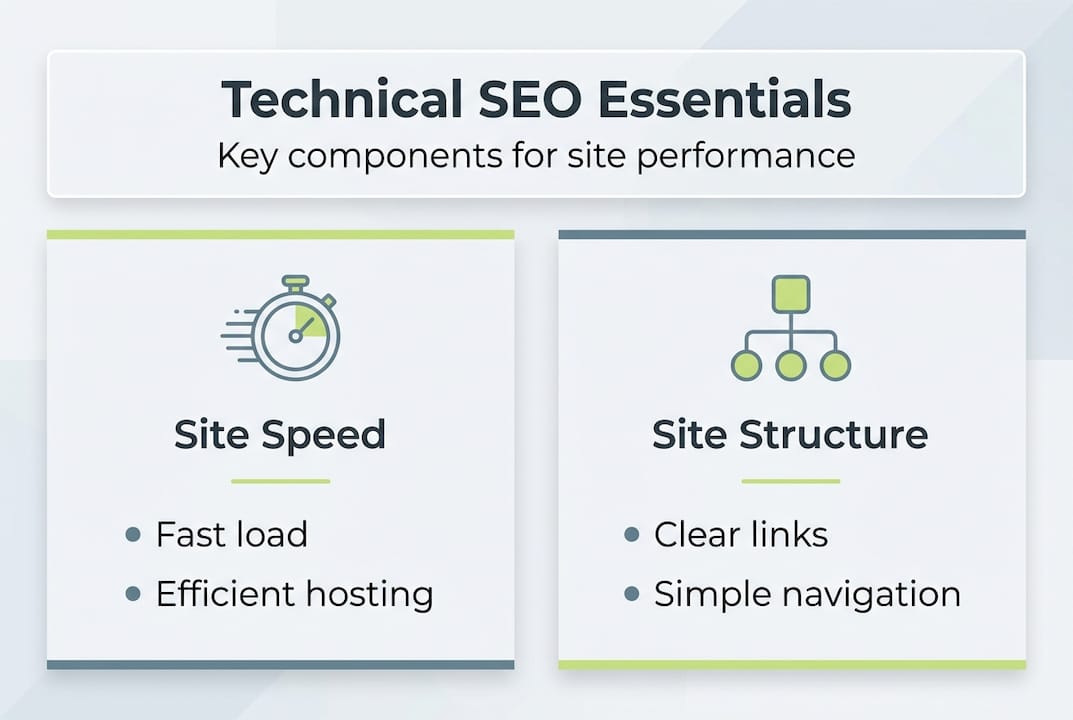
ComponentWhat it involvesTarget benchmarkSite speed (LCP)Time for main content to load≤ 2.5 secondsInteraction to Next Paint (INP)Responsiveness to user input≤ 200 millisecondsCumulative Layout Shift (CLS)Visual stability during load≤ 0.1Mobile-friendlinessResponsive design on all devicesPass Google Mobile TestCrawlabilityRobots.txt and XML sitemapsNo unintended blocksHTTPSSecure encrypted connectionValid SSL certificateStructured dataSchema markup for rich resultsValidated via Rich Results Test
These Core Web Vitals benchmarks are not arbitrary. Google uses them as direct ranking signals, meaning a site that falls short on LCP, INP, or CLS is actively penalised in search results compared to faster, more stable competitors.
Here is a practical order to address these components if you are starting from scratch:
Pro Tip: Use Google’s free PageSpeed Insights tool to get an instant Core Web Vitals score for any page on your site. It also provides specific recommendations ranked by impact, so you know exactly where to focus first.
Staying current with SEO trends for SMBs will help you anticipate which technical factors Google is likely to weight more heavily in future algorithm updates.
How to execute a technical SEO audit: Steps and tools
A technical SEO audit is a structured review of your website’s health. It sounds complex, but with the right tools and a clear process, most SMBs can complete a meaningful audit without a large team.
Here is a step-by-step approach:
ToolPrimary useCostScreaming FrogSite crawl and error detectionFree up to 500 URLsGoogle Search ConsoleIndex status and CWV reportingFreePageSpeed InsightsPage speed and CWV scoresFreeRich Results TestSchema markup validationFree
The audit methodology involves reviewing crawl errors, optimising site architecture, implementing schema markup, and improving Core Web Vitals through image optimisation, JavaScript minimisation, and faster server response times. Each of these is actionable with the tools listed above.
Pro Tip: After making technical fixes, use Google Search Console’s URL Inspection tool to request re-indexing of updated pages. This speeds up the time it takes for improvements to be reflected in search results.
If you want expert support running technical SEO audits, working with a specialist can surface issues that automated tools alone may miss.
Common technical SEO issues and how to prioritise fixes
Once you have completed an audit, you will likely find more issues than you can address immediately. The key is prioritisation. Not all problems carry equal weight.
The most common technical SEO issues SMBs encounter include:
“For SMBs, prioritise fixing poor Core Web Vitals, structured data for rich snippets, and mobile speed to boost visibility without requiring large teams or budgets.”
When deciding what to fix first, apply a simple decision framework. Ask two questions: How many pages does this issue affect? How directly does it block search engines from accessing or ranking content? Issues that affect site-wide performance, such as slow server response times or a misconfigured robots.txt file, should always come before cosmetic or single-page problems.
Core Web Vitals fixes consistently offer the highest return on investment for SMBs. Achieving an LCP of 2.5 seconds or better can meaningfully shift your position in competitive search results. Pairing technical improvements with strong SEO content planning creates a compounding effect where better-indexed content also ranks more competitively.
Technical SEO in the bigger marketing picture
Technical SEO does not exist in isolation. It is the foundation upon which every other marketing effort rests. Your paid campaigns drive traffic to landing pages. Your content strategy depends on those pages being indexed. Your backlink building efforts only pay off if the pages receiving links can actually be crawled and ranked.
When technical SEO is neglected, the entire marketing stack suffers. You may be spending on Google Ads while your organic pages are blocked from indexing. You may be producing excellent blog content that Google simply cannot render correctly.
“Technical SEO enables content discovery; neglect it and even high-quality content remains invisible. Test changes empirically, because Google’s algorithm evolves rapidly and assumptions can mislead.”
To integrate technical SEO into your ongoing marketing processes, consider these habits:
A well-maintained technical foundation means your SEO strategy guide and digital marketing optimisation efforts translate into actual visibility rather than wasted spend.
Our perspective: What most guides miss about technical SEO
Most articles treat technical SEO as a checklist you complete once and move on. That is the single biggest mistake we see SMBs make. Websites are living systems. Every plugin update, new page, or server change can introduce fresh technical problems. The businesses that maintain strong organic performance are those that build small, regular technical checks into their routine rather than waiting for a crisis.
Here is something that surprises many clients: a single technical fix, such as correcting a misconfigured robots.txt file or improving server response time, can produce more organic traffic growth than three months of new content. That is not an argument against content. It is a reminder that content needs a healthy site to perform.
We also see SMBs over-invest in minor details while ignoring site-wide performance problems. Spending hours perfecting schema markup on one page matters far less than fixing a slow server that drags down every page simultaneously. Follow proven SEO tactics and prioritise systemic improvements before granular ones.
Unlock technical SEO for your business growth
Understanding technical SEO is one thing. Implementing it consistently, while running a business, is another challenge entirely. At Geo Growth Media, we carry out hands-on technical SEO services for SMBs, from full site audits to ongoing monthly optimisation. We identify the issues that are costing you rankings and fix them in a structured, prioritised way.

DIY fixes can take you so far, but sustainable search growth comes from systematic, expert-led optimisation. Our SEO expertise spans technical audits, content planning, and backlink building, giving your site the complete foundation it needs to compete and grow. Get in touch to find out how we can support your business.
Frequently asked questions
How does technical SEO differ from on-page and off-page SEO?
Technical SEO focuses on website infrastructure, ensuring search engines can crawl and index your site, while on-page SEO targets content and keywords, and off-page SEO covers backlinks and external signals. All three work together, but technical SEO is the infrastructure that makes the other two effective.
What tools can I use for a technical SEO audit?
The most widely used tools are Screaming Frog, Google Search Console, and PageSpeed Insights. These cover crawl error detection, index status, and Core Web Vitals improvements including image optimisation and JavaScript minimisation.
What are Core Web Vitals and why do they matter for SMBs?
Core Web Vitals are Google’s performance metrics covering load speed, interactivity, and visual stability. Meeting the LCP, INP, and CLS targets directly influences your search rankings and user experience, making them essential for any SMB competing online.
How often should I perform a technical SEO audit?
A full technical SEO audit should be conducted every six to twelve months, or after any major site update. Because Google’s algorithm evolves rapidly, lighter monthly checks in Google Search Console are also recommended to catch new issues early.


.png)