.png)

.svg)


TL;DR:
- SEO improves website ranking through unpaid, organic content strategies for long-term visibility, whereas SEM offers paid, rapid results with targeted advertising. The rise of AI-driven answers and zero-click results reduces organic click-through rates, requiring adaptation in both approaches. Combining SEO and SEM provides a resilient, flexible search presence that adapts to evolving search behavior and algorithm changes in 2026.
Many business owners use “SEO” and “SEM” interchangeably, assuming they are simply two labels for the same thing. They are not, and confusing the two can mean spending months on the wrong strategy while competitors capture your customers. Add to this the rise of AI-powered search and zero-click results, and the stakes have never been higher for getting your search strategy right. This article breaks down exactly what each term means, how they compare in practice, and how to decide which approach, or combination, will actually drive growth for your business in 2026.
Table of Contents
- What is SEO and what is SEM?
- Key differences between SEO and SEM
- How AI and answer-driven search are changing the game
- When to use SEO, SEM, or a blend: practical frameworks
- Why the ‘SEO vs SEM’ mindset could limit your growth
- Ready to grow? Get expert help with SEO and SEM
- Frequently asked questions
Key Takeaways
| Point | Details |
|---|---|
| SEO and SEM differ | SEO builds organic visibility over time, while SEM buys instant traffic through paid ads. |
| AI reshapes search | Answer engines and zero-click results require new optimisation strategies beyond classic SEO. |
| Blended approach works | Combining SEO’s credibility and SEM’s speed often yields the best business growth results. |
| Adapt to change | Success comes from pivoting your strategy as search trends and technologies evolve. |
What is SEO and what is SEM?
Let us start with the basics, because even experienced marketing managers sometimes inherit muddled definitions from previous teams.
SEO (Search Engine Optimisation) is the practice of improving your website and its content so that search engines like Google rank it higher in unpaid, organic results. There is no cost per click. Instead, you invest time and effort into creating quality content, earning backlinks, improving site speed, and structuring your pages so that search engines understand and trust your site. The reward is sustained visibility that does not stop the moment you turn off a budget.
SEM (Search Engine Marketing) is broader in definition but, in everyday agency and marketing usage, it almost always refers to paid search advertising, specifically pay-per-click (PPC) campaigns on platforms like Google Ads. You bid on keywords, your ad appears above organic results when triggered, and you pay each time someone clicks. For a more thorough search engine marketing overview, the core distinction is simple: SEO earns its place; SEM pays for it.
Common SEO tactics include:
- Technical audits and site speed improvements
- Keyword research and on-page content optimisation
- Building backlinks from authoritative websites
- Structured data markup to improve how results appear
- Creating in-depth, useful content that satisfies search intent
Common SEM tactics include:
- Google Search Ads and Shopping campaigns
- Remarketing ads targeted at previous site visitors
- Performance Max campaigns across Google’s entire network
- Bid strategy management and ad copy testing
- Audience targeting and location-based ad delivery
Here is where it gets interesting for 2026. Traditional SEO assumed that ranking number one for a keyword meant capturing the most traffic. That assumption is under genuine pressure. As AI-dominated answer surfaces increasingly provide direct answers at the top of results pages, ranking high in classic “blue link” results may no longer be enough.
“SEO-focused content can still underperform for certain queries when search results become dominated by answer surfaces, so marketers may need to adapt tactics beyond classic rank-number-one blue links.” — Search Engine Land
This does not mean SEO is dead. It means the game has shifted. Understanding both SEO and SEM properly is the first step to responding intelligently.
Key differences between SEO and SEM
Now with clear definitions in mind, a direct comparison helps clarify when each approach shines.
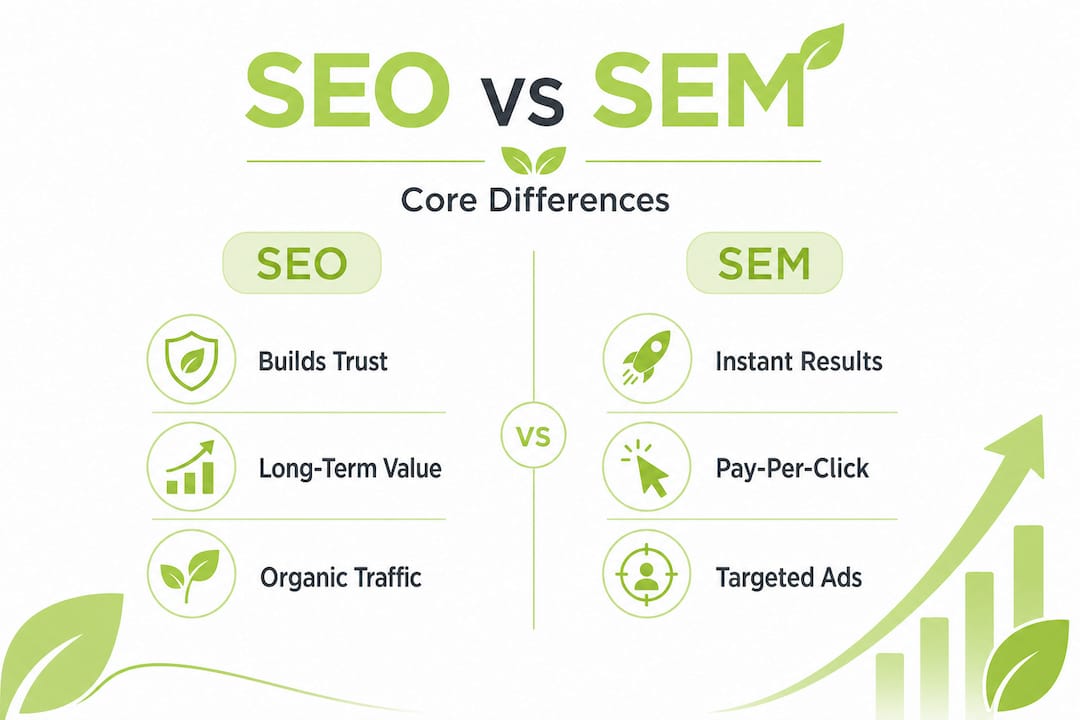
| Factor | SEO | SEM (paid search) |
|---|---|---|
| Cost model | Time and resource investment | Pay-per-click budget |
| Speed to results | Months to years | Days to weeks |
| Longevity | Builds over time | Stops when budget stops |
| Scalability | Slow but compounding | Fast but linear with spend |
| Control over targeting | Limited | Highly precise |
| Vulnerability to algorithm changes | High | Lower |
| Trust perception | Generally higher | Clearly labelled as ad |
The table tells a clear story. SEO is the long game. It requires patience, consistent effort, and a willingness to invest before you see returns. But when it works, it can deliver high-quality traffic month after month without recurring ad spend. A well-ranked page from two years ago can still generate leads today.

SEM, by contrast, is a tap you can turn on immediately. Launch a campaign on Monday and you can have qualified visitors arriving by Tuesday. This responsiveness makes it indispensable for product launches, promotional periods, or when you simply need leads this quarter rather than next year.
The evolving search environment adds another dimension to this comparison. As answer-driven queries increasingly return AI-generated summaries rather than clickable links, classic SEO checklists may be insufficient. You may need structured data, content architecture designed for AI retrieval, and a strategy for being referenced within answer surfaces rather than simply ranked.
Current visibility challenges both channels face:
- Featured snippets and AI overviews reducing click-through rates
- Shopping panels and local packs occupying prime screen real estate
- Voice search delivering single answers without listing alternatives
- Personalised results meaning rankings vary by user and location
Our SEO services comparison explores how modern SEO must evolve to account for these changes. The critical takeaway is that neither channel operates in a vacuum anymore.
Pro Tip: Use SEO to build foundational authority and domain trust over time, but layer SEM on top during campaign periods, new market entry, or whenever you need fast data on which messages resonate with your audience. The two strategies inform each other powerfully.
How AI and answer-driven search are changing the game
With a clearer understanding of the key differences, it is vital to look at how these strategies are evolving due to AI and search engine changes.
Search behaviour has shifted dramatically. Google’s AI Overviews, which roll out answers directly at the top of search pages, have fundamentally altered what it means to “rank.” You can hold the number one organic position and still receive fewer clicks than you did three years ago, because the user already got their answer without scrolling.
The zero-click phenomenon is measurable. Studies indicate that a significant portion of searches result in no click at all, with users satisfied by the information displayed directly on the results page. This proportion is growing as AI-generated summaries become more capable and more trusted by users. For AI-driven search changes, this represents perhaps the biggest structural change to search marketing in a decade.
| Search environment | Estimated impact on organic clicks |
|---|---|
| Traditional blue link results | Baseline click-through |
| Featured snippet present | Click-through reduced by 5 to 10% |
| AI Overview present | Click-through reduced by 15 to 30% |
| Combined answer features | Click-through reduced by up to 40% |
These figures illustrate why a strategy built entirely around climbing organic rankings can be brittle. Search results dominated by answer surfaces require marketers to think beyond traffic volume and consider presence across multiple touchpoints, including paid ads which continue to appear even when AI summaries dominate the organic area.
Here is what SMEs should practically do in response:
- Audit your keyword portfolio and identify which queries are now dominated by AI-generated answers. These are often informational, question-based searches.
- Add structured data markup (schema) to your key pages so search engines can extract and reference your content in answer surfaces more easily.
- Create answer-oriented content with clear headings, concise definitions, and direct responses to common questions.
- Invest in branded search campaigns via SEM to ensure you appear when someone specifically searches for your business name, even when answer boxes crowd the organic space.
- Monitor brand mentions in AI tools like ChatGPT, Gemini, and Perplexity, as these are becoming discovery channels in their own right.
- Diversify traffic sources beyond Google alone, using paid social media, email, and direct partnerships to reduce dependence on organic search alone.
SEM remains particularly valuable in this environment because paid ads sit above AI Overviews in many results pages. Even when Google answers a question directly, sponsored results often appear first. This gives SEM a structural advantage that pure SEO cannot replicate under current search layouts.
When to use SEO, SEM, or a blend: practical frameworks
Understanding the technical shifts is one thing, but applying the right strategy is what brings results.
The choice between SEO, SEM, or a combination is not about which is superior in the abstract. It is about matching the right tool to your current situation. Here is a practical framework for making that decision.
Step 1: Define your primary goal. Are you trying to generate leads within the next 30 days, or build a sustainable pipeline over the next 12 months? Immediate needs point toward SEM. Long-term growth points toward SEO. Both goals existing simultaneously, which is common, points toward a blended approach.
Step 2: Assess your budget and timeline honestly. SEO requires upfront investment in content, technical work, and link building before results materialise. SEM requires ongoing ad spend that scales with ambition. A business with a tight budget and immediate cash-flow pressure is often better served by a targeted SEM campaign than a six-month SEO project.
Step 3: Evaluate the competitive landscape. In highly competitive industries, SEO can take years to gain traction because established players with enormous authority already dominate the results. SEM lets you bypass this and appear immediately alongside competitors. Conversely, in niches with low search competition, SEO may deliver strong results relatively quickly.
Here are the most common scenarios and recommended approaches:
- You need leads within the next four to six weeks — prioritise SEM with tightly targeted campaigns.
- You are launching a new product or entering a new market — use SEM for fast visibility and data gathering, then use learnings to inform SEO content strategy.
- You want to test which messages convert before committing to content — SEM allows rapid A/B testing of ad copy and landing pages.
- You are building long-term brand authority — invest in SEO, particularly thought leadership content and backlink acquisition.
- You want to dominate a search term completely — combine SEO ranking with SEM ads to occupy multiple positions on the same results page.
- You operate seasonally — use SEO year-round to maintain presence and add SEM during peak periods for amplification.
The right SEM strategies for higher ROI often include techniques specifically designed to maintain visibility even when direct answers crowd out organic results. These approaches, such as advanced SEM guide frameworks like structured campaign hierarchies and intent-based bidding, ensure your paid presence works hard even in a zero-click environment.
Pro Tip: If you are a small business with limited resources, start with a modest SEM campaign to generate early revenue and gather keyword data, then reinvest a portion of that revenue into building an SEO foundation. This sequence avoids the painful gap between SEO investment and first results.
Why the ‘SEO vs SEM’ mindset could limit your growth
The debate between SEO and SEM has existed for as long as paid search has been available. It is a debate we encounter regularly with new clients, usually framed as a binary choice. “Should we do SEO or Google Ads?” The honest answer, rooted in real experience across dozens of client accounts, is that framing it as a competition is the wrong starting point entirely.
We have worked with businesses that abandoned SEM entirely because “SEO is more sustainable,” only to watch their lead flow dry up during the six months it took for their organic rankings to improve. We have also seen businesses pour money into Google Ads month after month with no corresponding investment in their organic presence, leaving them entirely exposed the moment ad costs rose or a campaign underperformed.
The businesses that grow consistently are those that treat search as an integrated system rather than a channel contest. They use SEM data to understand which search terms convert, then build SEO content around those proven terms. They use SEO authority to improve their Quality Score in Google Ads, which reduces their cost per click. Each channel strengthens the other.
The modern search landscape reinforces this integrated approach. As adapting beyond blue-link tactics becomes essential, the businesses that will win are those agile enough to maintain paid visibility while simultaneously building the kind of authoritative, structured content that appears in AI summaries, featured snippets, and answer boxes.
Our perspective, shaped by working with SMEs across various industries, is this: the question should never be “SEO or SEM?” It should be “how do we build a search presence that keeps working regardless of how the algorithm or the interface changes next?” That requires both channels, applied thoughtfully, with regular review. For more context on how search engine marketing insights continue to evolve, the direction is clear: integrated beats isolated every time.
Ready to grow? Get expert help with SEO and SEM
Navigating the SEO and SEM landscape takes real expertise, particularly as AI continues to reshape how search works. Getting the balance right between building organic authority and driving immediate paid traffic can feel overwhelming when you are also running a business.
At Geo Growth Media, we work as an extension of your marketing team, building tailored strategies that combine the strengths of both channels. Whether you need our SEO services to build lasting authority, or want to explore paid social media and search advertising to drive fast, measurable results, we create campaigns designed around your specific goals, budget, and market. Reach out today to find out how a blended search strategy could accelerate your growth.
Frequently asked questions
Is SEO better than SEM for small businesses?
SEO builds long-term value and reduces reliance on ongoing ad spend, but SEM delivers immediate visibility for businesses that need leads now. Given that certain queries underperform even with top organic rankings, most small businesses benefit most from using both channels together.
How do AI and zero-click results affect SEO?
AI-driven answer surfaces mean users increasingly receive answers without clicking through to websites, reducing organic traffic even for high-ranking pages. As search results shift toward answer-first experiences, SEO now requires structured, answer-oriented content and schema markup to maintain meaningful visibility.
Should I use SEO, SEM, or both?
Most SMEs achieve the best results by combining SEO’s authority building with SEM’s fast, targeted reach, adjusting the balance based on goals and budget. Our visibility techniques for direct answers outline practical approaches for maintaining presence across both paid and organic environments.
How long does it take for SEO to show results?
SEO typically requires three to six months before significant ranking improvements appear, with full compounding results often taking twelve months or more. SEM campaigns, by contrast, can generate qualified traffic within days of launching.
Can SEM work if answer boxes dominate search results?
Yes. Paid ads and sponsored listings are displayed above AI Overviews and answer boxes in many results pages, ensuring your business maintains prominent visibility. As answer surfaces increasingly dominate organic positions, SEM actually becomes more valuable as a guaranteed placement mechanism.


.png)