.png)

.svg)




Many e-commerce businesses pour time and budget into SEO content, only to watch traffic climb whilst sales remain flat. Marketing managers at growing brands face a persistent challenge: creating content that ranks well but fails to convert visitors into customers. This guide delivers a practical, revenue-focused framework for SEO content planning that aligns with your business growth objectives. You’ll discover how to combine technical SEO foundations, strategic content clusters, and performance measurement to drive measurable online sales. By following this structured approach, you can transform SEO from a traffic exercise into a genuine revenue engine for your e-commerce brand.
Table of Contents
- Key takeaways
- Understanding the problem: why SEO content planning matters for e-commerce
- Preparation: essential prerequisites for successful SEO content planning
- Execution: building and implementing an effective SEO content plan
- Verification and optimisation: measuring SEO content success and scaling growth
- Boost your e-commerce SEO with Geo Growth Media
- Frequently asked questions
Key Takeaways
| Point | Details |
|---|---|
| Technical audit first | Before creating content, run a full technical SEO audit to identify and fix issues that could undermine rankings and user experience. |
| Revenue focused planning | Build the SEO content strategy around revenue goals and the customer journey rather than chasing traffic alone. |
| Content clusters for buyers | Develop content clusters aligned to buyer intent to boost conversions and guide customers toward purchase. |
| AI human hybrid approach | Adopt AI driven content where appropriate while ensuring human expertise adds strategic value and quality control. |
Understanding the problem: why SEO content planning matters for e-commerce
E-commerce marketing managers often celebrate rising organic traffic, only to discover their bottom line hasn’t moved. This disconnect reveals a fundamental flaw: content created for search engines without strategic planning rarely converts browsers into buyers. Your SEO efforts might generate thousands of visits, but if those visitors aren’t finding what they need to make a purchase decision, you’re simply burning budget.
The reality is that benefits of SEO investment extend far beyond rankings. You need to focus on metrics that matter: conversion rate, average order value, and actual sales revenue. Traffic alone is a vanity metric that impresses stakeholders in presentations but doesn’t pay the bills. Different e-commerce verticals face unique challenges too. Beauty brands typically see higher conversion rates than apparel retailers, so your content strategy must reflect your specific industry dynamics.
Artificial intelligence has transformed content creation, but the approach matters enormously. Research shows AI-hybrid content outperforms pure AI or human efforts, with 57% of top-ranking content using blended strategies. This doesn’t mean you should automate everything and hope for the best. Instead, strategic planning helps you determine where AI accelerates efficiency and where human expertise adds irreplaceable value.
Consider these common pitfalls that strategic planning helps you avoid:
- Creating content around high-volume keywords that attract browsers, not buyers
- Publishing blog posts disconnected from your product catalogue and customer needs
- Ignoring technical SEO issues that prevent even brilliant content from ranking
- Measuring success by organic sessions rather than revenue generated from those sessions
Without a structured approach, your content team produces articles that might rank but don’t serve your business objectives. Strategic SEO content planning addresses this by connecting every piece of content to specific revenue goals, buyer personas, and stages in the customer journey. You’re not just creating content; you’re building a system that guides potential customers from initial research through to checkout.
“The most successful e-commerce brands treat SEO content as a revenue channel, not a traffic source. Every article, guide, and landing page exists to move customers closer to purchase.”
Preparation: essential prerequisites for successful SEO content planning
Before writing a single word of content, you need solid foundations. Skipping preparation is like building a house on sand: your efforts might look impressive initially, but they’ll crumble when tested. The first critical step is conducting a comprehensive technical SEO audit to identify and resolve site issues that could sabotage your content efforts. Broken internal links, slow page speeds, mobile usability problems, and indexation errors will undermine even the most brilliant content strategy.
Next, optimise your category pages for commercial search intent. These pages represent your most valuable SEO real estate because they target customers ready to buy. A well-optimised category page for “organic skincare products” will generate more revenue than ten informational blog posts about skincare routines. Focus on clear product hierarchies, compelling descriptions, and conversion-optimised layouts before expanding into supporting content.

You must establish clear SEO goals tied directly to business revenue. Forget about ranking for 50 keywords or generating 10,000 monthly visits. Instead, set targets like “increase organic revenue by 25% in six months” or “achieve 3.5% conversion rate from organic traffic.” These goals force you to think strategically about which content will actually drive sales, not just attract eyeballs.
Pro Tip: Configure revenue tracking in Google Analytics from day one. Tag organic traffic sources properly and connect them to transaction data. This setup allows you to measure true SEO impact and demonstrate clear ROI to stakeholders who care about profit, not pageviews.
Prepare your resources systematically:
- Complete keyword research aligned with your target customer needs and search behaviour
- Map out customer personas with specific pain points, questions, and purchase triggers
- Audit competitor content to identify gaps and opportunities in your market
- Assemble your content creation team, whether in-house writers, freelancers, or AI tools
- Set up analytics and tracking to measure performance from the first published piece
The small business SEO guide emphasises starting with technical audit and category optimisation before content clusters. This sequence ensures your site can actually rank the content you create. Many e-commerce brands rush into content production, only to discover their technical issues prevent Google from properly indexing and ranking their articles.
Your preparation phase should also include resource allocation. How much budget can you dedicate to content creation monthly? Do you have design support for infographics and visual content? Can you commit to consistent publishing, or will content appear sporadically? Answering these questions honestly prevents the common trap of starting ambitiously, then abandoning your strategy when reality hits.
Finally, establish your SEO strategy guide for e-commerce growth by documenting your approach. Write down your goals, target keywords, content themes, and success metrics. This document becomes your roadmap and keeps your team aligned as you execute. Consider engaging technical SEO services if your internal team lacks the expertise to conduct thorough audits and implement fixes properly.
Execution: building and implementing an effective SEO content plan
With foundations in place, you’re ready to build content that actually drives sales. Start by identifying content clusters centred on your buyer personas and their journey through the purchase funnel. A content cluster groups related articles around a pillar topic, creating topical authority that Google rewards with better rankings. For an e-commerce beauty brand, you might create a cluster around “anti-aging skincare” with supporting articles on ingredients, routines, product comparisons, and application techniques.
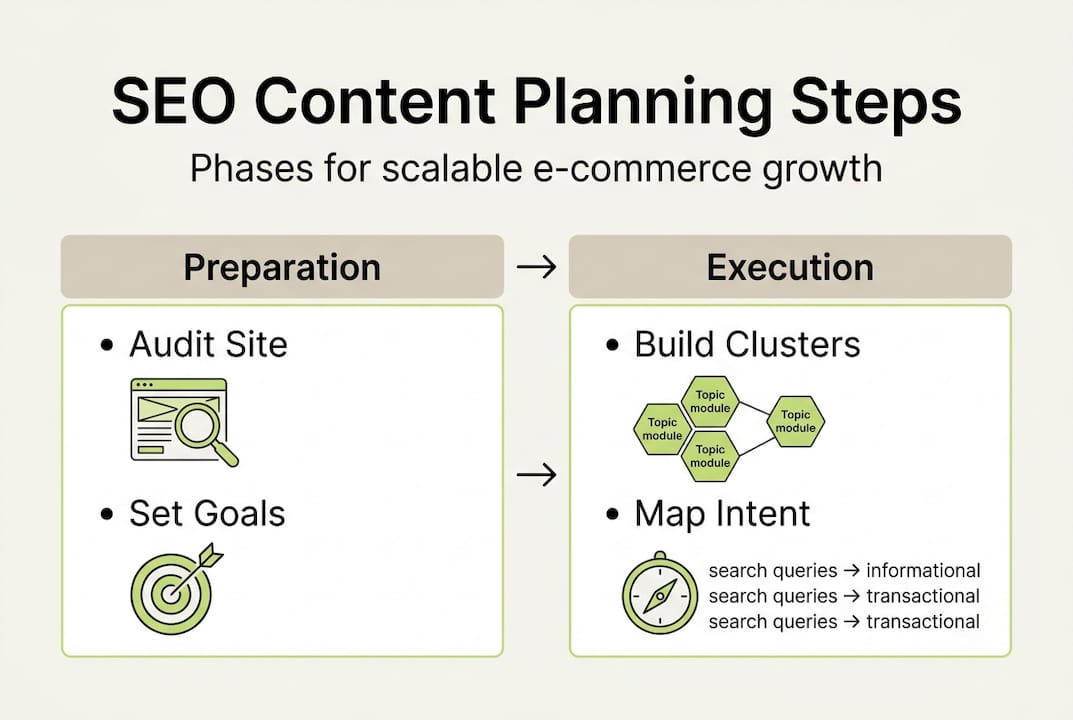
Map each piece of content to specific user intent: informational, navigational, or transactional. Informational content answers questions and builds trust early in the journey. Navigational content helps customers find specific products or categories. Transactional content targets buyers ready to purchase. Your content mix should reflect where your potential customers are in their decision process, with heavier emphasis on bottom-funnel content that converts.
Combine AI-generated drafts with human editing to optimise relevance and quality. AI-hybrid content outperforms pure AI or human approaches, capturing efficiency without sacrificing authenticity. Use AI tools to generate initial drafts, research keywords, and suggest content structures. Then apply human expertise to add brand voice, industry insights, and persuasive elements that AI cannot replicate convincingly.
Implement a content calendar aligned with your promotional campaigns and product launches. If you’re launching a new product line in March, publish supporting content in January and February to build search visibility before the launch. Coordinate with your marketing team to ensure SEO content amplifies other channels rather than existing in isolation. This integrated approach multiplies impact across your entire marketing mix.
| E-commerce vertical | Content cluster example | Target buyer intent | Expected outcome |
|---|---|---|---|
| Apparel | Sustainable fashion guide | Informational + transactional | Build authority, drive category traffic |
| Beauty | Anti-aging skincare routine | Informational + transactional | Educate buyers, increase AOV |
| Electronics | Smart home setup tutorials | Informational + navigational | Position as expert, cross-sell products |
| Home goods | Interior design trends 2026 | Informational + inspirational | Attract new audience, build email list |
Follow these execution steps systematically:
- Select your first content cluster based on keyword opportunity and business priority
- Create the pillar page as your comprehensive resource on the core topic
- Develop 5 to 8 supporting articles that dive deeper into specific subtopics
- Interlink all cluster content strategically to distribute authority and guide users
- Optimise each piece for featured snippets and other SERP features to maximise visibility
- Publish consistently according to your calendar, maintaining quality over quantity
Pro Tip: Repurpose high-performing content formats based on SEO data trends. If your comparison tables drive strong engagement and conversions, create more comparison content across different product categories. Let performance data guide your content investment decisions.
Consider these execution priorities:
- Prioritise content that targets buyers close to purchase over purely educational topics
- Include clear calls to action that guide readers toward relevant product pages
- Optimise images and media for fast loading without sacrificing visual appeal
- Structure content with scannable headings, short paragraphs, and bullet points for readability
Your SEO strategy examples for SMB growth should demonstrate how content clusters work in practice across different industries. Study successful competitors to understand what content formats resonate with your target audience. Don’t copy their approach directly, but learn from their successes and failures to inform your own strategy.
As AI and conversational search reshape how customers find products, adapt your content to match natural language queries. Write in a conversational tone that answers specific questions clearly. Structure content to serve voice search and AI overviews, which increasingly influence how searchers discover and evaluate products.
Verification and optimisation: measuring SEO content success and scaling growth
Creating content is only half the battle. You must track, measure, and optimise performance to ensure your SEO efforts actually drive revenue growth. Traditional SEO metrics like organic traffic and keyword rankings matter, but they’re leading indicators, not the end goal. Your real focus should be revenue-centric KPIs: conversion rate from organic traffic, average order value for organic customers, and total sales attributed to SEO channels.
Set up A/B testing to optimise page layouts, calls to action, and content elements for conversion. Test different product recommendation placements, CTA button colours, and content lengths to discover what drives the best results for your specific audience. Small improvements in conversion rate compound dramatically when applied across high-traffic pages. A 0.5% conversion increase on a page receiving 10,000 monthly visits generates 50 additional sales monthly.
Use these analytics tools and metrics for ongoing monitoring:
- Google Analytics 4 for traffic sources, user behaviour, and revenue attribution
- Google Search Console for search performance, indexation status, and technical issues
- Rank tracking tools to monitor keyword positions and identify ranking opportunities
- Heatmap software to understand how users interact with your content and pages
- CRM integration to track customer lifetime value from different acquisition channels
| Metric type | Traffic-focused example | Revenue-focused example | Why revenue matters more |
|---|---|---|---|
| Primary KPI | Organic sessions | Organic revenue | Sessions don’t pay bills; sales do |
| Secondary KPI | Keyword rankings | Conversion rate | Rankings mean nothing without conversions |
| Success indicator | Traffic growth % | Revenue per session | Efficiency matters more than volume |
| Reporting focus | Pageviews | Average order value | Higher AOV multiplies impact |
The small business SEO guide emphasises measuring revenue, not just traffic, for genuine e-commerce success. This shift in perspective transforms how you evaluate content performance. A blog post generating 1,000 visits but zero sales is failing, whilst an article attracting 200 visits that convert at 5% is succeeding brilliantly.
Implement iterative content updates based on data insights. Review your content performance quarterly and identify opportunities to improve underperforming pieces. Update statistics, refresh examples, expand thin sections, and improve internal linking to boost rankings and engagement. Google rewards fresh, comprehensive content with better visibility, so treating your content library as a living asset pays dividends.
Pro Tip: Set up automated revenue reports linked directly to your SEO efforts. Create custom dashboards showing organic revenue trends, top-performing content by sales generated, and conversion rates by content type. These reports demonstrate clear business impact to stakeholders and justify continued investment in SEO content.
Connect your content performance to broader digital marketing for e-commerce brands initiatives. SEO shouldn’t exist in isolation but should reinforce and amplify your paid advertising, email marketing, and social media efforts. Content that ranks well organically can be promoted through paid channels to maximise reach, whilst insights from SEO inform messaging across all channels.
Scale your success systematically by:
- Identifying your highest-performing content themes and creating more in those areas
- Expanding successful content clusters with additional supporting articles
- Applying winning content formats to new product categories and topics
- Training your team on what works based on real performance data
Your approach to SEO business growth for SME success should evolve as you gather more data. What works for one product category might not work for another. Stay flexible and let evidence guide your decisions rather than assumptions or industry best practices that may not apply to your specific situation.
Boost your e-commerce SEO with Geo Growth Media
Implementing a strategic SEO content plan requires expertise, resources, and consistent execution. Many e-commerce marketing managers struggle to balance content creation with their other responsibilities, leading to inconsistent results and missed opportunities.

Geo Growth Media specialises in SEO services tailored specifically for growing e-commerce brands. We combine technical SEO foundations with strategic content planning to drive measurable sales growth, not just traffic increases. Our team acts as an extension of your marketing department, delivering personalised strategies aligned with your goals, sector, and budget. From comprehensive SEO consultancy to conversion-optimised landing page design, we provide the expertise needed to transform your SEO efforts into a genuine revenue engine. Partner with specialists who understand that e-commerce success means sales, not just rankings.
Frequently asked questions
What is the most important first step in SEO content planning?
A thorough technical SEO audit is essential before creating any content. This audit identifies site health issues, indexation problems, and technical barriers that could prevent your content from ranking properly. Without fixing these foundational issues first, even brilliant content will struggle to achieve visibility and drive the growth you need.
How can AI tools improve SEO content planning?
AI assists with keyword research, draft content creation, and uncovering user intent patterns from search data. Hybrid approaches that combine AI efficiency with human expertise yield higher-quality, more relevant content that ranks well and converts effectively. Use AI to accelerate research and drafting, then apply human insight to refine messaging and add authentic brand voice.
Why should SEO success be measured by revenue not traffic?
Traffic alone doesn’t guarantee sales or profit growth for your business. Measuring revenue aligns your SEO efforts with genuine business objectives, ensuring you optimise for outcomes that matter to stakeholders. A smaller amount of highly qualified traffic that converts beats massive traffic volumes that bounce without purchasing.
How long does it take to see results from SEO content planning?
Most e-commerce brands begin seeing measurable improvements within three to six months of implementing a strategic content plan. Initial months focus on technical fixes and building content authority, whilst later months deliver compounding returns as your content library grows and rankings improve. Patience and consistency are essential for sustainable SEO success.
What makes content clusters more effective than individual blog posts?
Content clusters establish topical authority by comprehensively covering a subject area through interconnected articles. Google recognises this depth and rewards it with better rankings across the entire cluster. Clusters also guide users through related content, increasing engagement and conversion opportunities compared to isolated articles.



.png)