.png)

.svg)


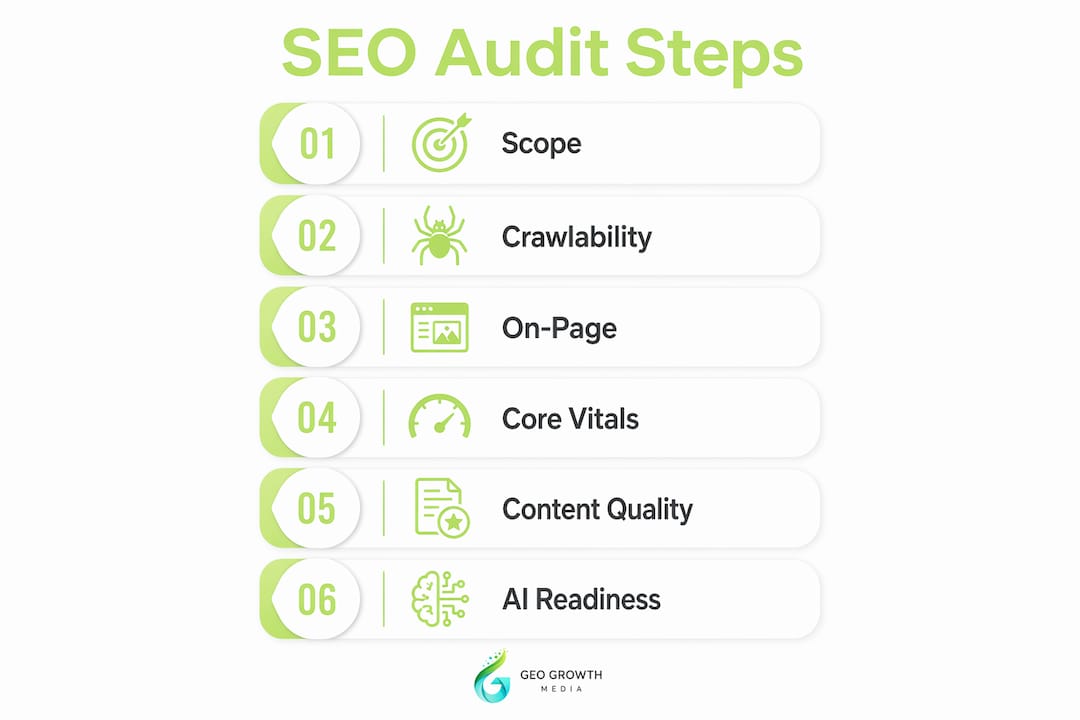
An SEO audit is a structured evaluation of your website’s technical health, on-page signals, content quality, and AI readiness that identifies the exact issues holding back your search rankings. Done properly, an seo audit step by step follows a strict hierarchy: fix crawlability first, then on-page signals, then Core Web Vitals, then content, and finally AI readiness. Skipping that order is like painting a house with a cracked foundation. Tools like Google Search Console and Screaming Frog give you the raw data. What you do with that data, and in what order, determines whether your rankings actually move.
What prerequisites and tools do you need before starting your SEO audit?
Starting without the right access is the single biggest reason audits stall. Before you touch a single page, confirm you have the following in place. Struggling to get started? Our ecommerce SEO services allows you to brain your strategy with an experienced professional, and get all the right tools in place.
Data access and permissions:
Crawl and analysis tools:
Stakeholder alignment:
Define the audit scope before you start. Are you auditing the full site or a specific section? What does success look like in 90 days? Getting this agreed upfront stops the goalposts moving mid-audit. Free tools like Google Search Console and Screaming Frog remove the cost barrier entirely for small businesses.
Pro Tip: Set up a shared Google Sheet before your first crawl. Use three tabs: Critical Issues, Quick Wins, and Backlog. Colour-code by priority. This single habit keeps your audit from becoming a document nobody reads.
How do you perform a technical SEO crawlability and indexation audit step by step?
Technical crawlability is the foundation of every other fix you will make. Foundational errors invalidate later optimisation work, so this step must come first. A page that cannot be crawled cannot rank, regardless of how good the content is.
Follow these steps in order:
Pro Tip: Run your Screaming Frog crawl with JavaScript rendering enabled if your site uses a framework like React or Vue. The difference between the raw HTML crawl and the rendered crawl often reveals hidden content gaps.
The most common audit mistake is jumping straight to meta titles and content before resolving these crawl issues. You will waste hours optimising pages that Google cannot even access.

What are the key steps to assess and fix on-page SEO and content structure issues?
Once crawlability is confirmed, on-page signals are your next priority. These are the elements Google reads to understand what each page is about and whether it deserves to rank.
Meta titles and descriptions:
Heading hierarchy and keyword usage:
Internal linking and orphan pages:
Keyword cannibalisation and content gaps:
Pro Tip: Export your Search Console Performance data filtered to queries with an average position between 8 and 20. These are your “almost ranking” pages. A focused on-page update, adding depth, updating the title, and improving internal links, often moves them onto page one within weeks.
E-E-A-T (Experience, Expertise, Authoritativeness, and Trustworthiness) is Google’s quality framework for content evaluation. Author bios, cited sources, and clear factual claims all contribute to E-E-A-T signals. Thin pages with no author attribution and no external references score poorly against this standard.
How to evaluate Core Web Vitals and user experience in your SEO audit?
Core Web Vitals are a direct ranking factor and directly influence how visitors experience your site. Poor scores do not just hurt rankings. They increase bounce rates and reduce conversions.
The three primary metrics to address are:
MetricWhat it measuresTarget thresholdLargest Contentful Paint (LCP)How fast the main content loadsUnder 2.5 secondsFirst Input Delay (FID)How quickly the page responds to interactionUnder 100 millisecondsCumulative Layout Shift (CLS)How much the page layout shifts during loadUnder 0.1
Run PageSpeed Insights for your five highest-traffic pages first. Chrome DevTools’ Lighthouse tab gives you a breakdown of exactly which elements are causing delays.
Common UX issues to check:
Prioritise fixes by impact and effort. A compressed hero image that cuts LCP by 1.2 seconds is a higher priority than removing a rarely-used font. Quick, high-impact fixes build momentum and demonstrate progress to stakeholders.
What does auditing content quality and AI search readiness involve in 2026?
The most significant shift in 2026 is the dual-audience requirement: your content must satisfy both traditional search engine crawlers and AI retrieval systems like ChatGPT and Gemini. Sites can rank well organically but still miss traffic if their content lacks AI citation readiness.
What to check in your content quality audit:
Non-authoritative or vague content limits citations by AI engines, which is now a measurable traffic source. A page that ranks on page one but never appears in an AI-generated answer is leaving visibility on the table.
Pro Tip: Review your top 10 pages and ask: “Could an AI engine extract a clear, citable answer from this page in under 10 seconds?” If the answer is no, the page needs restructuring. Add a clear definition in the first paragraph, use numbered steps where relevant, and remove filler sentences that dilute the core message. For more on this, the guide on AI-driven SEO covers the structural changes in detail.
Content freshness also matters. Pages last updated in 2021 with outdated statistics signal low quality to both crawlers and AI systems. Schedule a quarterly content refresh as part of your ongoing SEO performance assessment.
Key takeaways
A successful SEO audit follows a fixed hierarchy: technical crawlability first, then on-page signals, then Core Web Vitals, then content quality, and finally AI readiness.
PointDetailsFix crawlability firstResolve robots.txt blocks, redirect chains, and noindex errors before any other work.Use free tools effectivelyGoogle Search Console, Screaming Frog, and PageSpeed Insights cover the full audit at no cost.Prioritise Core Web VitalsTarget LCP under 2.5 seconds, FID under 100ms, and CLS under 0.1 for ranking and UX gains.Audit for AI readinessStructure content with clear definitions, schema markup, and authoritative signals for AI citation.Cluster fixes into sprintsGroup recommendations into sprints to avoid analysis paralysis and maintain momentum.
The audit mindset that actually gets results
Running SEO audits for small businesses has taught me one thing above all else: the audit itself is not the hard part. The hard part is deciding what to fix first and actually doing it.
Most audits I see fail not because the data is wrong, but because the list of issues becomes so long that nothing gets done. The fix is simple. Identify quick wins that take under 30 minutes to resolve and tackle those in week one. Fixing a missing meta title, removing a noindex tag from a key product page, or compressing an oversized hero image are all tasks that take minutes and show results within weeks. That early momentum is what keeps stakeholders engaged and budgets intact.
The 2026 shift towards AI readiness has also changed how I approach content audits. Two years ago, I would have called a page “good” if it ranked on page one. Now I ask whether it is also appearing in AI-generated answers. That is a different bar, and most small business sites are not meeting it yet. The businesses that get ahead of this now will have a significant advantage as AI-driven search continues to grow.
My honest advice: do not treat an SEO audit as a one-off project. Build it into a quarterly rhythm. A 90-minute audit every three months, focused on crawl health, content freshness, and Core Web Vitals, will outperform a single exhaustive audit done once a year and then forgotten.
How Geo Growth Media can help you act on your audit findings
Completing an audit is one thing. Turning findings into ranking improvements is where most small businesses get stuck.
Geo Growth Media’s specialist SEO services are built for exactly this stage. From technical fixes and on-page optimisation to content planning and backlink building, the team works as an extension of your marketing function. Whether you need a full site audit, targeted fixes for crawl issues, or an ongoing SEO performance assessment, Geo Growth Media delivers measurable results without the agency fluff. If your site also needs structural improvements to support better rankings, the website development service covers performance and SEO readiness from the ground up.
FAQ
What is an SEO audit?
An SEO audit is a structured review of your website’s technical health, on-page signals, content quality, and AI readiness to identify issues that limit search engine rankings and visibility.
How often should you run an SEO audit?
A full audit is recommended quarterly. Technical crawl checks and Core Web Vitals reviews can be run monthly to catch issues before they compound.
What tools do you need for a complete SEO audit?
Google Search Console, Screaming Frog, PageSpeed Insights, and Bing Webmaster Tools cover the full seo audit checklist at no cost for most small business sites.
Why does crawlability need to be checked first?
Foundational crawl errors invalidate all later optimisation work. A page blocked by robots.txt or carrying an accidental noindex tag cannot rank regardless of content quality.
What is AI search readiness in an SEO audit?
AI search readiness means structuring content so that AI retrieval systems like ChatGPT and Gemini can extract and cite it accurately. Clear definitions, schema markup, and authoritative signals are the key factors to assess.


.png)