.png)

.svg)


TL;DR:
- Scalable marketing uses systems that grow output proportionally without increasing team size.
- Structured, automation-driven processes outperform ad-hoc campaigns in ROI and predictability.
- Building disciplined processes and integrating key tools enables SMBs to achieve sustainable growth.
Many marketing managers at small to medium-sized businesses operate under a quiet assumption: that genuinely scalable marketing is something only enterprise brands with big budgets can pull off. That assumption is costing you growth. The right systems, even when operated by a lean team, consistently outperform ad-hoc campaigns on every meaningful metric. This article walks you through the mechanics of scalable marketing, why it outperforms traditional approaches, what tangible results look like for real SMBs, and exactly which tools and steps will get you there. Expect practical frameworks, real data, and a clearer picture of what modern digital marketing can do for your business.
Table of Contents
- What makes a marketing solution scalable?
- Scalable vs. traditional marketing: What’s the real difference?
- Key benefits: Why SMBs achieve more with scalable marketing
- The core toolkit: Components of scalable marketing for SMBs
- The truth most managers miss about scalability
- Unlock your growth with expert scalable marketing support
- Frequently asked questions
Key Takeaways
| Point | Details |
|---|---|
| Scalable outperforms ad-hoc | Systems-based marketing means better ROI, long-term efficiency, and less resource waste than tactics-led campaigns. |
| Sustainable ROI for SMBs | Small businesses can achieve 3-5 times higher returns with scalable solutions and data-driven optimisation. |
| Essential toolkit | The key to scalable marketing is a blend of automation, CRM integration, cross-channel tools, and proper measurement. |
| Discipline beats technology | Marketing discipline and clear goals drive scalability more than simply adding new software tools. |
What makes a marketing solution scalable?
Scalability in digital marketing is not about spending more money. It is about building systems that produce proportionally greater output as your business grows, without requiring you to hire proportionally more people. For an SMB marketing manager, that distinction matters enormously.
At its core, a scalable marketing solution shares several defining characteristics:
- Centralised lead capture: All prospect data flows into one system, reducing duplication and missed follow-ups.
- Marketing automation: Repetitive tasks, such as email sequences, retargeting triggers, and lead scoring, run without manual input.
- AI orchestration: Intelligent tools manage bid strategies, audience segmentation, and content personalisation across channels simultaneously.
- Multi-touch attribution: You understand which touchpoints actually drive conversions, not just the last click.
- Customer lifetime value (CLV) modelling: Campaigns are optimised for long-term revenue, not just quick wins.
The mechanics of scalable marketing require you to build systems with centralised lead capture, automation, AI agents for orchestration, multi-touch attribution, and CLV modelling rather than relying on last-click measurement alone. This approach gives small teams the structural advantage that larger organisations have historically purchased through headcount.
Scalability also means agility. When a new channel, say TikTok or Performance Max, becomes relevant to your audience, a scalable system can absorb it without rebuilding everything from scratch. This is where integrating AI in marketing becomes a genuine competitive lever rather than a buzzword.
“Scalability is not a tool you buy. It is a discipline you build into every process, from how you capture a lead to how you measure its lifetime value.”
Pro Tip: Do not chase every new platform or software release. Focus first on systems that handle higher volume without requiring you to expand your team. Consolidation beats proliferation every time.
Scalable vs. traditional marketing: What’s the real difference?
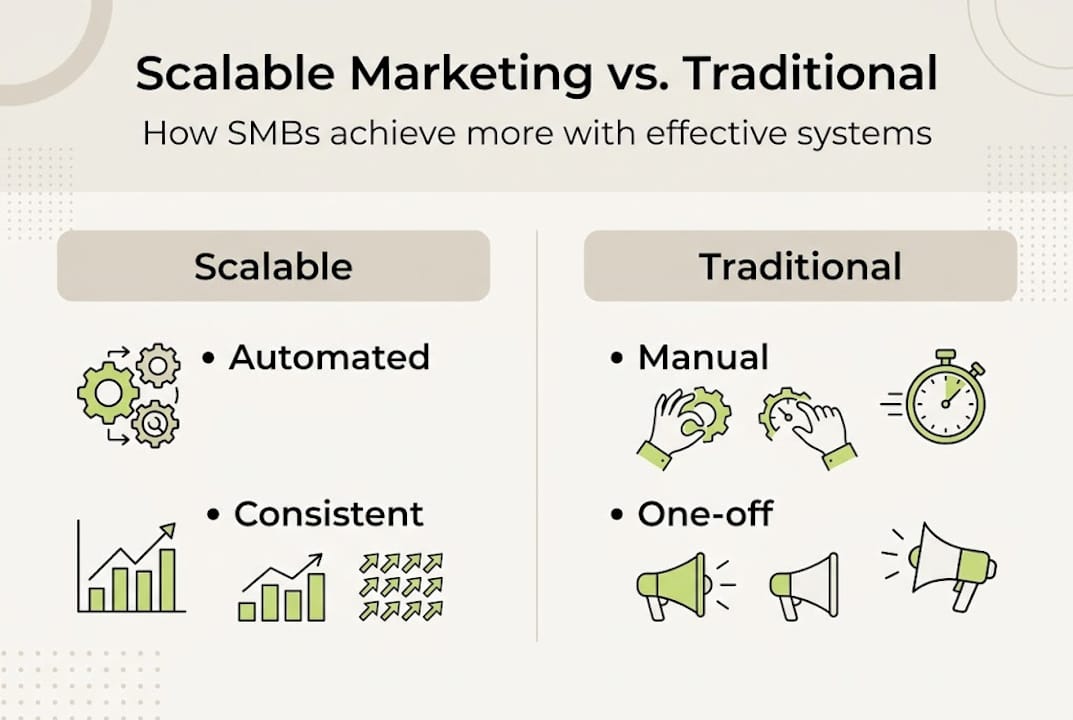
Traditional, ad-hoc marketing is not without its merits. A well-timed campaign can generate a spike in enquiries, a surge in web traffic, or a strong month of sales. The problem is what comes after. Without scalable infrastructure, that spike creates a bottleneck: your team scrambles, quality drops, and by the time you recover, the momentum has evaporated.
Scalable approaches solve this through strategic foundations. The contrast is stark when you lay it out clearly:
| Feature | Scalable marketing | Traditional ad-hoc |
|---|---|---|
| Process consistency | Automated, repeatable | Manual, campaign-by-campaign |
| Cost predictability | Structured and forecastable | Variable, often reactive |
| ROI measurement | Multi-touch, CLV-linked | Last-click or estimated |
| Agility | Channel-flexible | Rebuild required |
| Team demand | Steady and manageable | Peaks and burnout cycles |
The data reinforces this clearly. Scalable strategies outperform short-term wins through strategic foundations that achieve CLV exceeding CAC by up to 3x, alongside rigorous data practices and structured experimentation. Ad-hoc methods, by contrast, produce feast-and-famine cycles that are notoriously difficult to manage or predict.
For SMB marketing managers, the feast-famine problem is particularly damaging. You spend two weeks firefighting a slow period, then three weeks overwhelmed by demand you cannot service properly. Scalable systems smooth that curve considerably.
Key differences that matter most in practice:
- Sustainable ROI: Built on sustainable SMB growth strategies that compound over time rather than resetting with every campaign.
- Predictable costs: You know roughly what you will spend and what you will get back, making budget conversations with leadership far simpler.
- Team wellbeing: Automation handles the repetitive load, so your team focuses on strategy, creativity, and optimisation.
The social media scalability question is a good example. Running paid social in an ad-hoc way means starting from scratch with each campaign brief. A scalable setup means your audience segments, creative frameworks, and bidding logic are already in place and simply need updating.
The bottom line: short-term tactics can supplement a strategy, but they cannot replace one.
Key benefits: Why SMBs achieve more with scalable marketing
The numbers are persuasive. A small nutrition clinic using CRM and data integration achieved a 5.4x ROI, 320% revenue growth, and a 48% drop in cost per acquisition. A bakery doubled its ROAS from 1.8x to 4.2x after switching to AI-powered advertising. These are not outliers; they reflect what structured systems can deliver for businesses of any size.
Here is what that looks like across channels:
| Channel | Typical ROAS range | Scalable system advantage |
|---|---|---|
| Paid search | 3x to 5x | Automated bidding, negative keyword management |
| Paid social | 2.5x to 4x | Dynamic audiences, creative testing at scale |
| SEO | Compounds over time | Content systems, technical health monitoring |
| Email/CRM | High but variable | Lifecycle automation, personalisation at volume |
Digital marketing ROI benchmarks confirm that paid search delivers 3x to 5x ROAS and paid social 2.5x to 4x, with scalable systems compounding SEO returns over time rather than delivering a single burst of traffic.
The three core benefits for SMBs break down like this:
- Measurable, repeatable ROI: Every campaign feeds data back into the system, improving the next one automatically. You can see real-world ROI examples of this working across sectors.
- Rapid scaling as you grow: When your revenue increases, your marketing infrastructure scales with it rather than buckling under new demand.
- Simplified team management: Integrated tools reduce the number of platforms your team juggles. Browse success stories from businesses that have done exactly this.
“The businesses that grow sustainably are not the ones with the biggest budgets. They are the ones with the clearest systems.”
Managers reviewing higher ROI marketing examples consistently find that the differentiator is not spend level but structural discipline. A well-configured scalable system will outperform a large but poorly organised budget every time.

The core toolkit: Components of scalable marketing for SMBs
Knowing the benefits is one thing. Actually assembling the toolkit is where most SMB teams stall. Here is a practical rundown of what you need and why each component earns its place.
- CRM integration: Your CRM is the nervous system of your marketing. It captures every lead, tracks every interaction, and feeds data to every other tool. Without it, you are guessing.
- Marketing automation platform: Handles email sequences, lead nurturing, re-engagement workflows, and triggered responses. This is what allows a team of two to behave like a team of ten.
- AI-powered targeting: Modern ad platforms include AI bidding and audience tools, but third-party AI layers add predictive modelling and creative optimisation that compound results significantly.
- Cross-channel campaign management: A single dashboard or integrated suite lets you manage Google Ads, Meta, TikTok, and LinkedIn without logging into five separate platforms every morning.
- Analytics and attribution: You cannot improve what you cannot measure. Multi-touch attribution tells you what actually influenced a conversion, not just what happened to be the last click.
AI-driven tools enable solo and small teams to compete like agencies, with documented examples showing 353% ROI using AI assistants. The focus on lifetime value over initial conversions is what makes this sustainable rather than just impressive in a quarterly review.
The practical steps to build your toolkit:
- Audit your current tools and identify where data is siloed or where manual work consumes the most time.
- Select a CRM that integrates natively with your ad platforms and email tools.
- Add automation for your top three most repetitive marketing tasks.
- Layer in AI targeting on your highest-spend channel first, then expand.
- Build a reporting dashboard that tracks CLV and CAC alongside short-term metrics.
Review the marketing optimisation guide for a structured approach to each of these steps. If you are in a specific sector, exploring tools for scaling within your industry context can shortcut a lot of the configuration work.
Pro Tip: Prioritise cross-platform literacy within your team. A marketing manager who understands how Google Ads, Meta, and a CRM talk to each other is worth more than three specialists who each only know one tool.
The truth most managers miss about scalability
Here is the uncomfortable reality that most guides on this subject avoid: technology does not create scalability. Discipline does.
We see this regularly. A business invests in five new platforms, integrates them loosely, and then wonders why results are no better than before. The tools are not the problem. The absence of clear attribution frameworks, structured campaign hierarchies, and consistent review cycles is.
True scalability depends on process far more than it depends on software. If your team does not have clear answers to questions like “what counts as a qualified lead” or “how do we define a successful campaign,” then no amount of AI will fix that. Sustainable growth insights consistently point back to this same foundation: clarity of process before complexity of tool.
The most scalable marketing operations we have worked with are not necessarily using the most sophisticated platforms. They are using fewer, better-configured systems, run by teams who understand the data and act on it consistently. That discipline is what you should build first.
Unlock your growth with expert scalable marketing support
Understanding scalable marketing is a genuine advantage. Implementing it well is where the real returns begin.
At Geo Growth Media, our scalable marketing services are designed specifically for SMBs that want measurable, sustainable growth without the overhead of a large in-house team. Whether you need SEO solutions that compound over time or paid social media expertise to drive immediate pipeline, we build strategies around your goals, sector, and budget. We act as an extension of your team, not a third-party vendor handing over reports. Schedule a free consultation with us and let’s map out what scalable growth looks like for your business specifically.
Frequently asked questions
What businesses benefit most from scalable marketing solutions?
SMBs with growth ambitions and lean teams see the greatest gains because AI-enabled systems allow small operations to compete like agencies, maximising output without proportional increases in staff or budget.
How does scalability improve marketing ROI?
Automation reduces wasted manual effort, multi-touch attribution shows where budget is genuinely working, and flexible infrastructure supports growth across channels, delivering 3x to 5x ROAS on paid search with compounding SEO returns over time.
Which tools are essential for building scalable marketing?
The core stack includes a CRM platform, marketing automation software, cross-channel campaign management, and AI analytics. The mechanics of scalable systems require centralised data, automation, and CLV-focused measurement working together.
Can scalable approaches work for very small budgets?
Absolutely. Scalable structures help you extract more value from every pound by organising spend for incremental growth and automating optimisation. SMB case studies show 5.4x ROI and a 48% CPA reduction even for small operations starting from a modest baseline.
Recommended
- Scalable marketing solutions for sustainable SMB growth
- Digital marketing for SaaS companies | Driving MRR and sustainable growth
- Growth-Focused Digital Marketing Agency: SEO, PPC & Social
- Top social media strategies for scalable SMB growth in 2026
- Launch Marketing - Trial
- Status 200 Uploads — Schedule Posts to TikTok, Instagram, FB, YouTube, X & LinkedIn


.png)