.png)

.svg)




Many marketing managers track dozens of metrics yet struggle to connect data to meaningful business outcomes. The problem isn’t the volume of information available, it’s knowing which data genuinely drives growth and how to apply it strategically. Data-driven marketing improves targeting and personalisation, whilst AI tools can raise ROI by about 30% when powered by quality information.
Table of Contents
- Understanding The Types Of Marketing Data And Their Uses
- Common Misconceptions About Data In Digital Marketing
- Data Quality, Privacy, And Governance In The UK Context
- Measurement And ROI Attribution Using Data
- Building A Data-Driven Culture For Sustainable Marketing Growth
- Case Studies And Practical Applications
- Conclusion: Transforming Digital Marketing With Data
- Discover Expert Digital Marketing Services For SME Growth
Key takeaways
| Point | Details |
|---|---|
| First-party data leads post-cookie | Direct customer data collection ensures compliance and accuracy for targeting in 2026. |
| Quality trumps volume | High-quality, relevant data generates better marketing outcomes than large datasets. |
| Measurement drives optimisation | Tracking bounce rate, conversions, and attribution reveals campaign effectiveness. |
| Data culture enables agility | Democratising data access speeds decision-making and continuous improvement. |
| UK SMEs prove tangible ROI | Real examples show 15-25% performance improvements through data-driven strategies. |
Understanding the types of marketing data and their uses
Successful digital marketing relies on understanding three distinct data categories and their strategic applications. First-party data comes directly from your customers through website interactions, email subscriptions, purchase history, and CRM records. This information delivers the highest accuracy and compliance because you control collection and storage.
Second-party data arrives through trusted partnerships where another organisation shares their first-party information with you. A complementary business might exchange customer insights to expand targeting reach whilst maintaining data quality. Third-party data, previously purchased from aggregators, faces severe limitations in 2026 due to cookie phase-out and privacy restrictions.
Analytics data provides the measurement foundation for your types of digital marketing strategies. Website analytics reveal visitor behaviour patterns, session duration, bounce rates, and conversion paths. Social media platforms report engagement metrics like reach, clicks, shares, and follower growth. Email marketing systems track open rates, click-through percentages, and subscriber actions.
Search data remains critical despite zero-click searches increasing on Google. You need visibility into keyword rankings, search volumes, and SERP features your content captures. Combining these analytics sources creates comprehensive performance pictures.
Key data sources for SME marketers include:
- Website analytics tracking user journeys and conversion funnels
- Social platform insights measuring campaign reach and engagement
- Email performance metrics revealing audience response patterns
- Search console data showing organic visibility and click behaviour
- CRM records documenting customer lifecycle and purchase history
Common misconceptions about data in digital marketing
The biggest myth plaguing SME marketing teams suggests more data automatically produces better results. Volume means nothing without quality and relevance. A focused dataset of 500 engaged customers delivers more value than 50,000 unqualified contacts gathered through questionable methods.
Another dangerous misconception treats data as a magic solution requiring no strategic thinking. Raw numbers sitting in dashboards accomplish nothing until you apply analytical frameworks and ask the right questions. Data informs decisions but doesn’t make them for you.
Many marketers still rely on third-party cookies despite their imminent disappearance from major browsers. This outdated approach wastes resources and creates compliance risks. The cookie phase-out isn’t coming, it’s already here for most of your audience.
Some teams believe sophisticated tools automatically generate insights without manual oversight. Automation handles repetitive tasks brilliantly but cannot replace human judgement about strategy and context. Your digital marketing optimisation guide depends on combining technology with expertise.
Common data misconceptions to avoid:
- Assuming larger datasets guarantee superior targeting accuracy
- Expecting analytics platforms to interpret findings without strategic input
- Continuing third-party cookie reliance despite privacy changes
- Believing data quality issues resolve themselves over time
- Thinking expensive tools substitute for proper data governance
Pro Tip: Review your data sources quarterly to eliminate low-quality information streams that waste analysis time without improving decisions.
Data quality, privacy, and governance in the UK context
AI marketing effectiveness depends fundamentally on data quality, transparency, and governance. Poor data quality undermines every algorithm and prediction model you deploy. UK GDPR compliance isn’t optional overhead, it’s the foundation for sustainable marketing that builds customer trust.

Small and medium businesses must implement transparent consent mechanisms when collecting customer information. Cookie banners need clear language explaining exactly what data you gather and why. Legitimate interest claims require documented justification that withstands regulatory scrutiny.
The transition from third-party to first-party data collected ethically through direct engagement protects both compliance and data quality. Build collection points into your customer journey: registration forms, preference centres, purchase processes, and email subscriptions. Each touchpoint should offer genuine value in exchange for information.
Household-level targeting balances precision, scale, and privacy in programmatic advertising. This approach groups individuals by household rather than tracking personal identifiers, maintaining effectiveness whilst respecting privacy boundaries. It’s particularly valuable for UK advertisers navigating post-cookie targeting.
Data governance practices for SMEs:
- Establish clear ownership for data quality and compliance responsibilities
- Document data flows showing how information moves through your systems
- Implement regular audits checking accuracy and consent validity
- Create retention policies deleting outdated or unnecessary records
- Train team members on GDPR requirements and ethical data use
Your digital marketing optimisation guide should reference these governance standards to ensure sustainable practices.
Pro Tip: Appoint a data champion within your marketing team to monitor quality issues and flag compliance concerns before they become problems.
Measurement and ROI attribution using data
Key metrics like bounce rate, average session duration, and conversion rates form the foundation for campaign optimisation. Without proper measurement frameworks, you’re essentially marketing blind. Understanding what is digital marketing uk means recognising that every strategy needs quantifiable success indicators.
The challenge is real: 50% of UK marketers struggle with measuring performance effectively. Attribution becomes particularly complex when customers interact across multiple channels before converting. Did the Instagram ad drive the sale or the follow-up email?
| Metric | Purpose | Impact on decisions |
|---|---|---|
| Bounce rate | Measures immediate exits | Reveals content relevance issues |
| Session duration | Shows engagement depth | Indicates content quality |
| Conversion rate | Tracks goal completions | Directly measures campaign effectiveness |
| Cost per acquisition | Calculates efficiency | Determines budget allocation |
| Customer lifetime value | Predicts long-term revenue | Guides retention investment |
Analytics tools transform raw data into actionable insights when configured properly. Google Analytics 4 tracks user journeys across devices and platforms. Social media platforms provide native analytics showing which content formats resonate. CRM systems reveal customer behaviour patterns and purchase cycles.
Attribution modelling challenges SMEs face:
- Multi-touch journeys spanning weeks or months across channels
- Limited budgets preventing investment in sophisticated attribution tools | Small sample sizes making statistical significance difficult
- Technical implementation gaps leaving measurement blind spots
Your digital marketing audit process 2026 should include measurement framework reviews quarterly. Compare your approach to proven platforms for small businesses 2026 that streamline tracking.
Building a data-driven culture for sustainable marketing growth
Data democratisation improves decision-making speed and campaign agility by giving team members direct access to insights. Breaking down information silos lets marketers test hypotheses quickly without waiting for analyst reports. However, democratisation requires proper training and governance to prevent misinterpretation or security breaches.
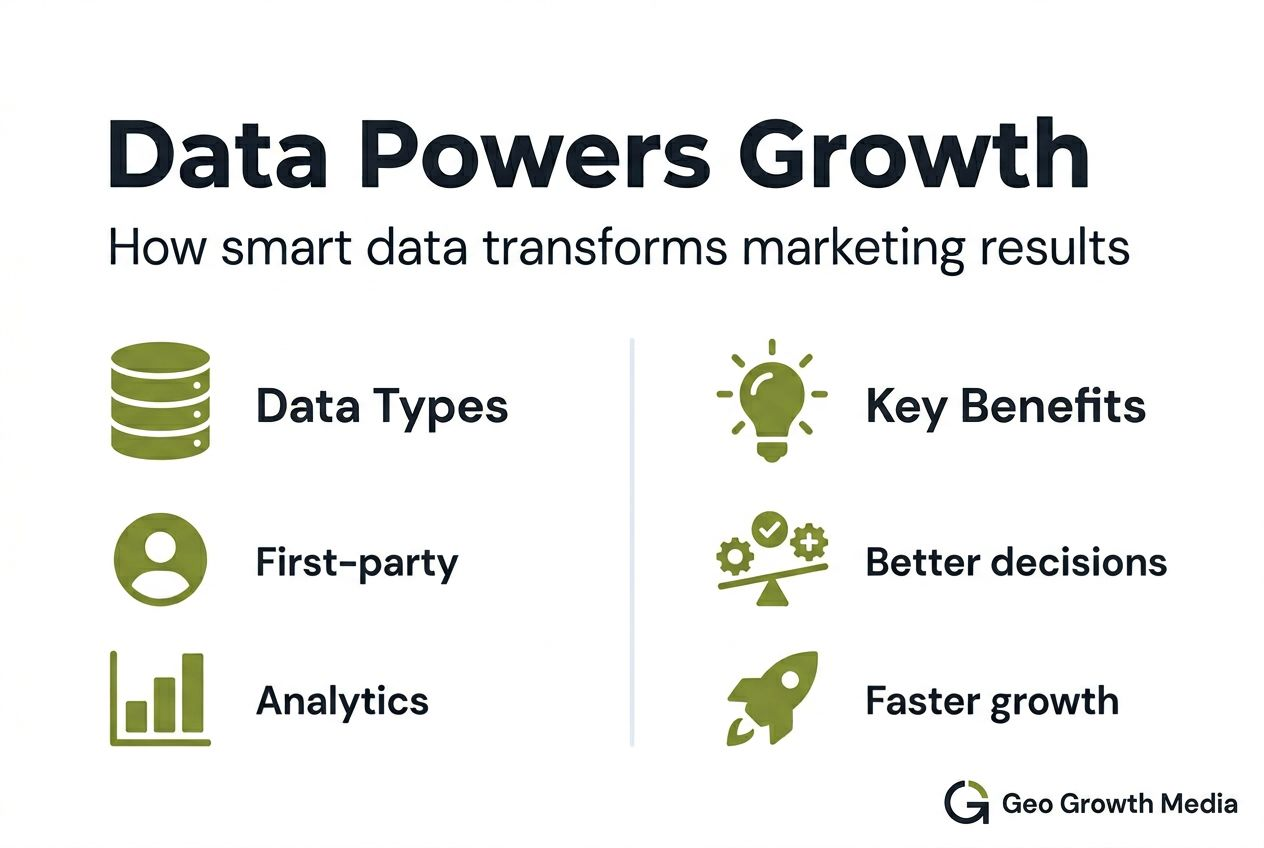
Automation handles repetitive data tasks brilliantly, freeing your team for strategic thinking. Marketing automation platforms can boost productivity by over 90% when implemented correctly. They handle email sequences, social posting schedules, and lead scoring whilst you focus on creative strategy and campaign development.
Leadership commitment makes the difference between lip service and genuine cultural transformation. When executives regularly reference data in meetings and reward evidence-based decisions, teams naturally adopt similar behaviours. You need consistent reinforcement that gut feelings take second place to validated insights.
Steps to build your data-driven marketing culture:
- Create accessible dashboards showing real-time campaign performance for all team members
- Schedule weekly data reviews where teams discuss metrics and share learnings
- Establish testing protocols requiring hypothesis documentation before campaign launches
- Reward experiments and learning, even from failed tests that generate insights
- Invest in training programmes developing analytical skills across your marketing function
- Implement collaboration tools letting teams annotate data and share interpretations
Your social media strategies 2026 benefit enormously from this cultural foundation. Teams comfortable with data naturally optimise content based on engagement patterns rather than assumptions.
Pro Tip: Start small by choosing one key metric as your north star, ensuring everyone understands how their work influences that number before expanding to complex multi-metric dashboards.
Case studies and practical applications
A Manchester-based e-commerce SME implemented AI-powered analytics to optimise their paid social campaigns across Meta and TikTok. Within six months, they achieved a 25% conversion increase by analysing customer behaviour patterns and adjusting creative accordingly. Their data-driven approach identified that video content under 15 seconds outperformed longer formats by 40% for their target audience.
Another UK SME in the professional services sector tracked a 15% ROI improvement after restructuring their measurement framework. They moved from vanity metrics like follower counts to tracking qualified lead generation and customer acquisition costs. This shift revealed their LinkedIn campaigns delivered three times better lead quality than previously favoured channels.
Key lessons from successful implementations:
- Cross-functional collaboration between marketing, sales, and customer service improves data interpretation
- Continuous benchmarking against past performance reveals incremental gains that compound over time
- Agility matters more than perfection when testing data-driven hypotheses
- Small budget SMEs can compete effectively using focused first-party data strategies
| Campaign metric | Before data optimisation | After data optimisation | Improvement |
|---|---|---|---|
| Conversion rate | 2.1% | 2.6% | 24% increase |
| Cost per lead | £45 | £32 | 29% reduction |
| Customer lifetime value | £380 | £465 | 22% increase |
| Campaign ROI | 180% | 245% | 36% improvement |
The koble designs case study demonstrates how strategic data application transforms marketing effectiveness. Their success came from consistent testing, rapid iteration based on results, and refusing to rely on assumptions.
Conclusion: transforming digital marketing with data
Data forms the foundation for effective targeting, accurate measurement, and continuous optimisation in modern digital marketing. Without quality information and proper analytics frameworks, you’re guessing rather than strategising. The evidence is clear: data-driven approaches deliver measurable growth and improved ROI when implemented with proper governance and cultural support.
Sustainable success requires more than collecting information. You need quality first-party data, privacy-compliant practices, and teams empowered to act on insights quickly. The UK SMEs achieving exceptional results share common traits: they prioritise data quality over volume, maintain rigorous measurement frameworks, and foster cultures where evidence drives decisions. Your competitive advantage in 2026 comes from applying these principles consistently whilst adapting to evolving privacy regulations and customer expectations.
Discover expert digital marketing services for SME growth
Applying data-driven strategies requires expertise, time, and technical capabilities many SMEs struggle to build in-house. That’s where professional support transforms good intentions into measurable results.
Geo Growth Media specialises in helping ambitious SMEs implement data-powered digital marketing that drives sustainable growth. Our paid social media services use advanced analytics to optimise campaigns across Meta, TikTok, and LinkedIn, ensuring your budget delivers maximum ROI. We don’t just run ads, we analyse performance data to continuously refine targeting and creative.
Our SEO services combine technical expertise with data insights to build organic visibility that compounds over time. We track rankings, analyse search behaviour, and optimise content based on what your audience actually searches for. Complement your data foundation with website design services that capture valuable first-party information whilst delivering exceptional user experiences. Contact us to discuss how data-driven strategies can accelerate your business growth.
Frequently asked questions
What types of data should SMEs prioritise in digital marketing?
Prioritise first-party data collected ethically directly from customers through website interactions, email subscriptions, and purchase records. This information ensures accuracy and compliance whilst third-party data has become unreliable due to privacy restrictions.
How can SMEs ensure compliance with UK data privacy regulations?
Implement transparent consent practices with clear cookie banners explaining data collection purposes. Shift focus to first-party data strategies and privacy-compliant targeting approaches like household-level methods that balance effectiveness with regulatory requirements.
What are the best metrics to track ROI in digital marketing?
Track bounce rate, average session duration, conversion rates, and cost per acquisition as your core measurement framework. Utilise analytics platforms to attribute performance across channels, revealing which tactics genuinely drive business outcomes.
How does building a data-driven culture benefit SME marketing teams?
Data democratisation speeds decision-making by giving team members direct access to performance insights, encouraging continuous optimisation. Automation handles repetitive tasks, boosting productivity whilst freeing marketers for strategic and creative work that drives growth.
Recommended
- Growth-Focused Digital Marketing Agency: SEO, PPC & Social
- Digital Marketing Optimization Guide for Measurable Growth
- Geo Growth Media Website
- Digital marketing for ecommerce brands | Scaling online sales in the UK
- 6 skutecznych strategii marketingowych online, których nie możesz przegapić – lokalne wizytówki pl


.png)