.png)

.svg)




Managing paid social campaigns can feel overwhelming when you’re juggling multiple platforms, tight budgets, and demanding stakeholders. Many marketing managers struggle with disjointed processes that lead to wasted spend and missed opportunities. A structured workflow transforms this chaos into a systematic approach that drives measurable results. This guide walks you through a proven paid social campaign workflow designed to maximise your return on investment whilst streamlining execution from planning through optimisation.
Table of Contents
- Preparing Your Paid Social Campaign
- Executing The Campaign Workflow Step By Step
- Measuring Results And Optimising Your Campaign
- Avoiding Common Paid Social Campaign Mistakes
- Boost Your Paid Social Campaigns With Expert Support
- Frequently Asked Questions
Key takeaways
| Point | Details |
|---|---|
| Structured workflows improve efficiency | A clear process enhances planning, execution, and measurement across all campaign stages |
| Data-driven optimisation maximises returns | Continuous monitoring and adjustment based on performance metrics increases ROI significantly |
| Proper preparation prevents costly mistakes | Setting clear objectives, researching audiences, and planning resources upfront saves time and budget |
| Regular iteration sustains performance | Weekly reviews and testing cycles keep campaigns responsive to market changes and audience behaviour |
Preparing your paid social campaign
Successful campaigns start long before you click publish. The preparation phase determines whether your paid social efforts will deliver results or drain resources without meaningful returns.
Define clear campaign goals aligned with your business objectives. Are you driving brand awareness, generating leads, or increasing direct sales? Each objective requires different metrics, creative approaches, and budget allocations. Vague goals like “increase engagement” won’t provide the direction needed for effective optimisation.
Research and segment your target audience precisely. Generic targeting wastes budget on uninterested users. Build detailed audience profiles based on demographics, interests, behaviours, and pain points. Social platforms offer sophisticated targeting options, but they only work when you understand exactly who you’re trying to reach.
Set realistic budgets considering rising ad spend trends. Global social media advertising is expected to exceed $234.14 billion in 2024, reflecting increased competition for audience attention. Calculate your cost per acquisition targets based on customer lifetime value, then work backwards to determine necessary daily budgets. Start conservatively and scale based on proven performance.
Choose social platforms suited to your audience and goals. LinkedIn excels for B2B lead generation, whilst Meta platforms dominate consumer retail. TikTok captures younger demographics with creative storytelling. Don’t spread budgets too thin across every platform. Focus resources where your audience spends time and the format matches your message.
Gather creative assets and plan necessary ad formats. Static images, carousel ads, video content, and stories each serve different purposes. Prepare multiple variations for testing, ensuring you have proper dimensions and specifications for each platform. Poor creative quality undermines even the best targeting and strategy.
Campaign preparation checklist:
- Document specific, measurable campaign objectives
- Create detailed audience personas with targeting parameters
- Calculate budget allocation across platforms and ad sets
- Prepare 3-5 creative variations per campaign
- Set up tracking pixels and conversion events
- Define team roles and approval workflows
| Preparation element | Time investment | Impact on success |
|---|---|---|
| Audience research | 4-6 hours | High |
| Creative development | 8-12 hours | Very high |
| Platform setup | 2-3 hours | Medium |
| Budget planning | 2-4 hours | High |
Pro Tip: Build a paid advertising workflow guide template that documents your process. This standardises execution across team members and reduces setup time for future campaigns whilst ensuring nothing gets overlooked.
Plan campaign timelines and assign team roles. Who handles creative approval? Who monitors daily performance? Who makes optimisation decisions? Clear responsibilities prevent bottlenecks and ensure swift responses to performance issues. Understanding why to use paid social ads helps align team efforts around shared objectives.
Executing the campaign workflow step by step
With preparation complete, execution requires methodical attention to detail. Each step builds on the previous one, creating a campaign structure that supports ongoing optimisation.
Step 1: Set up ad accounts and tracking pixels properly. Install platform pixels on your website to track conversions accurately. Configure custom events for key actions like form submissions, purchases, or content downloads. Test pixel firing before launching campaigns to avoid data gaps that compromise optimisation decisions.

Step 2: Write compelling copy tailored to the target audience. Paid advertising campaigns involve copywriting and bidding as core components. Address specific pain points your audience faces. Lead with benefits, not features. Keep primary text concise for mobile viewing whilst providing enough context to drive action. Test multiple headline variations to identify what resonates.
Step 3: Choose optimal bidding strategies based on campaign goals. Manual bidding offers control but requires constant monitoring. Automated bidding leverages platform algorithms but needs sufficient conversion data to perform well. Start with manual bidding for new campaigns, then transition to automated strategies once you’ve gathered performance insights.
| Bidding strategy | Best for | Pros | Cons |
|---|---|---|---|
| Manual CPC | New campaigns, tight budgets | Full control, predictable costs | Time-intensive monitoring |
| Target CPA | Lead generation | Optimises for conversion cost | Requires conversion history |
| Target ROAS | E-commerce sales | Maximises revenue efficiency | Needs robust tracking data |
| Lowest cost | Brand awareness | Maximum reach within budget | Less cost predictability |
Step 4: Define ad placements and scheduling for maximum impact. Don’t default to automatic placements without testing. Review where your audience engages most, then allocate budget accordingly. Schedule ads during peak engagement hours unless you’re testing 24-hour performance. Business audiences respond differently on weekdays versus weekends.
Step 5: Launch the campaign and ensure all systems are functioning. Submit ads for platform review well before your intended start date. Approval can take 24-48 hours. Once live, verify that ads are delivering, pixels are tracking, and budgets are pacing correctly. Small technical issues caught early prevent wasted spend.
Step 6: Monitor initial performance closely for quick adjustments. The first 48-72 hours reveal critical insights about targeting accuracy and creative resonance. Don’t make hasty changes during the learning phase, but watch for obvious problems like zero impressions or extremely high costs per result.
Pro Tip: Create a launch day checklist covering pixel verification, budget pacing checks, ad approval status, and initial performance benchmarks. This systematic approach catches issues before they consume significant budget. Our paid social media services include comprehensive launch protocols that ensure campaigns start strong.
Understanding paid media strategy explained helps contextualise how individual campaign execution fits within broader marketing objectives. Each campaign should ladder up to overarching business goals whilst maintaining tactical flexibility for optimisation.
Campaign launch checklist:
- Verify pixel installation and event tracking
- Confirm budget allocation matches strategy
- Check ad copy for errors and brand compliance
- Review targeting parameters for accuracy
- Set up performance alerts and dashboards
- Document baseline metrics for comparison
The execution phase transforms preparation into action. Attention to detail during setup prevents costly mistakes and creates the foundation for effective optimisation. Learn more about paid social advertising growth and ROI to understand what drives successful campaign outcomes.
Measuring results and optimising your campaign
Launching campaigns is just the beginning. Continuous measurement and optimisation separate mediocre results from exceptional performance. Data-driven decisions compound over time, steadily improving efficiency and returns.
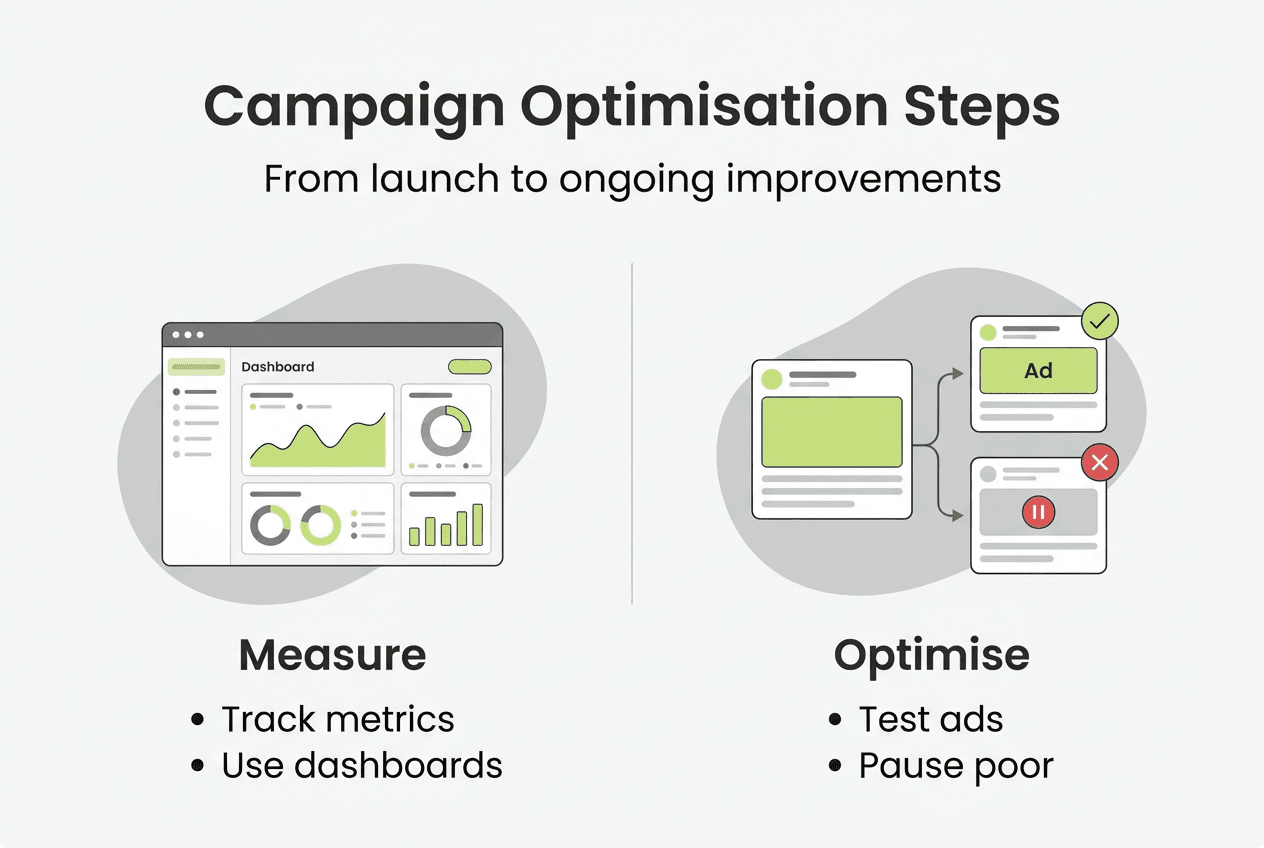
Track metrics like click-through rate, cost per acquisition, return on ad spend, and conversion rates. These core indicators reveal campaign health and highlight optimisation opportunities. Don’t obsess over vanity metrics like impressions or likes unless they directly support your objectives. Focus on metrics that connect to business outcomes.
Use dashboards and analytics tools for real-time data. Platform native analytics provide immediate performance insights, whilst third-party tools offer cross-platform comparison and deeper analysis. Build custom dashboards that surface your most important metrics at a glance, enabling quick decision-making without drowning in data.
Identify underperforming ad sets and test alternatives. When certain audiences, placements, or creatives consistently underdeliver, pause them and reallocate budget to better performers. This doesn’t mean abandoning struggling elements immediately. Give campaigns sufficient data before making changes, but don’t cling to poor performers out of optimism.
Advertisers see an average return of $5.28 for every $1 spent on paid social, but achieving this requires active optimisation. Results don’t happen automatically. Regular testing and refinement based on performance data drive these returns.
Adjust targeting, bids, and creatives according to data insights. Narrow targeting when cost per result is high. Expand reach when you’re efficiently converting a small audience. Test new creative angles when engagement drops. Increase bids for high-performing placements. Every adjustment should respond to specific performance signals, not hunches.
Key optimisation metrics:
- Click-through rate (CTR): Measures ad relevance and appeal
- Cost per acquisition (CPA): Tracks efficiency of conversion generation
- Return on ad spend (ROAS): Calculates revenue generated per pound spent
- Conversion rate: Indicates landing page and offer effectiveness
- Frequency: Monitors audience saturation and ad fatigue
| Optimisation action | When to apply | Expected impact |
|---|---|---|
| Pause underperforming ads | CPA 50% above target for 3+ days | Reduce wasted spend |
| Increase budget on winners | ROAS 2x target consistently | Scale profitable performance |
| Refresh creative assets | Frequency above 3, declining CTR | Combat ad fatigue |
| Refine audience targeting | High CTR, low conversion rate | Improve audience quality |
Continuous iteration yields sustained performance improvement. Set a regular optimisation schedule rather than making random changes whenever you check performance. Weekly reviews work well for most campaigns, with daily monitoring for large budgets or time-sensitive promotions.
Pro Tip: Document every optimisation change with the rationale behind it. This creates a knowledge base showing what works for your specific audience and objectives. Over time, these insights inform faster, more confident decisions across all campaigns. Discover additional advantages of social ads to maximise your strategic approach.
Optimisation is never truly finished. Markets shift, audiences evolve, and competitors adjust strategies. Maintaining campaign performance requires ongoing attention and willingness to test new approaches whilst scaling what works.
Avoiding common paid social campaign mistakes
Even experienced marketers fall into predictable traps that undermine campaign performance. Recognising these mistakes helps you sidestep costly errors and maintain efficient workflows.
Insufficient targeting wastes budget on uninterested audiences. Casting too wide a net might generate impressions, but it rarely drives quality conversions. Conversely, overly narrow targeting limits reach and inflates costs. Find the balance through testing, starting broader then refining based on performance data.
Poor creative testing leaves money on the table. Running a single ad variation means you never discover what truly resonates. Test multiple headlines, images, calls to action, and value propositions. Let data reveal winner combinations rather than relying on assumptions about what will work.
Ignoring analytics turns paid social into expensive guesswork. Platforms provide extensive performance data specifically to guide optimisation. Failing to review metrics regularly means missing opportunities to improve results and eliminate waste. Set calendar reminders for performance reviews if necessary.
“Data-driven decisions consistently outperform intuition in paid advertising. The marketers who succeed are those who let performance metrics guide strategy rather than personal preferences or assumptions.”
Over-spending too early without data validation burns through budgets before you’ve identified what works. Start with modest daily budgets, prove your targeting and creative effectiveness, then scale investment proportionally. Patience during the testing phase pays dividends through more efficient spending later.
Workflow bottlenecks from unclear team communication slow campaign execution and optimisation. When approval processes drag on or responsibilities overlap, campaigns suffer. Document clear workflows showing who handles each task, decision authority levels, and communication channels for issues.
Common mistakes to avoid:
- Launching campaigns without conversion tracking in place
- Making optimisation changes during platform learning phases
- Ignoring mobile optimisation for ads and landing pages
- Failing to set frequency caps, causing audience fatigue
- Neglecting competitor research and market positioning
- Running identical campaigns across different platforms
Pro Tip: Schedule regular performance reviews and A/B tests into your workflow calendar. Treat optimisation as a recurring commitment rather than an occasional activity. Consistent attention prevents small issues from becoming expensive problems whilst identifying improvement opportunities early. Implementing social media strategies for SMB growth provides additional context for avoiding common pitfalls.
Mistakes are inevitable, especially when testing new approaches. The key is learning from them quickly and adjusting before they significantly impact campaign performance. Maintain detailed notes on what doesn’t work alongside successes to build institutional knowledge that improves future campaigns.
Boost your paid social campaigns with expert support
Managing paid social campaigns effectively requires specialised knowledge, consistent attention, and ongoing optimisation. Whilst this workflow provides a solid foundation, partnering with experienced professionals can accelerate results and free your team to focus on core business activities.
Geo Growth Media offers tailored paid social campaign management designed specifically for ambitious brands seeking scalable growth. Our team acts as an extension of your marketing department, bringing platform expertise and proven optimisation frameworks that maximise return on investment. We handle everything from initial strategy through daily management and continuous refinement.
Integrated services including SEO and landing page design ensure your paid social traffic converts efficiently. Driving qualified visitors to poorly optimised pages wastes ad spend. Our holistic approach aligns every element of your digital presence to support campaign objectives and business growth.
Expert teams help streamline your workflow and maximise ROI through transparent reporting, data-driven decisions, and personalised strategies tailored to your sector and budget. Contact Geo Growth Media’s paid social media services to elevate your paid social efforts and achieve sustainable business growth.
Frequently asked questions
What is a paid social campaign workflow?
A paid social campaign workflow is the structured process covering planning, execution, optimisation, and measurement of paid social media advertisements. It provides a systematic approach ensuring all necessary steps are completed efficiently, from initial strategy development through ongoing performance refinement. This framework helps marketing teams maintain consistency, avoid costly mistakes, and maximise return on investment across campaigns.
How can I improve ROI on paid social campaigns?
Focus on precise targeting, compelling creatives, and continuous optimisation to increase ROI. Start with thorough audience research to reach the right people, test multiple ad variations to identify what resonates, and regularly review performance metrics to reallocate budget towards top performers. Advertisers see an average return of $5.28 for every $1 spent on paid social when they actively optimise based on data insights rather than set campaigns and forget them.
Which tools help streamline paid social campaign workflows?
Platforms like Facebook Ads Manager, Google Analytics, and campaign management software simplify workflows and tracking. These tools provide centralised dashboards for monitoring performance across platforms, automate reporting, and enable quick optimisation adjustments. Third-party solutions like Hootsuite, Sprout Social, or HubSpot offer additional features for team collaboration, approval workflows, and cross-platform campaign management that improve efficiency for busy marketing teams.
How often should I review and adjust my paid social campaigns?
Review campaigns at least weekly initially, then bi-weekly once stable, to respond promptly to data insights. New campaigns require closer monitoring during the first two weeks as platforms complete learning phases and performance stabilises. High-budget campaigns or time-sensitive promotions may warrant daily checks. Establish a regular review schedule rather than making random changes, as consistent optimisation based on sufficient data yields better long-term results than reactive adjustments.


.png)