.png)

.svg)




TL;DR:
- A clear, measurable strategy with defined goals is essential for successful paid advertising campaigns.
- Audience research and platform selection should be driven by target customer behavior and preferences.
- Continuous testing and optimization of creatives, landing pages, and targeting are vital for long-term growth.
Many e-commerce brands pour thousands into paid advertising only to watch their budget disappear with little to show for it. The problem is rarely the platform or the product. It’s the absence of a clear, structured strategy. Without defined goals, precise targeting, and aligned creatives, even the most generous ad spend will underperform. This guide walks you through every stage of building a paid ads strategy that actually converts, from setting objectives and choosing platforms to launching campaigns and optimising for compounding returns. Whether you’re scaling an established store or launching a new product line, the steps below will help you invest smarter and grow faster.
Table of Contents
- Define your objectives and budget
- Research your audience and choose platforms
- Plan compelling creatives and landing pages
- Launch, test and optimise your campaigns
- What most e-commerce brands get wrong about paid ads strategy
- Accelerate your results with expert support
- Frequently asked questions
Key Takeaways
| Point | Details |
|---|---|
| Set clear objectives | Define specific goals and allocate budget accordingly for your paid ads campaigns. |
| Know your audience | Research customer behaviours and select platforms where your buyers are most active. |
| Align creative and landing page | Ensure your ad messaging and landing page content match for higher conversions. |
| Test, measure and optimise | Regularly review key metrics and test ad variations for ongoing campaign improvement. |
Define your objectives and budget
Before you spend a single penny on paid advertising, you need to know exactly what you want it to achieve. Vague goals like “get more sales” or “increase traffic” are not enough. Setting paid ads goals with precision is what separates campaigns that scale from those that stall.
Start by identifying your primary business objective. Are you driving direct product sales, generating leads for a high-ticket item, building brand awareness for a new launch, or re-engaging existing customers? Each objective demands a different campaign structure, bidding strategy, and set of success metrics. Mixing them into one campaign without clarity is one of the fastest ways to waste budget.
Once your objective is clear, use the SMART framework to formalise it. SMART goals ensure campaigns have measurable outcomes, meaning every decision you make, from ad format to audience size, is tied to a specific, time-bound target. For example, rather than “increase sales,” a SMART goal reads: “Generate 200 product purchases at a ROAS of 4x within 30 days.”
Budget planning comes next. Your spend should be anchored to your customer lifetime value (CLV) and your acceptable cost per acquisition (CPA). If a customer is worth £300 over their lifetime and your average order value is £75, you have room to spend more per conversion than a brand with a £25 average order. Use paid ads for growth as a reference point when calibrating spend against expected returns.
Allocate your budget by campaign priority. Product launches typically need heavier upfront investment to build momentum, while evergreen campaigns can run on leaner budgets once optimised. A practical starting split might look like this:
| Campaign type | Budget allocation | Primary KPI |
|---|---|---|
| Product launch | 50% | ROAS, CPA |
| Retargeting | 30% | Conversion rate |
| Brand awareness | 20% | CPM, CTR |
The key metrics to track across all campaigns include:
- ROAS (Return on Ad Spend): Revenue generated per pound spent
- CPC (Cost Per Click): How much you pay for each visit
- CTR (Click-Through Rate): Percentage of people who click your ad
- CPA (Cost Per Acquisition): What you pay for each conversion
Familiarise yourself with important paid search metrics so you can interpret your data confidently from day one.
Pro Tip: Review your budget allocation monthly, not just when something goes wrong. Shifting even 10% of spend from a low-ROAS campaign to a high-performer can meaningfully improve overall returns.
Research your audience and choose platforms
With your goals and budget in place, the next step is understanding who you’re targeting and where to find them. Audience research is not a one-time task. It’s an ongoing discipline that sharpens your targeting and reduces wasted spend over time.
Start by mapping your ideal customer profile. Go beyond basic demographics like age and location. Consider their interests, online behaviour, purchase triggers, and the problems your product solves for them. If you have existing customer data from your CRM or e-commerce platform, use it. Purchase history, average order value, and browsing behaviour are all signals that can inform tighter audience segments.

Different platforms offer unique targeting capabilities and audience profiles, which means your platform choice should follow your audience, not the other way around. Here’s a quick comparison to guide your thinking:
| Platform | Best for | Key targeting strength |
|---|---|---|
| Google Ads | High-intent buyers | Keyword and search intent |
| Meta (Facebook/Instagram) | Visual products, broad reach | Interest and behavioural targeting |
| TikTok | Younger demographics, viral content | Interest and engagement data |
| B2B and professional products | Job title, industry, seniority |
For most e-commerce brands, Google Ads and Meta are the natural starting point because they offer the broadest reach and the most mature targeting tools. But if your product resonates with a younger audience, TikTok’s cost-per-click can be significantly lower than Meta’s, making it worth testing early.
Use social media audience research tools to validate your assumptions before committing budget. You may find that your assumed audience differs from your actual buyers, and that gap is where many campaigns go wrong.
Key principles for platform selection:
- Start with one or two platforms and master them before expanding
- Match ad format to platform strengths (video for TikTok, Shopping for Google)
- Test audience segments with small budgets before scaling
- Review paid ads case studies from your sector to benchmark expectations
If you want a broader view of what’s available, explore paid media services to understand how different channels can work together as part of a unified strategy.
Plan compelling creatives and landing pages
Knowing your audience and platform, you now need to grab their attention and turn that interest into action. This is where creative strategy and landing page planning become critical, and where many otherwise well-structured campaigns fall apart.
The single most important principle here is message match. Your ad copy and your landing page must tell the same story. If your ad promises “30% off summer footwear,” your landing page must lead with that exact offer. Any disconnect between the two creates friction, and friction kills conversions. Cohesive creative and landing page design significantly increases conversion rates, making message match one of the highest-leverage improvements you can make.
For your ad creatives, focus on these fundamentals:
- Lead with benefits, not features: Customers care about outcomes, not specifications
- Use a single, clear call to action: “Shop now,” “Get 30% off today,” or “See the collection”
- Include trust signals: Star ratings, review counts, and security badges reduce purchase hesitation
- Keep visuals clean and on-brand: Cluttered ads lose attention within the first second
- Optimise for mobile: The majority of e-commerce traffic comes from mobile devices
For landing pages, the same rules apply. Explore landing page design tips to understand what high-converting pages have in common, and review landing page examples to see these principles in action. If you need professional support building pages that convert, optimising landing pages is a service worth considering early in your strategy.
A/B testing is non-negotiable at this stage. Test one variable at a time, whether that’s the headline, the hero image, or the call-to-action button colour. Running multiple tests simultaneously makes it impossible to attribute performance changes accurately. For inspiration on what great pages look like in practice, landing page inspiration from across industries can spark useful ideas.
Pro Tip: Build a dedicated landing page for every major campaign rather than sending traffic to your homepage. A focused page with a single conversion goal consistently outperforms a general page with multiple distractions.
Launch, test and optimise your campaigns
Once your creatives and landing pages are ready, it’s time to go live. But launching is just the beginning. The brands that see compounding returns from paid advertising are the ones that treat every campaign as a learning opportunity.
Here’s a practical launch sequence to follow:
- Start with a controlled budget. Launch at 20 to 30% of your planned spend to gather data without overcommitting.
- Set clear test parameters. Define what you’re testing, for how long, and what result would constitute a winner.
- Monitor daily for the first two weeks. Watch for anomalies in CTR, CPC, and conversion rate that signal something is off.
- Run A/B tests on one variable at a time. Headlines, images, audience segments, and bidding strategies should each be tested in isolation.
- Review weekly and act on the data. Pause underperformers, scale winners, and document every learning for future campaigns.
“Continuous testing and optimisation are key to achieving a high return on ad spend.” Following a structured paid ads workflow ensures you build on what works rather than starting from scratch each time.
A consistent ad testing strategy is what separates brands that plateau from those that grow. The data you gather in the first 30 days of a campaign is arguably more valuable than the revenue it generates, because it informs every decision you make going forward.
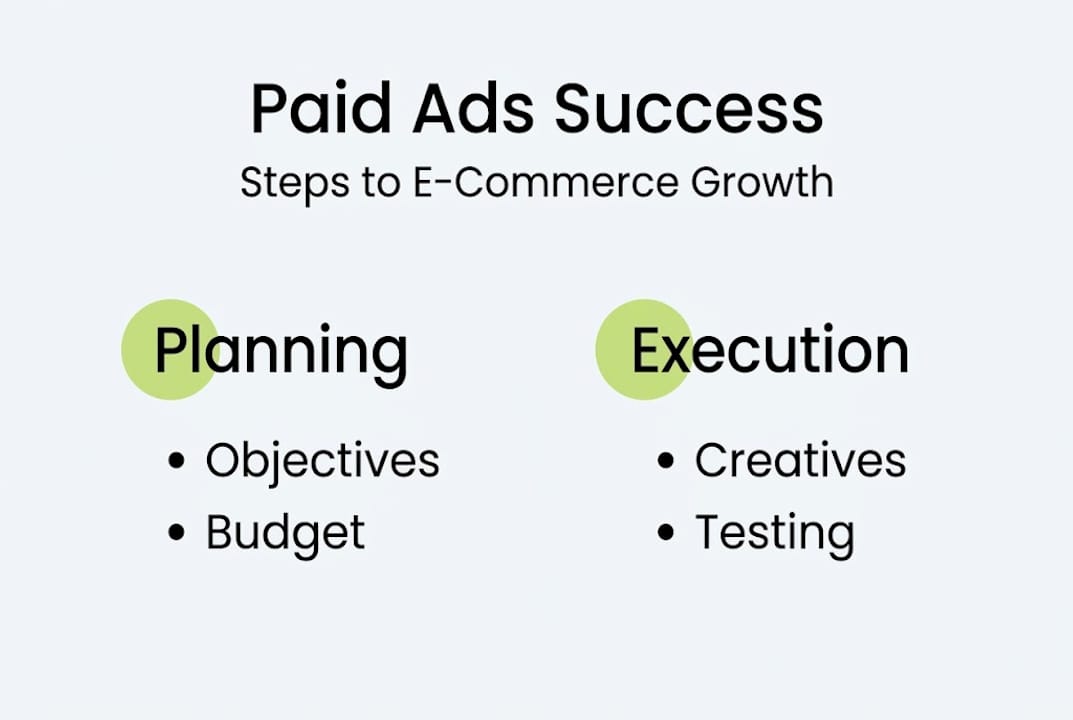
When reviewing performance, focus on maximising paid ad ROI by looking beyond surface metrics. A high CTR with a low conversion rate often signals a landing page problem, not an ad problem. A low CTR with strong conversions suggests your audience is highly qualified but your creative isn’t broad enough. Reading these signals correctly is what drives real optimisation.
Key optimisation actions by metric:
- Low ROAS: Review audience targeting and landing page alignment
- High CPC: Improve Quality Score through better ad relevance
- Low CTR: Test new creative angles and headlines
- High CPA: Tighten audience segments or adjust bidding strategy
What most e-commerce brands get wrong about paid ads strategy
Here’s something we see repeatedly: brands follow every strategic step correctly and still underperform. They set SMART goals, choose the right platforms, and build decent creatives. But their results are inconsistent. The reason is almost always the same. They treat paid ads as a standalone channel rather than part of a connected customer journey.
The most common failure point is not the ad itself. It’s the gap between the ad, the landing page, and the post-purchase experience. When these three elements don’t speak the same language, the customer feels a subtle but real sense of disconnection, and that hesitation costs you the sale.
We also see brands chase every new platform or ad format the moment it gains traction, abandoning campaigns that haven’t had time to gather meaningful data. Consistency and iteration beat novelty almost every time. The brands featured in paid advertising success stories share one common trait: they closed the feedback loop between their ads, their audiences, and their conversion paths, and they kept refining it. That discipline is what turns a decent paid ads strategy into a genuine growth engine.
Accelerate your results with expert support
Building a paid ads strategy that consistently delivers results takes time, expertise, and continuous attention. If you’re managing multiple campaigns across platforms while running a growing e-commerce business, the margin for error is slim.
At Geo Growth Media, we work as an extension of your marketing team, handling everything from strategy and creative to campaign management and analytics. Our paid social media services cover Meta, TikTok, and LinkedIn, while our search and shopping expertise spans Google Ads and Performance Max. Whether you need end-to-end campaign management or support for a specific channel, explore our digital marketing services or see how we specifically support e-commerce brands looking to scale profitably.
Frequently asked questions
What is the most important component of a paid ads strategy?
Clear, measurable objectives aligned with business goals are the foundation of any effective paid ads strategy. SMART goals ensure every campaign decision is tied to a defined, trackable outcome.
How do I choose the right ad platform for my e-commerce brand?
Select platforms based on your audience’s online habits and the targeting capabilities that best match your objectives. Platforms offer unique targeting strengths, so your choice should follow where your customers actually spend their time.
How often should I review and optimise my campaigns?
Weekly reviews and ongoing split tests are crucial for maximising return on ad spend. Continuous testing is what separates brands that plateau from those that achieve compounding growth.
What’s a common mistake to avoid when building paid ads?
Launching campaigns without aligning ad messaging with landing page content often leads to poor conversions. Cohesive creative and landing page design is one of the most impactful improvements any e-commerce brand can make.


.png)