.png)

.svg)




Nearly half of SMB marketing managers underestimate the strategic depth required to lead successful digital initiatives. This misconception limits their effectiveness and undermines business growth potential. Marketing managers are not just creative coordinators but strategic leaders who shape digital transformation, align campaigns with business objectives, and drive measurable results through data-driven optimisation. This guide clarifies the pivotal role marketing managers play in digital strategy development, execution, and continuous improvement.
Table of Contents
- Understanding The Marketing Manager’s Role In Digital Strategy
- Strategic Alignment: Integrating Digital Marketing Into Business Goals
- Frameworks And Models For Marketing Managers To Build Effective Digital Strategies
- Essential Digital Skills And Tools For Marketing Managers
- Common Misconceptions About The Marketing Manager Role In Digital Strategy
- Practical Steps For SMB Marketing Managers To Enhance Digital Strategy Performance
- Boost Your Digital Strategy With Expert Help
- Frequently Asked Questions
Key takeaways
| Point | Details |
|---|---|
| Strategic leadership | Marketing managers in SMBs are strategic leaders who develop comprehensive digital strategies, not just creative coordinators. |
| Business alignment | Aligning digital marketing with overarching business goals maximises ROI and ensures cohesive brand messaging across all channels. |
| Structured frameworks | Using practical frameworks for audit, planning, execution, and optimisation improves campaign effectiveness by approximately 25%. |
| Essential skills | Data analytics proficiency, paid media management, and continuous learning drive better campaign outcomes and competitive advantage. |
| Common misconceptions | Understanding that marketing managers lead strategic planning, budgeting, and cross-functional collaboration prevents limiting organisational support. |
Understanding the marketing manager’s role in digital strategy
Marketing managers in SMBs wear multiple hats that extend far beyond creative direction. They develop and implement digital marketing strategies tailored to promote business growth across digital platforms. This involves orchestrating campaigns, analysing performance data, managing budgets, and coordinating cross-functional teams.
In smaller organisations, marketing managers tend to be significantly more hands-on than their enterprise counterparts. They often manage creative execution directly whilst simultaneously steering strategic direction. This dual responsibility requires balancing tactical implementation with high-level planning.
The role serves as a critical bridge between creative teams, sales departments, and executive leadership. Marketing managers translate business objectives into actionable digital campaigns whilst ensuring creative efforts remain aligned with revenue goals. They must understand customer behaviour, competitive dynamics, and emerging platform capabilities to make informed channel and budget allocation decisions.
Key responsibilities typically include:
- Developing comprehensive digital strategies across SEO, paid media, social platforms, content marketing, and email campaigns
- Managing marketing budgets and ensuring optimal spend allocation for maximum ROI
- Analysing campaign performance data to identify optimisation opportunities and inform strategic adjustments
- Coordinating with sales teams to ensure marketing qualified leads convert effectively
- Staying current with digital platform updates, algorithm changes, and emerging marketing technologies
Understanding this multifaceted role establishes the foundation for building effective digital strategies. For SMBs seeking to maximise their digital marketing optimisation, recognising the strategic depth required of marketing managers is the essential first step.
Strategic alignment: integrating digital marketing into business goals
Strategic alignment transforms digital marketing from isolated tactical activities into a cohesive growth engine. When marketing managers align digital campaigns with overarching business objectives, they ensure consistent brand messaging and maximised ROI across all channels. This integration prevents wasted spend on disconnected initiatives that fail to support company priorities.
Integrated digital strategies significantly outperform isolated campaigns because they create synergies across channels. A well-aligned approach means paid search reinforces organic visibility, social media amplifies content marketing, and email nurtures relationships initiated through other touchpoints. Marketing managers coordinate these multiple channels towards unified business targets rather than allowing each to operate independently.
The alignment process begins with thoroughly understanding business objectives. Marketing managers must translate high-level goals like “increase market share” or “expand into new segments” into specific, measurable digital marketing targets. This might mean focusing on customer acquisition cost reduction, lifetime value improvement, or geographic expansion through localised campaigns.

Regularly revisiting business goals strengthens campaign relevance and prevents strategic drift. Markets change, competitive dynamics shift, and internal priorities evolve. Marketing managers who schedule quarterly alignment reviews can quickly pivot digital efforts to remain synchronised with company vision.
Pro tip: Create a simple alignment matrix that maps each digital campaign to specific business objectives, allowing you to identify gaps and redundancies quickly whilst demonstrating marketing’s direct contribution to business outcomes.
The role of data in digital marketing becomes particularly important during alignment activities. Data reveals which campaigns genuinely drive business results rather than vanity metrics, enabling marketing managers to make evidence-based strategic adjustments.
Frameworks and models for marketing managers to build effective digital strategies
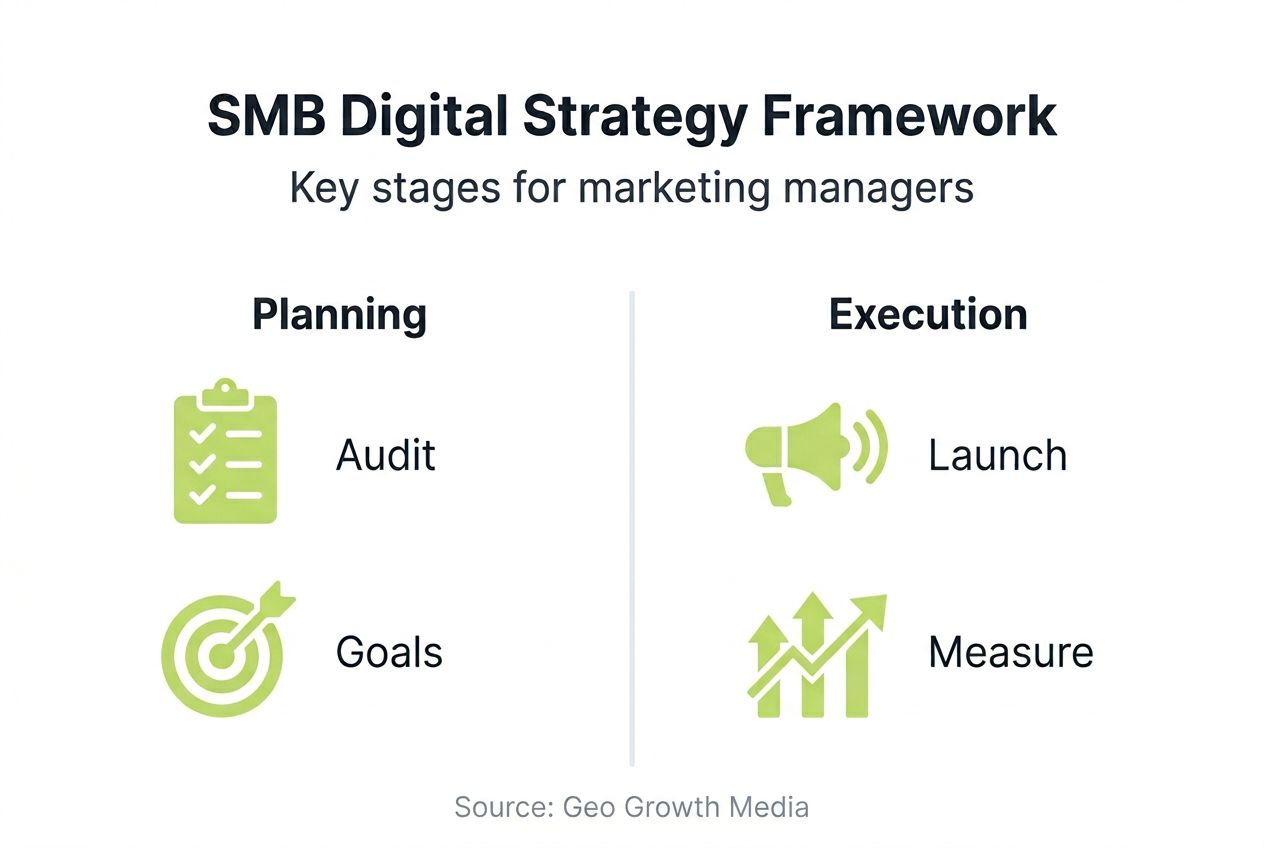
A practical digital strategy framework for SMB marketing managers provides structure for planning, executing, and optimising campaigns effectively. Following a systematic approach improves campaign ROI by approximately 25% compared to ad hoc tactics because it ensures comprehensive coverage whilst preventing critical gaps.
The six-stage framework adapts to SMB resource constraints and market realities:
- Audit current state: Assess existing digital presence, campaign performance, competitor positioning, and audience insights to establish your baseline.
- Set clear objectives: Define specific, measurable goals aligned with business priorities, including target metrics and timelines.
- Select optimal channels: Choose platforms and tactics based on audience behaviour, budget availability, and competitive advantage opportunities.
- Execute campaigns: Launch coordinated initiatives across selected channels with consistent messaging and brand positioning.
- Measure performance: Track key metrics continuously using analytics platforms to understand what’s working and what needs adjustment.
- Optimise iteratively: Make data-driven improvements to targeting, creative, bidding, and channel mix based on performance insights.
This framework creates a continuous improvement cycle rather than one-off campaign launches. Marketing managers who implement regular measurement checkpoints enable agile adjustments that respond quickly to performance signals.
| Framework stage | Key activities | Primary benefit |
|---|---|---|
| Audit | Analyse current performance, competitors, audience | Identifies opportunities and gaps |
| Goal-setting | Define SMART objectives aligned to business | Creates clear success criteria |
| Channel selection | Evaluate platform fit and resource requirements | Optimises budget allocation |
| Execution | Launch coordinated campaigns with consistent messaging | Ensures cohesive brand experience |
| Measurement | Track KPIs using analytics platforms | Provides performance visibility |
| Optimisation | Adjust based on data insights | Improves ROI continuously |
The beauty of this framework lies in its scalability. Small teams can apply it with basic tools whilst larger operations can add sophisticated automation and testing layers. Starting with a thorough digital marketing audit ensures the foundation is solid before building campaigns.
Pro tip: Document your framework application in a simple project management tool so you can track progress, identify bottlenecks, and demonstrate strategic thinking to stakeholders who may question marketing investments.
For channel-specific implementation, a social media strategy checklist provides tactical guidance that complements the broader framework.
Essential digital skills and tools for marketing managers
Marketing managers who continuously update their knowledge of digital trends and technologies are more effective at adapting strategies and sustaining competitive advantage. Tech-savviness helps managers stay agile amid constant platform changes, algorithm updates, and emerging channel opportunities.
Data analytics proficiency stands out as the most critical skill for modern marketing managers. The ability to interpret performance metrics, identify patterns, and translate insights into strategic adjustments separates effective leaders from those who rely on intuition alone. This includes understanding statistical significance, attribution modelling, and cohort analysis.
Paid media management requires mastery of platform-specific tools and bidding strategies. Marketing managers must understand how Google Ads, Meta Ads Manager, LinkedIn Campaign Manager, and other platforms operate to make informed budget allocation decisions. This technical knowledge prevents costly mistakes and identifies optimisation opportunities.
Core competencies marketing managers should prioritise:
- Data analytics: Proficiency in Google Analytics, platform-specific analytics, and data visualisation tools to inform strategic decisions
- Paid media platforms: Hands-on experience with major advertising platforms including bidding strategies, audience targeting, and creative optimisation
- Content marketing: Understanding of content strategy, SEO principles, and how quality content supports broader digital objectives
- Marketing technology: Familiarity with CRM systems, marketing automation, email platforms, and integration capabilities
- Project management: Ability to coordinate multiple campaigns, manage timelines, and keep cross-functional teams aligned
- Financial acumen: Budget management skills including forecasting, spend tracking, and ROI calculation
Continuous learning boosts campaign outcomes by up to 30% because it keeps strategies current with platform capabilities and audience expectations. Marketing managers should dedicate time weekly to industry publications, platform updates, and skill development.
The digital marketing blog offers ongoing insights into emerging trends, tactical guidance, and strategic frameworks that support continuous professional development. Staying informed transforms marketing managers from order-takers into strategic advisors who drive business growth.
Common misconceptions about the marketing manager role in digital strategy
Misunderstanding the marketing manager’s role undermines strategic effectiveness and limits organisational support. The most damaging misconception positions marketing managers as creative coordinators rather than strategic leaders. In reality, they manage strategic planning, budget allocation, and analytics essential for digital success.
Misconception 1: Marketing managers only oversee creative content and brand aesthetics.
Correction: Whilst marketing managers certainly guide creative direction, their responsibilities extend to comprehensive strategy development, budget management, performance analysis, and cross-functional collaboration. They make critical decisions about channel selection, audience targeting, and resource allocation that directly impact business outcomes.
Misconception 2: Digital marketing functions best when isolated from broader business strategy.
Correction: Integration with business goals significantly increases campaign success rates. Marketing managers who operate in silos miss opportunities for synergy with sales, product development, and customer service initiatives. The most effective digital strategies emerge when marketing leaders actively participate in strategic business planning.
Misconception 3: Anyone familiar with social media can manage digital marketing strategy.
Correction: Personal social media use differs fundamentally from strategic digital marketing management. Effective marketing managers combine platform knowledge with analytical rigour, budget discipline, and strategic thinking that casual users never develop.
“Research indicates that 45% of SMB marketing managers underestimate the strategic complexity of their role, focusing disproportionately on tactical execution whilst neglecting higher-level planning that drives sustainable growth.”
These misconceptions create several problems:
- Insufficient budget allocation based on undervalued strategic contributions
- Limited access to executive decision-making forums where marketing input could shape business direction
- Inadequate staffing and resources that leave marketing managers stretched across too many tactical tasks
- Missed opportunities for digital marketing optimisation because strategic planning receives insufficient attention
Addressing these misunderstandings requires marketing managers to demonstrate their strategic value through clear ROI documentation, business-aligned reporting, and proactive participation in strategic discussions beyond marketing topics.
Practical steps for SMB marketing managers to enhance digital strategy performance
Marketing managers can implement specific tactics immediately to optimise digital spend, improve targeting, and achieve measurable growth. These actionable steps bridge the gap between understanding strategic principles and executing high-performance campaigns.
Leveraging data analytics improves customer targeting and campaign optimisation dramatically. Marketing managers should establish regular reporting cadences that review performance against objectives, identify trends, and surface optimisation opportunities. This means looking beyond surface-level metrics like impressions and clicks to understand conversion paths, customer lifetime value, and attribution across touchpoints.
Regularly realigning campaigns with updated business goals and market trends prevents strategic drift. Markets evolve, competitive dynamics shift, and customer preferences change. Marketing managers who schedule monthly strategy reviews can quickly pivot resources toward higher-performing initiatives whilst cutting underperforming campaigns before they waste significant budget.
Applying structured frameworks consistently for planning and execution eliminates the chaos of reactive marketing. Each campaign should follow the audit, goal-setting, channel selection, execution, measurement, and optimisation cycle to ensure comprehensive coverage.
Actionable optimisation steps:
- Implement conversion tracking: Ensure all campaigns have proper conversion tracking configured to measure actual business outcomes, not just engagement metrics
- Conduct audience research quarterly: Update buyer personas and targeting parameters based on customer behaviour data and market changes
- Test systematically: Run structured A/B tests on creative, messaging, landing pages, and audience segments to identify what resonates
- Audit channel performance monthly: Review which channels drive the best ROI and reallocate budget accordingly
- Establish competitor monitoring: Track competitor digital activities to identify gaps and opportunities in your market
- Create content calendars: Plan content themes and campaign timing strategically rather than reactively
- Build marketing dashboards: Centralise key metrics in visual dashboards that make performance trends immediately visible
Pro tip: Schedule 90-minute quarterly reviews dedicated solely to strategic planning rather than tactical execution, allowing you to step back from daily operations and assess whether your digital strategy still aligns with evolving business priorities.
Using data analytics effectively requires discipline and consistency. Marketing managers should establish standard operating procedures for campaign setup, performance monitoring, and optimisation decisions to ensure quality remains high even when resources are stretched.
The combination of strategic thinking and tactical excellence separates marketing managers who drive business growth from those who simply keep campaigns running. Continuous digital marketing optimisation transforms adequate performance into exceptional results.
Boost your digital strategy with expert help
Executing comprehensive digital strategies whilst managing daily operations stretches even the most capable marketing managers thin. Strategic partnerships amplify your impact without expanding headcount.

Geo Growth Media specialises in supporting SMB marketing managers with tailored digital marketing solutions that integrate seamlessly with your existing efforts. Our services span SEO, PPC, paid social across Meta, TikTok, and LinkedIn, plus strategic consulting that helps you make smarter decisions about channel selection and budget allocation. We function as an extension of your team, bringing specialist expertise whilst you maintain strategic control.
Whether you’re scaling e-commerce operations or expanding into new markets, our sector-specific experience across diverse industries means we understand your unique challenges. Explore our comprehensive digital marketing services to discover how strategic partnerships can elevate your results whilst freeing you to focus on high-level strategy rather than tactical execution.
Frequently asked questions
What are the primary responsibilities of marketing managers in digital strategy?
Marketing managers lead digital strategy development by defining objectives aligned with business goals, selecting optimal channels, and coordinating campaign execution across platforms. They manage budgets, analyse performance data to identify optimisation opportunities, and continuously refine approaches based on insights. Their role bridges creative execution with strategic business outcomes.
How do marketing managers align digital campaigns with business objectives?
Effective alignment begins with thoroughly understanding company priorities and translating them into measurable digital marketing targets. Marketing managers create campaign strategies that directly support revenue goals, market expansion, or customer retention objectives. Regular reviews ensure digital efforts remain synchronised with evolving business needs.
What digital skills are most important for marketing managers in SMBs?
Data analytics proficiency tops the list, enabling evidence-based decision making and campaign optimisation. Paid media platform expertise, content marketing understanding, and marketing technology familiarity are equally critical. Continuous learning about platform updates and emerging trends ensures strategies remain competitive.
How can marketing managers improve ROI on digital marketing spend?
Implementing structured frameworks for planning and execution improves ROI by approximately 25%. Regular performance measurement, systematic testing, and data-driven optimisation identify what works and eliminate wasteful spending. Proper conversion tracking and audience refinement based on customer behaviour data drive significant efficiency gains.
What common mistakes do SMB marketing managers make with digital strategy?
Many underestimate the strategic complexity required, focusing too heavily on tactical execution whilst neglecting comprehensive planning. Operating in isolation from broader business strategy limits effectiveness. Insufficient data analysis and reactive rather than proactive campaign management also undermine results. Addressing these through structured approaches and regular strategic reviews dramatically improves outcomes.
Recommended
- Top social media strategies for scalable SMB growth in 2026
- 7 Key Types of Digital Marketing Strategies for E-Commerce Brands
- Digital Marketing Optimization Guide for Measurable Growth
- Growth-Focused Digital Marketing Agency: SEO, PPC & Social
- Report Prime Reports, Global Market Research Reports, Trends & Competitor Analysis


.png)