.png)

.svg)




You’ve invested in paid ads, built traffic to your site, yet visitors leave without converting. Poor landing page performance costs e-commerce brands thousands in lost revenue every month. The gap between attracting clicks and capturing leads often comes down to overlooked optimisation details. This guide walks you through proven, data-backed strategies to transform underperforming landing pages into conversion engines that deliver measurable results for your business.
Table of Contents
- Key takeaways
- What you need before optimising your landing page
- Step-by-step guide to optimising landing pages for conversion
- Testing and measuring success to refine landing page performance
- Explore Geo Growth Media’s landing page optimisation services
- Frequently asked questions
Key Takeaways
| Point | Details |
|---|---|
| Clear conversion goals | Define measurable targets tied to revenue such as email signups, purchases or bookings. |
| Align ad with landing | Ensure the landing page headline echoes the ad promise to reduce confusion and build trust. |
| Improve page speed | Aim for load times under three seconds on desktop and mobile to maximise conversions. |
| Reduce form fields | Limit requests to essential information to lower friction and increase lead capture. |
What you need before optimising your landing page
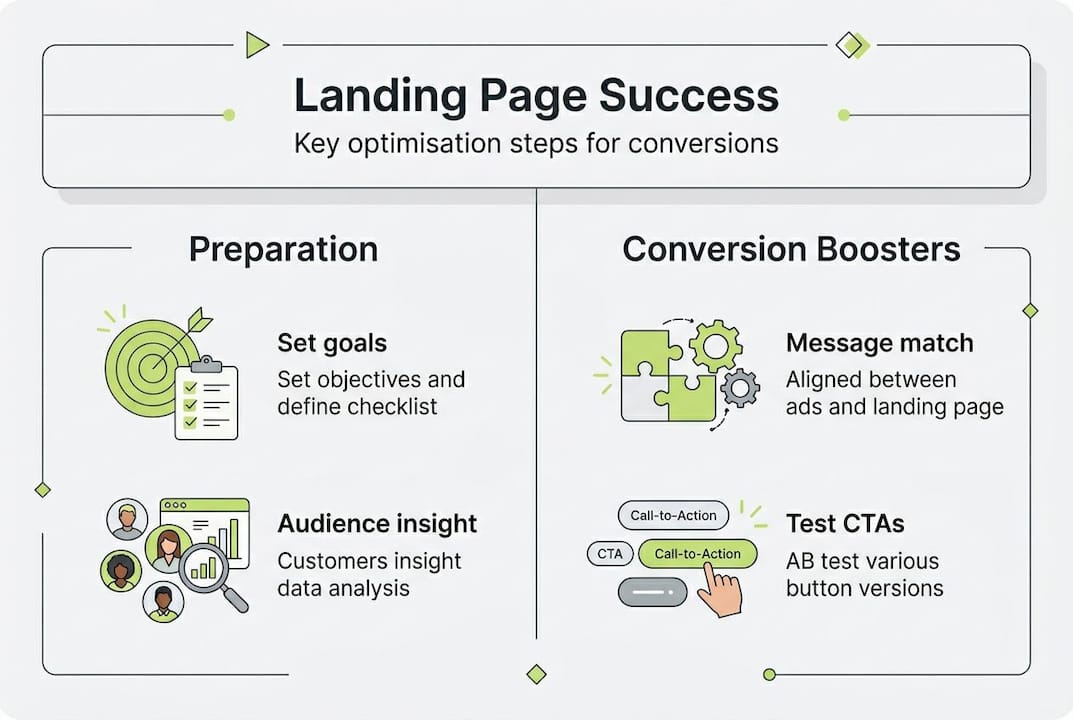
Successful landing page optimisation starts long before you change a single element. You need clarity on what success looks like for your business. Define specific conversion goals tied to revenue targets, whether that’s email signups, product purchases, or consultation bookings. Without measurable objectives, you’re optimising blindly.
Understanding your audience transforms generic pages into targeted conversion tools. Analyse where visitors come from, what problems they’re trying to solve, and what objections prevent them from converting. Traffic from paid social behaves differently than organic search visitors. Map these patterns to tailor your approach.
Prepare your technical foundation before testing begins. Install Google Analytics 4 to track user behaviour, set up conversion tracking for accurate measurement, and choose an A/B testing platform that integrates with your tech stack. These tools provide the data that separates guesswork from strategic decisions.
The PIE prioritisation framework helps you focus efforts where they matter most. Evaluate potential tests based on three criteria: Potential impact on conversions, Importance to business goals, and Ease of implementation. High scores across all three indicate your best starting point. This systematic approach prevents wasting time on low-impact changes.
Collect baseline performance data before making changes. Document current conversion rates, bounce rates, average time on page, and traffic sources. This benchmark proves whether your optimisations work. Record user behaviour through heatmaps and session recordings to identify friction points visitors encounter.
Pro Tip: Create a testing hypothesis document that clearly states what you’re changing, why you expect it to improve conversions, and how you’ll measure success. This discipline keeps tests focused and makes learning transferable across campaigns.
Your preparation phase should also include competitor research. Analyse high-performing landing pages for lead generation in your sector. Note common patterns in layout, copy structure, and conversion elements. This research reveals industry standards and opportunities to differentiate.
Step-by-step guide to optimising landing pages for conversion
Page speed determines whether visitors stay long enough to convert. Every second of load delay costs 7% of conversions, making speed your first optimisation priority. Aim for load times under three seconds on both desktop and mobile. Compress images without sacrificing quality, minify CSS and JavaScript files, and leverage browser caching. Mobile users are particularly unforgiving, with 53% abandoning pages that take longer than three seconds.
- Audit current page speed using Google PageSpeed Insights and identify specific bottlenecks
- Compress all images to WebP format and implement lazy loading for below-the-fold content
- Remove unnecessary scripts and plugins that slow initial page rendering
- Enable content delivery network (CDN) distribution for faster global access
- Test load times across devices and connection speeds to verify improvements
Message match creates seamless transitions from ad to landing page. When visitors click an ad promising “Free shipping on orders over £50”, your landing page headline must echo that exact offer. Consistent messaging boosts conversions by 212% because it eliminates confusion and builds immediate trust. Match visual elements too, using similar colours, imagery, and design style between ads and landing pages.
Your call to action (CTA) deserves obsessive attention. Single CTAs convert 13.5% better than pages cluttered with multiple competing actions. Choose one primary conversion goal per page and make that button impossible to miss. Use action-oriented copy that states the benefit clearly: “Get Your Free Audit” outperforms generic “Submit” buttons.
Pro Tip: Test CTA button colours that contrast sharply with your page background. Orange and green buttons often outperform blue in A/B tests, but your audience may respond differently. Test placement too, with above-the-fold positioning typically winning for high-intent traffic.
Form optimisation directly impacts lead capture rates. Long forms intimidate visitors and create abandonment. Research shows three-field forms achieve 25% conversion rates, whilst 11-field forms struggle to break 10%. Every additional field you require increases friction exponentially.
| Form fields | Average conversion rate | Best use case |
|---|---|---|
| 3 fields | 25% | Newsletter signups, content downloads |
| 4-5 fields | 15-20% | Consultation requests, demo bookings |
| 6-8 fields | 10-15% | Detailed service enquiries |
| 9+ fields | Below 10% | Complex applications only |
Personalisation transforms generic pages into relevant experiences. Visitors from paid social campaigns respond to different messaging than those from organic search. Dynamic content that adapts based on traffic source, previous site behaviour, or demographic data can increase conversions by up to 80%. Simple personalisation includes changing headlines for different ad groups or showing location-specific offers.
Your landing page design should guide eyes naturally towards conversion elements. Use directional cues like arrows or images of people looking towards CTAs. Implement white space strategically to prevent cognitive overload. Visitors should understand your offer and how to act within five seconds of landing.

Social proof builds trust that overcomes purchase hesitation. Display customer testimonials with photos and full names near your CTA. Show real-time conversion notifications if volume supports it. Include trust badges, security certifications, and money-back guarantees prominently. Specific numbers work better than vague claims: “Join 2,847 satisfied customers” beats “Join thousands of customers”.
Remove navigation menus on dedicated landing pages. Every exit link provides an escape route from conversion. Your page should offer two choices: convert or leave. This focused approach prevents distraction and keeps visitors moving towards your goal. Learn more about landing page design that boosts e-commerce conversions through strategic element placement.
Testing and measuring success to refine landing page performance
Structured A/B testing separates successful optimisers from those who guess. A/B testing delivers an average 49% conversion uplift, but only when executed systematically. Test one variable at a time to isolate what drives results. Changing headlines, images, and CTAs simultaneously makes it impossible to know which element caused conversion changes.
The PIE framework prioritises which tests to run first. Score potential tests on Potential impact (how much could this improve conversions?), Importance (how much traffic does this page receive?), and Ease (how quickly can we implement and measure this?). Focus on high-scoring opportunities that balance impact with implementation speed. Testing obscure page elements that few visitors see wastes time regardless of potential gains.
Track metrics that matter beyond basic conversion rate:
- Bounce rate indicates whether visitors find your page relevant immediately
- Average time on page shows engagement level and content consumption
- Scroll depth reveals whether key conversion elements appear too low
- Form abandonment rate identifies specific fields causing friction
- Click-through rate on CTAs measures button effectiveness independent of overall conversions
Mobile-first testing protects your largest traffic segment. Mobile traffic comprises 55%+ of web visits, yet many brands still optimise for desktop first. Unoptimised mobile pages suffer 1.6 times higher bounce rates than their desktop counterparts. Test every change on mobile devices first, ensuring touch targets are large enough, forms work smoothly, and load times remain fast on cellular connections.
| Testing approach | Pros | Cons | Best for |
|---|---|---|---|
| Manual A/B testing | Clear cause and effect, easy to interpret | Slower to find winners, tests one change at a time | Small to medium traffic sites |
| Multivariate testing | Tests multiple elements simultaneously | Requires high traffic volume, complex analysis | High-traffic enterprise sites |
| AI-driven testing | Automatically optimises, finds patterns humans miss | Expensive, black box decision making | Brands with large testing budgets |
Pro Tip: Prioritise mobile-first testing given that over half your traffic likely comes from smartphones. Small mobile screens magnify design flaws that desktop users might overlook. Test thumb-friendly button sizes, readable font sizes without zooming, and fast load times on 4G connections.
Companies running 30+ tests monthly see conversion improvements exceeding 50% because they compound small wins. Each successful test builds on previous learnings. Document every test result, including failures, to build institutional knowledge. Failed tests teach you what doesn’t work, preventing repeated mistakes.
Exit-intent technology captures abandoning visitors without annoying engaged ones. Traditional pop-ups increase bounce rates by interrupting the user experience. Exit-intent overlays only trigger when cursor movement suggests leaving, offering a final conversion opportunity without disrupting those still exploring. Use them to offer discounts, capture emails, or address common objections.
Continuous testing is key to outperforming competitors. The moment you stop optimising is the moment your conversion rates stagnate whilst competitors improve.
Monitor testing statistical significance before declaring winners. Most A/B tests need at least 100 conversions per variation and 95% confidence levels to produce reliable results. Ending tests too early leads to false positives where random variation appears as real improvement. Patience in testing prevents implementing changes that don’t actually work. Refer to resources on building landing pages for lead generation to understand the complete testing cycle.
Explore Geo Growth Media’s landing page optimisation services
Optimising landing pages requires expertise, time, and continuous testing that many in-house teams struggle to maintain alongside daily responsibilities. Geo Growth Media specialises in landing page design services that transform underperforming pages into conversion engines tailored to your specific audience and business goals.
Our approach combines data-driven testing with strategic design, ensuring every element serves your conversion objectives. We integrate landing page optimisation with paid social media services to create cohesive campaigns where ad creative and landing experiences work together seamlessly. This holistic strategy eliminates the message mismatch that kills conversions.
Partnering with specialists accelerates results whilst freeing your team to focus on core business activities. Our SEO services complement landing page optimisation by driving qualified organic traffic to your newly optimised pages, multiplying the return on your conversion rate improvements. We act as an extension of your marketing team, bringing specialised skills without the overhead of full-time hires.
Frequently asked questions
What is the ideal number of form fields on a landing page?
Short forms with three to four fields convert best, with three-field forms achieving 25% conversion rates compared to 10% or less for forms with 11+ fields. Reducing fields from 11 to four can improve conversion by 120%. Only ask for information absolutely necessary for your immediate goal, then collect additional details through follow-up communications.
How important is message match between ads and landing pages?
Consistent messaging between ads and landing pages boosts conversions by 212%, providing users with the expected content and reducing friction. When your ad promises a specific offer or solution, your landing page headline and opening copy must reinforce that exact promise. Mismatched messaging creates confusion and distrust that kills conversions immediately.
What role does page load speed play in landing page optimisation?
Every one-second delay in page loading reduces conversions by 7%, making speed a critical conversion factor. Pages loading under three seconds retain 53% more visitors, particularly crucial for mobile traffic which now represents over half of web visits. Speed optimisation should be your first priority before testing other elements.
How can A/B testing help improve landing pages?
A/B testing delivers an average 49% conversion uplift by systematically identifying which page elements drive better results. Companies running 30 or more tests monthly see conversion improvements exceeding 50% because they compound small wins over time. Testing removes guesswork and provides data-driven proof of what works for your specific audience.
Should landing pages include navigation menus?
Dedicated landing pages should remove navigation menus to eliminate exit routes that distract from conversion goals. Every additional link provides an escape path that reduces conversion rates. Your landing page should offer visitors two clear choices: convert through your call to action or leave the page. This focused approach keeps attention on your primary conversion objective.


.png)