.png)

.svg)




TL;DR:
- Measuring ROI in digital marketing involves calculating the financial return on all campaign costs and attributed revenues. Using a full cost model and consistent attribution methods is essential to obtain accurate, actionable results. Regular tracking aligned with sales cycles helps optimize marketing spend and improve campaign effectiveness.
Measuring ROI in digital marketing is the process of calculating the financial return on every pound spent across your campaigns, accounting for all costs and attributed revenues to evaluate true marketing effectiveness. The standard formula is ROI (%) = (Attributed Revenue – Total Marketing Cost) / Total Marketing Cost x 100, and it applies whether you are running Google Ads, Meta campaigns, or an SEO programme. Tools like Google Analytics 4, Meta Ads Manager, HubSpot, and CRM platforms are essential for linking spend to revenue across the full customer journey. The challenge is not the formula itself. It is applying it with enough rigour to produce numbers you can actually act on. This guide walks you through how to measure ROI for digital campaigns accurately, from cost accounting to attribution models and tracking cadence.
What costs and revenues should you include when measuring ROI?
Most businesses undercount their costs. They record media spend and stop there, which inflates ROI figures and leads to poor budget decisions. Non-ad costs like agency fees, creative production, software subscriptions, and internal labour must all be included for an accurate picture.

The full cost model
A complete cost model for any digital campaign includes:
- Media spend: the actual budget paid to Google, Meta, TikTok, or LinkedIn
- Agency or freelancer fees: management costs from any external partners
- Creative production: design, copywriting, video production, and photography
- Software subscriptions: tools like Google Analytics 4, HubSpot, Semrush, or Hotjar
- Internal labour: the time your in-house team spends managing and reporting on campaigns
For e-commerce brands, you also need to subtract the cost of goods sold (COGS) from attributed revenue before applying the ROI formula. Skipping this step means you are measuring gross revenue return, not profit return. Those are very different numbers.
Incomplete vs full cost comparison
| Cost component | Incomplete model | Full cost model |
|---|---|---|
| Media spend | ✓ Included | ✓ Included |
| Agency fees | ✗ Excluded | ✓ Included |
| Creative production | ✗ Excluded | ✓ Included |
| Software subscriptions | ✗ Excluded | ✓ Included |
| Internal labour | ✗ Excluded | ✓ Included |
| COGS (e-commerce) | ✗ Excluded | ✓ Included |
The difference between these two models can swing your reported ROI by 30–50%. That gap is not a rounding error. It is the difference between a profitable campaign and one that is quietly losing money.
Pro Tip: Build a simple campaign cost tracker in Google Sheets that captures every cost component before you launch. Updating it weekly takes five minutes and prevents the nasty surprise of discovering your “profitable” campaign was not profitable at all.
How do you attribute revenue correctly across digital channels?
Attribution is where ROI measurement gets genuinely complicated. The model you choose determines which channels get credit for a sale, and that directly shapes where you invest next.
Attribution models explained
The three most common models are:
- Last-click attribution: gives 100% of the credit to the final touchpoint before conversion. Simple to implement, but it systematically undervalues upper-funnel channels like SEO, display, and content marketing.
- Multi-touch attribution: distributes credit across multiple touchpoints in the customer journey. Linear, time-decay, and position-based are common variants. More accurate, but harder to set up and interpret.
- Data-driven attribution: uses machine learning to assign credit based on actual conversion path data. Available in Google Analytics 4 and Google Ads. Requires sufficient conversion volume to be reliable.
Last-click vs multi-touch: which should you use?
| Attribution model | Best for | Limitation |
|---|---|---|
| Last-click | Direct response paid search | Undervalues SEO, social, and content |
| Multi-touch (linear) | Full-funnel visibility | Harder to action at channel level |
| Data-driven | High-volume Google campaigns | Needs 300+ conversions per month |
| Blended MER | System-level health check | Does not isolate individual channels |
Indirect channels like SEO and content marketing create a particular challenge. A blog post may have introduced a prospect to your brand six months before they converted via a branded search. Last-click attribution gives that blog post zero credit. Consistent UTM parameters, conversion tracking, and CRM data linked back to campaigns are the practical foundation for any attribution model you choose.
The most reliable approach is to use a blended system metric alongside channel-level attribution. Marketing Efficiency Ratio (MER = Total Revenue / Total Marketing Spend) gives you a single number that reflects overall marketing health without being distorted by attribution model quirks. Think of MER as your sanity check. If your channel-level ROI looks strong but your MER is declining, something is wrong.
Pro Tip: Document your attribution model in writing and share it with every stakeholder who sees your ROI reports. When the model changes, note it. Attribution model switches are one of the most common causes of “performance drops” that are actually just measurement changes.
What is the right tracking frequency for digital marketing ROI?
Tracking too infrequently means you miss problems until they are expensive. Tracking too frequently means you react to noise rather than signal. The right cadence depends on the channel.
Track paid media ROI weekly for Google Ads, Meta, TikTok, and LinkedIn. Paid channels give you fast feedback loops. Weekly reviews let you catch overspending, underperforming ad sets, and budget pacing issues before they compound.
Organic channels like SEO and content marketing move more slowly. Monthly tracking is appropriate here. A single month of organic data rarely tells you much. What matters is the trend over three to six months.
Quarterly reviews serve a different purpose. They are your strategic reallocation moment. Pull together all channel ROI data, compare against your annual targets, and decide where to shift budget for the next quarter. This is also when you should review your attribution model and cost tracking setup to confirm they are still fit for purpose.
Measurement windows must align with your actual sales cycle. B2B campaigns with sales cycles of 90–180 days cannot be judged on a four-week window. Doing so will make effective campaigns look like failures and lead you to cut spend that was actually working. For e-commerce, a 7–30 day window is usually sufficient. For B2B or high-consideration purchases, extend that window to match reality.
Pro Tip: Use a ROI calculator to model different measurement windows before you set your reporting cadence. Seeing how the numbers shift across 30, 60, and 90-day windows helps you choose a window that reflects your actual buying cycle rather than your reporting convenience.
How to calculate ROI for digital campaigns step by step
Follow these steps every time you run an ROI calculation. Consistency matters more than sophistication. A simple process applied consistently beats a complex one applied sporadically.
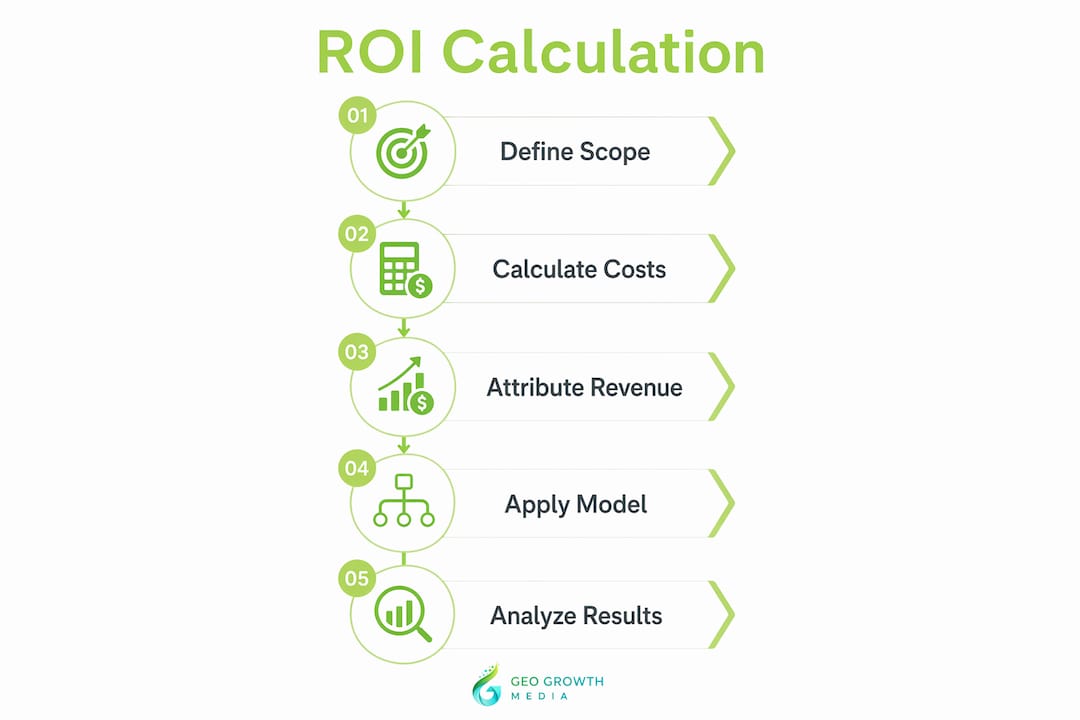
- Define campaign scope and period. Specify exactly which campaigns, channels, and date range you are measuring. Vague scope produces vague results.
- Calculate total investment. Add media spend, agency fees, creative costs, software costs, and a fair allocation of internal labour time. Use the full cost model from Section 1.
- Attribute revenue. Pull conversion data from Google Analytics 4, Meta Ads Manager, or your CRM. Apply your chosen attribution model. Cross-reference with UTM parameter data to confirm accuracy.
- Apply the ROI formula. (Attributed Revenue – Total Cost) / Total Cost x 100. A result of 200% means you returned £3 for every £1 spent.
- Benchmark the result. Compare against your historical campaign data and industry benchmarks. A 200% ROI is excellent for some sectors and below average for others. Context is everything.
- Identify the cause of performance. Do not stop at the number. Dig into which campaigns, ad sets, or keywords drove the result. That is where the data-driven decisions live.
ROI calculation summary
| Step | Action | Tool |
|---|---|---|
| Define scope | Set campaigns, channels, and date range | Spreadsheet or project brief |
| Total investment | Sum all cost components | Google Sheets, CRM |
| Attribute revenue | Pull conversion data with UTM tracking | Google Analytics 4, Meta Ads Manager |
| Apply formula | (Revenue – Cost) / Cost x 100 | Calculator or spreadsheet |
| Benchmark | Compare to historical and sector data | Internal reports |
| Diagnose | Identify top and bottom performers | GA4, Ads dashboards |
The most common mistakes are ignoring long sales cycles, excluding non-media costs, and comparing ROI across channels that use different attribution models. That last one is particularly misleading. Comparing last-click Google Ads ROI against blended SEO ROI is like comparing apples to spreadsheets. You need a consistent methodology before you can make meaningful comparisons.
Pro Tip: Run a digital marketing audit before you set your ROI benchmarks. Knowing your current baseline across channels gives you a realistic starting point and makes your targets credible rather than aspirational.
Key takeaways
Accurate ROI measurement for digital campaigns requires a full cost model, a consistent attribution approach, and a tracking cadence matched to your sales cycle.
| Point | Details |
|---|---|
| Use the full cost model | Include media spend, agency fees, creative, software, and labour to avoid inflated ROI figures. |
| Choose attribution deliberately | Match your attribution model to the channel type and document it for all stakeholders. |
| Track at the right frequency | Review paid media weekly, organic channels monthly, and conduct full strategic reviews quarterly. |
| Align windows to sales cycles | B2B campaigns need 90–180 day windows; short windows undervalue slow-burn channels like SEO. |
| Benchmark every result | Raw ROI numbers mean little without historical data and sector context to compare against. |
The uncomfortable truth about ROI measurement
At Geo Growth Media, we see the same pattern repeatedly. A business runs campaigns for six months, pulls a ROI report, and concludes that paid social “doesn’t work” while Google Ads “does.” Nine times out of ten, the real issue is not channel performance. It is measurement methodology.
Paid social often operates at the top of the funnel. It introduces people to your brand who later convert through branded search. Last-click attribution gives Google Ads the credit. The business cuts social spend. Branded search volume drops. Then Google Ads ROI falls too, and nobody can work out why.
The fix is not a fancier attribution model. It is understanding what each channel actually does in your customer journey and measuring it accordingly. MER gives you the system-level view. Channel-level attribution gives you the tactical detail. You need both.
We also see businesses set measurement windows based on their reporting calendar rather than their sales cycle. A monthly report feels tidy. But if your average customer takes 75 days to convert, a monthly window will consistently underreport ROI for your slower channels. That leads to budget cuts in exactly the wrong places.
The most effective marketers we work with treat ROI measurement as an ongoing discipline, not a quarterly exercise. They test, they document, and they adjust their methodology as their business evolves. That iterative approach is what separates businesses that genuinely improve their marketing performance from those that just produce better-looking reports.
— Geo Growth Media
How Geo Growth Media can help you improve campaign ROI
If you are spending budget on digital campaigns but struggling to get clear, reliable ROI data, you are not alone. Most businesses have gaps in their tracking setup, their cost accounting, or their attribution model, and those gaps make it impossible to optimise with confidence.

Geo Growth Media works as an extension of your marketing team across paid social, SEO, PPC, and web development. We build measurement frameworks that reflect your actual sales cycle, set up attribution correctly from day one, and give you reporting you can act on rather than just admire. Whether you are running Meta campaigns, Google Shopping, or a content-led SEO programme, we connect spend to revenue in a way that informs real decisions. Get in touch to find out how we can help you measure and improve your digital marketing ROI.
FAQ
What is the basic ROI formula for digital marketing?
The formula is ROI (%) = [(Attributed Revenue – Total Marketing Cost) / Total Marketing Cost] x 100. Total marketing cost must include all expenses beyond media spend, including agency fees, creative production, and software.
How do I know which attribution model to use?
Use last-click for direct response paid search campaigns with short sales cycles. Use multi-touch or data-driven attribution for full-funnel campaigns, and supplement with Marketing Efficiency Ratio (MER) as a system-level check.
How often should I measure digital marketing ROI?
Track paid media weekly, organic channels monthly, and conduct a full strategic review quarterly. Align your measurement window to your actual sales cycle, not your reporting calendar.
Why does my ROI look different across channels?
Different channels often use different attribution models, which makes direct comparison misleading. Standardise your attribution methodology across channels and use a blended metric like MER to get a consistent view of overall performance.
What is the biggest mistake in measuring campaign ROI?
Excluding non-ad costs such as agency fees, creative production, and internal labour is the most common error. It inflates ROI figures and leads to budget decisions based on inaccurate data.


.png)