.png)

.svg)



TL;DR:
- Remarketing targets users who previously visited your website but did not convert, helping recover lost traffic. Proper setup of tracking pixels, audience segmentation, and frequent creative rotation are essential for effective campaigns. Focusing on high-intent segments and controlling frequency caps maximizes return on ad spend and minimizes ad fatigue.
Remarketing is defined as the practice of serving targeted ads to users who have previously visited your website or app but left without completing a desired action. Nearly 98% of visitors leave without converting, which means the average business loses the vast majority of its hard-won traffic on the first visit. With platforms like Google Ads, Meta Ads, and TikTok Ads all offering native remarketing tools, recapturing that lost intent has never been more accessible. This guide to remarketing campaigns walks you through every stage, from technical setup to audience segmentation, creative strategy, and budget control, so you can turn browsers into buyers without burning through your ad spend.
What does a guide to remarketing campaigns actually require to get started?
Before you launch a single ad, you need the right tracking infrastructure in place. Without it, you are essentially flying blind, spending money on audiences you cannot properly define or measure.
The two core tracking tools are the Google Ads tag (or Google Analytics 4 audience integration) and the Meta Pixel. Both work by dropping a small piece of code on your website that records user behaviour, page visits, and conversion events. Google Analytics 4 is worth connecting to your Google Ads account specifically because it unlocks more flexible audience definitions, such as users who viewed a specific product category or spent more than 60 seconds on a page.
Audience size also matters before you go live. Google Ads requires at least 100 users for Display remarketing and 1,000 users for Search remarketing. Meta Ads has a similar threshold of around 100 matched users before a Custom Audience becomes active. If you are a smaller business just starting out, you may need to run prospecting campaigns first to build your pool.
| Prerequisite | Google Ads | Meta Ads |
|---|---|---|
| Tracking tag | Google Ads tag or GA4 | Meta Pixel or Conversions API |
| Minimum audience size | 100 (Display), 1,000 (Search) | 100 matched users |
| Audience source | Website, app, YouTube, GA4 | Website, app, customer list |
| Conversion tracking | Google Tag Manager recommended | Events Manager setup required |
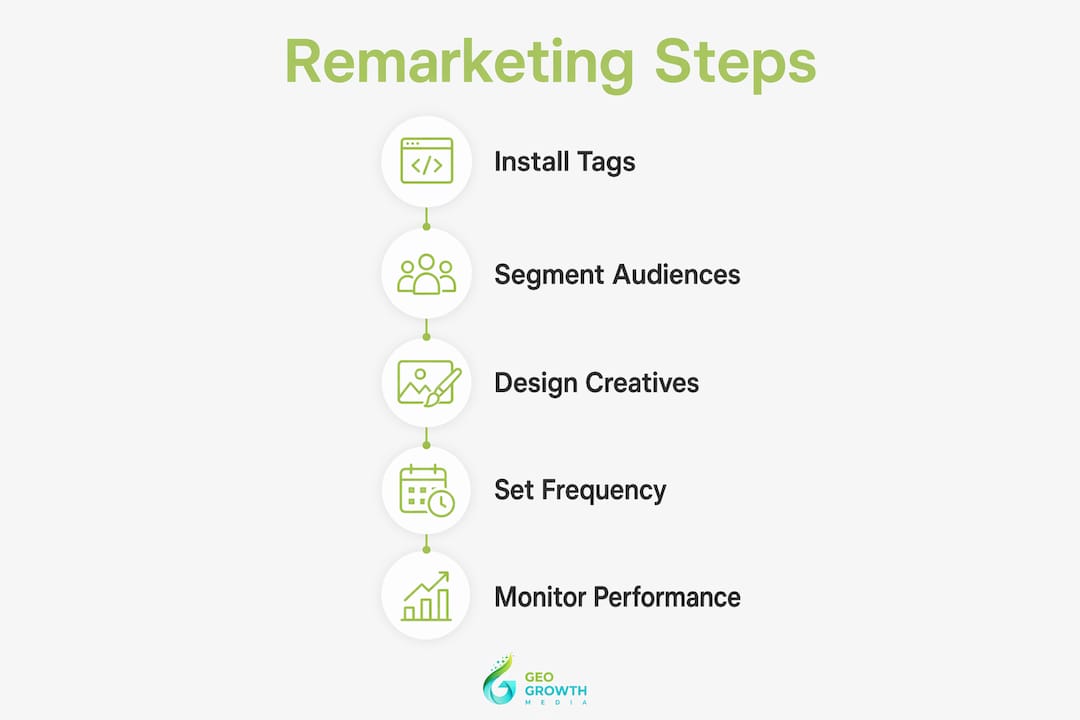
Key steps before launch:
- Install your tracking pixel via Google Tag Manager to avoid hard-coding changes on every page
- Verify pixel firing using the Meta Pixel Helper or Google Tag Assistant browser extensions
- Set up at least one conversion event (purchase, lead form, add to cart) before building audiences
- Link Google Analytics 4 to Google Ads for richer audience signals
Pro Tip: Do not wait until your campaign is ready to install your pixel. Install it the day you decide to run remarketing. Every day without it is audience data you cannot recover.
How do you segment and build effective remarketing audiences?
Audience segmentation is where most SMBs either win or waste their budget. Throwing all your past visitors into one audience and hitting them with the same ad is the equivalent of sending the same email to everyone on your list regardless of what they clicked. It rarely works well.

The most effective remarketing audiences are built around intent signals and funnel stage. A user who added a product to their cart and abandoned it is far more valuable than someone who landed on your homepage and left after ten seconds. Treat them differently.
Here are the core audience types worth building from day one:
- Cart abandoners (0 to 7 days): Highest intent. These users got close. Hit them with a direct reminder, product imagery, and social proof.
- Product page viewers (0 to 14 days): Mid-funnel. They showed interest but did not commit. Use benefit-led messaging and reviews.
- Blog or content readers (0 to 30 days): Top of funnel. Warm them up with brand awareness ads rather than hard-sell creative.
- Past purchasers (30 to 90 days): Cross-sell or upsell opportunity. Exclude them from acquisition campaigns to avoid wasted spend.
- Short bouncers (under 5 seconds on site): Exclude these entirely. Excluding users who bounced within 5 seconds and recent converters avoids wasted spend and prevents brand annoyance.
Recency windows matter enormously. A 180-day audience window might seem like more reach, but it dilutes your targeting with users who have long forgotten your brand. Tighter windows of 7 to 30 days typically deliver stronger conversion rates for most SMBs.
Dynamic remarketing takes segmentation a step further. Dynamic remarketing ads automatically personalise the products shown based on the exact pages a user visited, increasing relevance without any additional manual work on your end. For ecommerce businesses with large product catalogues, this is one of the highest-ROI tactics available.
When a user qualifies for multiple audience lists, prioritising high-intent segments improves ad relevancy and conversion likelihood. Set your campaign priority rules so that cart abandoners always see cart-specific creative, not a generic brand ad.
Pro Tip: Update your exclusion audiences daily. Purchasers and quick bouncers should be removed from active campaigns as soon as they qualify. Regularly updating exclusion audiences for purchasers and bouncers daily avoids wasted budget and ad fatigue.
What creative strategies work best for remarketing ads?
The biggest creative mistake in remarketing is running the same ad you use for cold prospecting. Your remarketing audience already knows who you are. Generic brand awareness messaging feels tone-deaf to someone who spent three minutes browsing your pricing page.
Match your creative to the specific action the user took. Cart abandoners respond well to product-specific imagery, urgency cues, and a clear call to action. Product page viewers benefit from testimonials and comparison content that addresses common objections. Past purchasers are primed for complementary product recommendations or loyalty-focused messaging.
Timing your incentives is equally important. Reserve discounts and incentives for users in the 8 to 14 day window post-visit. Offering a discount too early trains users to abandon carts intentionally, knowing a voucher will follow. Hold back the offer until the user has had time to consider and is at risk of going cold.
Creative fatigue is a real performance killer. Rotating creative every 7 to 10 days prevents ad fatigue and keeps campaigns performing. If you are running the same static image for three weeks, your frequency metrics will tell you the story: click-through rates drop, cost per acquisition rises, and users start hiding your ads.
Cross-platform coherence is another lever worth pulling. Cross-platform retargeting captures users across different sessions and devices with coordinated messaging. This does not mean running identical ads on Google Display and Meta. It means maintaining a consistent narrative, so a user who sees your Google Display ad and then encounters your Meta ad feels like they are being spoken to by the same brand, not bombarded by the same message twice.
Pro Tip: Build at least three creative variants per audience segment before launch. Rotate them on a schedule, not just when performance drops. Proactive rotation keeps your frequency costs lower and your audience more receptive.
How should you set frequency caps and allocate budget?
Frequency and budget are the two dials that separate efficient remarketing from expensive annoyance. Get them wrong and you will spend money irritating the very people most likely to convert.
For frequency caps, the recommended limits vary by placement. Display remarketing should be capped at 3 to 5 impressions per user per day, while YouTube remarketing performs better at 2 to 3 impressions per week. These are not arbitrary numbers. Exceeding them correlates with rising CPCs, declining CTRs, and users actively blocking your ads, all of which damage both performance and brand perception.
Budget allocation for remarketing typically sits at 15 to 25% of your total paid media spend. This reflects the fact that remarketing costs 50 to 75% less per conversion than prospecting campaigns, thanks to lower CPMs and CPCs on Meta and Google Display. You do not need to spend heavily to see results, but you do need enough budget to maintain consistent presence across your audience windows.
Here is a practical budget and frequency framework for SMBs:
- Allocate 15 to 25% of total ad spend to remarketing across all platforms
- Set daily impression caps in Google Ads at the campaign level under “Frequency management”
- Use Meta’s campaign budget optimisation with audience-level frequency rules in Ads Manager
- Weight budget towards your highest-intent segments, typically cart abandoners and recent product viewers
- Review performance weekly and shift budget away from audiences with declining ROAS
| Metric | What to monitor | Action threshold |
|---|---|---|
| ROAS | Revenue per £1 spent | Below target ROAS: pause or adjust bids |
| CTR | Click-through rate by audience | Below 0.5% on Display: refresh creative |
| CPA | Cost per acquisition | Rising CPA: check frequency and exclusions |
| Frequency | Average impressions per user | Above 5 per day: tighten caps immediately |
For scaling digital ads without losing ROI, the principle is the same: do not scale spend before you have validated your frequency controls and exclusion lists.
Pro Tip: Segment your remarketing budget by audience value, not just audience size. A cart abandoner list of 500 users is worth more budget than a homepage visitor list of 5,000.
What are the most common remarketing mistakes to avoid?
Even well-structured campaigns can bleed budget if a few critical mistakes go unchecked. These are the issues Geo Growth Media sees most often when auditing underperforming remarketing accounts.
- Skipping exclusions entirely: Running ads to recent converters is one of the fastest ways to annoy your best customers. Build exclusion lists for purchasers, lead form completers, and short bouncers before you go live.
- Using audience windows that are too wide: A 540-day remarketing window sounds like more reach, but it captures users with no meaningful intent. Stick to 7 to 30 days for high-intent segments and 30 to 60 days for broader awareness audiences.
- Ignoring platform differences: What works on Google Display does not automatically translate to Meta or YouTube. Each platform has different ad formats, user mindsets, and frequency tolerances. Treat them as separate channels with coordinated but distinct strategies.
- Letting creative go stale: Creative fatigue is silent. You will not notice it until your CPA has already climbed. Set a calendar reminder to review and rotate creative every 7 to 10 days.
- No cross-channel view: If you are running remarketing on both Google and Meta without a unified view of frequency, you may be hitting the same user 8 times a day across platforms without realising it.
Remarketing creative must be surgical and tailored to user behaviour to prevent budget waste and preserve brand reputation. Generic ads served to the wrong audience at the wrong frequency do more damage than no remarketing at all.
Continuous monitoring is not optional. Check your frequency metrics, exclusion audience sizes, and creative performance at least once a week. The campaigns that deliver the best performance marketing ROI are the ones that get reviewed and adjusted regularly, not set and forgotten.
Key takeaways
Remarketing campaigns succeed when precise audience segmentation, tailored creative, and controlled frequency work together to re-engage high-intent users at the right moment.
| Point | Details |
|---|---|
| Install tracking early | Set up your Google Ads tag and Meta Pixel before building any audiences. |
| Segment by intent | Build separate audiences for cart abandoners, product viewers, and past purchasers. |
| Rotate creative regularly | Refresh ad creative every 7 to 10 days to prevent fatigue and maintain CTR. |
| Cap frequency by platform | Limit Display to 3 to 5 impressions per day and YouTube to 2 to 3 per week. |
| Exclude low-value users | Remove recent converters and short bouncers from active campaigns daily. |
Our take on what actually moves the needle in remarketing
The most common thing we see when auditing remarketing accounts is not a lack of budget or the wrong platform. It is a lack of surgical thinking about who should and should not be seeing the ads.
Most businesses build one or two audiences, set a 90-day window, and let the campaign run. The result is a bloated audience full of users who bounced in two seconds, customers who already bought last week, and people who visited a blog post about a topic tangentially related to the product. All of them see the same ad. None of them convert at a meaningful rate.
The businesses that get remarketing right treat it like a conversation, not a broadcast. They think about what the user did, how long ago they did it, and what message would be most relevant given that context. They synchronise their Google and Meta campaigns so the messaging feels coherent without being repetitive. And they rotate their creative before it goes stale, not after the CPA has already spiked.
Automation helps, but it does not replace judgement. Smart bidding and dynamic ads are powerful tools, but they work best when the audience architecture underneath them is clean and well-maintained. If you feed a broad, unfiltered audience into an automated campaign, the algorithm will optimise for the wrong signals.
The digital marketing optimisation principle that applies here is simple: better inputs produce better outputs. Tighten your audiences, sharpen your creative, and cap your frequency. The results follow.
— Geo Growth Media
How Geo Growth Media can help you launch and optimise remarketing
Running remarketing well takes more than installing a pixel and setting a budget. It requires the right audience architecture, creative strategy, and ongoing performance management to deliver consistent returns.
Geo Growth Media works with SMBs and marketing teams as an extension of their in-house function, designing and managing remarketing campaigns across Google Ads, Meta Ads, and TikTok Ads. From pixel setup and audience segmentation to creative briefing and frequency management, the team handles the detail so you can focus on the bigger picture. If you are ready to stop losing warm traffic and start converting it, explore Geo Growth Media’s digital marketing services or take a closer look at the agency’s paid social media offering to see how remarketing fits into a broader growth strategy.
FAQ
What is remarketing and how does it work?
Remarketing is the practice of serving targeted ads to users who previously visited your website or app without converting. It works by placing a tracking pixel on your site that records user behaviour, which is then used to build audiences on platforms like Google Ads and Meta Ads.
How many users do I need before I can run remarketing?
Google Ads requires at least 100 users for Display remarketing and 1,000 for Search remarketing. Meta Ads requires a minimum of 100 matched users before a Custom Audience becomes active.
How much of my budget should go to remarketing?
Remarketing typically accounts for 15 to 25% of total paid media spend. Because it costs significantly less per conversion than prospecting, even a modest remarketing budget can deliver strong returns when audiences are well-segmented.
How often should I update my remarketing creative?
Rotate your creative every 7 to 10 days to prevent ad fatigue. Leaving the same creative running for longer leads to declining CTRs and rising CPAs as your audience becomes desensitised to the ad.
Should I run remarketing on Google, Meta, or both?
Running remarketing on both platforms gives you the best coverage, but each requires a distinct strategy. Start with whichever platform drives the most of your existing traffic, validate your approach, then expand to the second platform with coordinated but platform-specific messaging.


.png)