.png)

.svg)



TL;DR:
- A data-driven marketing workflow uses customer and campaign data to guide decisions, increasing customer acquisition and retention. Building reliable data connections, organizational alignment, and structured testing are essential for effectiveness, minimizing wasted spend. Implementing a disciplined, step-by-step process rapidly improves ROI through faster insights, personalized messaging, and evidence-based budget reallocation.
A data-driven marketing workflow is defined as the systematic process of using customer and campaign data to guide every marketing decision, from budget allocation to creative testing. Organisations that build this process correctly are 23 times more likely to acquire customers and six times more likely to retain them. Tools like Salesforce, Google Analytics 4, and Mailchimp sit at the heart of most effective workflows, connecting raw data to real decisions. If you are a marketing professional or business owner still relying on gut instinct to allocate spend, this guide gives you a practical, step-by-step path to change that.
What does a data-driven marketing workflow actually require?
Before you run a single test or pull a single report, you need the right foundations in place. The most common mistake is treating this as a technology problem when it is actually a data quality problem first.

Core data sources you cannot skip
Your workflow needs four primary data inputs: a CRM system, a web analytics platform such as Google Analytics 4, an email platform like Mailchimp or HubSpot, and your paid advertising accounts across Google Ads or Meta. Each source captures a different part of the customer journey. Together, they give you a complete picture of what is working and what is wasting budget.
Effective practitioners maintain clean data across 3–4 core tools rather than collecting everything prematurely. This matters because data sprawl creates noise, not insight. Start with the tools you already use, connect them properly, and document every data point you collect and why.
Tool comparison: building your marketing technology stack
| Tool | Primary Function | Best For |
|---|---|---|
| Google Analytics 4 | Web and app event tracking | Understanding user behaviour on site |
| HubSpot CRM | Contact management and pipeline tracking | Connecting marketing to sales outcomes |
| Mailchimp | Email campaign analytics and segmentation | Measuring engagement and list health |
| Google Ads / Meta Ads | Paid campaign performance data | Tracking CPCs, CPMs, and conversion rates |
Organisational prerequisites that most teams ignore
Technology alone does not build a working workflow. You need data governance, which means clear rules about who owns each data source, how data is labelled, and how often it is reviewed. You also need team alignment, so that your paid media, SEO, and content teams are all working from the same definitions of success. Without this, you end up with three teams pulling three different reports and reaching three different conclusions.
Platforms like Google Analytics, HubSpot, and Mailchimp enable real-time tracking and personalised activation, but only when the data flowing into them is clean and consistently structured.
Pro Tip: Start with one clean data source, document every field and its definition, and expand only once that source is reliable. Institutional knowledge built early saves weeks of confusion later.
How do you execute a data-driven marketing workflow step by step?
A working workflow follows a clear sequence. Skipping phases is where most teams go wrong.
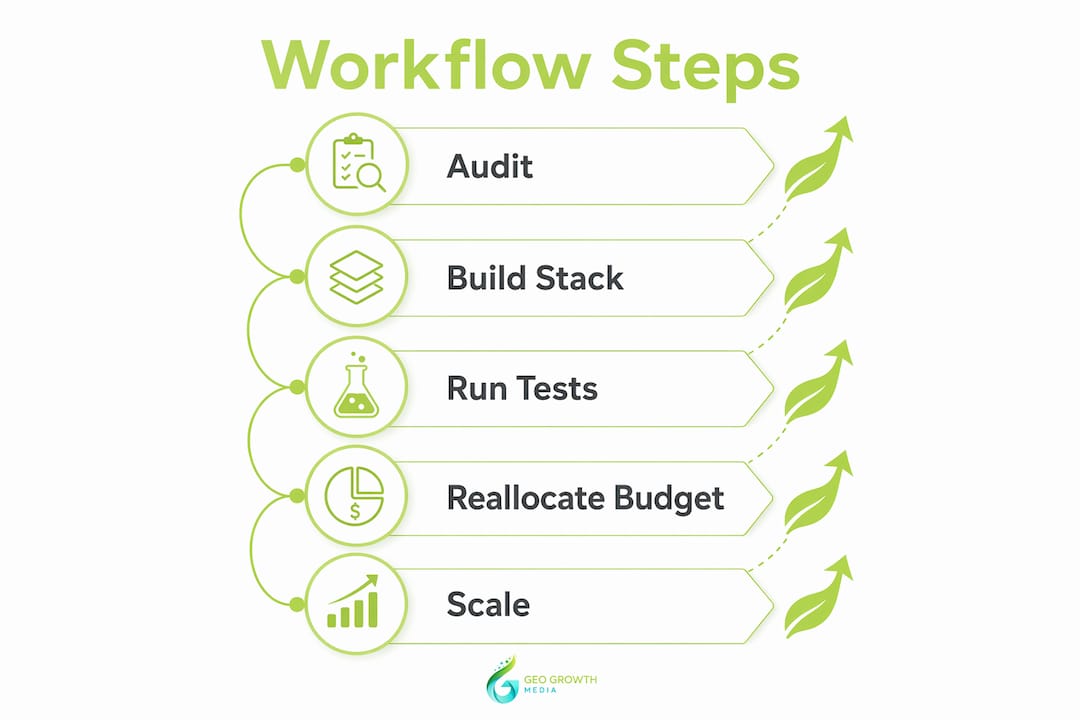
Phase 1: audit and define
Begin by auditing your existing data. Identify what you are currently tracking, where the gaps are, and what marketing questions you cannot yet answer. Then define your objectives in measurable terms. “Increase conversions” is not a marketing question. “Reduce cost per lead on Google Ads from £45 to £30 within 90 days” is.
Phase 2: build your measurement stack
Set up event tracking in GA4 for every meaningful user action: form submissions, product page views, add-to-cart events, and checkout completions. Connect your CRM to your ad platforms using UTM parameters so you can trace every lead back to its source campaign. This is the infrastructure that makes everything else possible.
Phase 3: run structured tests
Do not test everything at once. Run 2–3 structured experiments per month, each lasting at least two weeks to reach statistical significance. Test one variable at a time: a landing page headline, an audience segment, a bidding strategy. Document your hypothesis before you launch, not after you see the results.
Maintaining strict documentation covering hypothesis, variables, sample size, duration, and results builds institutional knowledge and prevents redundant testing. This is the difference between a team that learns and a team that keeps repeating the same mistakes.
Phase 4: reallocate budget based on evidence
Once your tests produce results, act on them. Shift budget from underperforming channels to those with proven returns. Use your CRM data to identify which audience segments convert at the lowest cost, then scale spend against those segments in Google Ads or Meta.
Workflow timeline: from audit to scale
| Phase | Activity | Typical Duration |
|---|---|---|
| Audit | Review existing data sources and gaps | 1–2 weeks |
| Build | Set up event tracking and integrations | 2–4 weeks |
| Test | Run structured experiments | 4–8 weeks |
| Optimise | Reallocate budget based on results | Ongoing |
| Scale | Expand winning strategies across channels | Ongoing |
Pro Tip: Run your first test on your highest-spend channel. The data you gain there will have the biggest impact on your overall budget efficiency.
What common mistakes derail a data-driven marketing workflow?
Even well-resourced teams stumble. Knowing where the pitfalls are saves you months of wasted effort.
-
Collecting everything without purpose. More data is not better data. Tracking every possible event creates noise that obscures the signals you actually need. Define what decisions each data point will inform before you collect it.
-
Operating in silos. Fewer than 30% of enterprises succeed in turning data insights into action, largely because technical and organisational silos block data from reaching decision-makers. Your paid media team needs to see CRM data. Your SEO team needs to see conversion data. Break the walls down.
-
Cherry-picking metrics after the fact. Setting clear success metrics and documenting all tests before launch prevents this. If you define what “success” looks like after you see the results, you are not doing data-driven marketing. You are doing confirmation bias with a spreadsheet.
-
Ignoring the feedback loop. The key difference between traditional and data-driven marketing is not access to data but the speed of the feedback loop. A slow feedback loop means slow decisions, which means wasted spend continues longer than it should.
-
Failing to build team buy-in. Organisational and cultural alignment is critical to converting marketing data into workable strategies. If your leadership does not trust the data, or your team does not understand why they are collecting it, the workflow breaks down at the human level.
-
Skipping documentation. Without a record of what you tested, why, and what happened, every new team member starts from zero. Document everything, even the tests that failed.
How does a data-driven marketing workflow improve ROI?
The ROI case for this approach is not theoretical. The numbers are concrete and the mechanisms are well understood.
“Organisations successfully implementing data-driven marketing are 23 times more likely to acquire customers and 6 times more likely to retain them.” — CDP.com
That retention advantage compounds over time. A customer retained costs a fraction of a new customer acquired. When your workflow identifies which channels and messages drive retention, you can invest more there and less in channels that only attract one-time buyers.
Budget recovery is the other major lever. Between 40–60% of total marketing spend is wasted or sub-optimally allocated. A structured workflow recovers a significant portion of that by replacing assumption-based decisions with evidence-based ones. If your monthly ad spend is £20,000, recovering even 30% of misallocated budget means £6,000 redirected to channels that actually convert. You can explore how analytics drives ROI recovery in more detail to understand the mechanics behind this.
Speed is the third advantage. Data-driven marketers can test and validate hypotheses in as little as 48 hours versus six months for traditional marketing cycles. That speed means you catch a failing campaign in days, not quarters. It also means you scale a winning campaign faster, compressing the time between insight and revenue.
Scalable personalisation through intelligent segmentation and automation is the final piece. When your data workflow is working, you can deliver the right message to the right segment at the right time, at scale, without manually managing every campaign. That is where the compounding advantage really kicks in. For a deeper look at how this connects to paid advertising performance, the principles translate directly.
The uncomfortable truth about data-driven marketing
Most teams that struggle with data-driven workflows are not failing because of bad tools. They are failing because they are trying to do too much, too fast, with data they do not fully trust.
At Geo Growth Media, we have worked with businesses that had GA4, HubSpot, and Salesforce all running simultaneously, yet still could not answer the question: “Which channel is driving our best customers?” The data was there. The connections were not. And without clean, connected data, every decision was still a guess dressed up in a dashboard.
The teams that get this right share one habit: they start smaller than feels comfortable. One clean data source. One defined question. One test. Then they build from there. It sounds slow, but it is actually faster than the alternative, which is six months of collecting data you cannot use.
There is also a cultural dimension that rarely gets discussed. Data does not replace creativity. It directs it. When you know which audience segment responds to which message, your creative team can focus their energy on making that message better, rather than guessing what to say to whom. The best marketing teams we work with treat data as a brief, not a constraint.
Stay adaptable as the technology evolves. Tools like GA4 and Performance Max are changing how data is collected and attributed. Build your workflow around principles, not platforms, and you will not be starting from scratch every time a tool updates.
— Geo Growth Media
Work with a team that builds this for you
Building a data-driven marketing workflow from scratch takes time, expertise, and the right technology connections. Geo Growth Media specialises in doing exactly this for ambitious brands across the UK.
From paid social campaigns on Meta, TikTok, and LinkedIn to Google Ads and SEO, every service Geo Growth Media delivers is built on clean data, structured testing, and evidence-based budget decisions. The team acts as an extension of your in-house marketing function, bringing the workflow discipline and channel expertise that turns ad spend into measurable growth. If you are ready to stop guessing and start scaling, explore Geo Growth Media’s digital marketing services to find the right fit for your goals and budget.
Key takeaways
A data-driven marketing workflow delivers measurable ROI gains only when clean data, structured testing, and organisational alignment work together from the start.
| Point | Details |
|---|---|
| Start with clean, connected data | Focus on 3–4 core tools before expanding your data sources. |
| Define success metrics upfront | Set measurable objectives before launching any test or campaign. |
| Run structured, documented tests | Test one variable at a time and record every hypothesis and result. |
| Act on the feedback loop quickly | Reallocate budget within days of results, not months. |
| Align your team around the data | Cultural buy-in determines whether insights ever reach decisions. |
FAQ
What is a data-driven marketing workflow?
A data-driven marketing workflow is the process of using customer and campaign data to guide every marketing decision, from targeting to budget allocation. It replaces assumption-based decisions with evidence gathered from tools like GA4, CRM systems, and ad platforms.
Why choose data-driven marketing over traditional methods?
Data-driven marketers can validate hypotheses in as little as 48 hours compared to six months for traditional marketing cycles. That speed advantage means faster optimisation, less wasted spend, and compounding improvements over time.
How much marketing budget is typically wasted without a data workflow?
Between 40–60% of total marketing spend is wasted or sub-optimally allocated in organisations without structured data workflows. A properly implemented workflow recovers a significant portion of that through evidence-based reallocation.
What tools do i need to start a data-driven marketing workflow?
You need a web analytics platform such as Google Analytics 4, a CRM like HubSpot or Salesforce, an email tool like Mailchimp, and your paid advertising accounts. Clean, connected data across these four tools is more valuable than a larger, disconnected technology stack.
Why do so many businesses fail to act on their marketing data?
Fewer than 30% of enterprises successfully turn data insights into action, primarily because of organisational silos and a lack of cultural alignment. The technology is rarely the barrier. The process and the people are.


.png)