.png)

.svg)


TL;DR:
- Successful data-driven marketing relies on unified data, clear objectives, and audience insights.
- Combining multi-touch attribution with marketing mix modelling improves measurement accuracy.
- AI enhances campaign personalization, testing, and continuous optimization for better ROI.
Spending more on marketing does not guarantee better results. Many marketing managers and business owners pour budget into campaigns that generate clicks but not conversions, leads but not revenue. The gap between spend and return rarely comes down to budget size. It comes down to whether your campaigns are built on reliable data and a clear strategic framework. This guide walks you through the exact steps to build, execute, and optimise data-driven marketing campaigns, from laying the right foundations to using AI for continuous improvement, so you can turn your marketing spend into measurable, repeatable ROI.
Table of Contents
- What you need to build a data-driven marketing foundation
- Step-by-step: Building and executing data-driven campaigns
- Choosing and combining attribution models
- Optimising and scaling campaigns with AI and iterative testing
- What most guides get wrong about data-driven marketing
- Supercharge your campaigns with expert support
- Frequently asked questions
Key Takeaways
| Point | Details |
|---|---|
| Data quality matters most | Without unified and clean data, even expensive marketing platforms can’t deliver strong ROI. |
| Step-by-step process wins | Following a structured approach from goal setting to measurement is key to campaign success. |
| Mix attribution models | Combining attribution and MMM delivers the best tactical and strategic insights for small businesses. |
| Test, optimise, repeat | Ongoing A/B testing and real-time analytics empower continuous improvement and growth. |
| AI is a force multiplier | Modern AI tools can rapidly personalise and optimise marketing across channels, boosting returns. |
What you need to build a data-driven marketing foundation
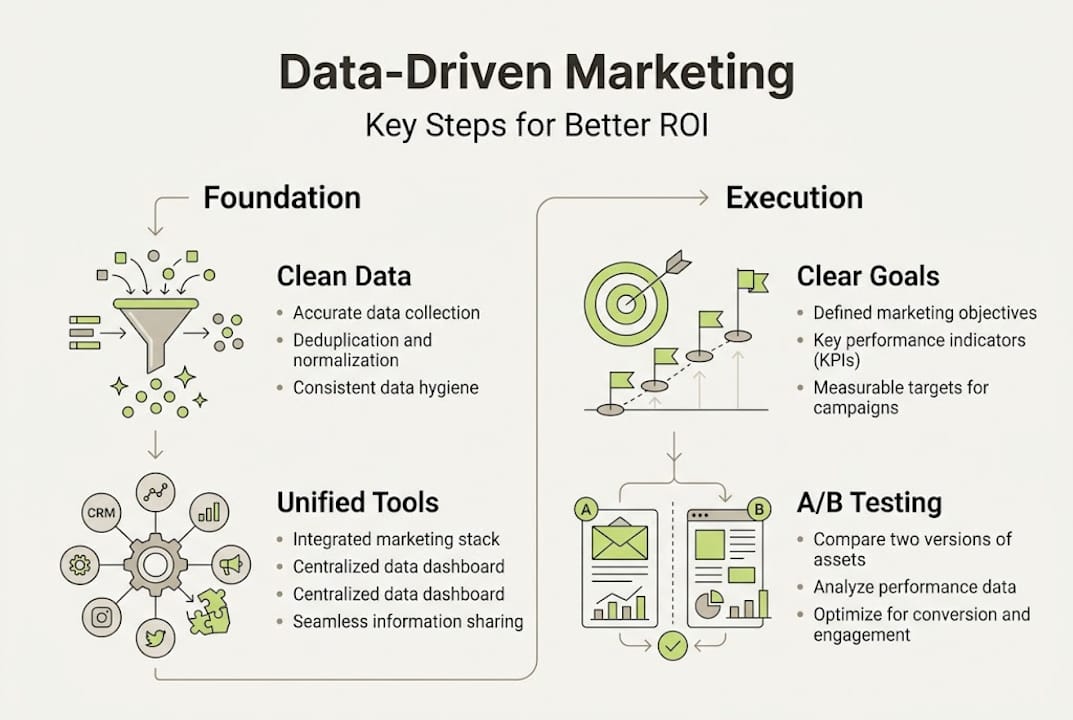
Before diving into execution, you must set up solid data and strategic foundations. Without them, even the most creative campaigns will underperform. Think of your data infrastructure as the engine beneath the campaign. If the engine is misfiring, no amount of clever creative will fix the output.
The most common cause of poor campaign ROI is fragmented data. When your website analytics, CRM, paid media platforms, and social channels are all reporting separately, you end up with contradictory numbers and no clear picture of what is actually working. As the clean data principle makes clear, fragmented data leads to poor ROI despite high spend. Unifying your data sources is not optional. It is the starting point.
Here are the core building blocks every SMB marketing team needs before launching a data-driven campaign:
- Unified data sources: Connect website analytics, CRM data, paid media, social, and any offline channels into one view
- Clear campaign objectives: Define what success looks like before you build anything (leads, sales, cost per acquisition)
- Audience intelligence: Build buyer personas based on real behavioural and demographic data, not assumptions
- Customer journey mapping: Understand the touchpoints your audience moves through from awareness to purchase
- Reporting infrastructure: Set up dashboards that surface the right metrics for your goals
For tools, start simple. Google Analytics 4 is essential for GA4 attribution setup and understanding on-site behaviour. HubSpot covers CRM and campaign tracking well. Google Sheets can handle early-stage reporting until you need something more advanced. The data roles in digital marketing go far beyond just analysts. Everyone touching a campaign should understand what the data is telling them.
The core methodology for effective data-driven campaigns starts with defining clear objectives, unifying data sources, and conducting thorough audience analysis. These three steps create the conditions for analytics-driven ROI growth at every stage of the campaign lifecycle.
| Foundation element | Tool options | Priority |
|---|---|---|
| Web analytics | GA4, Adobe Analytics | High |
| CRM and lead tracking | HubSpot, Salesforce | High |
| Paid media reporting | Google Ads, Meta Ads Manager | High |
| Data visualisation | Looker Studio, Google Sheets | Medium |
| Customer data platform | Segment, Klaviyo | Medium/Advanced |
Pro Tip: Start with free tools before investing in advanced platforms. GA4 and HubSpot’s free tier will take most SMBs a long way before they need to upgrade.
Step-by-step: Building and executing data-driven campaigns
With a solid foundation established, you are ready to follow a proven step-by-step framework to campaign execution. This is where strategy becomes action.
- Conduct market and audience research. Use your CRM data, social listening tools, and competitor analysis to understand what your audience needs and where they spend time. Key steps include market research, buyer persona creation, and competitive analysis as the backbone of any effective campaign.
- Set measurable goals tied to business outcomes. A campaign goal of “increase brand awareness” is not measurable enough. Instead, target a specific cost per lead, a conversion rate improvement, or a revenue figure within a defined timeframe.
- Select your channels using data. Look at where your existing customers came from and where your competitors are active. Do not spread budget across every channel. Concentrate it where the data points.
- Develop creative and content mapped to personas. Your best-performing creative will differ significantly by audience segment. Use past campaign data to inform which formats, messages, and calls to action resonate with each persona.
- Implement KPI tracking across every platform. Set up conversion tracking in Google Ads, Facebook Pixel or Meta Conversions API, and GA4 before you launch anything. Launching without tracking is the equivalent of driving without a speedometer.
- Launch, monitor, and adjust continuously. Do not set campaigns live and check back in a fortnight. Review performance daily in the first two weeks, then weekly, using your dashboard to catch underperformance early.
For paid search specifically, a well-structured SEM campaign setup will make your tracking and optimisation significantly cleaner. Similarly, Performance Max strategies require a thoughtful data input approach to work at their best.

HubSpot’s campaign best practices reinforce the value of iterative testing and structured planning from the outset.
Pro Tip: Use predictive audiences in GA4 and segment by customer lifetime value (CLV) for advanced targeting. This allows you to bid more aggressively for high-value prospects and protect budget from low-intent traffic. Expert guidance on data-driven attribution supports this approach with real campaign efficiency gains.
Choosing and combining attribution models
A precise campaign setup is only as effective as your ability to measure impact across different touchpoints. Attribution is the mechanism that tells you which channels and interactions contributed to a conversion. Get it wrong and you will consistently over-invest in the wrong places.
There are three main approaches:
Single-touch attribution (first click or last click) is simple but misleading. It credits one touchpoint for the entire journey and ignores everything else. Useful for quick directional insight, but not reliable for budget decisions.
Multi-touch attribution (MTA) distributes credit across multiple touchpoints, giving a much more accurate picture of the customer journey. It is strong for tactical, real-time optimisation but becomes unreliable in long sales cycles or when offline channels are involved.
Marketing mix modelling (MMM) takes a top-down, statistical approach to measuring the impact of all marketing activity, including offline. It is better for strategic budget allocation and remains effective in privacy-constrained environments. The trade-off is that it requires six to twelve months of historical data and is less granular than MTA.
The smartest approach is to combine both methods and validate findings with incrementality tests. Use MTA for week-to-week optimisation decisions and MMM for quarterly or annual budget planning. The comparison of attribution vs MMM shows why neither model alone is sufficient for ambitious growth.
For analytics across multi-touch campaigns, the key is triangulating your data rather than relying on a single source of truth.
| Model | Best for | Limitation |
|---|---|---|
| Last-click | Simple campaigns, quick insight | Ignores full journey |
| Multi-touch (MTA) | Tactical optimisation, digital-only | Privacy constraints, long cycles |
| Marketing mix modelling | Strategic planning, offline channels | Slow, needs 6-12 months of data |
| Incrementality testing | Validating any model | Resource-intensive |
Signs your current attribution model is not working:
- Your top-performing channel by last-click shows weak results in revenue reports
- You cannot explain performance swings week on week
- Budget decisions are being made on gut feel rather than data
- You have no visibility into offline or cross-device conversions
The statistic is worth noting: 82% of marketers find data-driven strategies effective, yet many still rely on single-touch models that distort their view of what is working.
Optimising and scaling campaigns with AI and iterative testing
Having clarity on attribution lets you fine-tune and then scale campaigns with confidence. This is where the real performance gains happen, and where AI is genuinely changing what is possible for marketing teams of every size.
“AI is now the fastest lever for campaign impact. The teams winning in 2026 are not the ones with the biggest budgets. They are the ones using AI to personalise, test, and adapt faster than their competitors.”
49% of marketers now prioritise AI for content personalisation, and the gap between businesses using these tools and those ignoring them is growing. AI enables dynamic creative optimisation, audience expansion based on predictive signals, and automated bidding that responds to real-time data far faster than any human team can.
Here is how to build an iterative testing and AI-powered optimisation process:
- Set up A/B tests on creative, copy, and targeting simultaneously. Do not test one variable at a time if your traffic volume allows multivariate testing. Move faster.
- Define a testing cadence. Run tests for a statistically significant period (usually two to four weeks minimum) before drawing conclusions. Ending tests early is one of the most common causes of wasted budget.
- Use real-time dashboards to catch problems early. If a campaign is burning through budget with a high cost per acquisition in the first 48 hours, you need to know immediately, not at the end of the week.
- Apply AI tools for personalisation at scale. Meta’s Advantage+ and Google’s Performance Max both use machine learning to match creative to audience. Feed them quality data and clear conversion signals.
- Review and reallocate weekly. Use the insights from your AI-powered marketing ROI analysis to shift budget toward what is working and pause what is not.
Continuous A/B testing and iterative optimisation are not a phase of the campaign. They are the permanent operating model. Complement this with strong website and landing page improvements to ensure your traffic has the best possible chance of converting.
For broader strategic context, HubSpot’s strategy optimisation guidance provides a useful framework for structuring these ongoing decisions.
Pro Tip: Set automated budget rules in Google Ads and Meta to increase spend on campaigns hitting your target CPA and pause those exceeding it. This prevents overnight budget bleed and keeps your accounts optimising even when you are not watching.
What most guides get wrong about data-driven marketing
Most articles on this topic make data-driven marketing sound like a technology problem. Buy the right tools, connect the right integrations, and the ROI will follow. In our experience working with SMBs across different sectors, that is rarely what holds teams back.
The real bottleneck is almost always human. It is getting a team to consistently act on data rather than just report it. It is resisting the urge to chase the latest platform or AI feature before you have clean, unified data feeding your existing campaigns. Chasing tools without fixing data quality is a genuinely expensive dead end. We have seen companies spend thousands on analytics platforms that produce dashboards nobody trusts because the underlying data is inconsistent.
Perfect attribution is not a prerequisite for growth. You do not need to solve every measurement challenge before making decisions. The best data-driven marketers make small, fast decisions, course-correct constantly, and treat every campaign as a source of learning. Action consistently beats analysis paralysis. If you are waiting until your attribution model is perfect, you are waiting too long.
For practical guidance on building measurable marketing growth into your regular operating rhythm, start with the data you already have and build from there.
Supercharge your campaigns with expert support
Building and running data-driven campaigns is genuinely rewarding when the systems are in place. But it takes time, expertise, and consistent attention to get right.
At Geo Growth Media, we work as an extension of your marketing team, bringing the strategic framework, the technical setup, and the ongoing optimisation that turns campaign potential into measurable revenue. Whether you need high-performing paid social media campaigns built on precise audience data or landing page design that converts your paid traffic into leads, we have the experience to make it happen. If you are ready to stop guessing and start growing, get in touch with our team today.
Frequently asked questions
What is the first step in creating a data-driven marketing campaign?
The first step is to define your campaign goals and ensure you have unified, clean data from all your marketing channels. Fragmented data leads to poor ROI regardless of how much budget you deploy.
Which analytics tools are most important for small businesses?
Start with free tools like Google Analytics 4 for attribution and HubSpot for campaign tracking before considering more advanced platforms. Data-driven attribution in GA4 is available at no cost and provides strong directional insight for SMBs.
How do you measure ROI in a data-driven marketing campaign?
Use multi-touch attribution for tactical ROI and marketing mix modelling for strategic insights, combining them where possible. Tactical versus strategic measurement requires different tools and different timeframes to interpret accurately.
What is the biggest pitfall for new data-driven marketers?
The most common mistake is failing to unify all marketing data, which leads to misleading insights and wasted budget. Clean data foundations are the single most important prerequisite for campaign success.
How does AI improve data-driven marketing campaigns?
AI accelerates personalisation and testing, helping businesses quickly identify and scale winning strategies for better ROI. With 49% of marketers now prioritising AI for content personalisation, the tools are mature enough for SMBs to adopt with confidence.


.png)