.png)

.svg)



TL;DR:
- B2B and B2C digital marketing differ fundamentally in target audiences, content strategies, and success metrics. B2B focuses on long sales cycles and relationship-building, while B2C emphasizes quick conversions through emotional appeal and visual content. Marketers must tailor their channels, messaging, and measurement approaches to fit each model.
B2B vs B2C digital marketing refers to two fundamentally different approaches: B2B targets business clients through relationship-driven, logic-based strategies, while B2C focuses on individual consumers using emotion-driven, fast-conversion tactics. Getting this distinction wrong is one of the most common and costly mistakes marketers make. A LinkedIn campaign built for a procurement director and a TikTok reel aimed at a weekend shopper require entirely different thinking, budgets, and creative briefs. This article breaks down the core differences in audience behaviour, content strategy, channel selection, and performance measurement so you can build campaigns that actually fit the model you are working in.
What are the key differences between B2B and B2C digital marketing?
B2B digital marketing targets organisations, buying committees, and professional decision-makers. B2C digital marketing targets individual consumers making personal purchases. The audience gap alone changes everything: your messaging, your channels, your creative, and your timeline.

B2B buying cycles average 11.3 months and involve multiple stakeholders, from procurement teams to C-suite sign-off. That length reflects the financial and operational risk businesses take when committing to a supplier or platform. B2C consumers, by contrast, make purchase decisions within minutes to days, driven by impulse and emotion rather than detailed research.
| Factor | B2B | B2C |
|---|---|---|
| Primary audience | Business buyers, committees | Individual consumers |
| Decision driver | Logic, ROI, risk reduction | Emotion, desire, social proof |
| Sales cycle length | Months to over a year | Minutes to days |
| Relationship type | Long-term, account-based | Transactional, loyalty-driven |
| Content depth | Detailed, educational | Visual, engaging, brief |
- B2B buyers involve an average of multiple stakeholders before a deal closes, each with different priorities and objections.
- B2C buyers respond to urgency, scarcity, peer reviews, and aspirational imagery.
- B2B messaging must address ROI, compliance, integration, and long-term value.
- B2C messaging must capture attention within seconds and reduce friction to purchase.
Pro Tip: If you are running B2B campaigns, map your content to each stakeholder role separately. A CFO needs cost justification. A department head needs proof of efficiency. One message rarely satisfies both.
How do content types and messaging differ for B2B and B2C?
Content is where the B2B and B2C divide becomes most visible. B2B content must educate, build authority, and earn trust over a long period. B2C content must entertain, provoke emotion, and convert quickly.
B2B content formats that consistently perform include whitepapers, case studies, in-depth blog posts, webinars, and ROI calculators. These formats reflect the early-stage education buyers need before they are ready to engage a sales team. Skipping this stage and going straight to a pitch is the equivalent of proposing on a first date.
B2C content leans heavily on user-generated content (UGC), short-form video, influencer partnerships, and visually rich social posts. Agile creative strategies that capture attention within seconds are not optional in B2C. They are the baseline. Platforms like Instagram, TikTok, and Meta reward content that stops the scroll, not content that explains the product specification.
The messaging tone shifts just as dramatically:
- B2B tone: Authoritative, data-backed, professional. Speak to business outcomes.
- B2C tone: Conversational, aspirational, emotionally resonant. Speak to personal desires.
- B2B storytelling: Lead with the problem, follow with proof, close with ROI.
- B2C storytelling: Lead with identity and aspiration, follow with social proof, close with urgency.
Understanding digital branding matters in both models, but the brand signals you send differ. B2B brands signal expertise and reliability. B2C brands signal lifestyle, values, and belonging.
Pro Tip: Repurpose B2B whitepapers into LinkedIn carousel posts and short video clips. You get multiple touchpoints from one piece of research without doubling your content budget.
Which digital channels work best for B2B versus B2C campaigns?
Channel selection is not a preference. It is a strategic decision based on where your audience spends time and how they make decisions.
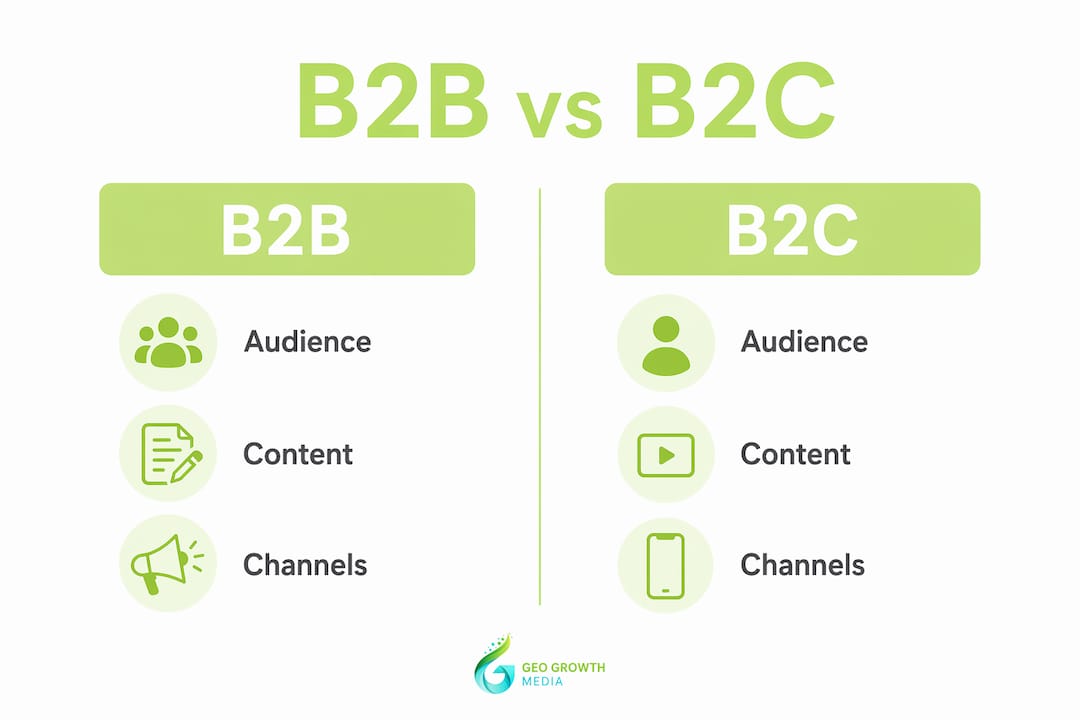
For B2B, LinkedIn generates approximately 80% of B2B social media leads. That figure makes LinkedIn the non-negotiable starting point for any B2B paid social strategy. Email marketing, SEO, and Account-Based Marketing (ABM) complete the core B2B channel mix. ABM targets specific companies and decision-makers with personalised content rather than casting a wide net. B2B buyers use an average of ten different channels before converting, which means your omnichannel presence directly affects whether you appear in their consideration set at all.
For B2C, Meta (Facebook and Instagram), TikTok, and Google Shopping are the primary paid channels. Organic social, influencer marketing, and email automation round out the mix. AI-driven lifecycle orchestration is now central to B2C marketing at scale. It personalises messages and delivery timing based on individual behavioural data, moving B2C marketers away from batch-and-blast email towards genuinely relevant communication.
| Channel | Best for | Primary use case |
|---|---|---|
| B2B | Lead generation, ABM, thought leadership | |
| Email automation | B2B and B2C | Nurture sequences, lifecycle marketing |
| Meta (Facebook/Instagram) | B2C | Prospecting, retargeting, brand awareness |
| TikTok | B2C | Brand discovery, UGC, impulse conversion |
| SEO | B2B and B2C | Organic visibility, inbound lead generation |
| Google Ads | B2B and B2C | Intent-based search capture |
Programmatic advertising adds another layer for B2B marketers looking to reach niche professional audiences across multiple sites without managing placements manually. For B2C, personalised e-commerce strategies tied to browsing and purchase behaviour drive repeat conversions at a lower cost per acquisition than cold prospecting alone.
What metrics and strategies should you prioritise for each model?
Measurement separates marketers who grow from those who guess. B2B and B2C require different KPIs because their definitions of success are fundamentally different.
B2B success is measured through pipeline velocity, lead quality, cost per qualified lead, and ultimately ROI against sales cycle length. B2B conversion is data-driven and ROI-focused, requiring detailed KPIs like pipeline velocity to track how quickly deals move through the funnel. A campaign that generates 500 leads but closes zero deals has failed, regardless of the click-through rate.
B2C success centres on conversion rate, cost per acquisition, customer lifetime value (CLV), and brand loyalty metrics like repeat purchase rate and net promoter score. Engagement metrics such as video views and social shares matter, but only when they connect to revenue outcomes.
One underappreciated B2B concept is the dark funnel. This refers to demand generation tactics that build brand authority and educate prospects before they formally identify themselves as leads. Founder-led content on LinkedIn, podcast appearances, and community engagement all feed the dark funnel. You cannot track it directly in Google Analytics, but it shortens sales cycles and improves close rates.
For B2C, impulse triggers are the equivalent mechanism. Scarcity messaging, countdown timers, social proof notifications, and one-click checkout reduce the gap between desire and purchase. Behavioural segmentation built around actual purchase behaviour, not assumed demographics, makes these triggers far more effective.
- B2B KPIs to track: Pipeline velocity, cost per qualified lead, sales cycle length, marketing-attributed revenue, and account engagement score.
- B2C KPIs to track: Conversion rate, cost per acquisition, customer lifetime value, repeat purchase rate, and return on ad spend (ROAS).
- Shared KPIs: Email open and click rates, organic search traffic, and cost per click across paid channels.
Pro Tip: Build a data-driven campaign framework before you launch. Decide which metrics define success for your specific model, then set benchmarks. Reviewing the wrong metrics mid-campaign leads to bad optimisation decisions.
Key takeaways
B2B and B2C digital marketing require distinct strategies because their audiences, buying cycles, content formats, channels, and success metrics are fundamentally different.
| Point | Details |
|---|---|
| Audience and cycle differ sharply | B2B involves multiple stakeholders over months; B2C targets individuals who decide within days. |
| Content must match the model | B2B needs educational depth; B2C needs emotional, visual content that converts fast. |
| Channel choice is non-negotiable | LinkedIn dominates B2B leads; Meta and TikTok drive B2C discovery and conversion. |
| Measure what matters to your model | B2B tracks pipeline velocity and ROI; B2C tracks conversion rate and customer lifetime value. |
| Dark funnel and impulse triggers | B2B builds authority before leads appear; B2C removes friction at the moment of desire. |
What we have learned running both B2B and B2C campaigns
The biggest mistake we see is marketers treating B2B and B2C as variations of the same thing. They are not. They are different disciplines that happen to share some tools.
B2B campaigns require patience that most clients find uncomfortable. When the buying cycle runs close to a year, the pressure to show quick wins leads teams to optimise for the wrong metrics. Chasing form fills instead of pipeline quality is a trap we see constantly. The dark funnel work, the LinkedIn thought leadership, the webinar series that generates no immediate leads, these activities build the authority that closes deals six months later. Cutting them because they do not show up in a monthly report is shortsighted.
B2C has its own trap: creative fatigue. Audiences on Meta and TikTok burn through ad creative faster than most teams can produce it. The brands that win in B2C are not necessarily the ones with the biggest budgets. They are the ones with the most agile creative processes. Testing three to five ad variations per week, reading the data honestly, and killing underperformers without sentiment is what separates consistent B2C performers from those stuck in a rut.
The rise of AI in digital marketing is changing both models, but differently. In B2C, AI lifecycle orchestration is already table stakes for brands at scale. In B2B, AI is improving lead scoring and personalisation at the account level. Neither model can afford to ignore it in 2026.
— Geo Growth Media
How Geo Growth Media supports your B2B and B2C growth
Whether you are selling to procurement teams or weekend shoppers, the channel strategy, creative, and measurement approach must fit your model precisely.
Geo Growth Media works as an extension of your marketing team across both B2B and B2C campaigns. Our paid social media services cover LinkedIn for B2B lead generation and Meta and TikTok for B2C conversion campaigns. Our SEO services build the organic visibility that feeds both inbound pipelines and consumer discovery. Every strategy we build is tied to the metrics that matter for your specific model, not a generic template. If you want campaigns that perform rather than just run, get in touch with the team at Geo Growth Media.
FAQ
What is the main difference between B2B and B2C digital marketing?
B2B digital marketing targets business buyers with logic-driven, relationship-focused strategies over long sales cycles. B2C digital marketing targets individual consumers with emotional, fast-conversion tactics across platforms like Instagram and TikTok.
Which platform is best for B2B digital marketing?
LinkedIn is the most effective platform for B2B, generating approximately 80% of B2B social media leads. Email marketing and SEO complement LinkedIn as core B2B channels.
How long is a typical B2B sales cycle compared to B2C?
The average B2B buying cycle extends to around 11.3 months and involves multiple stakeholders. B2C consumers typically decide within minutes to days.
What content works best for B2C digital marketing?
Short-form video, user-generated content, influencer partnerships, and visually rich social posts perform best in B2C. Agile creative that captures attention within seconds is the baseline requirement.
How do you measure success differently in B2B versus B2C?
B2B success is measured through pipeline velocity, cost per qualified lead, and marketing-attributed revenue. B2C focuses on conversion rate, customer lifetime value, and return on ad spend.


.png)