.png)

.svg)




Small e-commerce brands often pour budget into creative campaigns and multi-channel advertising, yet struggle to understand which efforts truly drive revenue. The missing piece isn’t creativity or reach, it’s analytics. Data-driven insights transform guesswork into strategic decisions, revealing exactly where your marketing pounds deliver returns and where they disappear. This guide unpacks how analytics optimises digital marketing for measurable ROI growth, covering core methodologies, proven performance gains, common pitfalls, and practical steps tailored for SMB e-commerce managers seeking sustainable competitive advantage.
Table of Contents
- Key takeaways
- What is digital marketing analytics and why it matters
- Core analytics methodologies and metrics used in digital marketing
- Real-world impacts: how analytics drives measurable ROI growth in e-commerce
- Common challenges and nuances in digital marketing analytics
- Practical steps for SMB e-commerce marketers to leverage analytics for better ROI
- Boost your digital marketing with Geo Growth Media
- Frequently asked questions
Key Takeaways
| Point | Details |
|---|---|
| ROI driven insights | Analytics turns raw data into actionable decisions that boost campaign return on investment. |
| Core analytics methods | Descriptive, predictive and prescriptive analytics form the decision making backbone in digital marketing. |
| Key metrics and models | Attribution modelling, cohort analysis, RFM segmentation and LTV modelling help identify value and prioritise spend. |
| Practical SMB steps | Build three dashboards for executive, operational and strategic use to prevent information overload. |
What is digital marketing analytics and why it matters
Digital marketing analytics is the systematic collection, measurement, and analysis of data across marketing channels to inform decisions, optimise campaigns, and improve ROI. For SMB e-commerce brands, this means transforming raw numbers from Google Ads, Meta, email platforms, and your website into actionable insights that reveal which tactics work, which audiences convert, and where budget adjustments yield the highest returns.
Analytics shapes every critical marketing decision. It identifies high-performing customer segments, pinpoints friction in your conversion funnel, and quantifies the true value of each marketing channel. Without robust analytics, you’re essentially flying blind, relying on gut instinct rather than evidence. The shift to GA4 and event-based tracking has made comprehensive measurement more accessible, yet many e-commerce managers still struggle to extract meaningful insights from the data avalanche.
The ROI impact is substantial. Analytics enables precise targeting, eliminating wasted spend on audiences unlikely to convert. It reveals optimal bid strategies, identifies content that drives engagement, and highlights retention opportunities within your existing customer base. For resource-constrained SMBs, this efficiency translates directly to sustainable growth without proportional budget increases. Understanding digital marketing and ROI dynamics becomes far simpler when you can trace each marketing pound to specific outcomes.
Pro Tip: Most e-commerce managers rely on a single dashboard view, missing critical insights. Build three distinct dashboards: executive (high-level KPIs and trends), operational (daily campaign performance and alerts), and strategic (long-term cohort behaviour and LTV modelling). This layered approach ensures every stakeholder gets relevant insights without information overload.
Core analytics methodologies and metrics used in digital marketing
Three fundamental methodologies power digital marketing analytics. Descriptive analytics answers what happened, summarising past campaign performance through metrics like click-through rates, conversion rates, and revenue. Predictive analytics forecasts what could happen, using historical patterns to estimate future customer behaviour, seasonal trends, and campaign outcomes. Prescriptive analytics recommends what to do, suggesting optimal budget allocations, audience targeting adjustments, and channel mix based on predictive models and business constraints.
Attribution modelling determines which touchpoints deserve credit for conversions. Different models suit different business contexts:
| Attribution model | Best for | Data requirement | Limitation |
|---|---|---|---|
| Last-click | Simple tracking, limited touchpoints | Minimal | Ignores earlier influences |
| Data-driven | Complex journeys, 1,000+ conversions monthly | High volume | Requires statistical significance |
| Multi-touch | Understanding full journey | Moderate | Can over-credit minor interactions |
Customer segmentation techniques unlock deeper insights. Cohort analysis groups customers by acquisition date or behaviour, revealing how different groups engage over time. RFM segmentation categorises customers by recency, frequency, and monetary value, enabling targeted retention campaigns. LTV modelling predicts long-term customer value, helping prioritise acquisition channels and justify higher initial acquisition costs for high-value segments.
Funnel analysis tracks conversion stages from awareness through purchase, identifying where prospects drop off. For e-commerce, typical stages include:
- Landing page visit
- Product page view
- Add to basket
- Checkout initiation
- Payment completion
Each stage reveals optimisation opportunities. High drop-off at checkout suggests friction in payment options or unexpected costs. Low add-to-basket rates indicate product page improvements needed.

Pro Tip: Choose attribution models based on your data volume and business complexity. If you process fewer than 1,000 conversions monthly, stick with last-click or position-based models. Data-driven attribution requires statistical significance that smaller volumes cannot provide. Explore digital marketing optimisation methods suited to your business scale.
Real-world impacts: how analytics drives measurable ROI growth in e-commerce
Empirical evidence demonstrates analytics’ tangible impact on e-commerce performance. Case studies reveal substantial improvements when brands implement data-driven strategies systematically.
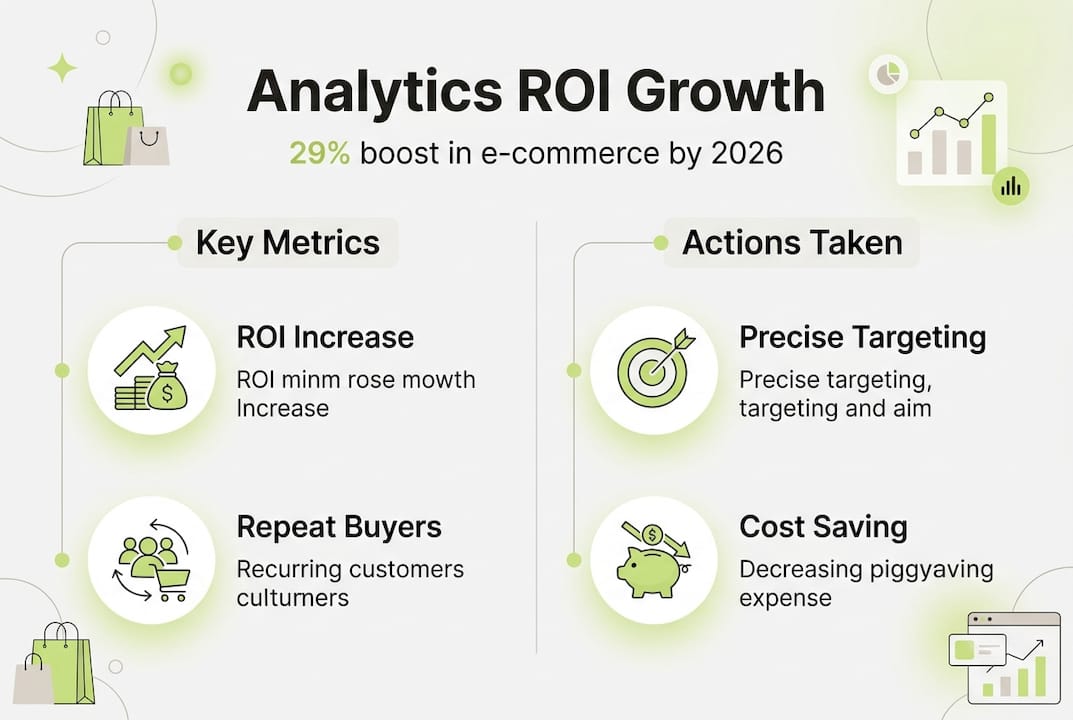
Analytics delivers 29% marketing ROI increase alongside £22,000 monthly savings. One D2C brand achieved 34% repeat purchase growth through cohort analysis and targeted retention campaigns. Another saw 11.5% higher revenue with 11.7% lower ad spend by reallocating budget based on true channel performance rather than platform-reported metrics. A fashion retailer reduced CPA by 22% whilst driving 41% year-over-year revenue growth through audience segmentation and creative testing informed by analytics.
| Performance metric | Improvement range | Primary driver |
|---|---|---|
| Marketing ROI | +29% to +41% | Better targeting and budget allocation |
| Cost savings | £22k monthly | Eliminating underperforming campaigns |
| Repeat purchases | +34% | RFM segmentation and retention focus |
| Cost per acquisition | -22% to -11.7% | Channel optimisation and audience refinement |
| Revenue growth | +11.5% to +41% | Data-driven creative and offer testing |
These gains stem from several factors:
- Precise audience targeting eliminates wasted impressions on low-intent users
- Budget reallocation from vanity metrics to genuine revenue drivers
- Segmentation enables personalised messaging that resonates with specific customer groups
- Continuous testing identifies winning creative, offers, and landing pages faster
- Attribution clarity reveals hidden channel value and prevents premature budget cuts
The standout statistic: 29% marketing ROI increase demonstrates that analytics isn’t merely about measurement, it’s about transformation. When you understand exactly which efforts drive results, every marketing decision becomes more effective. SMB e-commerce brands can achieve enterprise-level efficiency without enterprise budgets by applying these insights systematically. Review e-commerce marketing results and consider a digital marketing audit process to benchmark your current performance.
Common challenges and nuances in digital marketing analytics
Despite proven benefits, analytics implementation faces significant obstacles that undermine data reliability and decision quality.
Imbalanced data creates model failures. When your dataset contains far more non-converters than converters, predictive models struggle to identify conversion patterns accurately. This skew is particularly problematic for SMB e-commerce brands with lower conversion volumes, leading to unreliable forecasts and misguided optimisation.
GA4 tracking suffers from browser blocking causing 34% to 42% data loss in US markets, with similar patterns across UK audiences. Safari’s Intelligent Tracking Prevention and Firefox’s Enhanced Tracking Protection block third-party cookies and limit first-party cookie duration, creating massive blind spots in customer journey data. You’re making decisions based on incomplete information without realising the scale of what’s missing.
Attribution models conflate correlation with causality. Just because a customer clicked a retargeting ad before converting doesn’t mean that ad caused the conversion. They might have already decided to purchase. Platform-reported ROAS often inflates true impact because algorithms cannot distinguish genuine influence from coincidental touchpoints. This leads to over-investment in channels that appear effective but merely intercept customers already committed to buying.
“Eighty per cent of analytics setups contain tracking gaps that distort performance measurement, whilst data silos prevent unified customer views essential for AI-powered insights.”
Data silos fragment your customer understanding. When email platform data, CRM records, ad platform metrics, and website analytics exist in separate systems, you cannot construct complete customer journeys. This fragmentation prevents accurate LTV calculation, hinders personalisation efforts, and obscures true channel contribution. Poor data quality compounds the problem, with duplicate records, inconsistent naming conventions, and missing values degrading AI model performance.
Common challenges e-commerce marketers face include:
- Insufficient conversion volume for statistically significant testing
- Technical skill gaps preventing proper implementation
- Budget constraints limiting access to enterprise analytics tools
- Cross-functional misalignment on KPI definitions and priorities
- Platform dependency creating vendor lock-in and limited data portability
Understanding these limitations helps you implement appropriate safeguards and validation methods. Explore how AI in marketing analytics can address some challenges whilst recognising that AI effectiveness depends entirely on underlying data quality.
Practical steps for SMB e-commerce marketers to leverage analytics for better ROI
SMB e-commerce managers can implement analytics effectively through systematic, focused actions that address common pitfalls whilst building sustainable measurement foundations.
-
Set up comprehensive GA4 e-commerce tracking. Configure enhanced e-commerce events including product views, add to basket, checkout steps, and purchases. Implement custom parameters capturing product categories, customer types, and campaign sources. Validate tracking accuracy through Google Tag Manager preview mode before relying on the data.
-
Build three-layer dashboards for different stakeholder needs. Create an executive dashboard showing weekly revenue, ROAS, and customer acquisition cost trends. Develop an operational dashboard tracking daily campaign performance, budget pacing, and conversion rate alerts. Construct a strategic dashboard analysing cohort behaviour, LTV progression, and channel contribution over 12-24 months.
-
Apply RFM and LTV models for smarter budget allocation. Segment customers by recency, frequency, and monetary value to identify high-value groups warranting increased retention investment. Calculate LTV by cohort to determine acceptable acquisition costs per channel. Shift budget towards channels delivering customers with highest predicted lifetime value, not just lowest initial CPA.
-
Implement server-side tagging to mitigate browser data loss. Deploy Google Tag Manager server-side container to bypass browser tracking restrictions. Route event data through your own server before sending to analytics platforms, recovering significant portions of the 42% data loss from browser blocking. This investment pays dividends through more complete customer journey visibility.
-
Run incrementality tests to validate platform-reported ROAS. Conduct geo-holdout tests or randomised control trials measuring true incremental impact of campaigns. Compare results against platform attribution to identify inflation. Use findings to adjust internal ROAS targets and prevent over-investment in channels claiming credit for conversions that would have occurred anyway.
-
Ensure cross-functional KPI alignment using data maturity models. Define consistent metrics across marketing, finance, and operations teams. Document calculation methodologies to prevent conflicting performance reports. Establish regular review cadences ensuring insights translate to action rather than remaining isolated in dashboards.
Pro Tip: Focus on true ROAS by unifying data sources rather than accepting platform-reported metrics at face value. Platforms have incentive to inflate their contribution. Build your own attribution model combining GA4 data, CRM records, and platform exports to calculate genuine incremental return. This transparency enables confident budget decisions based on reality, not algorithmic optimism. Examine search engine marketing examples applying these principles for tangible results.
Boost your digital marketing with Geo Growth Media
Transforming analytics insights into sustained revenue growth requires both technical expertise and strategic execution. Geo Growth Media specialises in data-driven digital marketing that turns measurement into measurable results for ambitious e-commerce brands.

Our paid social media services leverage advanced analytics to optimise Meta, TikTok, and LinkedIn campaigns, ensuring your budget targets high-intent audiences with proven creative. We combine this with comprehensive SEO services including technical optimisation, content strategy, and authoritative backlink building that compounds organic visibility over time. Our website development offerings create conversion-optimised experiences informed by user behaviour analytics, turning traffic into customers efficiently. We function as an extension of your team, delivering personalised strategies aligned with your goals, sector dynamics, and budget realities. Ready to convert analytics into competitive advantage? Let’s discuss how data-driven strategies can accelerate your growth.
Frequently asked questions
What is the difference between descriptive, predictive, and prescriptive analytics?
Descriptive analytics summarises what happened in past campaigns through metrics and reports. Predictive analytics forecasts what could happen using historical patterns and statistical models. Prescriptive analytics recommends what actions to take based on predictions and business constraints. Each methodology serves different optimisation stages, from understanding baseline performance to making proactive strategic decisions.
How can small e-commerce brands overcome data loss from browser tracking restrictions?
Implement server-side tracking through Google Tag Manager to bypass browser blocking mechanisms that cause up to 42% data loss. This routes event data through your own server before reaching analytics platforms, recovering visibility into customer journeys. Validate your metrics through incrementality testing rather than relying solely on cookie-based attribution, ensuring decisions rest on accurate performance measurement.
What is RFM segmentation and why is it valuable?
RFM segments customers by recency of purchase, frequency of transactions, and monetary value spent. This identifies your most valuable customers warranting retention investment and distinguishes them from one-time buyers. RFM enables targeted campaigns with relevant messaging and offers, improving marketing efficiency by focusing resources where they generate highest returns. It’s particularly effective for e-commerce brands building long-term customer relationships.
Why is incrementality testing important in digital marketing?
Incrementality testing measures true campaign impact beyond platform-reported ROAS by comparing results between exposed and control groups. This reveals whether conversions genuinely resulted from your marketing or would have occurred anyway. Platforms often inflate their contribution by claiming credit for conversions they merely observed rather than caused. Incrementality testing prevents over-investment based on misleading attribution, ensuring budget flows to genuinely effective channels.



.png)