.png)

.svg)




TL;DR:
- Programmatic advertising automates digital ad buying, enabling precise, real-time targeting.
- It offers faster launch, better efficiency, and higher-quality B2B leads compared to traditional methods.
- Success requires ongoing optimization, tailored creative, and collaboration between sales and marketing teams.
Many B2B marketing managers still picture ad buying as a process involving phone calls, spreadsheets, and lengthy negotiations with media sales teams. The reality in 2026 is very different. Programmatic advertising automates the buying of digital ad space using algorithms and real-time data, removing the manual guesswork entirely. This means you can reach the right decision-maker, on the right channel, at the right moment, without a single phone call. In this article, we cover how programmatic works, how it compares to traditional buying, and how to use it to generate higher-quality B2B leads.
Table of Contents
- What is programmatic advertising?
- How programmatic compares to traditional ad buying
- How programmatic drives better B2B lead generation
- Implementing programmatic in your marketing strategy
- Our take: What most B2B marketers miss with programmatic advertising
- Take your lead generation further with expert programmatic support
- Frequently asked questions
Key Takeaways
| Point | Details |
|---|---|
| Automated ad buying | Programmatic advertising eliminates manual negotiation and optimises placement with algorithms. |
| Superior B2B targeting | Data-driven targeting finds decision-makers for better lead quality and campaign ROI. |
| Measurable campaign value | Real-time analytics let you track, optimise, and justify ad spend easily in B2B settings. |
| Step-by-step implementation | Clear processes and common pitfalls help you start and scale programmatic campaigns with confidence. |
What is programmatic advertising?
Programmatic advertising is the automated buying and selling of digital ad space. Instead of a human negotiating a fixed placement, software handles the entire transaction in milliseconds. Every time a webpage loads, an auction takes place behind the scenes, and your ad either wins or loses that impression based on your bid, your audience data, and your campaign settings. It is fast, precise, and scalable in ways that manual buying simply cannot match.
There are three main types of programmatic buying worth knowing. Real-time bidding (RTB) is the open auction model where impressions are bought and sold instantly. Private marketplaces (PMP) are invite-only auctions where premium publishers offer inventory to selected advertisers. Programmatic direct involves a fixed deal between an advertiser and a publisher, but the delivery is still automated. Each model suits different budget levels and campaign goals.
Understanding the paid advertising workflow helps you see where programmatic fits within a broader campaign structure. Here are the core components you will encounter:
- DSP (Demand-Side Platform): The tool advertisers use to buy ad inventory across multiple exchanges from one interface.
- SSP (Supply-Side Platform): The tool publishers use to sell their ad inventory to the highest bidder.
- Ad exchange: The digital marketplace where DSPs and SSPs connect to trade impressions.
- Audience targeting: Using first-party, second-party, or third-party data to define who sees your ads.
| Component | Role |
|---|---|
| DSP | Manages buying decisions and bids on behalf of the advertiser |
| SSP | Maximises publisher revenue by connecting to multiple buyers |
| Ad exchange | Facilitates real-time auctions between buyers and sellers |
| DMP / CDP | Stores and segments audience data for targeting |
Pro Tip: Before setting up any programmatic campaign, map your target buyer’s journey from awareness to decision. The cleaner your audience segmentation, the more efficiently your budget will perform.
How programmatic compares to traditional ad buying
Traditional media buying involves a human media planner identifying relevant publications or websites, contacting a sales representative, negotiating rates, agreeing on placements, and then waiting for the campaign to go live. The entire process can take days or even weeks. Reporting is often delayed and limited to surface-level metrics.
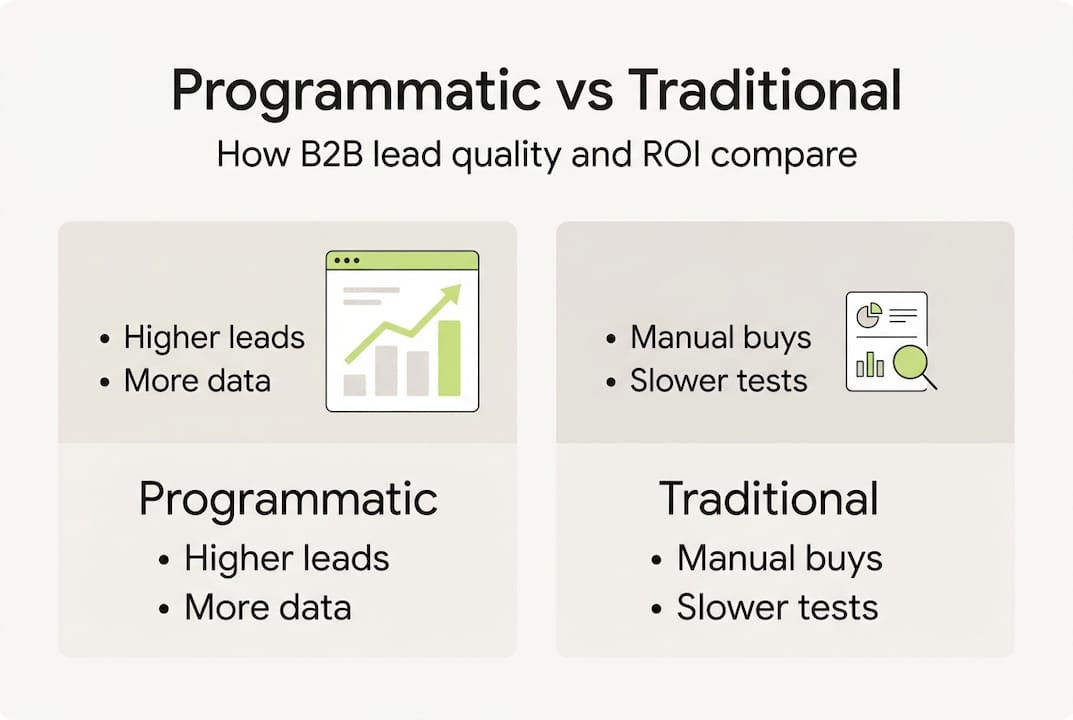
Programmatic delivers better efficiency, faster campaign launches, and more precise targeting than traditional buying. Here is how the two approaches compare step by step:
Traditional buying:
- Identify target publications manually.
- Contact sales teams and request rate cards.
- Negotiate placements and pricing.
- Submit creative assets and await approval.
- Campaign goes live, often days later.
- Receive basic performance reports periodically.
Programmatic buying:
- Define audience segments and KPIs in your DSP.
- Set campaign parameters, budget, and bidding strategy.
- Upload creative assets directly to the platform.
- Campaign goes live within hours.
- Real-time reporting allows continuous optimisation.
- Adjust targeting, bids, and creative on the fly.
More than 80% of UK digital display ads are now bought programmatically, reflecting how decisively the industry has shifted away from manual processes.
For B2B marketers, the advantages go beyond speed. Programmatic lets you layer multiple data signals, such as job title, company size, industry sector, and browsing behaviour, to reach genuine decision-makers rather than a broad audience. You can explore paid advertising examples to see how precise targeting translates into real campaign results. A well-structured paid media strategy that incorporates programmatic can also reduce wasted spend significantly by eliminating irrelevant impressions.
Ignoring automation in B2B marketing is increasingly costly. Competitors who adopt programmatic can test, learn, and iterate in real time while manual buyers are still waiting for their next campaign to be approved.
How programmatic drives better B2B lead generation
Programmatic is not just about buying ads more efficiently. It fundamentally changes the quality of the leads you generate. Here is how it works in practice for B2B campaigns:
- Data-driven targeting: Combine firmographic data (company size, sector, revenue) with behavioural signals to reach buyers who are actively researching solutions like yours.
- Sequential messaging: Show different creatives to the same prospect depending on where they are in the buying cycle, moving them from awareness to consideration to intent.
- Rapid optimisation: Algorithms continuously shift budget towards the placements and audiences delivering the best results, reducing cost per lead over time.
- Lookalike audience building: Upload your existing customer data and find new prospects who share the same characteristics as your best accounts.
On average, programmatic campaigns deliver 25 to 35% higher lead quality than non-automated campaigns, largely because of improved audience targeting and real-time personalisation. This matters enormously when your sales team’s time is finite and every poor-quality lead is a wasted conversation.
Pro Tip: Integrate your CRM or lead scoring platform directly with your DSP. This allows you to suppress existing customers from prospecting campaigns and automatically prioritise budget towards your highest-value audience segments.
Consider a B2B software company targeting IT directors at mid-sized manufacturers. Using programmatic, they can combine LinkedIn audience data, intent signals from third-party data providers, and their own CRM lists to serve tailored display ads exclusively to that profile. The result is a far tighter funnel than any broad-reach campaign could achieve. Pairing this with paid advertising for measurable growth principles ensures every pound spent is accountable. You can also complement programmatic display with search engine marketing to capture demand at the moment of active search.

Implementing programmatic in your marketing strategy
Knowing the benefits is one thing. Getting started without wasting budget is another. Adopting programmatic requires clear KPIs, trusted partners, and ongoing measurement. Follow these steps to launch effectively:
- Set clear objectives. Define whether you are targeting brand awareness, lead volume, or pipeline acceleration. Your goal shapes every subsequent decision.
- Select the right platforms. Evaluate DSPs based on your audience data access, reporting capabilities, and minimum spend requirements.
- Integrate your data. Connect your CRM, website analytics, and any third-party intent data sources before the campaign launches.
- Test creative variations. Programmatic allows A/B testing at scale. Run multiple ad formats and messages simultaneously to identify what resonates.
- Ensure compliance. Confirm that your data usage aligns with GDPR requirements, particularly around consent and data retention.
- Measure and iterate. Review performance weekly at minimum. Adjust bids, audiences, and creative based on what the data tells you.
Avoid these common pitfalls:
- Targeting too broadly and diluting your budget across irrelevant audiences.
- Ignoring data privacy obligations, which can result in significant fines and reputational damage.
- Underestimating the importance of creative quality. Even perfect targeting fails if the ad itself does not engage the viewer.
- Launching without a clear attribution model, making it impossible to measure true ROI.
Start with a pilot campaign on a single channel and a modest budget. Use a well-documented paid media strategy as your foundation, then scale what works. When evaluating vendors, ask specifically about their brand safety tools, fraud prevention measures, and transparency in reporting. A clear advertising workflow guide will help your team stay aligned as campaigns grow in complexity.
Our take: What most B2B marketers miss with programmatic advertising
Having worked with B2B brands across multiple sectors, we have noticed a consistent pattern. Marketers invest in the technology, set up their targeting, and then treat the campaign as largely self-managing. Programmatic is powerful, but it is not passive.
The biggest missed opportunity is creative. Most B2B programmatic campaigns run with generic banner ads that could belong to any company in any sector. Precise targeting means nothing if the ad itself fails to speak directly to the buyer’s specific challenge. Tailoring creative to each stage of the buyer journey, not just the audience segment, is where real performance gains come from.
The second issue is organisational. Programmatic works best when sales and marketing share data openly. If your sales team’s CRM insights are not feeding back into your DSP targeting, you are leaving significant efficiency on the table. Explore how AI in digital marketing is making this feedback loop faster and more intelligent.
Pro Tip: Assign a named person internally to own campaign learning. Your agency can manage execution, but someone on your team must be accountable for understanding what the data is telling you and acting on it.
The brands we see generating the best results treat programmatic as a continuous learning system, not a set-and-forget channel.
Take your lead generation further with expert programmatic support
Programmatic advertising offers B2B marketing managers a genuine edge, but the gap between understanding it and executing it profitably can be significant. Getting the platform setup, data integration, and creative strategy right from the start saves both time and budget.
At Geo Growth Media, we help ambitious B2B brands build and manage programmatic strategies that generate measurable pipeline growth. From platform selection and audience architecture to creative testing and compliance, our team acts as an extension of yours. Explore our full range of digital marketing services or discover how our SEO for B2B growth can complement your paid media activity. Get in touch to request a tailored campaign audit and find out exactly where your biggest opportunities lie.
Frequently asked questions
How does programmatic advertising differ from Google Ads?
Google Ads operates separately from most programmatic exchanges, with different automation features and a platform-specific inventory. Programmatic buying accesses a far wider range of publishers and data sources through open and private marketplaces simultaneously.
What budget is needed to start with programmatic advertising?
Entry budgets for programmatic typically start around £1,000 to £2,500 per month, though higher budgets unlock richer data signals and faster optimisation cycles. Starting smaller is fine, provided you have clear KPIs to measure against.
How do B2B companies measure programmatic ad ROI?
B2B marketers measure ROI by tracking lead volume, cost per acquisition, lead quality scores, and revenue attribution through integrated CRM and analytics tools. A clear attribution model must be in place before the campaign launches.
Is programmatic advertising GDPR-compliant?
It can be, provided strict data privacy and consent policies are followed, documented, and reviewed regularly. Working with a reputable DSP that has built-in consent management tools significantly reduces compliance risk.
Can programmatic support account-based marketing (ABM)?
Yes. Programmatic enables ABM by overlaying firmographic and intent data segments to serve tailored messaging directly to named target accounts. It is one of the most effective ways to scale an ABM programme beyond what manual outreach alone can achieve.


.png)