.png)

.svg)


Managing search engine marketing campaigns can feel overwhelming when you’re juggling budgets, keywords, and constantly shifting auction dynamics. Many marketing managers struggle with costly mistakes that drain budgets without delivering measurable growth. This guide cuts through the complexity with a proven, data-driven approach to SEM that drives real ROI. You’ll learn how to prepare strategically, execute campaigns effectively, and optimise continuously for sustainable business growth in 2026.
Table of Contents
- Understanding Search Engine Marketing And Its Benefits
- Preparing Your Business For Search Engine Marketing Success
- Executing Search Engine Marketing Campaigns Effectively
- Monitoring Performance And Optimising For Growth
- How Geo Growth Media Can Help You Master Search Engine Marketing
- Frequently Asked Questions About Search Engine Marketing
Key takeaways
| Point | Details |
|---|---|
| High ROI potential | Google Ads can deliver 800% ROI when managed strategically with proper targeting and optimisation |
| Cost reduction through quality | Optimising ad relevance and quality score can reduce acquisition costs by 40-60% while maintaining performance |
| Campaign testing essential | Testing Performance Max, Shopping, and Search campaigns identifies the most effective approach for your business |
| ROAS management crucial | Strategic target ROAS adjustments and bid optimisation can achieve returns up to 790% for ecommerce brands |
| Data-driven decisions win | Monitoring KPIs and applying continuous optimisation sustains growth and scales profitable campaigns |
Understanding search engine marketing and its benefits
Search engine marketing encompasses paid advertising strategies that place your business at the top of search results when potential customers actively seek your products or services. Unlike SEO, which builds organic visibility over time, SEM delivers immediate traffic through platforms like Google Ads. The core components include pay-per-click advertising, keyword targeting, ad creation, and bid management.
The distinction between PPC and SEO matters for your marketing strategy. SEO focuses on earning organic rankings through content optimisation and technical improvements, whilst PPC pays for prominent ad placement. Both drive traffic, but SEM offers speed and precision that organic methods cannot match.
Why does SEM drive such impressive returns? Google Ads can deliver an ROI of 800%, meaning £8 for every £1 spent when campaigns are optimised properly. This happens because you’re reaching people with high purchase intent at the exact moment they’re searching for solutions. The targeting precision eliminates wasted spend on uninterested audiences.
Consumer behaviour strongly favours paid search. Research shows 63% of people would click on a Google ad when searching for products or services. This click-through behaviour translates directly into website traffic, leads, and sales for businesses that execute campaigns effectively.
Real-world results demonstrate SEM’s power:
- Ecommerce brands regularly achieve 400-800% ROAS through strategic campaign management
- Service businesses generate qualified leads at 50-70% lower costs than traditional advertising
- Small businesses compete effectively against larger competitors through smart bidding strategies
Pro Tip: SEM works best when integrated with your broader digital marketing strategy, complementing SEO efforts and social media campaigns for maximum impact across all customer touchpoints.
The speed of results sets SEM apart. Whilst SEO requires months to build momentum, properly configured Google Ads campaigns can generate traffic and conversions within days. This makes SEM invaluable for product launches, seasonal promotions, or businesses needing immediate revenue growth. Understanding why choose search engine marketing helps you evaluate whether it fits your business objectives and budget constraints.
Preparing your business for search engine marketing success
Effective SEM starts long before you launch your first campaign. Strategic preparation determines whether you’ll achieve exceptional returns or waste budget on poorly targeted ads. Begin by clarifying your specific business objectives. Are you prioritising immediate sales, building your email list, or generating qualified leads for your sales team? Each goal requires different campaign structures and success metrics.
Audience segmentation transforms generic campaigns into precision-targeted engines. Break your market into distinct groups based on demographics, purchase behaviour, and search intent. A homeowner searching for emergency plumbing services has completely different needs than a property manager researching annual maintenance contracts. Your campaigns must reflect these distinctions.
Keyword research forms the foundation of successful SEM. Follow this systematic approach:
- List your core products, services, and solutions in plain language your customers use
- Expand each core term with modifiers like location, urgency, and specific features
- Analyse competitor keywords to identify gaps and opportunities in your market
- Categorise keywords by search intent: informational, commercial, or transactional
- Prioritise high-intent commercial keywords that signal ready-to-buy prospects
Campaign type selection directly impacts your results and budget efficiency. Google Ads offers several formats, each suited to different objectives. Performance Max campaigns use machine learning to optimise across all Google properties, ideal for businesses with diverse product catalogues. Shopping campaigns showcase products with images and prices, perfect for ecommerce. Search campaigns target specific keywords with text ads, offering precise control over messaging and targeting.
Testing different campaign types is crucial to determine the most effective approach for your business model and audience. What works brilliantly for one ecommerce brand might underperform for another in a different sector. The only way to know is systematic testing with proper budget allocation.
Pro Tip: Start with a focused pilot campaign targeting your highest-margin products or services rather than trying to promote everything simultaneously, allowing you to learn quickly and scale what works.
Align your campaign choice with specific objectives. If you need immediate sales from a known product range, Shopping campaigns deliver fast results. For brand awareness combined with conversions, Performance Max leverages Google’s full network. Service businesses often find Search campaigns most effective for capturing high-intent local queries.
Budget planning requires realistic expectations. Most successful SEM campaigns need at least three months of consistent spend to gather sufficient data for optimisation. Underfunding campaigns prevents the algorithm from learning effectively, whilst excessive initial budgets risk waste before you’ve refined targeting. Detailed guidance on Google Ads campaign setup helps you structure campaigns for optimal learning and performance.
Executing search engine marketing campaigns effectively
Google’s ad auction operates on value, not just bid amount. Many advertisers mistakenly believe the highest bidder always wins top placement. The reality is more nuanced and favourable for businesses that optimise properly. Google evaluates Ad Rank, which combines your bid amount with ad quality, relevance, and expected impact from ad extensions. This means ads with £2 bids can outrank competitors bidding £15+ for the same keywords when quality scores are superior.

Setting effective bid strategies requires understanding your business economics. Calculate your maximum cost per acquisition by working backwards from customer lifetime value and profit margins. If a customer generates £200 profit and you’re comfortable with 25% customer acquisition costs, your maximum CPA is £50. This number guides your bidding decisions and campaign optimisation.
Target ROAS (return on ad spend) management drives profitability at scale. Follow these steps:
- Establish baseline ROAS by tracking initial campaign performance for 2-4 weeks
- Set conservative target ROAS 20-30% below your break-even point initially
- Monitor daily performance and adjust targets gradually as the algorithm learns
- Increase target ROAS incrementally when campaigns consistently exceed targets
- Separate high-performing and low-performing products into different campaigns for granular control
Ad relevance and Quality Score directly impact your costs and placement. Google assigns Quality Scores from 1-10 based on expected click-through rate, ad relevance, and landing page experience. Higher scores reduce your cost per click whilst improving ad positions. A Quality Score improvement from 5 to 8 can cut costs by 30-40% whilst maintaining the same visibility.
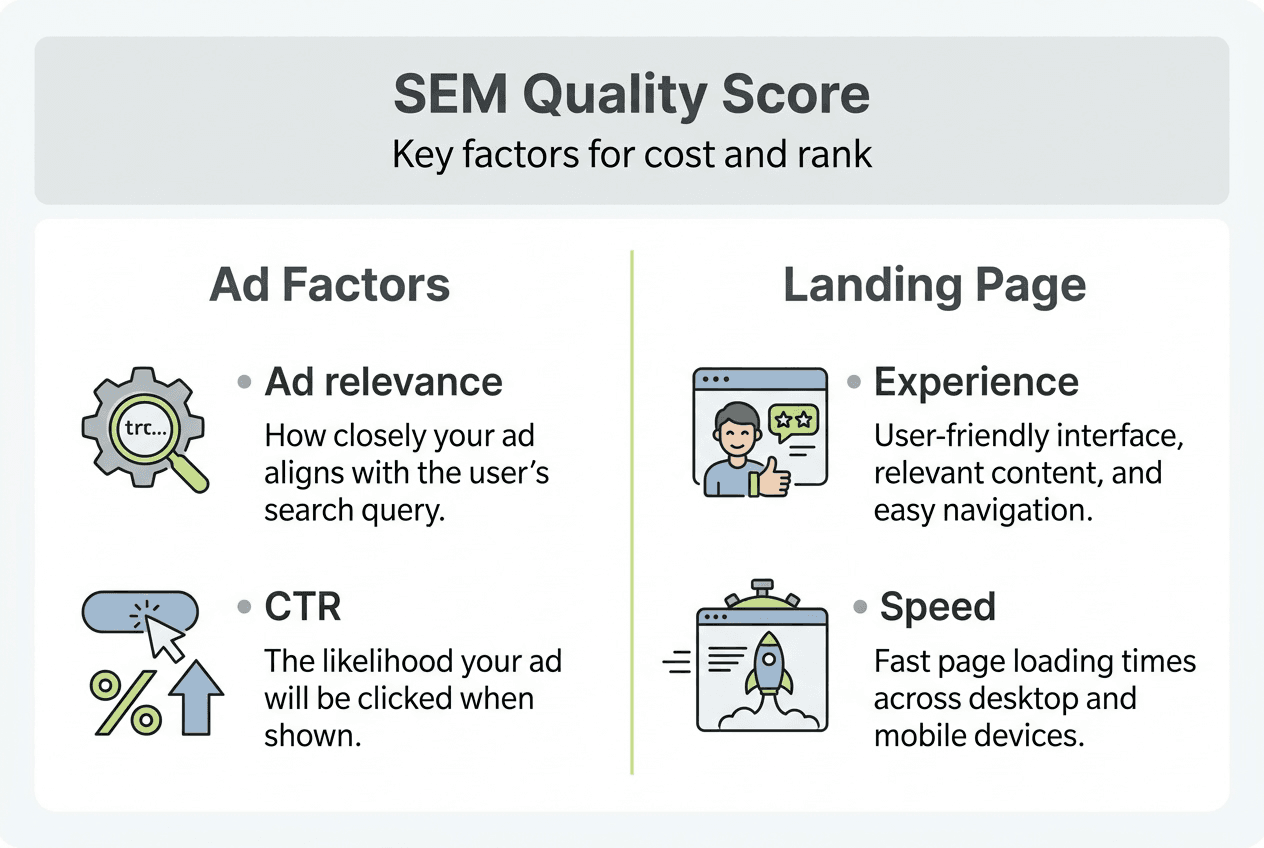
| Quality Score | Estimated Cost Impact | Practical Meaning |
|---|---|---|
| 1-3 | +200% to +400% | Poor relevance, very expensive clicks |
| 4-6 | +25% to +100% | Average performance, room for improvement |
| 7-8 | -15% to -30% | Good relevance, competitive advantage |
| 9-10 | -40% to -50% | Excellent relevance, maximum efficiency |
Bid optimisation techniques separate profitable campaigns from budget drains. Start with automated bidding strategies like Target CPA or Target ROAS, which use machine learning to adjust bids in real-time. These strategies need sufficient conversion data to work effectively, typically 30-50 conversions per month minimum. Manual bidding offers more control but requires constant monitoring and adjustment.
Pro Tip: Review search term reports weekly to identify irrelevant queries triggering your ads, then add these as negative keywords to eliminate wasted spend and improve campaign efficiency immediately.
Cost reduction whilst maintaining performance is entirely achievable. Industry experts report that clients reduce costs by 40-60% through systematic optimisation of ad relevance, landing page experience, and bid strategies. These savings come from eliminating waste, not reducing reach or conversions.
Ad extensions enhance your ads with additional information like phone numbers, location details, site links, and callouts. These extensions improve click-through rates by 10-25% whilst providing more value to searchers. They also increase Ad Rank without additional cost, giving you better positions at lower prices. Configure all relevant extensions for every campaign to maximise this free performance boost.
Landing page optimisation completes the execution puzzle. Your ad might be perfect, but if the landing page disappoints, conversions suffer. Ensure message match between ad copy and landing page headlines. Load times under two seconds prevent abandonment. Clear calls-to-action guide visitors toward conversion. Mobile optimisation is non-negotiable, as mobile traffic often exceeds 60% for many sectors. Reviewing search engine marketing examples with higher ROI reveals how top performers structure their campaigns and landing pages for maximum conversion rates.
Monitoring performance and optimising for growth
Tracking the right metrics separates successful SEM management from wasted effort. Focus on key performance indicators that directly connect to business outcomes rather than vanity metrics. Conversion rate reveals how effectively your campaigns turn clicks into customers. Cost per acquisition shows whether you’re acquiring customers profitably. Return on ad spend measures overall campaign profitability. Click-through rate indicates ad relevance and appeal. Impression share tells you how much potential reach you’re capturing versus competitors.
Data interpretation requires context and comparison. A 2% conversion rate might be excellent for high-ticket B2B services but poor for impulse-buy ecommerce products. Compare your performance against industry benchmarks and your own historical data. Week-over-week trends reveal whether optimisation efforts are working. Month-over-month comparisons account for seasonal variations.
Identifying issues early prevents budget waste. Watch for these warning signs:
- Declining click-through rates suggest ad fatigue or increased competition
- Rising cost per click without corresponding conversion increases indicates auction pressure
- Dropping conversion rates point to landing page issues or audience mismatch
- Low impression share means you’re missing opportunities due to budget or bid constraints
Optimisation timing matters as much as the tactics themselves. Google’s algorithms need time to learn and stabilise. Make significant changes no more than once per week for established campaigns. New campaigns require daily monitoring for the first week, then shift to weekly optimisation as performance stabilises. Avoid changing multiple variables simultaneously, which makes it impossible to identify what drove results.
Campaign type testing reveals which formats deliver best for your specific business. Run parallel campaigns with identical budgets and targeting but different formats. A typical test might compare:
| Campaign Type | Best For | Typical Timeline | Control Level |
|---|---|---|---|
| Search | High-intent keywords | Immediate results | Maximum control |
| Shopping | Product catalogue | 1-2 weeks | Moderate control |
| Performance Max | Broad reach | 3-4 weeks | Automated optimisation |
Real-world optimisation delivers remarkable results. Strategic SEM optimisation reduced acquisition costs by 82% and increased return on ad spend to 790% for a nutrition and health ecommerce brand. These improvements came from systematic testing, audience refinement, and continuous bid optimisation over several months.
Scaling profitable campaigns requires discipline. When you’ve identified winning combinations of keywords, ads, and landing pages, increase budgets gradually. A 20-30% weekly increase allows the algorithm to adjust without disrupting performance. Monitor cost per acquisition closely during scaling, as it often rises slightly when expanding reach. If CPA increases more than 15-20%, pause scaling and optimise further before continuing expansion.
Seasonal adjustments keep campaigns profitable year-round. Retail businesses see dramatic demand shifts around holidays and shopping events. Service businesses experience seasonal patterns tied to weather or business cycles. Adjust budgets and bids proactively based on historical patterns rather than reacting after performance changes. This forward-looking approach captures opportunities whilst competitors scramble to respond.
Automation and manual oversight work together for optimal results. Automated bidding handles the millions of micro-adjustments needed for real-time auction participation. Human oversight identifies strategic opportunities, creative improvements, and market shifts that algorithms miss. The best SEM managers leverage both, using automation for efficiency whilst applying strategic thinking to campaign structure and messaging.
Continuous learning accelerates improvement. The digital marketing landscape for ecommerce brands evolves constantly with new features, competitor tactics, and consumer behaviour shifts. Regular training, industry publications, and case study analysis keep your skills sharp. Testing new features early often provides temporary advantages before widespread adoption. Understanding broader marketing communications principles helps you integrate SEM with other channels for compounding returns.
How Geo Growth Media can help you master search engine marketing
Navigating SEM’s complexities whilst managing your core business creates real challenges for marketing managers and business owners. Geo Growth Media specialises in driving measurable growth for ecommerce and service businesses through expert search engine marketing management.
Our comprehensive digital marketing services include strategic Google Ads management, Shopping campaign optimisation, and Performance Max implementation tailored to your specific goals and budget. We’ve helped UK businesses across diverse sectors achieve the kind of results discussed throughout this guide, from dramatic cost reductions to exceptional ROAS improvements.
Our approach extends your in-house marketing team rather than replacing it. We work collaboratively to understand your business deeply, then develop and execute data-driven strategies that deliver sustainable growth. Whether you’re launching your first SEM campaign or optimising existing efforts, our expertise in digital marketing for ecommerce brands ensures you’re implementing best practices from day one. Ready to transform your SEM performance? Explore our proven approach to Google Ads campaign setup and discover how we can help you achieve measurable results.
Frequently asked questions about search engine marketing
What is the difference between SEM and SEO?
SEM uses paid advertising to appear in search results immediately, whilst SEO optimises your website to earn organic rankings over time. SEM delivers fast, targeted traffic through platforms like Google Ads, whereas SEO builds long-term visibility through content and technical improvements. Both strategies complement each other for comprehensive search visibility.
How much should small businesses budget for SEM?
Most small businesses should allocate £1,000-£3,000 monthly for effective SEM campaigns, though this varies by industry competitiveness and business goals. Start with a modest budget to gather data and prove ROI, then scale investment as you identify profitable campaigns. The key is consistency over at least three months to allow proper optimisation.
How long does it take to see results from SEM?
You’ll typically see initial traffic within 24-48 hours of launching campaigns, but meaningful performance data requires 2-4 weeks of consistent running. Full campaign optimisation and stable ROI usually develop over 2-3 months as algorithms learn and you refine targeting. Patience during the learning phase prevents premature decisions that undermine long-term success.
Can I manage SEM campaigns without an agency?
Yes, many businesses successfully manage their own SEM campaigns using Google’s tools and educational resources. However, the time investment is substantial, requiring ongoing learning, daily monitoring, and continuous optimisation. Agencies bring specialised expertise, advanced tools, and dedicated resources that often deliver better results whilst freeing your time for core business activities.
What are the biggest mistakes to avoid in SEM?
The most costly mistakes include inadequate keyword research leading to poor targeting, neglecting negative keywords that waste budget on irrelevant searches, making too many changes too quickly before gathering sufficient data, ignoring mobile optimisation despite mobile’s dominance, and failing to align ad messaging with landing page content. Avoiding these pitfalls dramatically improves campaign performance and ROI.
Recommended
- 6 Search Engine Marketing Examples for Higher ROI
- Digital Marketing Optimization Guide for Measurable Growth
- What Is Performance Marketing: 30% Higher ROAS in 2026
- SEO Strategy Guide 2026: Drive E-Commerce Growth
- Performance Marketing aus Österreich: Dein Erfolg, unsere Strategie | LD Media Solutions
- Marketing Communications | Stonington Media LLC


.png)