.png)

.svg)


TL;DR:
- Brand positioning shapes customer perceptions and differentiates your business from competitors.
- Clear, consistent, and emotionally resonant positioning drives measurable growth over time.
- Regularly review and refine your positioning to stay relevant and maintain a competitive edge.
Brand positioning strategies for competitive growth in 2026
Most marketing managers assume brand positioning is about logos, colour palettes, or a catchy tagline. It is not. Brand positioning is the strategic foundation that determines how your customers perceive you relative to every competitor in your market. Get it right, and the results are striking. Coca-Cola’s ‘Share a Coke’ campaign achieved a 7% consumption lift and 2% US sales growth simply by repositioning around personal connection. This guide will cut through the confusion, explain the mechanics of strong positioning, and give you a practical framework to apply within your own business.
Table of Contents
- Defining brand positioning and why it matters
- Core elements of effective brand positioning
- Brand positioning in practice: Stories and results
- Practical steps to position your brand for growth
- The unseen truth: Brand positioning is a journey, not a project
- Enhance your brand strategy with expert support
- Frequently asked questions
Key Takeaways
| Point | Details |
|---|---|
| Positioning drives growth | A clearly defined brand position leads to measurable sales and market share gains. |
| Core elements matter | Effective positioning relies on understanding your audience, differentiation, and credibility. |
| Learn from leaders | Top brands like Coca-Cola, Nike, and Tide showcase the ROI of strong positioning. |
| Apply and adapt | Positioning is an ongoing strategy that should evolve with your market and customers. |
Defining brand positioning and why it matters
Brand positioning is, at its core, the place your business occupies in a customer’s mind relative to competitors. It is not your logo, your brand colours, or even your strapline. Those elements are expressions of your position. The position itself is the perception: who you are, who you serve, and why you are the better choice.
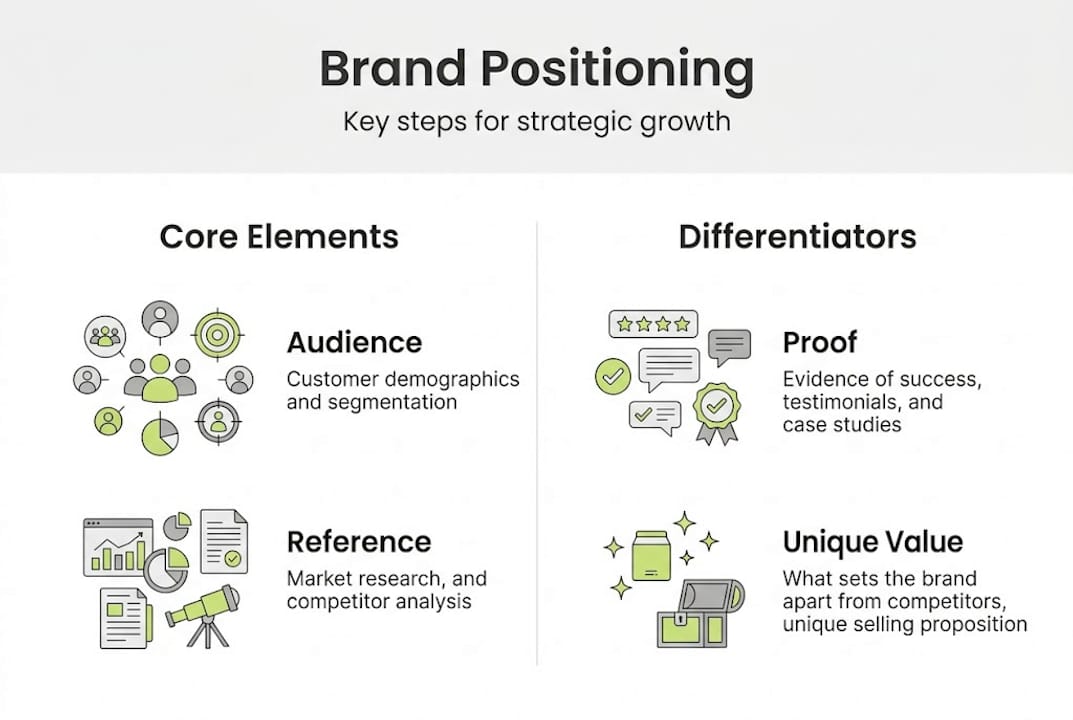
It helps to distinguish between three related but distinct concepts. Positioning is the strategic decision about how you want to be perceived. Branding is the creative expression of that decision through visuals, tone, and identity. Messaging is the specific language used to communicate your position across channels. Many SME marketing managers conflate all three, which leads to inconsistency and, ultimately, lost market share. When your website says one thing, your social media posts say another, and your sales team pitches something entirely different, customers cannot form a coherent view of your brand. Confusion breeds indifference, and indifference hands business to your competitors.
The stakes are high. Consider what deliberate, refocused positioning achieved for one of the world’s most recognised brands:
Nike’s ‘Dream Crazy’ campaign added $6 billion to brand value by refocusing positioning around bold, values-driven storytelling rather than product features alone.
For an SME marketing manager, that figure is obviously at a different scale. But the underlying mechanism is identical. When your positioning is clear, emotionally resonant, and consistently communicated, it builds a cumulative perception that compounds over time.
A well-crafted positioning statement follows a simple but powerful structure. It defines:
- Who your target customer is
- What category you compete in
- Why you are meaningfully different
- How that difference is credible and provable
For example: “For ambitious SME marketing managers who need measurable growth, [Brand X] is the digital agency that delivers transparent, data-driven campaigns backed by real results.” That is a positioning statement. It is not a tagline. It is an internal compass that guides every external communication decision.
Pro Tip: Consistency is the multiplier in brand positioning. A well-defined position communicated across every touchpoint, from your website homepage to your LinkedIn bio to your email signature, creates compounding recognition that no single campaign can replicate.
Core elements of effective brand positioning
With the concept defined, explore the building blocks that make brand positioning both strategic and actionable. Strong positioning does not emerge from a single brainstorming session. It is constructed from four interconnected elements, each of which must be deliberate and evidence-informed.

1. Target audience. Who are you specifically trying to reach? Not “businesses” or “consumers,” but a defined segment with recognisable needs, motivations, and pain points. The more precisely you define your audience, the more targeted and effective your positioning becomes.
2. Frame of reference. What category do you compete in? This sets the competitive context for your customers. It tells them which alternatives to compare you against, which shapes their expectations and evaluation criteria.
3. Point of difference. What do you offer that competitors genuinely cannot or do not? This must be meaningful to the target audience, not just internally valued. Differentiation that customers do not care about is not differentiation at all.
4. Reason to believe. What proof supports your point of difference? Testimonials, data, certifications, track records, and case studies all serve this function. Without credibility, a positioning claim is just a promise.
A useful exercise is to stress-test your current positioning statement against all four elements. Most businesses can articulate their audience and category reasonably well. Far fewer can clearly state a genuine point of difference backed by compelling proof.
Here is a comparison to make it concrete:
| Element | Weak positioning | Strong positioning |
|---|---|---|
| Target audience | “Businesses of all sizes” | “Marketing managers at growth-stage SMEs” |
| Frame of reference | “We do digital marketing” | “We operate as your in-house team” |
| Point of difference | “We are results-driven” | “We optimise every campaign to improve ROI weekly” |
| Reason to believe | “Years of experience” | “Documented case studies with verified revenue growth” |
The difference is specificity. Vague positioning is forgettable. Precise positioning is magnetic.
Clarity and consistency in positioning also produce measurable outcomes over time. Tide’s 14.3% global market share and a 4.57 average rating across 203 million reviews demonstrate what happens when a brand commits to a single, unwavering point of difference: superior cleaning performance. Tide has never tried to be fashionable, eco-friendly, or budget-friendly. It owns one position, defends it relentlessly, and the market rewards it consistently.
The lesson for SME marketers is not to copy Tide’s positioning, but to copy its discipline. Choose a position that is genuinely defensible, and then align every marketing decision around it.
Brand positioning in practice: Stories and results
Having detailed the components of positioning, illustrate their value with stories and data that resonate directly with SME marketing managers. The most persuasive case for investing in positioning is not theoretical. It is empirical.
The table below summarises the business impact of strategic repositioning across three well-documented examples:
| Brand | Repositioning focus | Measurable outcome |
|---|---|---|
| Coca-Cola | Personal connection (Share a Coke) | 7% consumption lift, 2% US sales growth |
| Nike | Values-driven storytelling (Dream Crazy) | $6 billion added to brand value |
| Tide | Consistent performance differentiation | 14.3% global market share, 4.57 rating from 203M reviews |
Coca-Cola, Nike, and Tide each achieved substantial, measurable market impact by making deliberate, strategic positioning decisions, not by increasing ad spend alone.
What can SME marketing managers take from these examples? Several universal principles emerge:
- Positioning is a choice, not a default. Each of these brands made a deliberate decision about what to stand for. Businesses that do not make this choice consciously will have their position defined by customers and competitors instead.
- Emotional resonance amplifies commercial outcomes. Coca-Cola’s personal connection angle and Nike’s values-driven stance both worked because they connected with something customers genuinely felt. Functional benefits alone rarely generate this level of impact.
- Consistency over time builds compounding value. Tide did not achieve 14.3% market share through a single campaign. It did so through decades of unwavering commitment to one central claim.
- Repositioning is a legitimate growth lever. None of these brands changed their product dramatically. They changed their story, their angle, and their emotional relationship with customers.
These principles are not exclusive to global brands with multi-million pound marketing budgets. Smaller, more agile businesses can execute them with significantly less resource if the strategic thinking is sharp. Our own work with clients like Side Plus, Alps Adventures, and Luxury Prize Company demonstrates that focused positioning, combined with targeted digital execution, produces measurable growth for businesses operating at an SME scale. The campaigns and channels differ, but the underlying logic is the same: clear positioning makes every marketing pound work harder.
Practical steps to position your brand for growth
With the power of positioning clearly demonstrated, the logical next question is: where do you start? The following process is designed for marketing managers who need a structured, realistic approach to assessing and refining their brand’s position.
1. Audit your current positioning. Write down, as honestly as possible, how you believe customers currently perceive your brand. Then check whether that perception is reflected in your website copy, your social profiles, your sales materials, and your advertising. Gaps between intention and execution are almost always present, and they matter.
2. Define your target audience with precision. Go beyond basic demographics. Identify the specific challenges, goals, and decision-making criteria of the people you most want to serve. Use customer interviews, reviews, and CRM data to build this picture.
3. Map the competitive landscape. List your five nearest competitors. For each one, identify the position they currently occupy: what they claim to stand for, and whether customers appear to believe it. Look for gaps, underserved niches, and positions that are overcrowded.
4. Identify your genuine differentiator. This is the hardest step. It requires honest self-assessment. What do you do measurably better, faster, or differently? What do your best clients consistently say about working with you that they do not say about others?
5. Draft and test a positioning statement. Write a candidate statement using the four-element framework from the previous section. Test it with a small group of existing clients and internal stakeholders. Ask whether it rings true, whether it is distinctive, and whether it feels credible.
6. Align internal consensus. For smaller teams, positioning only works when everyone understands it and communicates consistently. A brief internal workshop or even a one-page positioning document can make an enormous difference to message consistency across channels.
7. Iterate based on feedback. Positioning is not carved in stone. Use customer feedback, campaign performance data, and market shifts to refine your statement over time. Strategic alignment across all marketing levels is what separates brands that maintain strong positions from those that drift.
Additionally, supporting your positioning with strong brand storytelling techniques can significantly accelerate the rate at which customers internalise and recall your brand’s differentiated value.
- Gather at least five direct customer quotes that describe your brand in their own words.
- Compare those quotes against your intended positioning to spot alignment gaps.
- Run A/B tests on key landing pages with different positioning angles to measure which resonates more strongly.
- Schedule a positioning review every six months, not just when performance drops.
Pro Tip: For SMEs, small shifts in messaging often produce disproportionately large results. Changing a single homepage headline to reflect a more specific, benefit-led position can meaningfully improve conversion rates without any increase in traffic or ad spend.
The unseen truth: Brand positioning is a journey, not a project
Here is something most brand consultants will not say plainly: the positioning frameworks, templates, and workshops are not the hard part. The hard part is accepting that positioning is never finished.
Many SME marketing managers treat positioning as a box to tick during a strategy refresh and then move on. The global brands we have examined tell a different story. Coca-Cola does not run the same campaign year after year. Nike has repositioned multiple times as culture has shifted. Tide defends its position actively through product innovation and consistent communication, season after season. The discipline is ongoing, not episodic.
For smaller, more agile businesses, this is actually an advantage. You can observe market shifts and respond faster than a large corporate structure allows. What this requires is a mindset change: positioning reviews should be built into your regular marketing rhythm, not reserved for when sales plateau. Markets shift. Customer expectations evolve. Competitors reposition. A brand that does not review its position regularly will find, gradually and then suddenly, that the market has moved on without it. Treat positioning as the foundation of everything you do, revisit it with genuine curiosity, and your marketing will compound in ways that reactive, campaign-only thinking never can.
Enhance your brand strategy with expert support
Understanding positioning is one thing. Translating it into digital campaigns that consistently reach the right audience, at the right moment, with the right message, is where the real work begins.
At Geo Growth Media, we work as an extension of your marketing team to ensure your brand’s position is embedded across every digital channel. Whether that means building paid social media campaigns that amplify your point of difference, strengthening your organic discoverability through SEO services, or creating website design solutions that communicate your position powerfully at every stage of the customer journey, we align execution with strategy. If you are ready to move from positioning concept to measurable growth, we are ready to help you get there.
Frequently asked questions
How is brand positioning different from branding?
Brand positioning defines your brand’s place in the market relative to competitors, while branding covers the visuals, tone, and messaging that reinforce and express that position.
Can effective brand positioning help small businesses compete with big brands?
Absolutely. Clear, specific positioning helps small businesses carve out unique market space and win customer loyalty, exactly as Tide and Coca-Cola have demonstrated through consistent, focused strategies.
What are early signs that my brand positioning needs improvement?
Look for symptoms like weak market differentiation, stagnant or declining sales, inconsistent customer feedback, and a sales process that relies heavily on price rather than value.
How long does it take to see results from repositioning?
With focused strategic execution, shifts in customer perception and measurable business outcomes can occur within months. Coca-Cola’s campaign showed a 7% consumption increase and 2% US sales growth within a single campaign period, illustrating how quickly repositioning can move the needle when executed with clarity and consistency.



.png)